Archives April 2020

How To Apply For A TSC Number in Kenya 2020

How To Apply For A TSC Number in Kenya 2020

This is a quick guide on how to apply and register for a Teachers Service Commission (TSC) number in Kenya as of 2019. This is a unique identification number given to all the qualified teachers in Kenya who have been successfully recruited by the Teachers Service Commission. Having highlighted on this website before on the TSC recruitment requirements for teachers in Kenya, on this post we are going to look at how you can apply and get your TSC number

You should scan and upload the following documents :

1. Original Professional and Academic Certificates
2. National identity card
3. Bank slip

Deposit Ksh 1,055 through Direct Banking or via MPesa. (KSh 1,000 is a non-refundable registration fee of and Ksh 55 for Bank Commission Charge to the TSC). Application for a duplicate certificate will be KSh 2055. All payable to National Bank of Kenya Ltd, Harambee Avenue branch, Account Name: TSC-Secretariat Account Number: 01001005707400. For Mpesa, the Pay Bill Business Number is 625625.

4. One passport size photo
5. KRA pin
6. GP69 form: You can download the GP69 form here. This form must be signed by a government doctor.
7. Certificate of good conduct: Here is a simple guide on how to apply for a certificate of good conduct in Kenya.
8. Entry and work permits for non-Kenyans. They are also required to upload a letter of clearance from the Ministry of Education.
Vetting Committee.

CLICK HERE to start your online registration for a TSC number.

A teacher who meets the requirements for registration will be issued with the certificate of Registration bearing a TSC number within 30 days.

Why teachers are irreplaceable!

I’ve said it many times before:

The job of a teacher is to inspire, to challenge, to excite their students to want to learn …..

If we can’t inspire the students in our classroom, we are simply not doing our job.  If we are unable to challenge them with tasks that provoke them to think, reflect and grow, we are still not doing our job.  And if we are unable to excite in our students a desire to learn, to ignite a passion and love of learning, then learning will just not happen.

Although I’ve blogged these thoughts often, this time the words are not just mine.  Instead they are said, very passionately

The fundamental role of a teacher is not to deliver information, it is to guide the social process of learning …

The most important thing a teacher does is make every student feel like they are important, to make them feel accountable for doing the work of learning ……

….. what really matters is what happens inside the learner’s head and making a learner think seems best achieved in a social environment with other learners and a caring teacher.

It is indeed through the influence of the teacher who creates a nurturing and caring classroom environment, that our students are able to learn, grow and achieve.

We must never doubt the incredibly strong impact that teachers have on their students.   Creating a caring, nurturing and safe learning space within the confines of each classroom is what it really is all about!  It is the role of teachers

  • to take time to get to know their students
  • to provide individualized programs which nurture the skills of each learner
  • to develop in each student an ‘I can’ attitude from which confidence can grow
  • to ensure a safe and secure classroom where risk taking is encouraged
  • to create opportunities in which students can be actively immersed in new learning
  • to guide students’ learning by providing them with a scaffold they will be able to use throughout their life to pursue future learning
  • to encourage students to be patient and to not expect that learning is instantaneous
  • to foster an understanding of the value and benefits gained from collaboration
  • to guard against students competing against each other
  • to help students appreciate the value of learning by doing

With this question sitting in the back of my mind over the last few days, I realize that this is the kernel of the issue I constantly grapple with when I try to inspire within students and teachers alike a love of reading and a love of learning.   Inspiration has many facets.  It encompasses much.  And it requires the guiding hand of a teacher to ensure that it happens.

What does inspiration involve and aim to achieve in our classes?

  • to awaken the mind of the learner
  • to arouse focused attention
  • to fill students with enthusiasm
  • to excite passionate interest
  • to motivate students to go one step further than they may do otherwise
  • to initiate activities in which students can learn with and from each other
  • to enable the student to also be the teacher
  • to stir imagination
  • to encourage risk taking
  • to create excitement
  • to arouse and enthuse involvement and participation
  • to light an insatiable spark within the heart and soul of the learner
  • to stimulate learners to be lifelong learners!


LEARNING AT HOME WON’T WORK , FIND BETTER OPTION

When President Uhuru Kenyatta shut down schools mid last month, it was estimated that it would be a temporary measure and that, sooner rather than later, learners would go back to class.

But that was not to be. They have now been out for six weeks, part of which coincides with the April holiday, with no end in sight. And now, anxiety is building up.

When will schools reopen? If the situation does not change now, will there be national examinations this year? This is a matter that the government must deal with concretely and definitively.

President Kenyatta and Education Cabinet Secretary George Magoha have stated categorically that, at the moment, the government has no intention of cancelling the exams.

Granted, if schools reopen, perhaps in mid-May, it will be possible to recover the lost time. The school calendar can be revised by, among others, shortening the August holiday to a week, and two, pushing the exams dates to the end of November and part of December.

LEARNING PACE

However, in the meantime, the question is, how will the extended stay at home affect learners? How can Standard Eight and Form Four candidates prepare for the exams?

So far, the stock response is that the government is offering online learning through programmes developed by the Kenya Institute of Curriculum Development. Fair enough.

However, what the public has not been told is, what is the content on offer and how is the delivery?

KICD has a large corpus of teaching content transmitted through radio, television, audiovisuals and online. Typically, though, this is supplementary content to support classroom teaching facilitated by teachers.

The material is not ordinarily the basic source of learning and for good reason: learning is determined by variables such as entry behaviour that presupposes prior knowledge, context, experience and pace. It is not universal.

And that is why classroom teaching is important; teachers can determine those variables and pitch their lessons accordingly.

Indeed, every class has fast and slow learners, both of whom have to be handled differently. To imagine that KICD content would be easily understood by all is not just unrealistic but unfair.

SCARCE RESOURCES

Fundamentally, digital and online learning raises the cardinal question of access — physical, mental and social.

Although statistically it is argued that many households have access to gadgets such as radio, television and smartphones, through which they can obtain the lessons, the reality is different.

Having gadgets is one thing but having the infrastructure, such as power supply for limitless access, as well as a conducive environment for consuming the content is another matter.

Worse, many parts of the country do not have internet connection and that automatically hinders them from downloading content or streaming.

Two, a practical reality in most households is that children are additional hands to be deployed to help in domestic chores and farm work.

When they are not in school, they are routinely asked to perform those duties. Since the KICD programmes are scheduled, it is idealistic to imagine that families will daily release their children to participate in TV lessons when there are tasks to be performed.

If, ordinarily, such social demands contribute to absenteeism and dropouts, how about when schools are closed?

LIMITED SPACE

The third element related to access is cognition and, specifically, helping learners to understand new and difficult concepts.

When in class, teachers explain concepts, answer questions or clarify facts. For the broadcasts and online content, that is not possible.

We are flagging a matter of great concern that ought to be handled with singular resolve and urgency.

Arguably, the broadcast and online programmes are no replacement for classroom teaching and should not be construed as adequate for learners to complete and understand the syllabus and candidates to prepare for exams.

Far too many learners are left out, accentuating the inequality that the school system is meant to eliminate.

The Kenya Secondary School Heads Association and the teachers’ unions have asked the government to consider a phased reopening of schools.

That means bringing back Forms Four and Three as well as Standard Eight and Seven learners and asking schools to keep health protocols. That is plausible.

But if the government has a better option, it should pronounce itself on it now. Keeping everyone guessing is not right.

Communication is pivotal at this point when the world is traumatised by the miseries caused by the coronavirus pandemic.

Time is running out, children are wasting away and parents are agonising, and so the government must give direction on the school calendar, especially reopening and national exams.

SOURCE nation.co.ke

Online learning a mirage in rural areas, MP tells Magoha

teacher and pupils under a tree

Education CS George Magoha has been criticised over his assertion that learning is going on online and through radio and TV lessons.

Mwingi Central MP Gideon Mulyungi said on Monday the CS is out of touch with the reality on the ground since most students in rural areas are unable to access online learning materials. Others have no access to TVs.

The lawmaker said it was unfortunate for Magoha to appear on TV and insinuate that schoolchildren are studying online while at home.

“From the perspective of my constituency and the picture in most parts of the country, this is not happening and it is a lie,” Mulyungi said.

He said learners in rural areas and some urban areas cannot afford the luxury of online learning due to a myriad of reasons.

The legislator said the only place online learning could be taking place is in urban areas where learners have access to internet connectivity, smartphones, laptops, airtime and data bundles. He insisted that in rural areas such facilities were unavailable.

“In other areas, there is no electricity and this is more the reason why the much-hyped government laptop project collapsed,” Mulyungi said.

He said in the wake of Covid-19 parents have turned their focus of putting food on the table and not online learning.

Mulyungi urged Magoha to come up with well-thought-out innovative and practical solutions to ensure all students continue with their studies.

The MP asked Magoha to also show how learners will catch-up with time lost during the Covid-19 pandemic and how parents will be compensated for the fees they had paid before schools were closed due to the coronavirus.

source https://www.the-star.co.ke/


Uhuru hints at partial reopening of schools

President Uhuru Kenyatta yesterday hinted at a partial reopening of schools and dismissed speculation that the KCPE and  KCSE exams could be cancelled.

Speaking during a live radio interview from State House, Nairobi, the President said the Education ministry will look at measures to enable candidates to sit the exams.

Since schools were closed on March 15, the future of the candidates has been a subject of debate, with divergent opinions causing anxiety.

But in the absence of more specific national guidance, Education expert Janet Muthoni says there is a need to work out the intricacies of what the school day will look like when they reopen.

“If we want to get kids back in the fall, we need to talk about what that’s going to look like today.”

Her worry is “the fear of what a disease outbreak could mean in schools if the government takes that path”.

While children who contract the virus appear less likely to become sick, scientists believe they can pass the infection along to other people, hence causing widespread infection among staff and families.

Educators have asked whether Education CS George Magoha plans to conduct an audit of the necessary materials and supply chain for cleaning, disinfecting and preventing the spread of the disease should children return to school.

The Kenya Union of Post-Primary Education teachers, in a memorandum to the Education ministry, demanded the school calendar rescheduled and exams postponed.

In view of the foregoing, President Kenyatta said the government will release a schedule on how learners will return to schools, especially those who are to sit the national exams.

“We need to know when it will be done and how it will be done. When that time comes, we will elaborate details of how we will make sure all this is taken care of,” he said.

The Kenya Certificate of Primary Education (KCPE) exam was scheduled to start on November 2 and end on November 3, while the Kenya Certificate of Secondary Education (KCSE) exam was to start on November 4 and end on November 30.

Recovering lost time

Already, three weeks of the school calendar have been lost. Although its impact on school activities cannot be underestimated, headteachers say it is easily recoverable.

They argue that if normalcy returns and schools are opened before June, then it is possible to recover the time lost.

Schools were scheduled to reopen on May 4 but the coronavirus crisis could well eat into part of the second term.

The Kenya Institute of Curriculum Development requires schools to have fully covered the syllabus by the end of September.

In calling for partial reopening, sector players and educationists say it is conceivable to have some schools open fully, some partially and others to remain closed. In the proposal, headteachers want candidates to report first.

Headteachers say this will avert a transition crisis as already most secondary schools are grappling with congestion.

The Kenya Secondary School Heads Association has recommended that the government foregoes the second term midterm and reduces the August holiday to recover the time lost.

“By the end of June, schools will have lost 10 weeks. This is longer than the third term of the school calendar [nine weeks],” chairman Kahi Indimuli told the Star.

“If we get into July with schools shut, then the calendar as it is will be fatigued. With less than 28 weeks, preparing students for examinations will exert pressure on the entire system.”

The principals argue that if the spread contained to “bearable” levels, then KCPEexam candidates, Form 3 and 4 students, could go to school under stringent safety measures.

Another proposal by education advisers is to have schools in counties with no Covid-19 cases resume lessons. This will, however, depend on how the virus spreads.


KCSE, KCPE Exams To Proceed As Scheduled – President Kenyatta

KCSE was expected to begin on October 30 with KPCE set to commence on October 27, according to a timetable published by the Kenya National Examination Council (KNEC).

President allayed fears the disruption caused by coronavirus, a global pandemic which has 14 lives in Kenya and infected 296 persons since the first case was confirmed in March, will not disrupt the examination calendar, amid concerns of coverage of the syllabus ahead of the national exams.

President Kenyatta said the Ministry of Education and KNEC was exploring modalities to ensure time lost by candidates is recovered before the exams commence.

“The exams will be done what we want to do is to sit down with other stakeholders in the education sector so as to ensure that our students prepare adequately as well as recover the lost time,” the President said during an interview with Kiswahili-broadcasting radio stations at State House, Nairobi.

He said plans on resumption of studies, especially for candidates, are also under review.

Learning institutions in Kenya were closed on March 15 in a bid to curb the spread of coronavirus in the country.

This is after the country confirmed the first case of coronavirus virus on March 13.

The President did not however specify when schools will reopen.

Education Cabinet Secretary Prof George Magoha last week said he “couldn’t give the exact date when the schools will resume.”

The CS said he was awaiting directions from the Ministry of Health on how the coronavirus situation was unfolding.

Prof Magoha noted most schools had been converted to quarantine and isolation facilities to support efforts to track and isolate COVID-19 cases in counties.

The Ministry of Education through Kenya Institute of Curriculum Development (KICD) has rolled around virtual classes for learners to ensure support students at home.

President Kenyatta expressed confidence that Kenya will win the war against the coronavirus.

Kenyans Ranked 2nd Best In English Speakers in Africa

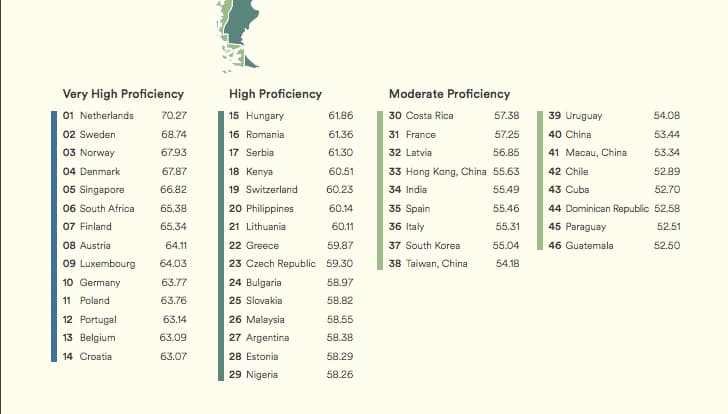
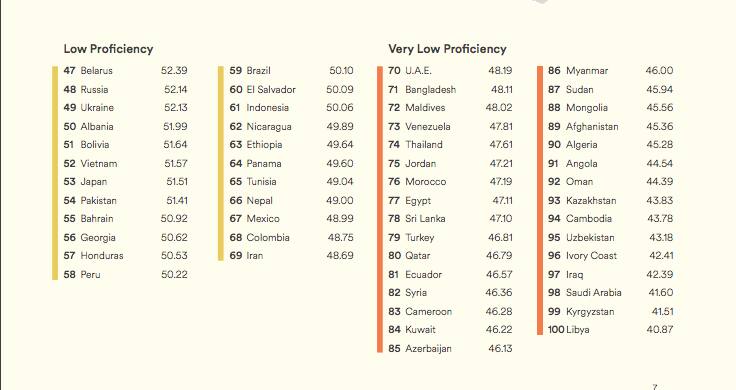
Kenyans have been ranked 18th best English speakers in the world and 2nd best in Africa after South Africa.

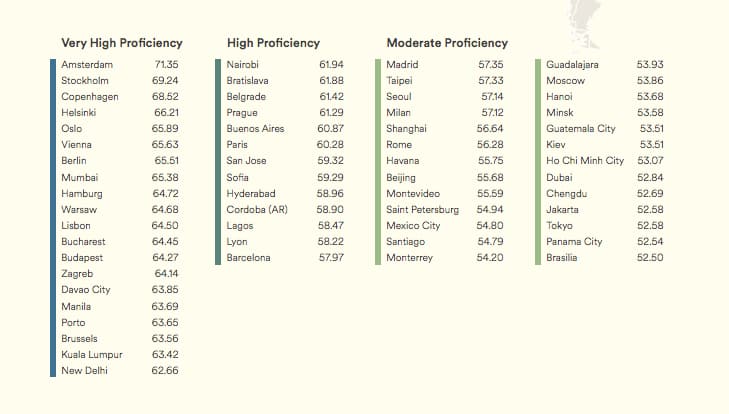
Nairobi ranked number 1 in African City followed closely by Lagos, Nigeria according to a report by global private language tutor, Education First (EF).

The English Proficiency Index (EPI) by the Switzerland-based company ranked Kenya behind South Africa even though Nairobi still emerged as the highest placed African city in English proficiency.

Other African countries that appeared in the top 100 list included Nigeria (29), Ethiopia (63), Tunisia (65), Egypt (77), Cameroon (83), Sudan (87), Algeria (90), Ivory Coast (96) and Libya (100).

The top country in the world was the Netherlands followed by Sweden, Norway, Denmark and Singapore finishing the list of the top five.

Kenya had a high proficiency EF EPI score of 60.51 with Netherlands leading with 70.27%.

Kenyans ranked second best in English proficiency in Africa
The countries ranked according to their scores. Photo: Screenshot from EF English Proficiency Index. Source: UGC

In terms of cities, Nairobi emerged top in Africa with an EPI score of 61.94% followed by Lagos which scored 58.47 %.

Africa’s average proficiency score dropped primarily due to score changes in South Africa and Ethiopia and the inclusion of Sudan and Cameroon, which both fall in the ”very low” proficiency band, the report said.

“As in previous years, a few African countries performed well while the rest performed poorly, and the gap between higher and lower proficiency countries is wider than ever,

“The overall average for Africa dropped significantly, primarily due to score changes in South Africa and Ethiopia – both countries with large populations – and to the inclusion of Sudan and Cameroon, which were not in the Index last year, and both fall in the Very Low Proficiency band,” read the report.

Kenyans ranked second best in English proficiency in Africa

The EF report links English proficiency to innovation, public investment in research and development, number of researchers per a population of one million as well as technicians per capita.

“For the first time, we find that adults aged 26-30 have the strongest English skills. This finding reflects the growing prominence of English instruction in university education around the world,” said EF.

Kenyans ranked second best in English proficiency in Africa

KCSE Past Papers 2018 CRE Paper 2 (313/2)

KCSE Past Papers 2019 CRE Paper 2 (313/2)

Kenya Certificate of Secondary Education

2018 Christian religious Education (CRE) Paper 2

1. (a) Outline Micah’s prophecy concerning the Messiah (Micah 5: 2-5).(7 marks)

(b) Describe the annunciation of the birth of Jesus by angel Gabriel as recorded in Luke I: 26-38.(8 marks)

(c) State five lessons Christians learn from the Magnificat. (5 marks)

2. (a) Explain the teachings of Jesus on the qualities of a true disciple (Luke 6: 20-49). (8 marks)

(b) Describe the incident in which Jesus foi’gave the sinful woman (Luke 7: 36-50). (7 marks)

(c) State five lessons Christians learn from the incident in which Jesus forgave the sinful woman. (5 marks)

3. (a) With reference to the story of the rich man and Lazarus, explain the teaching of Jesus on the proper use of wealth (Luke 16: 19-31). (7 marks)

(b) Outline six signs of the end times as taught by Jesus in Luke 21: 5-38. (6 marks)

(c) Give seven ways in which Christians are preparing themselves for the second coming of Jesus Christ. (7 marks)

4. (a) Identify eight characteristics of love as tau8ht by Saint Paul in I st Corinthians 13.(8 marks)

(b) Explain thc unity of believers as expressed in the concept of the church (Ephesians 5: 21-32). (5 marks)

(c) Identify seven factors that hinder effective cooperation among Christians in Kenya ioday. (7 marks)

5. (a) Outlinc the importance of professional Codes of Ethics. (6 marks)

(b) Identify seven factors that have led to an increased rate of child labour in Kenya loday. (7 marks)

(c) State seven ways through which Christ ians in Kenya are helping to reduce child labour in the society. (7 marks)

6. (a) Give seven reasons why Christians are opposed to plastic surgery. (7 marks)

(b) State seven effects of pollution on the environment in Kenya today. (7 marks)

(c) Identify six ways through which Christians in Kenya can conool desertification. (6 marks)

Questions and Answers

Christian Religious Education Paper 2

1. (a) Outline Micah’s prophecy concerning the Messiah (Micah 5: 2-5).(7 marks)

(i) The Messiah would be born in Bethlehem.

(ii) He will rule over Israel.

(iii) His origin is from the o1d/ancient days.

(iv) He would be born of a woman.

(v) He will feed His flock.

(vi) He will rule in majesty/strength of God.

(vii) In His time Israel will be secure/peaceful.

(viii) He shall be great to the ends of the earth/eternal.

(b) Describe the annunciation of the birth of Jesus by angel Gabriel as recorded in Luke I: 26-38.(8 marks)

(i) Angel Gabriel was sent/appeared to Mary in Nazareth.

(ii) Mary was a young woman who had been engaged to a man named Joseph from the house of David.

(iii) The angel greeted Mary “Hail, O favoured one, the Lord is with you.”

(iv) Mary was troubled by the greeting/wondered what it could be.

(v) The angel told her not to be afraid since she had found favour with God/was going to conceive/give birth to a son.

(vi) He would be called Jesus.

(vii) The angel told Mary that Jesus will be great/will be called the son of the Most High/God will give him the throne of his father David.

(viii) Mary asked the angel how she was going to conceive without a husband.

(ix) The angel told her that she would conceive by the power of the Holy Spirit.

(x) The angel told Mary that her kinswomen Elizabeth had also conceived a son/was six months pregnant

(xi) Mary accepted the angel’s message/said “I am the hand maid of the Lord, let it be to me as you have said.”

(xii) The angel departed from her.

(c) State five lessons Christians learn from the Magnificat. (5 marks)

(i) Christians should always appreciate/thank/glorify God for His favours.

(ii) Christians should have faith in God. (iii) Christians should be humble.

(iv) Christians should rejoice when they are blessed by God.

(v) Christians should obey/respect the will of God.

(vi) Christians should depend on God for provision.

2. (a) Explain the teachings of Jesus on the qualities of a true disciple (Luke 6: 20-49). (8 marks)

(i) Perseverance in the face of persecution — A true disciple should endure suffering.

(ii) Unwavering faith in Jesus — A true disciple should have absolute faith in God.

(iii) Love for enemies — A true disciple should love even their enemies/pray for them.

(iv) Obedience/implementers of the teachings of Jesus — A true disciple should accept the lordship of Christ/implement His teaching.

(v) Forgiving others — A true disciple should forgive others/not revenge.

(vi) Generosity/kindness — A true disciple should share with others/be generous.

(Vil) Not to judge others — A true disciple should exercise self-criticism before judging others.

(viii) Show compassion/mercy to others — A true disciple should be mercifiil just like God.

(b) Describe the incident in which Jesus foi’gave the sinful woman (Luke 7: 36-50). (7 marks)

(i) Simon the Pharisee invited Jesus to his house to eat with him.

(ii) A woman who was known to be a sinner came to Jesus with an alabaster flask of ointment.

(iii) She started seeping/wiped the feet of Jesus with her hair/kissed/anointed the feet of Jesus.

(iv) Simon wondered how Jesus could allow such a sinner to touch Him.

(v) Jesus knowing Simon’s thoughts decided to tell him the parable of the two debtors who owed their master different amounts of money and the master forgave them.

(vi) Jesus asked Simon who among the two debtors was more grateful.

(vii) Simon answered that the debtor who had more was more grateful.

(viii) Jesus told Simon that the sinful woman had shown a lot of love because her many sins had been forgiven.

(ix) Jesus told the woman to go in peace for her faith had saved her/her sins had been forgiven.

(c) State five lessons Christians learn from the incident in which Jesus forgave the sinful woman. (5 marks)

(i) Christians should confess/repent their sins.

(ii) The Kingdom of God is open to all/universal.

(iii) Christians should have faith in God.

(iv) Christians should be merciful/show compassion to those who are lost in sin.

(v) Christians should not judge others.

(vi) Christians should be grateful/thankful for the free gift of salvation/forgiveness of sins.

3. (a) With reference to the story of the rich man and Lazarus, explain the teaching of Jesus on the proper use of wealth (Luke 16: 19-31). (7 marks)

(i) Jesus taught that wealth should be used to alleviate the suffering of others/help the needy.

(ii) Wealth should be used to spread the good news.

(iii) Wealth should be used to serve others/glorify God.

(iv) Wealth should not be used to buy unnecessary materials for luxuries when others are suffering.

(v) Proper use of wealth enables one to be rewarded in heaven.

(vi) Wealth should not be used to oppress/humiliate the poor.

(vii) Too much trust in wealth can prevent someone from having eternal life/entering the kingdom of God.

(viii) Wealth is a gift/blessing from God/Christians are custodians of wealth.

(ix) Wealth is temporary/not permanent.

(b) Outline six signs of the end times as taught by Jesus in Luke 21: 5-38. (6 marks)

(i) Strange things will happen to the celestial bodies/sun/moon/star.

(ii) People will come claiming to be the Messiah.

(iii) There will be wars between nations.

(iv) Natural calamities like earthquakes/roaring of the seas will occur.

(v) The followers of Christ will be hated/persecuted.

(vi) There will be famine/pestilences.

(c) Give seven ways in which Christians are preparing themselves for the second coming of Jesus Christ. (7 marks)

(i) Christians pray/fast in readiness for the second coming of Jesus.

(ii) By accepting/confessing Jesus as their personal savior.

(iii) Living holy lives/pursuing righteousness.

(iv) Through preachlng the gospel to others/winning souls for Christ.

(v) Reading/practicing the word of God.

(vi) By fellowshipping/encouraging one another.

(vii) By helping the poor/needy.

(viii) Christians confess/repent their sins.

4. (a) Identify eight characteristics of love as tau8ht by Saint Paul in I st Corinthians 13.(8 marks)

(i) Love is patient.

(ii) It is kind.

(iii) It is not Jealous/boastful.

(iv) Love is not arrogant/rude.

(v) Love is not se1f-seeking does not insist on its own way.

(vi) Love is not irritable/resentful.

(vii) It does not rejoice in wrong/rejoices in the right.

(viii) Love bears all things.

(ix) Love endures/perseveres.

(x) Love believes/trusts all things.

(xi) Love never ends/it is eternal.

(xii) It is the greatest gift.

(b) Explain thc unity of believers as expressed in the concept of the church (Ephesians 5: 21-32). (5 marks)

(i) Paul used the symbol of marriage to show the unity of believers.

(ii) Christians are united to Christ just as a husband is united to his wife.

(iii) Christ loves the church just as the husband loves the wife.

(iv) The church has to submit to Christ just as the wife submits to her husband.

(v) Christ is the head of the church just as the husband is the head of the wife.

(vi) Just as a husband loves his own body/nourishes it, so Christ loves the church/nourlshes it.

(c) Identify seven factors that hinder effective cooperation among Christians in Kenya ioday. (7 marks)

(i) Greed for power/leadership wrangles.

(ii) Competition to win more converts/members.

(iii) Materialism/desire to have more.

(iv) Discrimination based on gender/tribe/education/race 1/social status/disability.

(v) Political interference.

(vi) Different interpretation of the Bible/doctrinal/denominational differences.

(vii) Emergence of cults/idol worship.

(viii) Lack of equity in resources/funds.

(ix) Poor infrastructure/language barrier/poor transport/communication facilities.

(x) Lack of money/inadequate funds.

5. (a) Outline the importance of professional Codes of Ethics. (6 marks)

(i) Professional code of ethics safeguard professionals against being compromised ln their work/upholds their integrity.

(ii) They give guidance on the relationship among professionals/those they serve.

(iii) They contain regu1ations/ terms of employment/promotion/remuneration/termination of services.

(iv) They promote se1f-discipline/accountability for the work done.

(v) They act as a measure of quality services/determine the expected levels of performance.

(vi) They enable the professionals to earn public trust/respect from people they serve/maintain public image of the profession.

(b) Identify seven factors that have led to an increased rate of child labour in Kenya loday. (7 marks)

(i) Poverty in the family has forced children to work.

(ii) They are cheap to contract/quest for cheap labour by employers.

(iii) Children can easily be employed/sacked/fired because they don’t have avenues to help them fight for proper terms/conditions.

(iv) Children have no skills/cannot negotiate for better terms of service/experience/knowledge.

(v) Greed for money by the child’s parent/guardian.

(vi) Death of parents/some children has been 1ef1 to fend for themselves.

(vii) Tiuancy from home/schools whereby some children abandon homes/schools due to peer pressure.

(viii) Gender discrimination in some communities/boys preferred/given priorities than girls.

(ix) Children are given too much responsibility at an early age/negligence/irresponsib1e parents.

(c) State seven ways through which Christ ians in Kenya are helping to reduce child labour in the society. (7 marks)

(i) Christians are helping to reduce child labour in the society by fighting for the rights of children/dignity of children.

(ii) By reporting those who employ children.

(iii) By advocating for stringent measures to curb child labour.

(iv) Teaching/sensitizing the society the evils of child labour.

(v) By condemning child labour/preaching against it.

(vi) Putting up homes for orphans/neglected children.

(vii) Through guidance and counselllng of parents on responsible parenthood.

(viii) Providing education to children from poor backgrounds.

(ix) By being role models/not practicing child labour.

6. (a) Reasons why Christians are opposed to plastic surgery.

(i) Plastic surgery takes the place of God/cha1lenges God as the creator/interferes with God’S lmage.

(ii) It shows lack of appreciation for oneself.

(iii) There are high risks involved/poor health/infections.

(iv) Plastic surgery is equated to idolatry/worship of the body.

(v) Plastic surgery promotes some vices/pride.

(vi) Plastic surgery can lead to death.

(vii) It can lower one’s self-esteem/stress/guilt.

(viii) It can lead to isolation/social stigma/rejection.

(b) Effects of pollution on the environment in Kenya today.

(i) Pollution has led to infections/diseases in human beings/animals.

(ii) It has led to global warming/result in climatic change/ozone layer.

(iii) Pollution has contributed to inconsistent rainfall patterns/drought/famine.

(iv) It has led to ecological/imbalance/migration/extinction of some animalsfiirds.

(v) It has led to death of human beings/animals/plants/birds.

(vi) It has led to human/animal conflicts.

(vii) It has damaged buildings/wastage of resources.

(viii) It has affected marine life/bio-diversity.

(c) Ways through which Christians in Kenya can control desertification.

(i) Christians can control desertification by protecting water catchment areas.

(ii) By exploiting/using alternative sources of energy/fuel.

(iii) Condemning/discouraging the distraction of forests.

(iv) Christians should participate in the planting of trees/afforestation/reforestation.

(v) By using better methods of farming.

(vi) Sensitizing/creating awareness of environmental conservation.

(vii) Christians should report those who destroy forests/environment to relevant authorities.

kcse exam 2020
kcse 2020 English
kcse 2020 prediction
kcse 2020 mathematics prediction
kcse 2020 biology prediction
kcse 2020 biology paper 1
kcse 2020 timetable
kcse computer project 2020 question paper
kcse past papers
kcse past papers 2018
kcse past papers 2018 pdf download
FREE KCSE 2017 PAST PAPERS (QUESTIONS, MARKING SCHEMES AND REPORTS)
KCSE 2016 PAST PAPERS (QUESTIONS, MARKING SCHEMES AND REPORTS)
KCSE 2015 PAST PAPERS (QUESTIONS, MARKING SCHEMES AND REPORTS)
KCSE 2014 PAST PAPERS (QUESTIONS, MARKING SCHEMES AND REPORTS

KCSE Past Papers 2018 CRE Paper 1 (313/1)

Christian religious Education

Kenya Certificate of Secondary Education

2018 Christian religious Education (CRE) Paper 1

1. (a)Outline seven teachings about human beings from the Biblical creation accounts. (7 marks)

(b) Give seven similarities between traditional African view of evil and the Biblical concept of sin. (7 marks)

2. (a)State six ways in which Christians in Kenya help to restore a member who has fallen into sin. (6 marks)

(b) Give five reasons why the Israelites broke the covenant they had made with God while at Mount Sinai (Exodus 32:1-35). (5 marks)

(b) Identify eight conditions that God gave to the Israelites during the renewal of the Sinai covenant (Exodus 34:1-35). (8 marks)

(c) State the importance of the Ten Commandments to Christians. (7 marks)

3. (a) Identify seven characteristics of the Canaanite religion. (7 marks)

(b) State the challenges faced by Elijah during his prophetic ministry in Israel. (6 marks)

(c) Give seven ways in which Christians fight comiption in Kenya today. (7 marks)

4. (a)Explain the vision of the basket of summer fruits shown to Prophet Arnos by God. (Amos 8:1-3). (6 marks)

(b) Outline the teaching of Prophet Amos on the day of the Lord. (7 marks)

(c) State seven ways in which Christians help the church leaders to perform their duties effectively. (7 marks)

5. (a) State the evils condemned by Prophet Jeremiah during the temple sermon. (6 marks)

(b) Explain four symbolic acts related to hope and restoration as demonstrated by Prophet Jeremiah. (8 marks)

(c)Give six lessons Christians learn from Prophet Jeremiah’s temple sermon. (6 marks)

6. (a)Outline six roles of priests in traditional African communities. (6 marks)

(b) Explain the importance of kinship ties in traditional African communities.( 5 marks)

(c) Identify six factors that have affected the kinship ties in the traditional African communities.(6 marks)

Questions and Answers

Christian Religious Education Paper 1

1. (a)Outline seven teachings about human beings from the Biblical creation accounts. (7 marks)

(i) Human beings are created in the image/likeliness of God

(ii) Human beings are co-creators with God/have to continue with God’s work of creation

(iii) Human life is God given/have the breath of life from God

(iv) They have the authority/dominion over God’s creation/superior to the rest of the creation.

(v) Human beings have the ability to thiñk/reason/make choices/decisions/bear consequence

(vi) Human beings are social beings/need companionship

(vii) They have a duty to take care of God’s creation/till the land/work

(viii) Human beings are to use other creation for their benefits/transform the world for the benefit

(ix) They are blessed by God

(x) Man and woman are equal before God

(xi) Human beings are to procreate through marriage/mutiply/fill the earth

(xii) They have been created to obey/fellowship with God

(xiii) The woman was created out of the man’s ribs.

(b) Give seven similarities between traditional African view of evil and the Biblical concept of sin. (7 marks)

(i) In both cases God/supreme being is good/not the author of sin/evil.

(ii) In both sin/evil is considered/known to interfere with the smooth running of the community as intended by God/supreme being.

(iii) In both sin/evil leads/results to alienation of human beings from God/interferes with good relationship.

(iv) Both sin/evil arises from human beings disobedience/greed/selfishness

(v) Both sin/evil causes a lot of suffering to human beings.

(vi) In both sin/evi1 may result from failing in a social/spiritual obligatiori/duty

(vii) In both human beings have the ability to overcome evil by choosing good/ right.

(viii) God is the guardian of morality/law/order in both.

(ix) In both sin/evil destroys the relationship among human beings/creates a situation of fear/mistrust/suspicion.

(x) In both sin/evil leads to punishment from God/can lead to destruction of God’s creation through natural calamities.

(xi) In both sin/evi1 leads to death

(xii) In both there is remedy for sin/evil

2. (a)State six ways in which Christians in Kenya help to restore a member who has fallen into sin. (6 marks)

(i) By praying for/with the member.

(ii) Through providing guidance and counselling/advice.

(iii) Visiting the member/doing a follow up after preaching to him/her.

(iv) By inviting him/her to come to church.

(v) Forgiving/accepting him/her in church.

(vi) Teaching/preaching the word of God to him/her.

(vii) By showing him/ her 1ove/ by providing material/financial support .

(viii) By encouraging him/her to confess/repent/seek for forgiveness

(b) Give five reasons why the Israelites broke the covenant they had made with God while at Mount Sinai (Exodus 32:1-35). (5 marks)

(i) Moses their leader had taken too long on the mountain.

(ii) Aaron, who had been left in charge of the peoples was weak/was easily manipulated.

(iii) The Israelites wanted a god they could see.

(iv) The Israelites were still influenced by the Egyptian way of worship/idolatry

(v) The teaching/influence of Moses had vanished from the people’s minds.

(vi) They lacked faith in God

(vii) They lacked knowledge of the nature of God.

(b) Identify eight conditions that God gave to the Israelites during the renewal of the Sinai covenant (Exodus 34:1-35). (8 marks)

(i) The Israelites were to obey God’s commands.

(ii) The Israelites were not to make anycovenant treaties with other tribes.

(iii) The Israelites were to destroy/break down the altars of their gods/smash their sacred stones/places of Idol worship.

(iv) They were not to worship any other god but Yahweh.

(v) They were to keep the feast of unleavened bread.

(vi) The Israelites were to dedicate all their first born male children/those of their flock to God.

(vii) The Israelites were to rest on the seventh day.

(viii) They were to offer to God the first fruits of their harvests/observe the feast of weeks.

(ix) All the male Israelites were to appear before the Lord God three times in a year.

(x) They were not to offer the blood of the sacrifices with leaven.

(xi) They were not to intermarry.

(xii) They were not to make graven images/idols.

(c) State the importance of the Ten Commandments to Christians. (7 marks)

(i) The Ten Commandments safegurds Christians against idol worship/promotes the worship of one true God.

(ii) They help Christians to have the right relationship with God/warns against indulging themselves in practices that drives them away from God/not to misuse God’s name.

(iii) They remind Christians to keep the Sabbath day/celebrate the Sabbath day by carrying out acts of charity/fellowshipping with one another.

(iv) They promote good relationship between parents and children/others.

(v) They help Christians to preserve/respect/protect human life.

(vi) They act as a guide to Christian living/safeguard marriages/bring stability in families.

(vii) The Ten Commandments help to protect pGople’s property/condemns all forms of theft.

(viii) They help to teach the virtue of honesty/self-control.

(ix) Ten Commandments promotes good relationship with other people/enhance peaceful co-existence.

3. (a) Identify seven characteristics of the Canaanite religion. (7 marks)

(i) Canaanite religion was a nature/cosmic/cyclic religion.

(ii) It comprised of many gods/goddesses/po1ytheistic.

(iii) They had a chief god/EL.

(iv) They worshipped their gods on mountain tops/high places of worship/temples/shrines.

(v) Symbols/idols/images were made to represent each god/goddesses.

(vi) The Canaanites practiced temple prostitution/was part of the worship of gods/goddesses.

(vii) They offered elaborate human/animal/crops sacrifices to the gods/goddesses.

L (viii) Feasts/festivals were celebrated in honor of gods/goddesses.

(ix) Each god had his/her own prophet/prophetess.

(x) Each god/goddess played a specific role in the community.

(b) State the challenges faced by Elijah during his prophetic ministry in Israel. (6 marks)

(i) Prophet Elijah had to defend his faith/religion to prove that Yahweh was the True God.

(ii) He was accused by King Ahab of being the trouble maker in Israel/enemy.

(iii) Prophet Elijah had to convince the people that he was the true prophet of Yahweh.

(iv) He lived in fear after pronouncing the drought in Israel.

(v) He had to flee from Israel after killing the prophets of Baal.

(vi) Jezebel threatened to kill him.

(vii) Elijah despaired/felt discouraged/lonely/wished to die.

(viii) True prophets of God were being persecuted/killed in Israel.

(ix) Elijah had to fight Baalism which had been made a state religion

(x) The presence of the many prophets of Baa1 in Israel

(c) Give seven ways in which Christians fight comiption in Kenya today. (7 marks)

(i) Christians fight corruption through condemning all the unjust practices in the society.

(ii) By praying for the corrupt people to change their behavior.

(iii) Through advocating for the enactment of laws that can help to strengthen the fight against comiption.

(iv) Christians act as role models for others to emulate/set good example by avoiding comipt practices.

(v) They make moral choices/informed decision/through the use of life skills. By lobbying for the punishment of all those who abuse justice/promote corruption,

(vi) By educating/providing civic education on the evils Of comiption.

(vii) Through exposing corrupt practices in the society.

(viii) By obeying the laws of the state.

(x) By preaching the importance of integrity to the people.

(ix) Christians repott those engaged in comtption to the relevant authorities

4. (a)Explain the vision of the basket of summer fruits shown to Prophet Arnos by God. (Amos 8:1-3). (6 marks)

(i) Prophet Amos was shown a basket of ripe fruits at the end of the harvest.

(ii) God told Amos that Israel was ripe for destruction.

(iii) Just as one waits for time to harvest fruits, God had waited for the Israelites to repent.

(iv) Since Israelites had not repented, the time had come for them to be punished.

(v) God’s judgement would not be delayed any longer.

(vi) Prophet Amos was silent/did not plead for God’s mercy for the Israelites.

(vii) This meant that punishment was inevitable.

(b) Outline the teaching of Prophet Amos on the day of the Lord. (7 marks)

(i) The day of the Lord would be full of darkness/no ligh/eclipse.

(ii) It would be a day of horror/disaster.

(iii) The day of the Lord will be a day of disappointment to the rich/rulers.

(iv) God would punish the (sraelites for their disobedience/He will remember their evil deed/God’s judgement would be upon them.

(v) There would be earthquakes/the land shall tremble/floods.

(vi) There will be mourning/wailing or the day of the Lord.

(vii) People will not delight in their feasts/festivals.

(viii) People will thirst/hunger for the word of God.

(ix) People will faint in the process of searching for the word of God.

(x) Israelites would be defeated by their enemies on the day of the Lord.

(xi) There would be famine/hunger/lack of food on the day of the Lord.

(xii) It will be a day of disappointment to the Israehtes/there will be no happiness/joy.

(c) State seven ways in which Christians help the church leaders to perform their duties effectively. (7 marks)

(i) Christians support church leaders financially/give material help/basic needs.

(ii) They defend them against unfair criticism.

(iii) By encouraging them iti their work/giving them moral support.

(iv) Advising/counseling them on various issues.

(v) By praying for/with them.

(vi) Respecting them/participate in church activities.

(vii) By practicing their teaching/obeying the word of God.

(viii) By giving tithes/offering to support the church activities.

5. (a) State the evils condemned by Prophet Jeremiah during the temple sermon. (6 marks)

(i) Prophet Jeremiah condemned the false belief that the temple could not be destroyed since it was God’s dwelling place.

(ii) He condemned the worship of other gods/idolatry.

(iii) He condemned the practice of human sacrifice which was against the commands of God.

(iv) He condemned hypocrisy among the people/syncretism/insincere worship.

(v) Prophet Jeremiah condemned the defilement of the temple/the people had put idols in it.

(vi) He condemned the oppression of the foreigners/widows/orphans which was against the covenant way of life.

(vii) He condemned the stubbornness of the Israelites against God’s warnings/had ignored the teachings of the prophets/failed to repent.

(b) Explain four symbolic acts related to hope and restoration as demonstrated by Prophet Jeremiah. (8 marks)

(i) The vision of two baskets of figs

Jeremiah saw a vision of two baskets of figs outside the temple. One basket had bad fruits that could not be eaten while the other one had good figs.

The good figs represented the first group who submitted to the deportation to exile.

This group of people would be restored/will be given new hearts/would be called people of God. The bad figs represented the group that refused to submit to the deportation to exile/would be punished.

(ii) The buying of land

God instructed Jeremiah to buy land from his cousin in Anathoth. He carried out the transaction before witnesses/gave the title deed to Baruch the scribe for safe keeping. This showed restoration of the Israelites to their homeland/They would reclaim the land.

(iii) The wooden Ox yoke

This symbolized the perseverance of the Jews in exile. After a period in exile, God would break the Babylonian yoke/restore the people back to the land/they would be set free.

(iv) The letter to the exiles

Jeremiah wrote the letter to encourage the exiles. They were to settle/build houses/have children/live in peace because they would return to Israel.

(v) Jeremiah’s visit to the potter’s house (c)Give six lessons Christians learn from Prophet Jeremiah’s temple sermon. (6 marks)

(i) Christians should have absolute trust/faith in God.

(ii) Christians should be morally upri%t/be exemplary.

(iii) They should warn people about judgement/punish the sinners/call sinners to repentance.

(iv) Christians should denounce/condemn social evils in the society.

(v) Christians should help the needy/widows/orphans.

(vi) They should be sincere in worship/shun hypocrisy/syncretism.

(vii) They should respect/ honour places of worship.

(viii) They should obey the word of God.

6. (a)Outline six roles of priests in traditional African communities. (6 marks)

(i) They give sacrifices to God/poor libations to ancestors.

(ii) They act as advisors of the community.

(iii) The priests intercede/offer prayers to God/spirits/ancestors on behalf of human beings.

(iv) They are the religious symbols of God’s presence in the community.

(v) In some communities the priest can act as a political leader.

(vi) They solve/settle disputes in the society/judge cases.

(vii) Priests preside over religious ceremonies/festivals.

(viii) They take care of shrines/places of worship.

(ix) They are custodians of customs/taboos/traditions of the community.

(b) Explain the importance of kinship ties in traditional African communities.( 5 marks)

(i) Kinship ties helps in preserving traditional customs through informal education.

(ii) They bind the entire life of a community/unites members of the same clari/family.

It helps to maintain law and order in the community.

Kinship ties promotes a sense of be1onging/security/identity. It defines the punishment/reward in the community.

It regulates marriage relationship in the community.

(vii) It helps in settling disputes in the community/family.

(viii) It defines duties/responsibilities of members of the clan/family.

(ix) It governs the relationship between the living and the dead.

(x) Kinship prepares the youth for leadership roles.

(xi) It enables people to share/help one another.

(c) Identify six factors that have affected the kinship ties in the traditional African communities.(6 marks)

(i) Formal education.

(ii) Modem religions/Christianity/Islam.

(iii) Mass media influence.

(iv) Permissiveness in the society.

(v) Western civilization.

(vi) Migration/individual land ownership.

(vii) New government structures/systems.

(viii) Economic factors/poverty/wealth/social status.

(ix) Urbanization.

(x) Modern science and technology.


kcse exam 2020
kcse 2020 English
kcse 2020 prediction
kcse 2020 mathematics prediction
kcse 2020 biology prediction
kcse 2020 biology paper 1
kcse 2020 timetable
kcse computer project 2020 question paper
kcse past papers
kcse past papers 2018
kcse past papers 2018 pdf download
FREE KCSE 2017 PAST PAPERS (QUESTIONS, MARKING SCHEMES AND REPORTS)
KCSE 2016 PAST PAPERS (QUESTIONS, MARKING SCHEMES AND REPORTS)
KCSE 2015 PAST PAPERS (QUESTIONS, MARKING SCHEMES AND REPORTS)
KCSE 2014 PAST PAPERS (QUESTIONS, MARKING SCHEMES AND REPORTS

KCSE Past Papers 2018 Chemistry paper 3 (233/3)

Practical

2018 Chemistry paper 3

1. You are provided with:

• 0.30 g solid A, magnesium metal

• Hydrochloric acid, solution B

• 0.15 sodium carbonate, solution C

• Methyl orange indicator

You are required to determine the:

• Enthalpy change, AH per mole, of the reaction between magnesium metal and excess hydrocholoric acid.

• Concentration in moles per litre of hydrochloric acid, solution B.

Procedure I

(i) Using a burette, measure 50.0 cm3 of solution B and place it in a 100 ml plastic beaker.

(ii) Measure the temperature of solution B in the beaker after every 30 seconds and record it in Table 1.

(iii) At the 90th second, add all of the solid A provided into the beaker, stir with the thermometer and continue measuring and recording the temperature after every 30 seconds. Complete Table 1. Retain the mixture in the beaker for use in procedure II.

Table 1

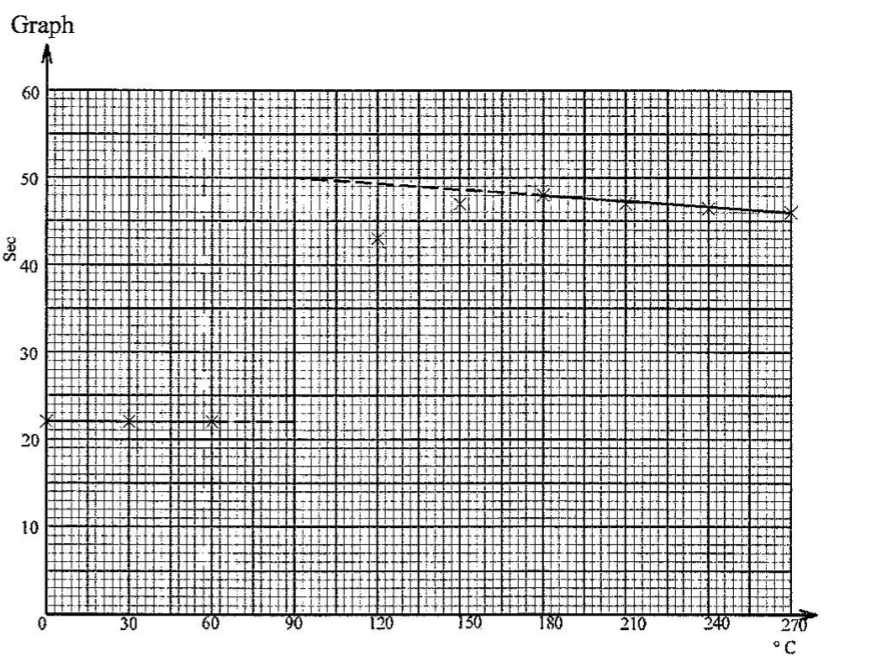
Time (seconds) 0 30 60 90 120 150 180 210 240 270
Temperature°C x

(3 marks)

(a) Plot a graph of temperature (vertical axis) against time on the grid provided. (3 marks)

(b) Determine the change in temperature, AT, for the reaction. Show the working on the graph.

AT . (1 mark)

(c) Calculate the heat change, in joules, for the reaction. Assume that for the solution, specific heat capacity is 4.2 Jg K 1 and density is 1.0gcm 3. (2 marks)

(d) The relative atomic mass of magnesium is 24.0. Calculate the enthalpy change, AH, of the reaction per mole of magnesium. Indicate the sign of AH. (1 mark)

Procedure H

(i) Fill a clean burette with the 0.15M sodium carbonate, solution C.

(ii) Place all of the mixture in the beaker from procedure I into a 250ml volumetric flask. Add distilled water to the mark and shake thoroughly. Label the mixture as solution D.

(iii) Using a pipette filler, pipette 25.0 cm3 of solution D into a 250 ml conical flask and add 2 drops of methyl orange indicator.

(iv) Titrate solution D in the conical flask with the sodium carbonate, solution C and record the readings in Table 2.

(v) Repeat steps (iii) and (iv) and complete Table 2.

Table 2

Observations Inferences

(a) Determine the average volume of the 0.15M sodium carbonate, solution C, used. (1 mark)

(b) Calculate the number of moles of:

(i) sodium carbonate used.

(ii) hydrochloric acid in the 25.0 cm3 of solution D.

(iii) hydrochloric acid in the 250 cm3 of solution D.

(iv) hydrochloric acid that reacted with magnesium metal.(1 mark)

(v) total number of moles of hydrochloric acid in the 50.0cm3, solution B. (1 mark)

(c) Determine the concentration of hydrochloric aeid in moles per litre, in solution B. (1 mark)

2. You are provided with solid E. Carry out the following tests and record the observations and inferences in the spaces provided.

(a) Place about one-third of solid E in a dry test-tube. Heat the solid strongly and test any gas with both blue and red litmus papers.

Observations Inferences

(b) Place the remaining amount of solid E in a boiling tube. Add about 15 cm3 of distilled water and shake. Divide the mixture into four test tubes each containing about 2 cm3 .

(i) To the first portion, add three or four drops of dilute hydrochloric acid (1 mark)

(ii) To the second portion, add two or three drops of aqueous barium nitrate.

Observations Inferences

(iii) To the third portion, add aqueous sodium hydroxide dropwise until in excess.

Observations Inferences

(iv) To the fourth portion, add aqueous ammonia dropwise until in excess.

Observations Inferences

3. You are provided with solid F. Carry out the following tests and record the observations and inferences in the spaces provided.

(a) Place about one-third of solid F on a clean metallic spatula and burn it in a Bunsen burner flame.

Observations Inferences

(b) Place the remaining amount of solid F in a boiling tube. Add about 10 cm3 of distilled water and shake. Use the mixture for tests (i) to (iii) below.

Observations Inferences

(i) Using about 2 cm3 of the mixture in a test-tube, determine the pH using universal indicator paper and chart.

Observations Inferences

(ii) To about 2 cm3 of the mixture in a test tube, add two or three drops of acidified potassium manganate(VII).

Observations Inferences

(iii) To about 2 cm3 of the mixture in a test-tube add two or three drops of bromine

Observations Inferences


Practical Answers

2018 Chemistry paper 3

1.

Time,s 0 30 60 90 120 150 180 210 240 270
Temperature ºC 22.0 22.0 22.0 x 43.0 47.5 48.0 47.0 46.5 46.0

• Complete table ———-(1 mark)

• Use of decimals ( Either whole numbers, one decimal place as 0.5 (1 mark)

• Accuracy —————-½

• Trends – constant readings from t=0 sec to t=60sec, continuous rise in temperature readings from t=120 sec to maximum followed by a drop ½

a).

• Scale——-(½ mark)

• Labeling of axes—–(½ mark)

On graph paper

b).△T=(50.0 – 22.0)oc =28.0o

• Plotting (1 mark)

• Curve / lines (1 mark)

c).Heat change = 4.2 x 50 x 28.0 Joules

= 5880 Jou1es

d).Moles of magnesium = 30 0.0125/24

Enthalpy change △H= —5880/0.0125 x 1 J mol-1

= – 470400 J mol-1 OR – 470.4 kJ mol-1

-ve sign must be shown otherwise penalize

I II III
Final brette reading 24.80 33.50 41.50
Initial burette reading 1.00 10.00 18.00
Volume of solution C used cm<sub>3</sub> 23.80 23.50 23.50

• Complete table with three titrations—-(1 mark)

• Use of decimals ( 1 or 2) consistently (1 mark)

For 2 decimal places, the second decimal should be 0 or 5

• Accuracy ( any one value compared to the school value that is within 0.10 cmm or 0.20 cm3 of the school value) (1 mark)

• Principles of averaging — average of volumes that are within -L 0.10cm to 0.20 cm3 from each other.

• Final accuracy- should be within 0.10 cm3 to 0.20 cmof the school value.

a).Average volume of solution C used

23.50 + 23.50 cm3/2 = 23.50 cmcm3

b).Moles of sodium carbonate = 0.15average titre/1000

23.50 x 0.15/ 1000

— 3.525 x10⁻³

(ii) Reaction ratio is 1 mole Na2 COC3 : 2 moles HCl

Moles of hydrochloric acid in 25.0cm’ = 2 x Answer in b(i) =2×3.525 x 10-3

= 7.05 x10 -3

(nf) Moles of hydrochloric acid in 250 cm° = Answer in b(ii) x 250 2

— 0.0705

(iv) Mg * 2HCl—+ Mg Cl, + H2

Reaction ratio is Mg : HCP = 1 : 2

Moles of magnesium — 0.0125

Moles of hydrochloric acid = 2 x 0.0125 M

= 0 025

(v) Total number of moles of hydrochloric acid in 50 cm3 of solution B = Answer in b(iii) + answer in b(iv)

= 0.0705 + 0.025

= 0.0955

Concentration of hydrochloric acid in moles per litre of solution B Answer in b(v) x i000 50

0.0955 x1000 Moles per litre

= 1.91 mol dm-3

Observations Inferences
(a) Colourless liquid
condenses the on cooler parts of the
test-tube.
Red litmus turned blue
Blue litmus remains blue
(2marks)
Hydrated compound of ammonium salt
(NH ) present
(1marks)
(b) No effervescence
(i) No white precipitate
CO-2 3
* and SOA’ absent
Pb2+absent
(ii) White precipitate SO2-4
(iii) White precipitate which dissolves in
excess aqueous sodium hydroxide
Zn2+  or Al3+ present
(iv) White precipltate
insoluble in excess aqueous ammonia
Zn2+ or Al
3+
3.(a)Bums with a yellow
smoky / sooty flame
Unsaturated organic compound
OR
– long-chain organic compound
(b) Dissolves forming a colourless solution. Polar compound
(i) pH = 2
(accept pH value from 1 to 3) Reject pH range
Acidic compound probably carboxylic
acid
(ii) Acidified potassium manganate
(VII)
decolourised / purple potassium manganate
(VII) changes to colourless.
Alkene / alkyne or alkanol present
Bromine  water decolourized
/ Yellow or brown colour of bromine turns colourless
Alkene
OR alkyne present


kcse exam 2020
kcse 2020 English
kcse 2020 prediction
kcse 2020 mathematics prediction
kcse 2020 biology prediction
kcse 2020 biology paper 1
kcse 2020 timetable
kcse computer project 2020 question paper
kcse past papers
kcse past papers 2018
kcse past papers 2018 pdf download
FREE KCSE 2017 PAST PAPERS (QUESTIONS, MARKING SCHEMES AND REPORTS)
KCSE 2016 PAST PAPERS (QUESTIONS, MARKING SCHEMES AND REPORTS)
KCSE 2015 PAST PAPERS (QUESTIONS, MARKING SCHEMES AND REPORTS)
KCSE 2014 PAST PAPERS (QUESTIONS, MARKING SCHEMES AND REPORTS