Archives 2020

KCSE Past Papers 2019 Geography paper 1 (312/1)

KCSE Past Papers 2019 Geography paper 1 (312/1)

2019 Geography Paper 1

SECTION A

Answer all the questions in this section.

1. (a) Distinguish between Geography and Environment.(2 marks)

(b) Identify the two branches of Geography.(2 marks)

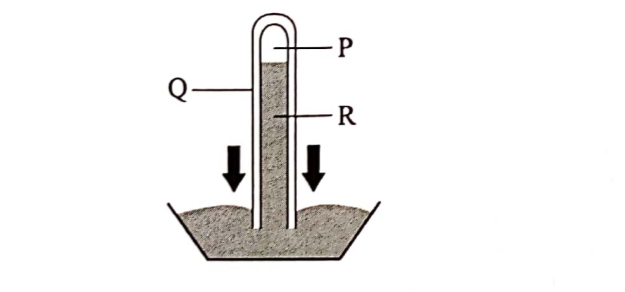
2. (a) The diagram below represents an instrument for measuring atmospheric pressure.

Name the parts marked P, Q and R.(3 marks)
(b) State three benefits of weather forecasting to human activities.(3 marks)

3. Give four proofs that support the theory of continental drift.(4 marks)

4. (a) Give three factors that influence the way a river transports its load.(3 marks)

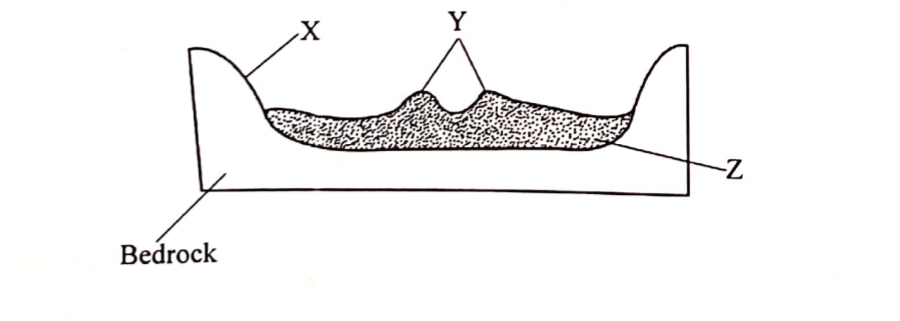
(b) The diagram below represents a cross-section of a flood plain. Name the features marked X, Y and Z. (3 marks)
5. (a) State the two causes of vertical movement of the ocean water.(2 marks)

(b) List three types of ocean tides.(3 marks)

SECTION B

Answer question 6 and any other two questions from fhis section.

6. Study the map of Yimbo 1: 50,000 (sheet l 15/1) provided and answer the following questions.

(â) (Î) What is the magnetic variation of the map?(2 marks)

(ii) Identify two natural features found at the grid square 3597.(2 marks)

(iii) Identify the two countries represented in the area covered by the map. (2 marks)

(b) (i) Give the direction of the trigonometrical station at the grid square 2789 from the air photo principal point at Nyagoma Mission School. (2 marks)

(ii) Measure the length of the provincial boundary to the North West of the area covered by the map. Give your answer in kilometres. (2 marks)

(c) (i) Give evidence that show the area covered by the map receives low rainfall. (3 marks)

(ii) Explain how each of the following factors have influenced the distribution of settlements in the area covered by the map:

I. Transport(2 marks)

II. Vegetation (2 marks)

III. Relief (2 marks)

(d) Describe the drainage of the area covered by the map.(6 marks)

7. (a) Using examples from East Africa, describe each of the following types of volcanoes:

(i) Active Volcano(3 marks)

(ii) Dormant Volcano(4 marks)

(b) Using a well labelled diagram, explain how each of the following features were formed:

(:) Composite Volcano (6 marks)

(ii) Volcanic plug (4 marks)

(c) Explain four negative effects of vulcanicity (8 marks)

8. (a) (i) Apart from inter tropical convergence zone (ITCZ), list four physical factors that influence climaie. (4 marks)

(ii) Give four charactcristics of inier tropical convergence zone (ITCZ). (4 marks)

(b) (i) Name the thrce equatorial climatic regions of Kenya. (3 marks)

(ii) Describe the tundra climate.(6 marks)

(c) Explain four human causes of desertification.(8 marks)

9. (a) (i) Define an ocean.(2 marks)

(ii) Explain the three causes of variation in the amount of salt in ocean water. * (6 marks)

(b) (i) Identify three processes involved in wave erosion. (3 marks)

(ii) With the aid of well labelled diagrams, describe the processes through which a wave cut platform is formed. (8 marks)

(c) You intend to carry out a field study on types of features resulting from wave deposition along the coast.

(i) Identify three methods you would use to record data. (3 marks)

(ii) Give three wave depositional features you are likely to observe during the field study.(3 marks)

10. (a) List three components of soil.(3 marks)

(b) Explain each of the following in relation to the classificati on of soil:

(i) Zonal(2 marks)

(ii) Intrazonal (2 marks)

(iii) Azonal (2 marks)

(c) Explain three causes of soil degeneration.(6 marks)

(d) Students from mwema school visited a nearby ranch to study types of soil.

(i) Explain why they carried the following tools:

i. Hoes (2 marks)

II. Polythene bags (2 marks)

(ii) Give three reasons why they would need to seek permission from relevant authorities. (3 marks)

(iii) List three types of soil erosion they are likely to observe. (3 marks)

Questions and Answers

2019 Geography Paper 1

SECTION A

Answer all the questions in this section.

1.Distinguish between Geography and Environment

Geography refers to the study of the distribution of natural and human features/phenomenon and their interrelationship on the earth surface while Environment refers to external conditions that surround an organism and has influence on its behaviour.

(b) Identify the two branches of Geography.(2 marks)

– Physical Geography

– Huma Geography

2. (a) The diagram below represents an instrument for measuring atmospheric pressure.

Name the parts marked P, Q and R.(3 marks)

P – Vacuum

Q – Glass tube

R – Mercury

(b) State three benefits of weather forecasting to human activities.(3 marks)

– It enables farmers to plan their farming activities.

– It helps in guiding tourist aGtlVities.

– It enables military personnel to plan their military activities.

– It enables people to choose suitable clothing.

– It guides people on sporting activities.

– It guides people on fishing activities.

– It helps to determine the times for air/sea.

3. Give four proofs that support the theory of continental drift.(4 marks)

4. (a) Give three factors that influence the way a river transports its load.(3 marks)

(b) The diagram below represents a cross-section of a flood plain. Name the features marked X, Y and Z. (3 marks)

5. (a) State the two causes of vertical movement of the ocean water.(2 marks)

(b) List three types of ocean tides.(3 marks)

SECTION B

Answer question 6 and any other two questions from fhis section.

6. Study the map of Yimbo 1: 50,000 (sheet l 15/1) provided and answer the following questions.

(â) (Î) What is the magnetic variation of the map?(2 marks)

(ii) Identify two natural features found at the grid square 3597.(2 marks)

(iii) Identify the two countries represented in the area covered by the map. (2 marks)

(b) (i) Give the direction of the trigonometrical station at the grid square 2789 from the air photo principal point at Nyagoma Mission School. (2 marks)

(ii) Measure the length of the provincial boundary to the North West of the area covered by the map. Give your answer in kilometres. (2 marks)

(c) (i) Give evidence that show the area covered by the map receives low rainfall. (3 marks)

(ii) Explain how each of the following factors have influenced the distribution of settlements in the area covered by the map:

I. Transport(2 marks)

II. Vegetation (2 marks)

III. Relief (2 marks)

(d) Describe the drainage of the area covered by the map.(6 marks)

7. (a) Using examples from East Africa, describe each of the following types of volcanoes:

(i) Active Volcano(3 marks)

(ii) Dormant Volcano(4 marks)

(b) Using a well labelled diagram, explain how each of the following features were formed:

(:) Composite Volcano (6 marks)

(ii) Volcanic plug (4 marks)

(c) Explain four negative effects of vulcanicity (8 marks)

8. (a) (i) Apart from inter tropical convergence zone (ITCZ), list four physical factors that influence climaie. (4 marks)

(ii) Give four charactcristics of inier tropical convergence zone (ITCZ). (4 marks)

(b) (i) Name the thrce equatorial climatic regions of Kenya. (3 marks)

(ii) Describe the tundra climate.(6 marks)

(c) Explain four human causes of desertification.(8 marks)

9. (a) (i) Define an ocean.(2 marks)

(ii) Explain the three causes of variation in the amount of salt in ocean water. * (6 marks)

(b) (i) Identify three processes involved in wave erosion. (3 marks)

(ii) With the aid of well labelled diagrams, describe the processes through which a wave cut platform is formed. (8 marks)

(c) You intend to carry out a field study on types of features resulting from wave deposition along the coast.

(i) Identify three methods you would use to record data. (3 marks)

(ii) Give three wave depositional features you are likely to observe during the field study.(3 marks)

10. (a) List three components of soil.(3 marks)

(b) Explain each of the following in relation to the classificati on of soil:

(i) Zonal(2 marks)

(ii) Intrazonal (2 marks)

(iii) Azonal (2 marks)

(c) Explain three causes of soil degeneration.(6 marks)

(d) Students from mwema school visited a nearby ranch to study types of soil.

(i) Explain why they carried the following tools:

i. Hoes (2 marks)

II. Polythene bags (2 marks)

(ii) Give three reasons why they would need to seek permission from relevant authorities. (3 marks)

(iii) List three types of soil erosion they are likely to observe. (3 marks)
TSC disown earlier communication on teachers missing April 2020 Salary

TSC-Teachers-Service-Commission- (3)

Teachers Service Commission has retracted its earlier communication on more than 3,500 teachers missing April salary as result of not declaring their wealth.

Through short message service (SMS), the commission has assured teachers that it will not stop salary for employees who failed to declare their wealth.

“Please ignore posts circulating on social media purporting that TSC will stop salary for employees who did not comply with the requirements of Declaration of Income Assets and Liabilities.

The Commission will communicate to the affected employees individually when normalcy resumes,” read the message sent to teachers.

Early on, the commission through a circular had indicated that it will stop the employees’ salaries for Non-Compliance from March and April 2020 payrolls.

“Over 3,500 employees (secretariat staff and teachers) did not declare their Wealth within the stipulated deadline. Consequently, the Commission has stopped the employees’ salaries for Non-Compliance from March and April 2020 payrolls,” it reads.

Affected teachers were to be reinstated after confirmation in writing by their immediate supervisor indicating they have been in the service thus been teaching all along and the letter forwarded to the TSC headquarters.

“They are expected to have a confirmation in writing by their immediate supervisor indicating they have been in the service thus been teaching all along and the letter forwarded to the TSC headquarters,”  read part of the circular.

The move comes amid rising concerns over the miscalculated move taken by the commission in the wake of the covid-19 pandemic.

Kuppet

At the same time, the Kenya Union of Post Primary Education Teachers, Kuppet, as lashed out at the teachers’ employer for threatening to expunge over 3,500 teachers and staff from the payroll.

“It would be insensitive on the Commission’s part to be punishing teachers during this pandemic when other government departments are issuing temporary reprieves to citizens and foreigners for non-compliance with certain protocols during this crisis. For instance, the government has extended an indefinite extension for foreign nationals whose work permits have expired,” advises Kuppet.

KCSE Past Papers 2019 English Paper 3 (101/3)

KCSE Past Papers 2019 English Paper 3 (101/3)

2019 English Paper 3

Answer three questions only.

1. Imaginative Composition (Compulsory)(20 marks)

Either

(a) Write a story beginning with the following sentence :

I was mistaken to have thought that the night would be like other peaceful nights.

Or

(b) Write a composition on the advantages and disadvantages of the internet.

2. Compulsory Set Text(20 marks)

H.R. Ole Kulet, Blossoms of the Savannah Irresponsible decisions can lead to serious consequences. Referring closely to H.R. Ole Kulet in Blossoms of the Savannah, write an essay in support of this statement.

3. The Optional Set Texts(20 marks)

Answer any one of the following three questions.

Either

(a) A Short Story

Moran (Ed.), Memories We Lost and Other Stories

Write a composition on the evils of war, using illustrations from “The President” by Mariatu Kamara.

Or

b) Drama

David Mulwa, Inheritance

Ill-gotten wealth can never bring true happiness. Write a composition in support of this statement, drawing examples from Lucuna Kasoo’s life.

Or

(c)The Novel

John Steinbeck, The Pearl

Desire without limits can be a source of agony both to ourselves and our family members, Using illustrations from The Pearl, write an essay in support of this statement.

KCSE Past Papers 2019 English Paper 2 (101/2)

ur suffices for people eating cooked food.

The advent of cooking enabled humans to eat more kinds of food, to devote less time to eating and to make do with smaller teeth and shorter intestines.

Some scholars believe there is a direct link between the advent of cooking, the shortening of the human intestinal track, and the growth of the human brain.

Since long intestines and large brains are both massive energy consumers, it’s hard to have both.

By shortening the intestines and decreasing their energy consumption, cooking inadvertently opened the way to the jumbo brains of Neanderthals and Sapiens. The domestication of fire was, therefore, a sign of things to come.

(Adapted from Sapiens: A brief History of Humankind by Yuval Noah Harari: London: Vintaee Books, 2011.)

(a) According to the author when did humans invent fire? ( 2 marks)

(b) In about 55 words,summarise what early humans used fire for before they cooked with it (5 marks)

Rough copy

————————————————————— ————————————————————— ————————————————————— ————————————————————— ————————————————————— ————————————————————— ————————————————————— ————————————————————— ————————————————————— ————————————————————— ————————————————————— ————————————————————— ————————————————————— ————————————————————— ————————————————————— ————————————————————— —————————————————————

Fair copy

————————————————————— ————————————————————— ————————————————————— ————————————————————— ————————————————————— ————————————————————— ————————————————————— ————————————————————— ————————————————————— ————————————————————— ————————————————————— ————————————————————— ————————————————————— ————————————————————— ————————————————————— ————————————————————— —————————————————————

(c) Identify four advantages of cooked food. ( 4 marks)

(d) Explain the link that the author sees between eating cooked food and the deveopment of the human brain ( 3 marks)

(e) What is the main point of this passage? ( 2 marks)

(f) Explain the meaning of each of the following words as used in the passage: (4 marks)

(i) Dependables ……………………………….

(ii) Enterprenures ……………………………….

(iii) Advent ……………………………………….

(iv) Inadvertently ……………………………………

Henrik Ibsen.A Doll’s house

2.Read the excerpt below and then answer the questions that follows (25 marks)

Children : On the doorway on the lc/t) Mother, the stranger man has gone out through the gate.

Nora : Yes, dears, I know. But, don’t tell anyone about the stranger man. Do you hear? Not even papa.

Children : No, mother; but will you come and play again?

Nora : No, no, — not now.

Children : But, mother, you promised us.

Nora : Yes, but I can’t now. Run away in; I have such a lot to do. Run away in, my sweet little darlings.

(She gels them into the room by degrees and shuts the door on them; then sits down on the sofa, takes up a piece of needlework and sews a few stitches, but soon stops.)

No! (throws down the work, gets up, goes to the hall door and calls out) Helen! bring the Tree in. (goes to the table on the left, opens a drawer; and stops again) No, no! it is quite impossible!

Maid : (coming in with the Tree) Where shall I put it, ma’am?

Nora : Here, in the middle of the floor.

Maid : Shall I get you anything else?

Nora : No thank you I have everything i want {EXIT Maid}.

Nora : (begins dressing the tree) A candle here — and flowers here — The horrible man! It’s all nonsense — there’s nothing wrong.

The tree shall be splendid! I will do everything I can think of to please you, Torvald! — I will sing for you, dance for you — (HELMER comes in with sonte papers under lits arm.) Oh! are you back already?

Helmer : Yes. Has anyone been here?

Nora : Here? No.

Helmer : That is strange. I saw Krogstad going out of the gate.

Nora : Did you? Oh yes, I forgot, Krogstad was here for a moment.

Helmer : Nora, 1 can see from your manner that he has been here begging you to say a good word for him.

Nora : Yes.

Helmer : And you were to appear to do it of your own accord .You were to conceal from me the fact of his having been here; didn’t he beg that of you too.

Nora : Yes, Torvald, but.

Helmer : Nora, Nora, and you would be a party a man like that, and give him any sort bargain?

Nora : : A lie — ?

Helmer : Didn’t you tell me no one had been hure? {shcike!1 hl,s,finge bird must never do that again. A songbird must have a clean beak to chirp with – no false notes! (puts his arm round her waist) That is so isn’t it? Yes l am sure it is.{Lets her go.) We will say no more about it, (sits down by the stove) How warm and the snug it is here! {turns over his papers)

(a) Place the excerpt in its immediate context. (4 marks)

(b) The Christmas tree is mentioned many times in the play. What does it stand for’? (3 marks)

(c) Describe the character of Helmer as brought out in the excerpt. ( 4 marks)

(d) What is the role of the children in the play. (2 marks)

(e) Identify and illustrate two stylistic devices used in the excerpt (4 marks)

(f) Identify and illustrate two themes brought out in the play (4 marks)

(g) Don’t tell anyone about the stranger man. (Rewrite beginning: Under……) (1 mark)

(h) Describe the tone Of this passage.(3 marks)

3. Read the Story below and then answer the questions that follows.

Once upon a time a father sent for his three sons and gave to the eldest a cock, to the second a scythe, and the third a cat.

“I am now old ,” said he, “my end is approaching, and I would fain provide for you before I die. Money I have none, and what 1 now give you seems of little worth; yet it rests with yourselves alone to turn my gins to good account.

Only seek out for a land where what you have is as yet unknown, and your fortune is made. After the death of the father, the eldest set out with his cock: but wherever he went, in every town, he saw from a far off a cock sitting upon the church steeple, and turning round with the wind.

In the villages he always heard plenty of them crowing, and his bird was therefore nothing new; so there did not seem much chance of his making his fortune.

At length it happened that he came to an island where the people who lived there had never heard of a cock and knew not even how to reckon the time.

They knew indeed if it were morning or evening; but at night if they lay awake, they had no means of knowing how time went.

“Behold,” said he to them, “what a noble animal this is! He carries a bright red crest upon his head, and spurs upon his heels; he crows three times every night at stated hours, and at the third time the sun is about to rise.

But this is not all; sometimes he screams in broad daylight, and then you must take warning, for the weather is surely about to change.” This pleased the natives mightily; they kept awake one whole night, and heard, to their great joy, how gloriously the cock called the hour, at two, four and six o’clock. Then they asked him whether the bird was to be sold, and how much he would sell it for.

“About as much as an ass can carry,” said he.

“A very fair price for such an animal,” cried they with one voice; and agreed to give him what he asked. When he returned home with his wealth, his brothers wondered greatly; and the second said, “ I will now set forth likewise, and see if he can turn my scythe to as good an account.”

There did not seem, however, much likelihood of this; for go where he would, he was met by peasants who had as good a scythe on their shoulders as he had. But at last, as good luck would have it, he came to an island where the people had never heard of a scythe; there, as soon as the com was ripe, they went into the fields and pulled it up; but this was very hard work and a great deal of it was lost.

The man then set to work with his scythe; and moived down their whole crop so quickly, that the people stood staring open-mouthed with wonder.

They were willing to give him what he asked for such a marvelous thing; but he only took a horse laden with as much gold as it could carry.

Now the third brother had a great longing, to go and see what he could make of his cat. So he set out; arid at first it happened to him as it had to the others, so long as he kept upon the main land, he met with no success; there were plenty of cats eve vhere, indeed too many, so that the young ones were for the most part, as soon as they came into the world, drowned in the water.

At last he passed over to an island where, as it chanced most luckily for him, nobody had ever seen a cat; and they were ovemin With mice to such a degree, that the little ivretches danced upon the tables and chairs, whether the master of the house were at home or not.

The people complained loudly of this grievance; the King himself knew not how to Find him self of them in his palace; in every conner mice were squeaking, and they gnawed everything that their teeth could lay hold of.

Here was a fine field for Puss — she soon began her chase and had cleared two rooms in the twinkling 01 an eye; when the people besought their King to buy the wonderful animal, for the good of the public, at any price.

The King willingly gave what was asked – a mule laden with gold and jewels; and thus the third brother returned home with a richer prize than either of the others. Meanwhile the cat feasted away upon the mice in the royal palace, and devoured so many that they were no longer in any great numbers.

At length, quite spent and tired with her work she became extremely thirsty; so she stood still, drew up her head, and cried, “Miau, Miau!” When the people heard this cry, they ran shrieking in great fright.

The King and his council decided to send a herald to the cat to warn her to leave the castle forthwith, or that force would be used to remove her. “We would far more willingly put up with the mice (since we are used to that evil), than get rid of them at the risk of our lives. ”

A page accordingly went and asked the cat whether she was willing to quit the castle. But Puss, whose thirst became every moment more and more pressing answered `Miau! Miau!” which the page interpreted to mean, “No! No!” and therefore carried this answer to the King. “Then we must try what force will do,” the King said.

So the guns were planted, and the palace was fired upon from all sides.

When the fire reached the room where the cat was, she sprang out of the window and ran away; but the besiegers did not see her, and went on firing until the whole palace was burnt to the ground.

(Adapted from Grimm’s Fairy Tales by Jacob and Wilhelm Grimm)

(a) How does the father prepare his sons for a life without him? (2 marks)

(b) Why was the first son at first almost despairing? (2 marks)

(c) How would you describe the first son from what he says? (2 marks)

(d) What is implied about the islanders who mught the cock? Illustrate your answer. (3 marks)

(e) How do we know that the islanders were convinced that the cock was very precious? (3 marks)

(f) What was the effect of the first son’s success on his siblings? (2 marks)

(g) Explain the meaning of the following metaphor: “Here was a fine field for Puss.” (2 marks)

(h) What two lessons do we learn from this story? (4 marks)

4 (a) Rewrite the following to remove ambiquity(3 marks)

(i) Juma told Ali that he lacked self-confidence.

(ii) I saw a monkey with a telescope.

(iii) Look at that cow with one eye.

(b) Choose the correct option from those given in brackets. (3 marks)

(I) My sister has five children and now she wants to …………………..,. a sixth one. [adapt/adopt]

(ii) The ………………………… of the neighbouring secondary school will be the guest of honour. [Principle/Principal]

(ln) My father was sitting in the room when the guest arrived. [leasing, living]

(c) Complete the following using an appropriate preposition. (3 marks)

(i) There is no exception…………..this rule.

(ii) My friends congratulated me………… my recent achievement.

(iii) Kola has a special liking…………Mathematics.

(d) Choose the best connector from those given in brackets.

(i) She is a new employee;…………, she has done very well. [although/even as/ nevertheless]

(ii) My brother is very committed to his work;…….., he has earned frequent promotions. [nonetheless/notwithstanding/consequently]

(iii) Jason seems to be quite intelligent;………………, he often gets poor grades. similarly/however/otherwise]

(e) Complete the following sentences by supplying the correct form of the verb given in brackets (3 marks)

(i) If they had not ………………………. him money, he would not have gone for the trip [send/sent]

(ii) We are going to ………………….. a house for our mother. [build/built]

(iii) Let’s ………………………. our clothes here. [hang/hung]


KCSE Past Papers 2019 English Paper 1 (101/1)

KCSE Past Papers 2019 English Paper 1 (101/1)

2019 English Paper 1

1. Imagine you have recently transferred to another school. Write a letter to your best friend in your former school persuading him or her to transfer to your new school.

In your letter, give at least three reasons why this school is better than your former school. (20 marks)

2. Read the passage below and fill in each blank space with the most appropriate word. (10 marks)

Regardless your intelligence and the way you learn, knowing how to concentrate is critical to a student’s success. Concentration is a (a)………… that is developed through self-discipline and (b)………………. It is a habit that (c)…………….. time and effort to develop for consistent success. Athletes have it. Surgeons have it; and successful students (d)…………. have it. Concentration can be defined as the process of paying attention or (e)………… full attention on the task (f)……………. hand. The mark of a genius is the (g) to concentrate on one thing at a time. This is (h)…………… if the task is fun and exciting. (i)…………. it becomes more difficult when one is required to read (j)………….. that is boring or complicated.

(Adapted from: Bridging the Gap by Brenda D. Smith, Pearson Education Inc. 2008)

3. (a) Study the poem below,and then answer the questions that follows.

A stooped old man and a young man Chanced to meet one day.

The young one said io the elder ln his usual braggart way,

“Why don’t you walk up straight like me?

That’s no way to grow old;

lt’s all a form of habit;

At least that’s what I’m told.”

The old man gave him a knowing look, And said,

“My dear young friend,

Have you ever examined your wheat field,

And noticed the heads that bend?

If not, just look them over As harvest time draws nigh;

You’ll find that the heads that are empty Are standing tall and high,

But the heads that count in the harvest Are filled and bending low,

Awaiting the reaper’s sickle;

Their time is short, they know.”

And as the young man passed on by,

He slowly bowed his head,

No doubt he pondered many a day

On the things that the old man said.

From How to Teach Poetry by Amy Z. Davis and Florence Stratton.

Heinemann Edu Books, 1984

(i) Identify two features of oral songs in this poem. (4 marks)

(ii) Identify any two words that yo would stress in the second line of the last stanza. Explain your answer.(3 marks)

(iiì) How would you perfome the fifth line of the first stanza? ( 2 marks)

(b) Identify the intonation in thc following sentences: ( 2 marks)

(¡) Did you do your home work? …………………

(ii) What a beautiful gírl!……………………..

(iii) Get out of sight now………………………

(c) For each of the following words, provide another that is pronounced in the same way. (6 marks)

(i) whale ……………………………..

(ii) Need ……………………………

(iii) Seem ………………………………

(iv) Queue ………………………………

(v) Rain ………………………………..

(vi) Pair ………………………………..

(d) Assume that you attended a youth conference on drug abuse.

Your principal has asked you to give an oral report during an assembly.

How would you use your voice effectively? ( 6 marks)

(e) For each of the situations below write what you would say.

(i) Would you like to join us for tea? ( 1 mark)

(ii) Thank you for the wonderful gift. (1 mark)

You walt to seek Clarification. (2 marks)

(iv) You did not complete your homework because you were not feeling well last night.

You go to your class teacher to explain (2 marks)

KCSE Past Papers 2019 CRE Paper 2 (313/2)

KCSE Past Papers 2019 CRE Paper 2 (313/2)

2019 Christian religious Education (CRE) Paper 2

1. (a) List five titles that Prophet Isaiah used to refer to the futtirl Messiah. (5 marks)

(b) Describe the annunciation of the birth of John the Baptist by Angel Gabriel. (Luke l:5-25) (8 marks)

(c) State seven ways in which a Christian couple should respond to the challenge of being childless. (7 marks)

2. (a) State five reasons why Jesus used parables in his teaching. (5 marks)

(b) Describe the parable of the good samaritan. (Luke 10:29-37). (7 marks)

(c) Give seven reasons why some Christians find it difficult to help the needy. (7 marks)

3. (a) State the teaching of Jesus on how a Christian should approach God in prayer. (7 marks)

(b) Describe the incident in which Jesus healed ten lepers. (Luke 17:11-19). (6 marks)

(c) Identify seven ways in which Christians demonstrate their faith in God. (7 marks)

4. (a) State the teaching of Saint Paul on the proper use of the gifts of the Holy Spirit in the church. (7 marks)

(b) Explain how the unity of believers is expressed in the image of the bride. (5 marks)

(c) Outline the role of the Holy Spirit in the Church today. (8 marks)

5. (a) Outline six roles of a professional code in a work place. (6 marks)

(b) State seven similarities in the traditional African and Christian view on work. (7 marks)

(c) Give seven reasons why Christians condemn idleness in the society today. (7 marks)

6. (a) Outline eight traditional African practices that promote order and justice in the society. (8 marks)

(b) State six reasons why Christians in Kenya should vote during the national general elections. (6 marks)

(c) Give six ways through which Christians can reduce tribalism in Kenya today. (6 marks

KCSE Past Papers 2019 CRE Paper 1 (313/1)

Christian religious Education

Kenya Certificate of Secondary Education

2019 Christian religious Education (CRE) Paper 1

1. (a) Explain how tlic learning of Christian Religious Education in secondary schools promotes the gonl of national development. (6 marks)

(b) State the meaning of the Biblical accounts of creation in Genesis chapters l and 2. (7 marks)

(c) Identify the consequences of sin from the story of the fall of human beings in Genesis chapter 3. (7 marks)

2. (a) State six commandments which guide on the relationships among human beings. (6 marks)

(b) Identify eight lessons Christians learn from the incident when the Israelites worshipped a golden calf while at Mount Sinai. (8 marks)

(c) List sia forms of worship that were practised by the Israelites in the wilderness which are found in Christian worship today. (6 marks)

3. (a) Identify six factors which led to widespread idolatry in Israel during the time of Prophet Elijah. (6 marks)

(b) Describe the incident in which Prophet Elijah challenged the prophets of Baal at Mount Carmel (1 Kings 18:19—41). (8 marks)

(c) State six reasons that may influence some Christians to turn away from God today. (6 marks)

4. (a) Explain four visions of Prophet Amos concerning the judgement that would befall Israel.(8 marks)

(b) Outline seven ways in which the rich oppressed the poor in Israel during the time of Prophet Amos. (7 marks)

(c) Give five ways through which the Christians in Kenya can avoid God’s punishment today.(5 marks)

5. (a) Outline the content of Prophet Jeremiah’s letter to the exiles in Babylon. (6 marks)

(b) Give seven reasons why Prophet Jeremiah condemned the practice of human sacrifice in Judah. (7 marks)

(c) Identify seven ways in which Christians can help to reduce human suffering today. in Kenya (7 marks)

6. (a) Identify six regulations that an expectant mother is required to observe in traditional African Communities (6 marks)

(b) EXplain the rituals performed during the birth ofa baby in traditional African communities.(7 marks)

(c) State Seven factors that undermine the role of medicine men in Kenya today. (7 marks)

2020 KCPE Predictions
2020 KCSE Chemistry Prediction Questions
2020 KCSE Leakage
2020 KCSE Predictions
2020 KCSE Time Table
Biology KCSE 2020
Chemistry KCSE 2020
Cre KCSE 2020
English KCSE 2020
Geography KCSE 2020
History KCSE 2020
KCPE 2020 Predictions
KCPE Prediction Questions
KCPE Predictions 2020
KCSE 2020
KCSE 2020 Exam Timetable
KCSE 2020 
KCSE 2020 Biology
KCSE 2020 Prediction

KCSE Past Papers 2019 Chemistry paper 3 (233/3)

Practical

2019 Chemistry paper 3

1. You are provided with:

Solution A aqueous Iron(III) sulphate.

• Solution B aqueous potassium iodide.

• Solution C mixture of aqueous starch and sodium thiosulphate solution.

You are required to determine the rate of reaction between aqueous Iron(III) sulphate (Solution A) and aqueous potassium iodide (solution B).

Procedure:

(i) Place 5 test tubes on a test tube rack and label them 1, 2, 3, 4 and 5. Fill a burette with solution A.

To each test tube place 3 cm3 of solution A from the burette.

(ii) Clean the burette and fill it with solution B. Place 8 cm3of solution B into a 100 ml beaker from the burette.

(iii) Using a 10 ml measuring cylinder, add 2 c 3 of solution C to the beaker containing Solution B followed by 7 cm3 of distilled water measured using the same 10m1 measuring cylinder.

(iv) Pour the contents of test tube 1 to the mixture in the beaker and immediately start the stop watch.

Swirl the contents of the beaker.

Record in table 1 the time taken for a blue colour to just appear.

Measure the temperature of the final mixture and record in the space provided.

Wash the beaker and proceed to step (v).

Place 6 cm3 of solution B into 100 ml beaker from the burene.

Add 2 cm3 of solution C followed by 9 cm3 of distilled water.

Add solution A in test tube 2 to the mixture in the beaker and immediately start the stop watch.

Swirl the contents of the beaker.

Record in table 1 the time taken for a blue colour to just appear. This is experiment 2.

(vi) Wash the beaker. Repeat step .

(v) With solution A in test tubes 3, 4 and 5 with corresponding volumes of solution B, solution C and distilled water as indicated in table 1 for experiments 3, 4 and 5.

(a) Temperature of final mixture……………………….°C (1 mark)

Experiment Volume (cm³) Time
(seconds)
Solution
A
Solution
B
Solution
C
Distilled
water
      1      3       8      2 7
      2      3       6 2 9
      3      3       5 2     10
      4      3       4      2 11
      5      3       3      2     12

(a) Complète table 2 for each experiment by: (3 marks)

(i) Calculate the square of volume of solution B,B2 and filling in the table.

(ii) calculating the rate of reaction which is given by the expression Rate 1/100 x 1000s-1 and filling in the table.

Experiment Rate = 1/time x 1000s-1
      1
      2
      3
      4
      5

(d) Plot a graph of rate (y-axix)against B2

(e) Using the graph, determine the time that it will take experiment is repeated using the following mixture:

Volume(cm³) of
Solution
A
Solution
B
Solution
C
Distilled water
3 7 2            8

(C) (f).In this experiment the rate of reaction was determined with respect to potassium iodide.

Describe how the rate of the reaction can he determined with respect to Iron(III) (3 marks)

2. You are provided with solid P. Carry out the followin2 tests and record the observations and inferences in the spaces provided.

(a) Place about one-third of solid P in a dry test tube and heat it strongly.

Test any gases produced with red litmus paper.

Observation Inferences

(b) Place the remaining amount of solid P in a boiling tube.

Add about 15 cm3 of distilled water and shake to dissolve the solid.

Use about 2 cm3 portions of the solution in a test tube for each of the tests (i) to (iv).

(i) To the first portion of the solution add aqueous sodium hydroxide.

(ii) To the second ponion of the solution add 2 or 3 drops of aqueous barium nitrate

Observation Inferences

(iii) To the third portion of the solution add 2 or 3 drops of aqueous lead(II) nitrate. Warm the mixture.

Observation Inferences

(iv) To solid D in the test tube add about 2cm of distilled water .shake and labe; this as chlorine water.

Add all the chlorine water to Ito: fourth re/Tiffin (if Shake tile mixture and then add 3 drops of starch solution,

Observation Inferences

(c) Give the formulae of the ions present in solid P: (i) cation ……….. (½ mark)

(ii) Anion …………….(½ mark)

3. You are provided with liquid Q.

Carry out the following tests and record the observation and inferences in the spaces provided.

(a) Place 2 drops of liquid Q on a watch glass. Ignite the liquid with a bunsen burner flame.

Observation Inferences

Place about 2cm3 of liquid Q in a test tube.Add about 2cm3 of distilled water and shake the mixture.

Observation Inferences

(c) To about 2 cm3 of liquid Q in a test tube, add all of the solid sodium hydrogen carbonate provided.

Observation Inferences

(d) To about 2 cm3 of liquid Q in a test tube, add 2 or 3 drops of bromine water.

Observation Inferences

(e) To about 2 cm3 of liquid Q in a test tube, add 2 or 3 drops of acidified potassium dichomate(VI) and warm the mixture.

Observation Inferences

KCSE Past Papers 2019 Chemistry paper 2(233/2)

KCSE Past Papers 2019 Chemistry paper 2(233/2)

Kenya certificate of primary Education

2019 Chemistry paper 2

1. (a) Alkanes are said to be saturated hydrocarbons.

(i) What is meant by saturatcd hydrocarbons. (1 mark)

(ii) Draw the strucuire of the third member of the alkane homologous series and name it. (2 marks)

(b) When the alkane, hexane, is heated to high temperature, one of the products is ethene.

(i) Write the equation for the reaction. (1 marks)

(ii) Name the process described in (b). (1 marks)

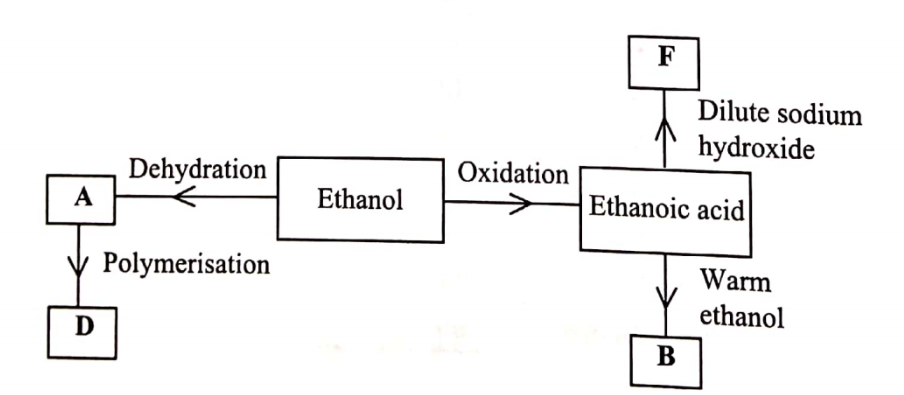
(c) Study the flow chart in Figure 1 and answer the questions that follow.

(i) Identify A. (1 marks)

(ii) State one physical property of B. (1 marks)

(iii) Draw the structure of D. (1 marks)

(iv) Give a reason why D pollutes the environment.(1 marks)

(v) Write an equation for the formation of F.(1 marks)

(d) Describe an experiment which can be used to distinguish butene from butanol. (2 marks)

2. (a) Zinc occurs mainly as zinc blende. Name one other ore from Which zinc can be extracted.(1 marks)

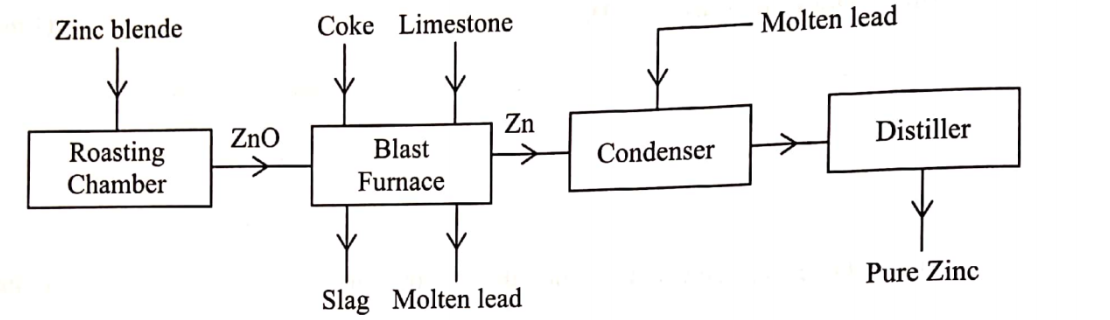
(b) The flow chart in Figure 2 shows the various stages in the extractİoil of zinc metal. Study it and answer the questions that follow.

(i) Write an equation for the reaction which occurs in the roasting chamber. (1 mark)

(ii) Describe the process that takes place in the blast furnace. (3 mark)

(iii) Explain why molten lead is added to the condenser. (1 mark)

(iV) State two uses of zinc.(1 mark)

(v) Give one reason why the extraction of zinc causes pollution to the environment.(1 mark)

(c) Explain the observations made when zinc metal is added to hot sodium hydroxide. (2 marks)

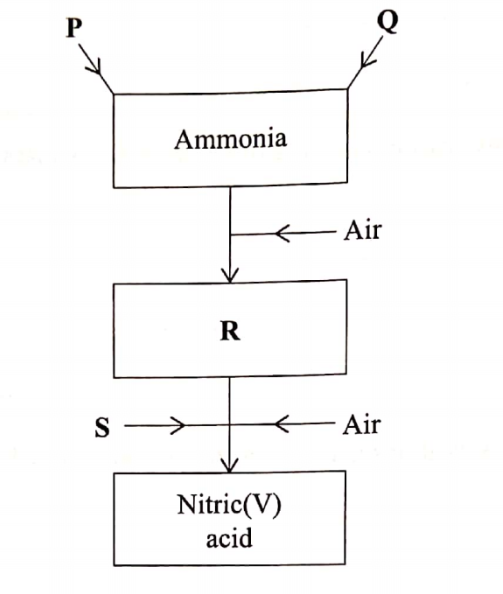
3. Figure 3 is a flow chart that shows the proccss that occurs in the manufacture of nitric(v)acid

(a) Name substance P, Q, R and S. P……………………… (1 marks)

Q………………………… (1 marks)

R…………………………..(1 marks)

S…………………………….(1 marks)

(b) To obtain substance R, ammonia is heated at 900 °C in the presence of air and a catalyst.The product is then cooled in air.

(i) Name the catalyst for the reaction. (1 marks)

(ii) Write the equations for the two reactions described in (b). (2 marks)

(iii) Other than nitric(V) acid, name another product that is formed. (1 mark)

(c) When ammonia is reacted with nitric(V) acid, it produces a nitrogenous fertiliser.

(i) Explain why fertilisers play a major role in food production. (2 marks)

(ii) State two problems associated with the use of nitrogenous fertilisers. (2 marks)

4. (a) Explain the following observations:

(i) The colour of aqueous copper(ii) sulphate fades when a piece of magnesium metal is droppcd into the solution. (2 marks)

(ii) A piece of iron bar is coated with a brown substance when left in the open on a rainy day. (2 marks)

(b) A sample of water is suspected to contain aluminium ions (AI3+) .

Describe a laboratory experiment that can be carried out to show that AI3+ ions are present in the water sample. (3 marks)

(c) In an experiment to determine the number of moles of water of crystallisation of a hydrated compound Na2SO4.XHsO,5g of the compound were heated strongly to a constant mass.

(i) Explain how a constant mass was obtained. (2 marks)

(ii) During the experiment, the mass of the residue was found to be 2.205 g.

Determine the number of moles of water of crystallisation in the compound. (Na = 23.0 ; O = 16.0 ; S = 32.0 ; H = 1.0) (3 marks)

5. (a) What is meant by a molar heat of neutralisation? (1 marks)

(b) In an experiment to determine the molar heat of neutralisation, 50 cm3 of IM hydrochloric acid was neutralised by adding 10 cm3 Onions Of dilute sodium hydroxide.

During the experiment, the data in Table 1 was obtained.

(i) Write the equation for the reaction in this experiment. (1 mark)

(ii) On the grid provided, plot a graph of temperature (Y-axis) against volume of sodium hydroxide (X-axis) added. (3 marks)

(iii) Determine from the graph the:

I. volume of sodium hydroxide which completely neutralises 50 cm3 of lM hydrochloric acid. (1 mark)

11. change in temperature, AT, when complete neutralisation occurred. (1 mark)

(IV) Calculate:

I. The heat change, dH when complete neutralisation occurred. (Specific heat capacity = 4.2 Jg-1 K-1 density of solution 1.0 gcm-3)(2 marks)

(v) How would the value of molar heat differ if 50 cm3 of lM ethanoic acid was used instead of IM hydrochloric acid? Give a reason. (2 marks)

6. (a) What is meant by standard electrode potential of an element (1 mark)

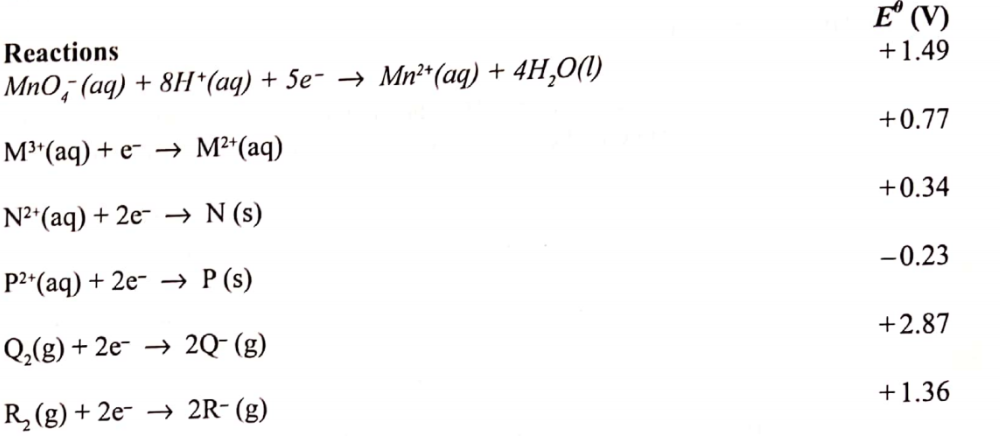
(b) Use the standard electrode potcntials given below to answer the questions that follow.

(i) State whether acidified MnO4 can oxidise M2+. Give a reason. (2 marks)

(ii) Select two half-cells which when combined will give the highest e.m.f. (1 mark)

(iii) Write the cell representation for the cell formed in b (ii). (1 mark)

(iv) Calculate the Eθ value for the cell formed in b (iii). (1 mark)

(c) A mass of 1.24g of a divalent metal was deposited when a current of 6A was passed through a solution of a metal sulphate for 12 minutes.Determine the relative atomic mass of the metal( Faraday = 96,500 C mol -1 (3 mark)

(d) State two application s of electrolysis. (I mark)

7. (a) What is meant by rate of reaction (1 mark)

(b) In the space provided, Sketch the diagram of a set-up that Can be used to determine the rate of reaction between manganese(IV) oxide and hydrogen peroxide. (3 marks)

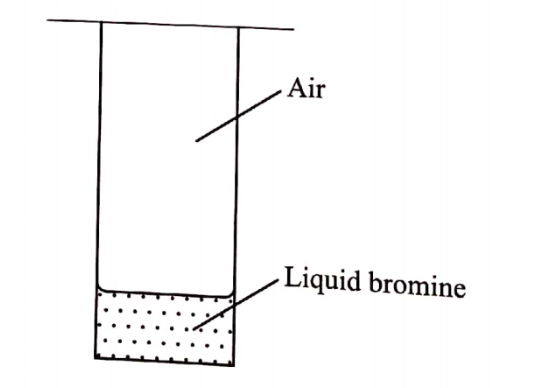
(c) A student placed a small amount of liquid bromine at the bottom of a sealed gas jar of air as shown in Figure 4.

(i) Describe what will be observed: (1 mark)

I. After two minutes………………………….

II. After 30 minutes ……………………..

(ii) Use the Kinetic theory to explain the observations: (2 marks)

I. After two minutes………………………….

II. After 30 minutes ……………………..

(d) Some plants have seeds that contain vegetable oil.

(i) Describe how the oil can be obtained from the seeds. (3 marks)

(ii) Explain how it could be confirmed that the liquid obtained from the seeds is oil. (1 mark)


2020 KCPE Predictions
2020 KCSE Chemistry Prediction Questions
2020 KCSE Leakage
2020 KCSE Predictions
2020 KCSE Time Table
Biology KCSE 2020
Chemistry KCSE 2020
Cre KCSE 2020
English KCSE 2020
Geography KCSE 2020
History KCSE 2020
KCPE 2020 Predictions
KCPE Prediction Questions
KCPE Predictions 2020
KCSE 2020
KCSE 2020 Exam Timetable
KCSE 2020 
KCSE 2020 Biology
KCSE 2020 Prediction

KCSE Past Papers 2019 Chemistry paper 1(233/1)

KCSE Past Papers 2019 Chemistry paper 1(233/1)

Kenya certificate of primary Education

2019 Chemistry paper 1

1. An atom of element A has mass number 39 and 19 protons.

(a) Write the electron arrangements of the atom (1 mark)

(b) State the pcriod and group to which elementt A belongs Group ………………………………….(½ mark)

Period …………………………………..(½ mark)

(c) State whether the element is a metal or a non-metal. (1 mark)

2. Describe how an increase in concentration increases the rate of a reaction. (2 mark)

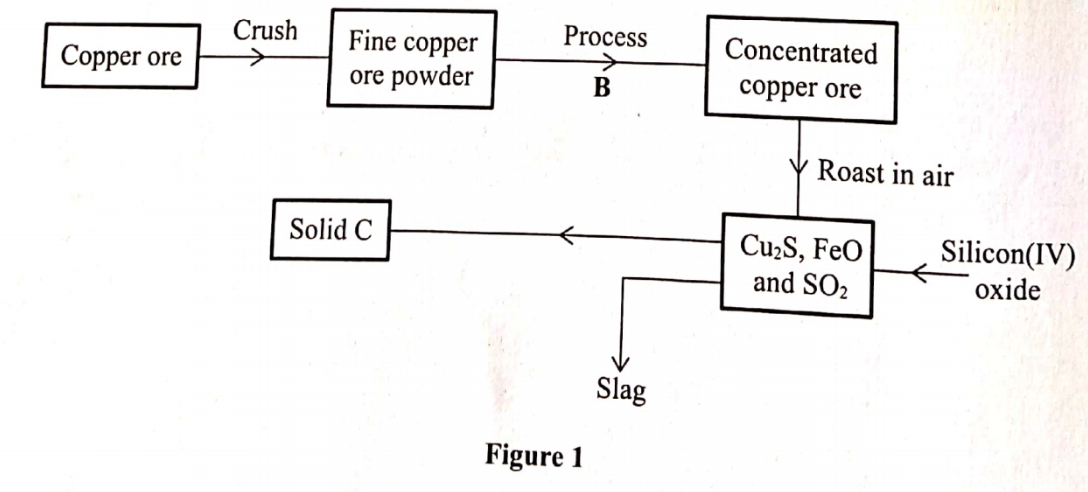
3. The flow chart in Figure 1 represents some stages in the extraction of copper metal. Study it and answer the questions that follow.

(a) Identify :

(i) The copper ore (1 mark)

(ii) Process B (½ mark)

(iii) Solid C (½ mark)

(b) Write an equation for the reaction that forms the slag. (1 mark)

4. A monomer has the following structure.

CH= CH2 ∣ C6H5

(a) Draw the structure of its polymer that contains three monomers.(1 mark)

(b) A sample of the polymer formed from the monomer has a molecular mass of 4992.

Determine the number of monomers that formed the polymer (C= 12; H= 1.0). (2 marks)

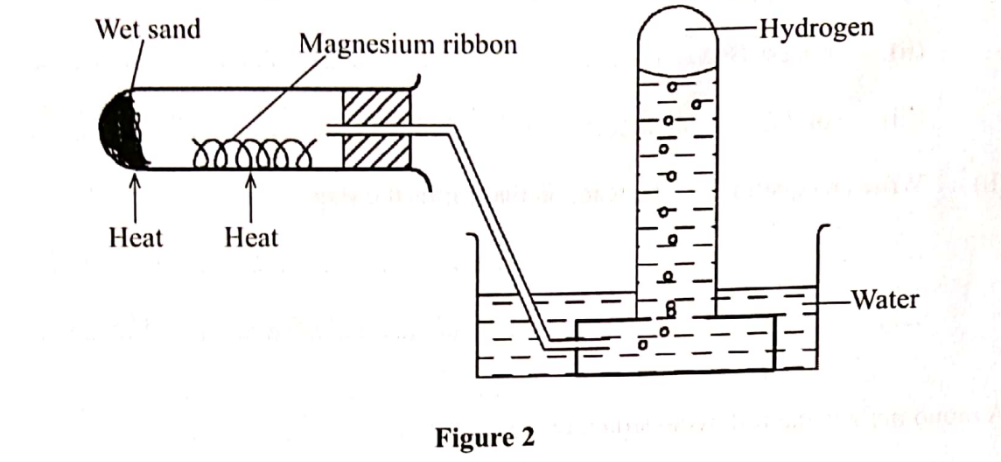
5. Hydrogcn has can be prepared by passing steam over heated magnesium ribbon as shown in the figure 2.

(a) Write an equation for the reaction that produces hydrogen gas. (I mark)

(b) Explain why the delivery tube must be removed from beneath the water before heating is stopped. (1 mark)

(c) Explain why sodium metal is not suitable for this experiment. (I mark)

6. A farmer intended to plant cabbages in his farm. He first tested the pH of the soil and found it to be 3.0.

If cabbages do well in alkaline soils, explain the advice that would be given to the farmer in order to realise a high yield.(2 marks)

7. A solution contains 40.3g of substance XOH per litre .250.0cm3of this solution required 30.0cm3 of 0.3M sulphuric(VI)acid for complete neutralisation. (a) Calculate the number of moles of XOH that reacted. (½ mark)

(b) Determine the relative atomic mass of X. (1½ mark)

8. Table 1 shows the properties of two chlorides, D and E.

Table 1

Chloride Melting Points(°C) Electrical Conductivity
(liquid)
      D            1074          Good
      E              203          Poor

(a) State the type of bond present in:

(i) D…………………..(1 mark)

(ii) E…………………..(1 mark)

(b) Explain in terms of structure and bonding, the difference in electrical activity of the chlorides D and E. (1 mark)

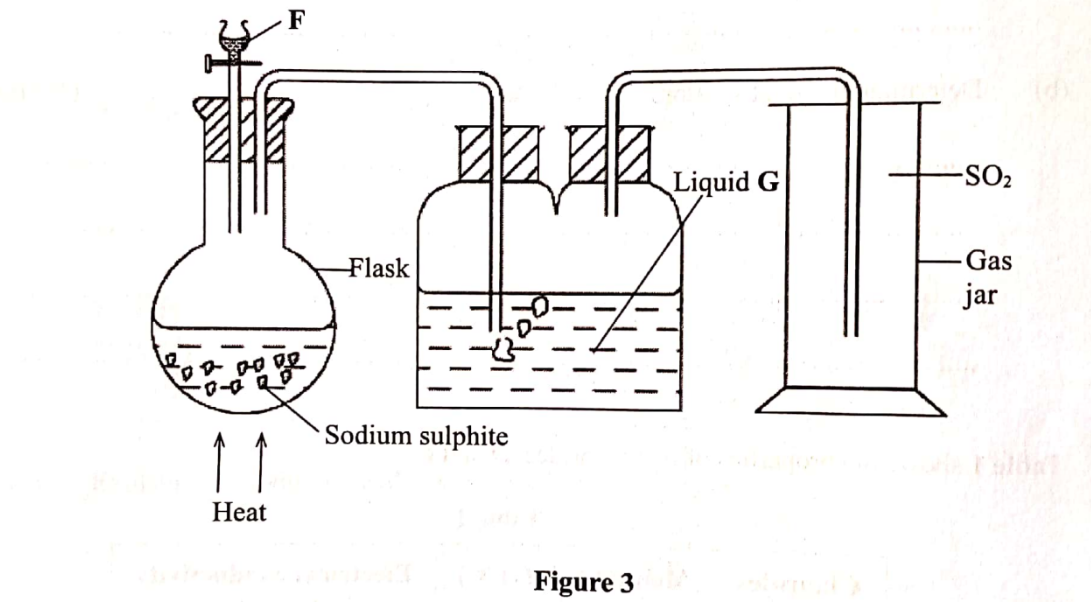
9. Sulphur(IV) oxide is prepared in the laboratory using the set-up in Figure 3.

Study it and answer the questions that follow.

(a) Identify substance F. (1 mark)

(b) Write an equation for the reaction that takes place in the flask. (1 mark)

(c) State the purpose of liquid G. (1 mark)

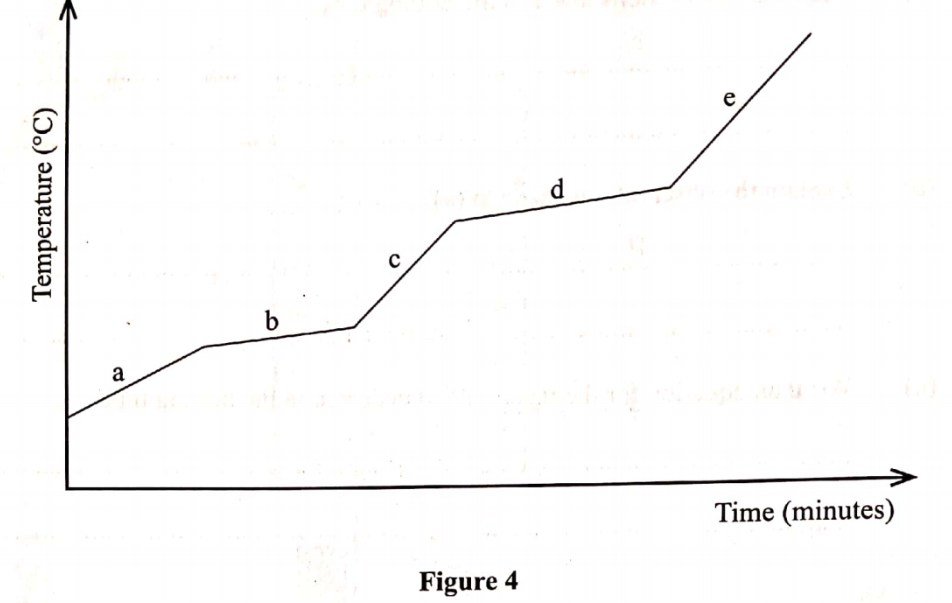
The graph in Figure 4 was obtained when a certain substance was heated and its temperature recorded at regular intervals.

(a) State the purity of the substance. (1 mark)

(b) Explain the answer in (a). (1 mark)

11. Ethene is prepared in the laboratory by dehydration of ethanol.

(a) Name a suitable dehydrating agent used in this process. (1 mark)

(b) State the condition necessary for the reaction to occur. (1 mark)

(C) Write an equation for the dehydration process. (1 mark)

112.A boiling yube filled with chlorine was inverted in a trough containing the same ssolution and the set-up left in sunlight for about 2 hours.

(a) State the observation made in the boiling tube ( 1 mark)

(b) Explain the observation made in (a) (1 mark)

(c) Write an equation for the reaction that occurred in the boiling tube (1 mark)

13. 5 g of calcium carbonate was strongly heated to a constant mass.

Calculate the mass of the solid residue formed (Ca = 40.0; C = 12.0; 0 = 16.0). (2 marks)

14. During laboratory preparation of oxygen, manganese(IV) oxide is added to reagent 11.

(a) Name reagent H. (1 mark)

(b) State the role of manganese(IV) oxide in this experiment. (1 mark)

(c) Write the equation for the reaction that takes place. ( I mark)

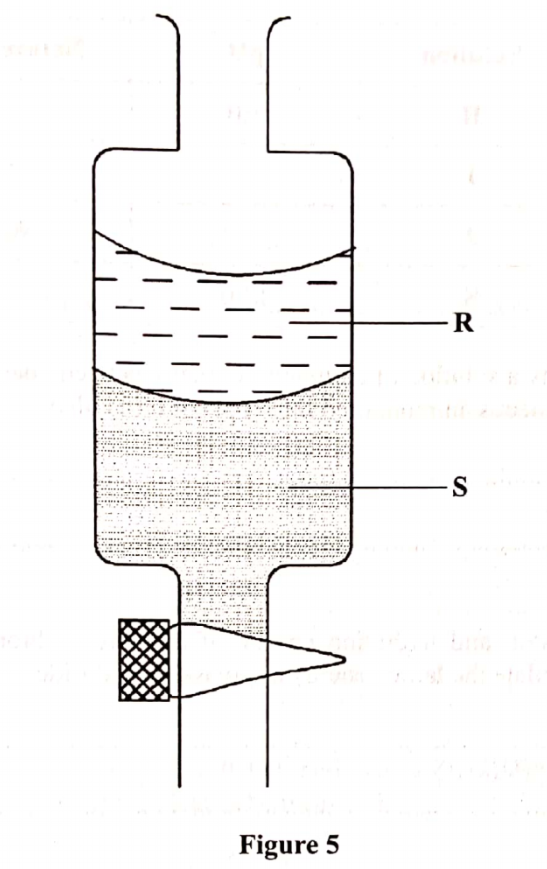
15. Figure 5 shows an apparatus used to seperate a mixture of water and hexene.

(a) Name the apparatus in Figure 5. (1 mark)

(b) State the principle by which the mixture of the two liquids is seperated (1 mark)

(c) Identify the liquids, R and S if the density of hexene is 0.66 g/cm3.

(i) R …………… (½ mark)

(ii) S …………………. (½ mark)

16.(a) Complete the following table.(2 mark)

Solution pH Nature of solution
   H 1.0
   I   Neutral
   J Weak acid
   K                13.0

(b) Explain why a solution of ammonia in methylbenzene has no effects on red litmus paper while in aqueous ammonia red litmus paper turns blue. (1 mark)

17. The heat of solution and hydration energy of potassium chloride is — 17.2 kJ and —689 kJ respectively.

Calculate the lattice energy of potassium chloride. (2 marks)

18. Use the information in Table 2 to answer the questions that follow.

Bond Bond energy(KJ mol(<sub>-1</sub>
C-H                412
  CI-CI               242
C-CI                338
H-C1               431

19. Given that the Eθ of CU(s),CU2+(aq)is + 0.34V and that 0f Zn(s)/Zn2+(aq)is- 0.76V,draw a labelled diagram of zinc and copper electrochemical cell. (3 marks)

20. During labomtory preparation of carbon(IV) oxide g tS. substance L in a conical flask.

(a) Identify substance L. (1 mark)

(b) Write an equation that produces carbon(IV) oxide. (1 mark)

(c) State the observations made when the gas produced WHS bubbled through calcium hydroxide solution for a long time. (1 mark)

21. Study the information in Table 3 and use it to answer the questions that follow. (I mark)

Elements Na Mg Al Si P S Cl
Atomic Numbers 11 12 13 14 15 16 17
Atomic radii(nm) 0.157 0.136 0.125 0.117 0.110 0.104 0.099

(a) Explain the trend in atomic radii from sodium to chlorine. (1 mark)

(b) Explain how the chloride of aluminium differs from those of other metals in the period.(2 marks)

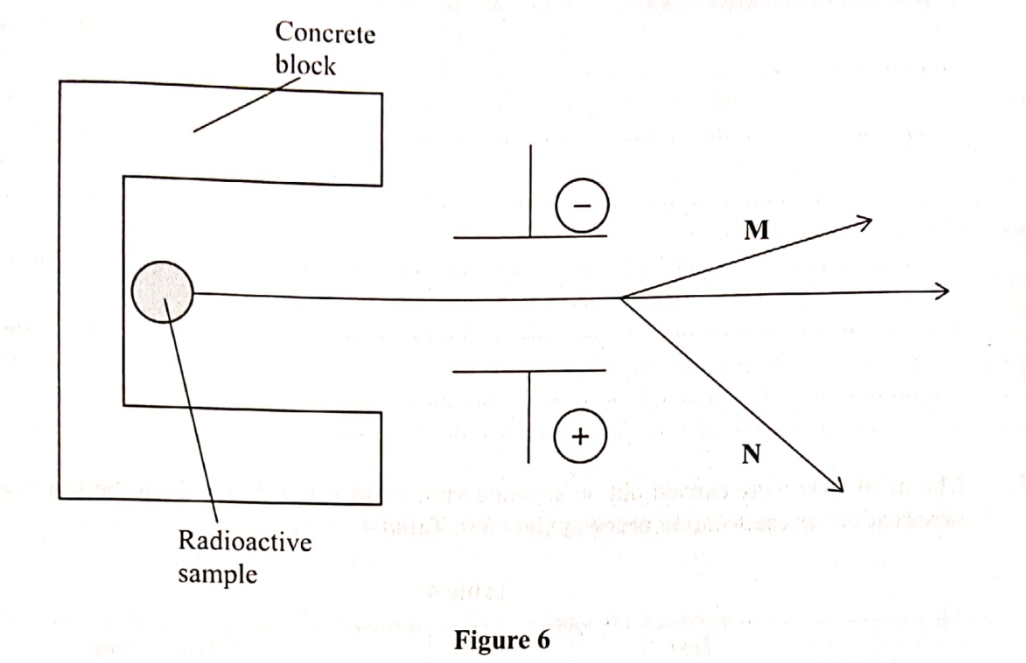
2. The diagram in figure 6 shows radiations emitted by a radioactive sample.

(a) Identify radiations:

(i) M ……………. (1 marks)

(ii) N ……………… (1 marks)

(b) Explain what would happen when a sheet of paper is placed in the path of the two radiations. (1 mark)

16/8 X 18/8 X are isotopes of element X.

They occur naturally in the ratio of 9:1 respectively.

Calculate the relative atomic mass of element X. (2 marks)

24. Starting with copper turnings, describe how a sample of copper (II) Sulphate crystals can be prepared in the laboratory. (2 marks)

25. Chemical tests were carried out on separate samples of water drawn from the same source. The observations made were recorded as shown in Table 4.

        Test Observation
(i) Addition of aqueous calcium chloride No white precipitate
(ii) Addition of dilute sulphuric(VI) acid No effervescence, colourless solution
(iii) Addition of a few drops of acidified
barium nitrate
No white precipitate
(iv) Addition of aqueous ammonia White precipitate dissolves

State the inferences made in reactions:

(i)……………………… (1 mark)

(ii)……………………….. (1 mark)

(iii)…………………………(1 mark)

26. 140cm3of nitrogen gas diffuses through a membranc in 70 seconds. How long will it take 200 cm3of carbon(iv) oxide gas to diffuse through the same membrane under the same conditions of temperature and presurre (3 marks)

27. When burning magnesium ribbon is introduced into a gas jar full of nitrogen, it continues to burn producing a greenish yellow powder.

(a) Write an equation for the reaction between nitrogen and magnesium. (I mark)

(b) Explain why magnesium continues to bum in nitrogen but sulphur does not. (2 marks)

(c) State one use of nitrogen. (I mark)

28. Draw in the space provided a labelled diagram of the set-up of the apparatus that can be used to electrolyse molten lead(II) bromide. (3 marks)

29. Name an appropriate apparatus that is used to prepare standard solutions in the laboratory.( I mark)

2020 KCPE Predictions
2020 KCSE Chemistry Prediction Questions
2020 KCSE Leakage
2020 KCSE Predictions
2020 KCSE Time Table
Biology KCSE 2020
Chemistry KCSE 2020
Cre KCSE 2020
English KCSE 2020
Geography KCSE 2020
History KCSE 2020
KCPE 2020 Predictions
KCPE Prediction Questions
KCPE Predictions 2020
KCSE 2020
KCSE 2020 Exam Timetable
KCSE 2020 
KCSE 2020 Biology
KCSE 2020 Prediction