KCSE Past Papers 2018 Geography paper 2 (312/2)

KCSE Past Papers 2019 Geography paper 1 (312/1)

 KCSE Past Papers 2018 Geography paper 2 (312/2)

Geography – Paper 2 – November 2018 – 2.45 Hours

2018 Geography Paper 2

SECTION A

Answer all the questions in this section.

1. (a) Name two categories of fish.(2 marks)

(b) Identify three methods of fishing that are used for deep sea fishing.(3 marks)

2. (a) Give three tourist attractions found in the lake region of Kenya.(3 marks)

(b) State three reasons why domestic tourism is encouraged in Kenya. (3 marks)

3. (a) Name three places in Kenya where geothermal energy has potential of being harnessed.(3 marks)

(b) State three physical factors that have favoured high Hydro-Electric Power production in Uganda.(3 marks)

4. (a) Give two trading blocs in Africa. (2 marks)

(b) Identify three political problems facing regional trading blocs in Africa. (3 marks)

5. List three environmental hazards that are caused by human activities. (3 marks)

SECTION B

Answer question 6 and any other two questions from this section.

6. Study the data provided below and answer the questions that follow.

Value of export earnings of selected crops from Kenya (Ksh millions)

Crop 2012 2013 2014
Tea 104141 104648 93996
Coffee 22271 16328 19913
Sisal 1184 1020 1325
Total 124896 121996 115234

(a) (i) Using a scale of 1 cm to 50,000 million, draw proportional circles to represent the total export earnings between 2012 and 2014. Use the diameter method. (10 marks)

(ii) Calculate the percentage decline in export value between 2012 and 2013. (2 marks)

(b) (i) What conclusion on value of exports can you make from the proportional circles? (3 marks)

(ii) State four disadvantages of using proportional circles to represent the export values.(4 marks)

(c) Explain how international trade in Kenya can be improved.(6 marks)

7. (a) (i) Define the term mining.(2 marks)

(ii) State four factors that influence the occurrence of minerals.(4 marks)

(b) Describe the open cast method of mining.(5 marks)

(c) The map below shows location of minerals in East Africa. Use it to answer question (e) (i).
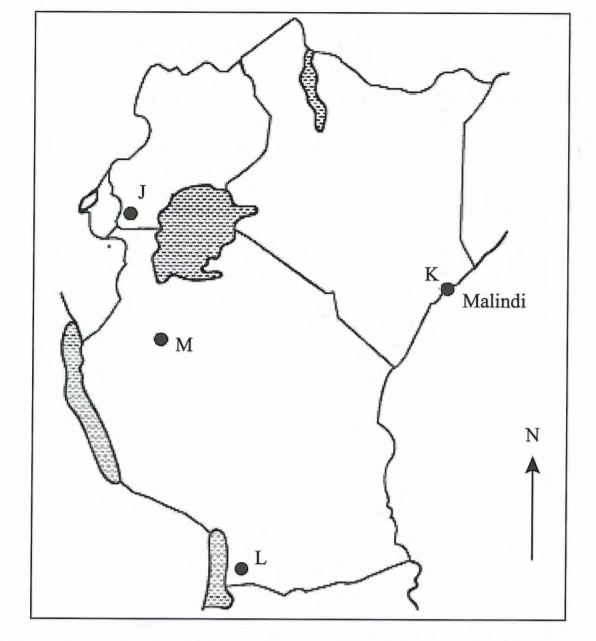
(i) Name the minerals found in areas marked J, K, L and M(4 marks)

(ii) Describe the processing of Trona in lake Magadi.(4 marks)

(d) Explain three ways in which mining promotes industrialisation in Kenya. (6 marks)

8. (a) (i) What is forestry?(2 marks)

(ii) Apart from tropical hardwood forests, name two other types of natural forest.(2 marks)

(iii) State the problems experienced in exploitation of tropical hardwood forests.(5 marks)

(b) List the characteristics of planted forests in Kenya.(5 marks)

(c) Explain three factors that favour forestry in Canada.(6 marks)

(d) Give five measures that the government has taken to conserve and manage forests in Kenya.(5 marks)

9. (a) Explain each of the following methods of land rehabilitation:

(i) Mulching(4 marks)

(ii) Bunds and gabions(6 marks)

(b) Give three ways in which the government is trying to rehabilitate overgrazed lands in Kenya.(3 marks)

(c) (i) Name four types of irrigation practised in Kenya.(4 marks)

(ii) Explain two conditions that favour irrigation farming in Kenya.(4 marks)

(d) Give the characteristics of land reclamation in Kenya.(4 marks)

10. The pyramids below represent the population structure of Kenya and Sweden in the year 2009.

Use them to answer question

POPULATION PYRAMIDS 2009
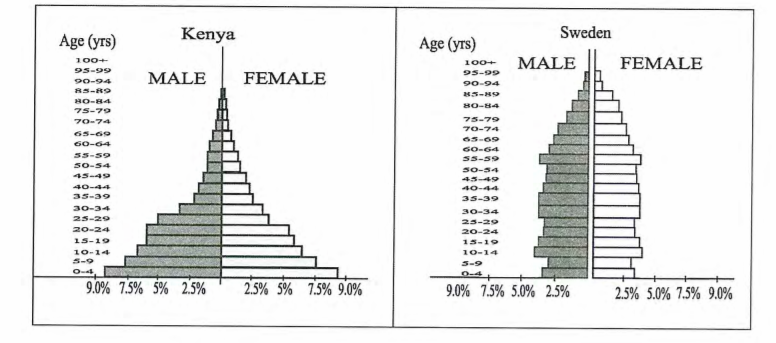
(a) Describe the characteristics of population of the two countries as represented by the pyramids. (6 marks)

(b) (i) What is fertility rate? (2 marks)

(ii) Explain three factors that have contributed to the reduction in fertility rate in Kenya. (3 marks)

(c) State three problems caused by slow population growth rate in developed countries. (3 marks)

(d) Explain four causes of rural-rural migration in Kenya. (8 marks

Questions and Answers

2018 Geography Paper 2

1. (a) Name two categories of fish.(2 marks)


  • Pelagic
  • Demersal Anadromous.
  • Fresh water.
  • Salt water/ marine fish.(b) Identify three methods of fishing that are used for deep sea fishing.(3 marks)
  • Trawling.
  • Long line.
  • Purse seining Drifting.
  • Whaling/harpooning.2. (a) Give three tourist attractions found in the lake region of Kenya.(3 marks)
  • Wildlife in Ruma National Park/lmpala Sanctuary/birds sanctuary at Orango /kakamega forest.
  • Lake Victorial./L.simbi/ox-bow lakes.
  • Culture of the people Kisumu Museum/historical/archaeological sites.
  • Hot sunny weather. Sport fishing.
  • Beautiful scenery/escarpments/ granitic tors/crying stones/rift valleys/hot springs//waterfal1s/beaches.(b) State three reasons why domestic tourism is encouraged in Kenya. (3 marks)
  • For people to appreciate the need to preserve wildlife/culture.
  • To utilize tourist facilities during low tourist season.
  • For the people to appreciate the tourist attraction features.
  • To earn revenue especially during the low tourist season.
  • To create employment opportunities/earn income to the people. For education/ research.
  • To enhance national unity.
  • To provide market for local products.3. (a) Name three places in Kenya where geothermal energy has potential of being harnessed.(3 marks)
  • Mt. Longonot/ Suswa/Homa hills.
  • Lake Bogoria/Baringo.
  • Eburru.
  • Menengai Crater/Mai-Mahiu.
  • Lake Turkana.
  • Lake Magadi.(b) State three physical factors that have favoured high Hydro-Electric Power production in Uganda.(3 marks)
  • Large volume of water from River Nile/ other rivers/L. Victoria.
  • The Owen Falls provided a natural waterfall for power generation. High rainfall/1000mm throughout the year to enable high volume of water.
  • The regular supply of water from rivers/lakes.
  • Presence of hard basement/rocks to form firm foundation.
  • Presence of deep valleys/gorges.
  • Presence of non-porous rocks / impervious prevent leakage of water.4. (a) Give two trading blocs in Africa. (2 marks)
  • Common Market for Eastern and Southern Africa (COMESA).
  • Southern African Development Community (SADC). Economic Community of West African States (ECOWAS).
  • East African Community (EAC).(b) Identify three political problems facing regional trading blocs in Africa. (3 marks)
  • Civil wars/insecurity in some countries.
  • Political differences among leaders.
  • Negative publicity of goods among countries.
  • Inadequate institutional/ policy framework. Ideological differences among countries.
  • Many African countries are still aligned to their former colonial masters.5. List three environmental hazards that are caused by human activities. (3 marks)– Air pollution/Toxic gases/land pollution/noise/sound pollution. floods Fires
  • Oil spills
  • Desertification/drought.
  • Soil erosion LandSlides.
  • Nuclear waste/radiation.
  • Pests.SECTION BAnswer question 6 and any other two questions from this section.

    6. Study the data provided below and answer the questions that follow.

    Value of export earnings of selected crops from Kenya (Ksh millions)

    Crop 2012 2013 2014
    Tea 104141 104648 93996
    Coffee 22271 16328 19913
    Sisal 1184 1020 1325
    Total 124896 121996 115234

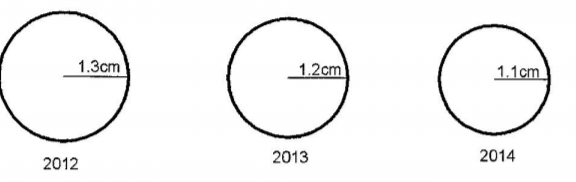
    (a) (i) Using a scale of 1 cm to 50,000 million, draw proportional circles to represent the total export earnings between 2012 and 2014. Use the diameter method. (10 marks)
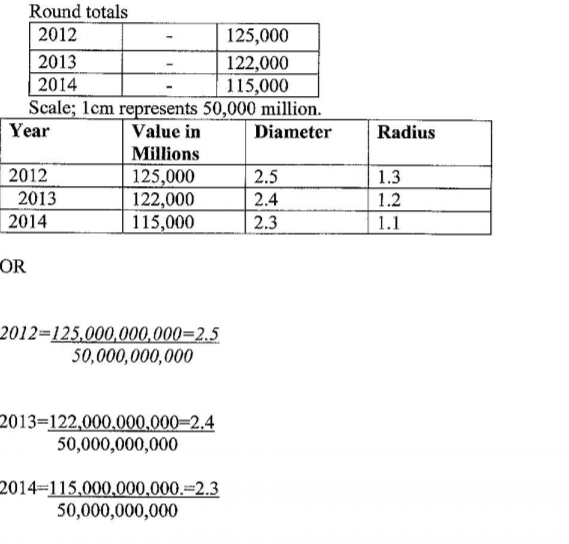
    The proportional circles showing the total export earnings for the period 2012 to 2014. The total export earning for the period 2012 to 2014 . (Proportional circles)
    (ii) Calculate the percentage decline in export value between 2012 and 2013. (2 marks)Difference 124896 —121996 = 2900

    = 2900 x100/124896

    2.3%

    (b) (i) What conclusion on value of exports can you make from the proportional circles? (3 marks)

  • The total export values for the selected crops was highest in 2012.
  • The total export value had a decline for the consecutive years. 2014 Tegistered the lowest export value.
  • Total exports value for the three years has very little significant difference.(ii) State four disadvantages of using proportional circles to represent the export values.(4 marks)
  • It is tedious to construct.
  • It is time consuming.
  • It is difficult to accurately estimate/extract the actual total values from the circles.
  • It is difficult to compare many sets of data.
  • It is difficult to represent extreme values/very high / very low Values.
  • It is difficult to compare values which have a small range. It is difficult to determine the trend of the values.(c) Explain how international trade in Kenya can be improved.(6 marks)
  • Kenya should improve her international transport/communication links for efficient transactions.
  • Kenya is exploring new markets in order to avoid over reliance on European market/ traditional market.
  • Trade agreements signed by Kenya and various countries in Africa and America may increase volume of trade.
  • Kenya is processing some of the agricultural products before export /export processing zone in order to add value hence increase earnings.
  • The setting up of industries in the neighbouring countries by some Kenyan entrepreneurs is likely to increase volume of trade to diversify the county’s exports in order to expand market/minimize competition.
  • Improving the state of security to guarantee state of traders and goods. Intensifying market campaigns internationally to create awareness of the locally produced goods.
  • Reduce cost of production so as to compete favourably in the international market.7. (a) (i) Define the term mining.(2 marks)
  • Mining is the extraction of valuable minerals from the earth crust.(ii) State four factors that influence the occurrence of minerals.(4 marks)
  • Vulcanicity leads to solidification of minerals in cracks and crevices.
  • Metamorphism lead to change into new mineral/formation of minerals.
  • Leaching a weathering process results into concentration of minerals in the crust.
  • Erosion loosens minerals and transports them eventually depositing them as alluvial deposits.
  • Sedimentation deposits, accumulates and concentrates minerals in specific areas making them occur in layers, beds and seams.
  • Evaporation enhances crystallization leading to formation of salts.
  • Weathering exposes minerals near the earth’s surface.(b) Describe the open cast method of mining.(5 marks)– The mineral deposits lie within a few metres from the ground. The unwanted material on the top layer/overburden is removed.

    – Soft mineral deposits are removed by drilling/scooping.

    – Hard minerals are removed by blasting with explosives.

    – The mineral is then scooped by excavator.

    – The mineral is loaded into Lorries /conveyor belt to be transported for processing.

    (c) The map below shows location of minerals in East Africa. Use it to answer question (e) (i).

    (i) Name the minerals found in areas marked J, K, L and M(4 marks)J — Tin

    K — Salt/gypsium/limestone

    L — Coal

    M — Diamond

    (ii) Describe the processing of Trona in lake Magadi.(4 marks)

    The crystals are crushed and mixed with Trona and liquor.

  • A mixture of Trona and liquor is pumped through a pipeline to the soda ash factory. Trona is separated from water by being put on large sieve like trays. The Trona is washed to remove mud and salt.
  • After drying Trona is heated/roasted in big cylinders and it breaks into small particles of sodium carbonate/soda ash. Soda ash is allowed to cool. It is then ground, weighed and packed into paper bags ready for transportation to the market.(d) Explain three ways in which mining promotes industrialisation in Kenya. (6 marks)
  • Some minerals provide essential raw materials for some manufacturing industries.
  • Minerals are exported to earn the country foreign exchange which is used for development of industries.
  • Mining stimulates development of roads/railways which promotes industrial growth/eases movement of raw materials/finished products to industries.
  • Mining attracts settlements leading to development of towns which attract industrial development.
  • Mining creates employment raising the living standards of the people hence, creating a greater demand for industrial products thus promoting industrial
  • Mining has stimulated growth of related industries that supply inputs/services.8. (a) (i) What is forestry?(2 marks)Forestry is the science of developing and cultivating forests and utilizing them.

    (ii) Apart from tropical hardwood forests, name two other types of natural forest.(2 marks)

  • Temperate hardwood.
  • Coniferous forests/temperate softwood.
  • Montane forest.
  • Mangrove forest.
  • Mixed forests(iii) State the problems experienced in exploitation of tropical hardwood forests.(5 marks)
  • Trees take long time to mature
  • Forests are dense/ thick.
  • Trees do not mature at different times making harvesting difficult and expensive.
  • The forest have mixed tree species making exploitation difficult and almost impossible.
  • Tree trunks are huge, supported by buttress roots/presence of tree climbers/lianas hence difficult to exploit.
  • The trees are heavy /bulky making transportation difficult. Impassable roads/some parts of the forests are inaccessible.(b) List the characteristics of planted forests in Kenya.(5 marks)
  • Trees appear in rows.
  • They have same species.
  • There are mainly softwoods.
  • They have little / no undergrowth.
  • They take short time to mature.
  • They appear in blocks.
  • They are mainly located in highland areas.(c) Explain three factors that favour forestry in Canada.(6 marks)
  • The valley bottoms/ Coasts form good sites for location of paper mil1s/ clay from valley bottoms is used for smoothening the paper surface. There are many rivers with waterfalls suitable for generation of hydro- electric power for use in the industries.
  • The low temperatures /cold climate in the highlands discourage settlement/agriculture leaving forestry as the only land use.
  • The landscape is rugged with thin soils that discourage agricultural/settlement activities therefore most of the mountain slopes are under forests.
  • Moderate to high precipitation throughout the year favours luxuriant growth of forests.
  • Presence of rivers which provide cheap water transport to transport logs to factories/presence of snow facilitates easy movement of logs.
  • Thete is ready market of forest products in Canada and USA.
  • Rivers provide water for processing timber.
  • The advanced technology which facilitates exploitation of forests. The advanced scientific research in forest management aids in forest conservation.(d) Give five measures that the government has taken to conserve and manage forests in Kenya.(5 marks)
  • It has enacted /enforced law’s to prohibit the cutting of trees without a licence /protecting indigenous trees.
  • It has established forest research stations to conduct research on tree species. The NGOs/ Green Belt Movement/NEMA/KWS/KFS encourage protection of threatened forests. It encourages people to use alternative sources of energy.
  • The tree planting programmes /campaigns are drawn during rainy seasons and implemented.
  • Forest are protected by establishing forests guards/development of the Nyayo Tea Zones.
  • It encourages people to use energy saving jikos.
  • It has declared endangered forest as forest reserves gazetting forests
  • Farmers are encouraged to practice agro forestry.
  • Farmers are encouraged to practice agroforestry.
  • Encouraging recycling of wood products. Creating awareness on the importance of trees.
  • Establishment of training institutions in forestry.9. (a) Explain each of the following methods of land rehabilitation:(i) Mulching(4 marks)
  • This is the use of crop residues such as vegetable remains, plant litter, and grass and polythene sheets to cover the soil/crop.
  • It helps to retain soil moisture, reduce soil erosion and reduce the splashing effect of rain water on soil.
  • It increases water infiltration in to the soil by preventing it from surface runoff.
  • When the vegetative materials decompose it produces organic matter which increases the fertility of the soil.(ii) Bunds and gabions(6 marks)
  • Bunds are soil piles across a slope constructed to control soil erosion.
  • Bunds are also built to check surface runoff which would cause soil erosion/influence water infiltration.
  • Gabions are wire mesh that are filled with soil, stones and other materials.
  • Gabions are constructed on slopes/across gullies to trap soils being carried by running water down slope.
  • Gabions encourage vegetation growth in the trapped soil.
  • Both are effective for controlling soil erosion/stabilizing slopes(b) Give three ways in which the government is trying to rehabilitate overgrazed lands in Kenya.(3 marks)
  • Livestock extension officers move around advising farmers on the importance of keeping livestock according to the carrying capacity of the land.
  • Introducing exotic breeds /cross breeds to emphasize quality and not quantity.
  • It has established / encouraged establishment of ranches in the livestock keeping regions to improve quality of animals.
  • It has encouraged farmers to grow fodder /introduced nourishing grass which is drought resistant.(c) (i) Name four types of irrigation practised in Kenya.(4 marks)
  • Livestock extension officers move around advising farmers on the importance of keeping
  • livestock according to the carrying capacity of the land.
  • Introducing exotic breeds /cross breeds to emphasize quality and not quantity.
  • It has established / encouraged establishment of ranches in the livestock keeping regions to improve quality of animals.
  • It has encouraged farmers to grow fodder /introduced nourishing grass which is drought resistant.(ii) Explain two conditions that favour irrigation farming in Kenya.(4 marks)
  • Gently sloping land which permits flow of water by gravity hence reducing pumping of water to the fields
  • Presence of clay soils/black cotton soils which retain water for longer use by crops.
  • Presence of rivers /reservoirs/lakes which provide regular water supply making it possible to irrigate land throughout the year. High temperatures throughout the year which allows multiple cropping/continuous farming activities throughout the year.
  • Availability of market which stimulates production.
  • Efficient transport systems easing movement of goods and inputs.
  • Low rainfall making irrigation necessary.
  • Government policy to develop irrigation projects enhances production.(d) Give the characteristics of land reclamation in Kenya.(4 marks)
  • Simple methods of reclaiming land are used like digging canals/ditches to drain water.
  • Land is reclaimed mainly from swamps/marginal lands.
  • Irrigation is used where there is low rainfa11/in arid areas.
  • Drought resistant crops are planted.
  • There is high evaporation of irrigation water due to high temperatures.
  • Trees are planted10. The pyramids below represent the population structure of Kenya and Sweden in the year 2009.Use them to answer question

    POPULATION PYRAMIDS 2009

    (a) Describe the characteristics of population of the two countries as represented by the pyramids. (6 marks)

  • In both Kenya and Sweden the number of male and female is almost equal at all ages.
  • In Kenya the aging population is low/there is low life expectancy. In Sweden the aging population is high/the life expectancy is high.
  • In Kenya the dependency ratio is high. In Sweden the dependency ratio is low.
  • In Kenya, the number of infants from age 0 to 4 years is high. In Sweden the numbers of infants from age 0-4 years is low.
  • In Kenya the working population is low. In Sweden the working population is moderate/high.
  • In Kenya, the number of youthful population is high .In Sweden the number of youthful population is low.
  • In Kenya birth rate is high. In Sweden the birth rate is low.
  • In Kenya the death rate ls high. In Sweden the birth rate is low.
  • The fertility rate is high in Kenya .In Sweden the fertility rate ls low.(b) (i) What is fertility rate? (2 marks)
  • Fertility rate is the number of live births in a given population in a year /the number of live births per thousand women of child bearing age in a given year.(ii) Explain three factors that have contributed to the reduction in fertility rate in Kenya. (3 marks)
  • The cost of bringing up children has gone up therefore parents limit the number of children they can have.
  • Increased use of birth control methods has lowered the number of children women get in their life time.
  • More girls are attending school/ are pursuing higher education and training. This makes them stay longer before getting married.
  • Modem career opportunities have a limiting influence on a woman’s fertility rate. Some employers do not want to employ women who keep going on maternity leave.
  • There is an increase in the number of women opting to remain single, thus reducing the number of children.
  • Urbanization has influenced people to have small families.(c) State three problems caused by slow population growth rate in developed countries. (3 marks)
  • The social amenities are underutilized/high cost of maintaining social amenities.
  • There is inadequate labour supply/manpower.
  • The dependency ratio is high in old age.
  • There is reduction in revenue collection.
  • There is underutilizatlon/under exploitation n of resources.
  • There is inadequate local market for the locally produced goods/ decline of industries.
  • The high cost of transport/services.
  • Limited investment.(d) Explain four causes of rural-rural migration in Kenya. (8 marks)
  • Explain four causes of rural — rural migration in Kenya.
  • People move one rural area to another in search of employment.
  • Insecurity in some rural areas make people move to safer places.
  • Pressure on land makes people buy /look for land elsewhere and settle.
  • Setting up of government development projects may cause displacement of people who are
  • settled elsewhere /government projects may attract settlement in those areas.
  • Pastoral communities migrate from one rural area to another in search of pasture/water for their livestock.
  • Changes in land tenure system/inheritance/land disputes cause people to move and settle elsewhere.
  • Natural calamities make people to move to safer places.
  • Transfer of services from one rural area to another/retirement/retrenchment.
 

KCSE Past Papers 2018 Geography paper 1 (312/1)

KCSE Past Papers 2019 Geography paper 1 (312/1)

KCSE Past Papers 2018 Geography paper 1 (312/1)

Geography – Paper 1 – November 2018 – 2.45 Hours

Kenya certificate of primary Education

2018 Geography Paper 1

SECTION A

Answer all the questions in this section.

1. (a) Define the term atmosphere.(2 marks)

(b) State the composition of the inner core.(3 marks)

2. (a) Name three types of folds.(3 marks)

(b) State three factors that determine the folding of crustal rocks.(3 marks)

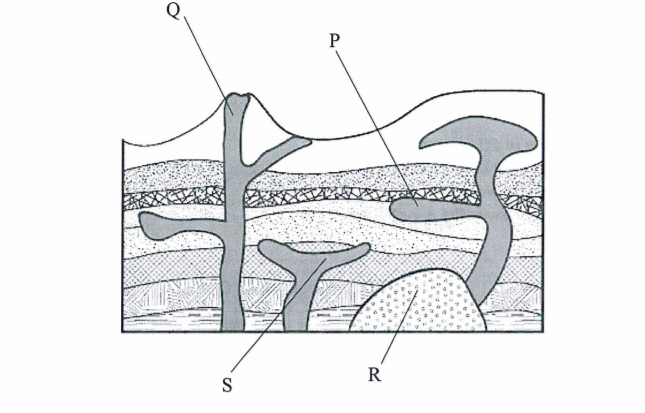
3. The diagram below represents some volcanic features. Use it to answer the questions below.

Name the features marked P, Q, R and S.

4. (a) Identify the main characteristics of the ocean water.(2 marks)

(b) Give three factors that influence wave deposition.(3 marks)

5. (a) List the three types of dunes. (3 marks)

(b) Identify two processes through which wind transports materials in arid areas. (2 marks)

SECTION B

Answer question 6 and any other two questions from this section.

6. Study the map of Taita Hills 1:50,000 (sheet 189/4) provided and answer the following questions.

(a) (i) Give the four figure grid reference of the trigonometrical station (2208m). (1 mark)

(ii) What is the general direction of the flow of River Voi (Goshi)? (1 mark)

(b) (i) Measure the length of the road labelled A23. Give your answer in kilometres. (2 marks)

(ii) Citing evidence from the map, identify three social services offered in the area covered by the map. (6 marks)

(c) Describe the relief of the area covered by the map. (7 marks)

(d) Citing evidence front the map, explain four factors that may have influenced agricultural activities in the area. (8 marks)

7. (a) (i) What is a rock? (2 marks)

(ii) Give Evo examples of plutonic igneous rocks. (2 marks)

(b) Describe the processes of formation of each of the following types of sedimentary rocks:

(i) Mechanically formed.(4 marks)

(ii) Organically formed.(4 marks)

(c) State the characteristics of rocks.(5 marks)

(d) You are planning to carry out a field study on rocks within the local environment.

(i) List three methods you would use to record data.(3 marks)

(ii) State three problems you are likely to encounter.(3 marks)

(iii) Give Evo economic uses of rocks you are likely to identify.(2 marks)

8. (a) (i) Identify the two types of earthquake waves.(2 marks)

(ii) Describe the two ways through which the strength of an earthquake is measured.(2 marks)

(b) (i) Explain how vulcanicity causes earthquakes.(6 marks)

(ii) Name three major earthquake zones of the world.(3 marks)

(c) Explain four effects of earthquakes on the human environment.(8 marks)

9. (a) Name two types of landslides.(2 marks)

(b) Explain how each of the following factors influence mass wasting:

(i) Climate(6 marks)

(ii) Slope(2 marks)

(c) (i) State four causes of soil creep.(4 marks)

(ii) Using a diagram, describe the process of solifluction.(5 marks)

(d) You intend to carry out a field study on the effects of mass wasting within the local environment.

(i) Give two methods of data collection that you would use for the study. (2 marks)

(ii) State two negative effects of mass wasting on the physical environment that you are likely to identify. (2 marks)

(iii) Give two follow-up activities you would be involved in after the field study. (2 marks)

10. (a) (i) Name the three types of river erosion.(3 marks)

(ii) Describe each of the following processes of river erosion:

I. Abrasion(4 marks)

II. Solution(3 marks)

(c) Describe the characteristics of the upper stage of a river.(6 marks)

(d) (i) What is river rejuvenation?(2 marks)

(ii) Give four causes of river rejuvenation.(4 marks)

(iii) Identify three features that result from river rejuvenation.(3 marks)

Questions and Answers

2018 Geography Paper 1

1. (a) Define the term atmosphere.(2 marks)

This is the layer of gases and vapour which surrounds the earth.

(b) State the composition of the inner core.(3 marks)

– It is composed of iron and nickel.

– It has very high temperalvre/ about 5000°C to 6000°C,

– The average density is 13-17gm/cc./very high density

– It is solid in nature.

2. (a) Name three types of folds.(3 marks)


  • Simple / symmetrical fold.
  • Asymmetrical fold.
  • Over fold. Recumbent fold.
  • Nappe fold./overthrust
  • Isoclinal fold. <li(b) State three factors that determine the folding of crustal rocks.(3 marks)</li
  • Crustal rocks should be in layers/sedimentary.
  • The rocks should be young in order to bend.
  • The forces operating on the crustal rocks should be compresslOnal.
  • The amount of pressure applied should be high.3. The diagram below represents some volcanic features. Use it to answer the questions below.

    Name the features marked P, Q, R and S.— Sill (1 mark) Q — Vent

    R — Batholith

    S— Lopolith

    4. (a) Identify the main characteristics of the ocean water.(2 marks)

  • Ocean water is saline/salty.
  • The temperature of ocean water varies horizontally and vertically. Varies in density
  • It is in constant movement(b) Give three factors that influence wave deposition.(3 marks)
  • The depth of the water should be shallow along the coast Configuration of the coastline/change in the alignment of coastline.
  • The shore should have a gentle gradient.
  • The breaking waves should have strong swash and a weak backwash./constructive wa es.
  • Ample materials to be deposits5. (a) List the three types of dunes. (3 marks)
  • Barchans
  • Seif dunes/longitudinal/linear Transverse/wave dunes.
  • Star dunes Draas(b) Identify two processes through which wind transports materials in arid areas. (2 marks)
  • Suspension Saltation
  • Surface creep/traction.SECTION B

    Answer question 6 and any other two questions from this section.

    6. Study the map of Taita Hills 1:50,000 (sheet 189/4) provided and answer the following questions.

    (a) (i) Give the four figure grid reference of the trigonometrical station (2208m). (1 mark)

    (2208m)

    2122

    (ii) What is the general direction of the flow of River Voi (Goshi)? (1 mark)

    Eastwards/south eastwards

    (b) (i) Measure the length of the road labelled A23. Give your answer in kilometres. (2 marks)

    14.6km (+ 0.1)

    (ii) Citing evidence from the map, identify three social services offered in the area covered by the map. (6 marks)

  • Social service
  • Evidence
  • Health services
  • Dlspensary/Health centre.
  • Religious services
  • Church/Mosques. Educational services – polytechnics/schools.
  • Administration services
  • chiefs/DC’s. Office.
  • Rehabilitation services -Rehabilitation center/prison.
  • Security
  • police post. Water supply
  • pump house(c) Describe the relief of the area covered by the map. (7 marks)
  • The land slopes from West to East.
  • The western part is a highland while the eastern is a lowland.
  • There are many hills in the area covered by the map. Example Mgange Hills/Mragua Hills.
  • The area has several river valleys.
  • The Eastern part of the area is generally gently sloping. The highest point is 2208 metres.
  • The lowest point is 620 metres. There is rugged landscape in the Western part/there are many ridges.
  • There are bluffs/cliffs.
  • The North Western part of the Map has steep slopes.
  • There are outcrop rocks.
  • There are many Cols.(d) Citing evidence front the map, explain four factors that may have influenced agricultural activities in the area. (8 marks)
  • Presence of road network to provide transport facilities.
  • The South Eastern part receives low rainfall as evidenced by scrub vegetation suitable for sisal growth.
  • There is availability of labour due to dense settlement at on the Western part around Mgange, Mragua and ,Mwangea
  • The Eastern part is sparsely settled/ widely spaced contours hence mechanization.
  • The Western part receives hi% rainfall as evidenced by forests and permanent rivers which has lnfluenced farming.
  • Availability of vertinary services evidenced by cattle dips favour livestock farming.
  • Availability of advisory services evidenced by farmers training center favour farming in the area.7. (a) (i) What is a rock? (2 marks)

    A rock is a naturally occurring aggregate of mineral particles forming part of the earth’s crust

    (ii) Give two examples of plutonic igneous rocks. (2 marks)

  • Granite Diorite Peridotite Gabbro
  • Syenite.
  • Nepheline
  • Diabase.(b) Describe the processes of formation of each of the following types of sedimentary rocks:

    (i) Mechanically formed.(4 marks)

  • Sediments used to form the rocks are derived from weathering of existing rocks.
  • The weathered materials are transported by wind/ice/water.
  • The weathered materials are deposited in layers on land or sea.
  • They are then compacted, and cemented into sedimentary rocks.(ii) Organically formed.(4 marks)
  • These rocks are formed from remains of dead plants and animals./fossiIs
  • These remains accumulate in the oceans/basins/land, in layers.
  • The materials are deposited in layers/strata.
  • The accumulated materials are compressed, compacted and cemented into sedimentary rocks.(c) State the characteristics of rocks.(5 marks)
  • Some rocks have joints.
  • Rocks have varied degree of hardness.
  • Rocks have cleavage.
  • Rocks have varied texture. Rocks have different colours Some rocks have lustre
  • Rocks have varied specific density.
  • Rocks have streak.
  • Rocks have difrerent minerals.
  • Rocks have varied mineral structures.(d) You are planning to carry out a field study on rocks within the local environment.

    (i) List three methods you would use to record data.(3 marks)

  • Photographing/video recording.
  • Labelling samples.
  • Note taking/recording observations.
  • Filling in questionnaires.
  • Drawing diagrams/sketches.
  • Tape recording.(ii) State three problems you are likely to encounter.(3 marks)

    Accidents may occur.

  • Inaccessibility of some areas with rocks.
  • Fatigue due to difficult terrain.
  • Unfavourable weather conditions that is heavy rains, high temperatures.
  • Attack by wild animals/snake bites.
  • Difficulty identifying some roks.
  • Difficulty breaking some rocks(iii) Give two economic uses of rocks you are likely to identify.(2 marks)
  • Some rocks are used for construction.
  • Some rocks are a Source of fossil fuel.
  • Some are used for making carvings.
  • Some are sources of valuable minerals. Some are tourist’s attractions.
  • Some rocks store underground water/for irrigation.
  • Rocks weather to form soils for agriculture.
  • Some rocks for example limestone is a raw materiaI/ cement manufacture.8. (a) (i) Identify the two types of earthquake waves.(2 marks)
  • Body waves/primary/secondary.
  • Surface waves/love/Rayleigh.(ii) Describe the two ways through which the strength of an earthquake is measured.(2 marks)
  • The strength of an earthquake is measured by its intensity.
  • Intensity measures how strong and hard the earthquake shakes the ground.
  • It is measured on Mercalli scale.
  • The strength of an earthquake ls measured by its magnitude.
  • It is measured on Richter scale correct method.(b) (i) Explain how vulcanicity causes earthquakes.(6 marks)
  • Sudden displacement of crustal rocks during vulcanicity causes tremors.
  • Violent volcanic eruptions/violent emissions of the volcanic gases can shake/shatter the rocks/tremors.
  • After volcanic eruption, a large void is created below the crust which causes the crustal rocks to sink due to gravity this causes the earth’s surface to shake.
  • Magma movement within the crust can cause tremors.
  • A sudden eruption of molten magma under the oceans can cause earth tremors as the water on the sea floor violently expands.(ii) Name three major earthquake zones of the world.(3 marks)
  • The Great Rift Valley belt.
  • The Mediterranean — Himalayan belt.
  • The circum- Pacific belt. /ring of fire.
  • Mid-Atlantic Ocean belt.(c) Explain four effects of earthquakes on the human environment.(8 marks)
  • Earthquakes lead to shaking/crumbllng of buildings leading to their destruction.
  • Earthquakes may lead to the falling of objects which may lead to loss of life.
  • Earthquakes may damage transport networks making movement difficult.
  • It may lead to destruction of electric lines/pipelines resulting to blackouts/fte incidences.
  • A large-scale sea wave caused by an undersea earthquake/Tsunami may flood the coastal lowlands leading to destruction of agricultural land.
  • Disturbances caused by earthquakes lead to landslides which crush and bury people/property.
  • Earthquakes may lead to collapsing of underground mines which may lead to burying of miners.
  • Earthquakes cause panic/anxiety/emotional shock.
  • Destruction of property leads to evacuation/displacement of people.
  • Strong earthquakes cause damage to nuclear plants/sewerage
  • systems which pollute the human environment.9. (a) Name two types of landslides.(2 marks)
  • Slump Debris slide
  • Rock slide
  • Debris fall
  • Avalanche
  • Rock fall.(b) Explain how each of the following factors influence mass wasting:

    (i) Climate(6 marks)

  • Areas that receive high rainfall experience massive landslides on steep s1opes/ areas that receive low rainfall have slow movement of rock materials down the slope.
  • In areas with large diurnal range of temperature there is expansion and contraction of soil particles which leads to movement of the soil particles.
  • Alternate freezing and thawing encourage mass movement of rock and soil materials.(ii) Slope(2 marks)
  • Steep slopes encourage faster movement of material down the slope. / Gentle slopes have slow movement of materials down the slope.(c) (i) State four causes of soil creep.(4 marks)
  • Ploughing on a slope loosening the soil particles.
  • Wetting and drying of soil particles.
  • External forces such as earthquakes/ explosives/eruptions/heavy vehicles movements.
  • Frost heaving beneath the soil.
  • Alternate heating and cooling of the soil particles.
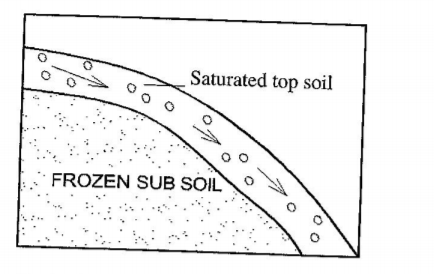
  • Undercutting of the base of the slope through road construction/mining.(ii) Using a diagram, describe the process of solifluction.(5 marks)

    In moderately/gentle sloping areas during winter water in the soil freezes thus freezing the soil.When the weather becomes warm the top soil thaws.

    Overtime the top soil becomes saturated with water while the sub- soil remains frozen (permafrost). The saturated mass of top soil creeps over the frozen ground (permafrost).

    (d) You intend to carry out a field study on the effects of mass wasting within the local environment.

    (i) Give two methods of data collection that you would use for the study. (2 marks)

    Give two methods of data collection that you would use for the study.

  • Observing.
  • Administering questionnaires.
  • Photographing/video recording.
  • Reading from secondary sources/viewin films/video clips.(ii) State two negative effects of mass wasting on the physical environment that you are likely to identify. (2 marks)
  • Destruction of vegetation.
  • Dereliction of land /scars
  • Blockage of rivers.
  • Exposure of land to soil erosion.(iii) Give two follow-up activities you would be involved in after the field study. (2 marks)
  • Data analysis/discussion about findings.
  • Report writing.
  • Data presentation.
  • Consulting geography teachers.
  • Display photographs taken.
  • Drawing conclusions.
  • Reading more on the topic.10. (a) (i) Name the three types of river erosion.(3 marks)
  • Head ward erosion /spring sapping.
  • Vertical erosion.
  • Lateral erosion(ii) Describe each of the following processes of river erosion:

    I. Abrasion(4 marks)

    The river transports the materials downstream.

  • The materials are used by the river as tools for scouring,
  • The load is hurled by the water against the banks and dragged along the river bed.
  • The load chips off the rocks on the bank and river bed. The load being dragged smoothens the river bed.
  • The eddy currents rotate the load in the hollows on the river bed grinding the rocks widening into potholes.II. Solution(3 marks)
  • River water contains both organic and weak inorganic acids. It reacts with some minerals in some rocks in the river bed to form soluble minerals.
  • The soluble minerals are carried downstream in solution form.OR
  • River water flows over rocks with soluble minerals.
  • The water dissolves soluble minerals to a solution.
  • The minerals are carried away in solution.(c) Describe the characteristics of the upper stage of a river.(6 marks)
  • The gradient is steep.
  • The river has a small load. The flow of the river is fast. Vertical erosion is dominant.
  • The cross profile of the valley is v-shaped. It has interlocking spurs.
  • The river valley is deep.
  • The river channel is narrow.
  • Some parts of the river course have rapids/waterfalls/cataracts.
  • The river volume is low.
  • The river channel is winding(d) (i) What is river rejuvenation?(2 marks)

    This is the renewal of a rivers erosive ability/activity/power.

    (ii) Give four causes of river rejuvenation.(4 marks)

  • Increase in river discharge.
  • Change in rock resistance.
  • Unequal regional subsidence.
  • Regional/local uplift of the land. Fall in sea level/drop in sea level.(iii) Identify three features that result from river rejuvenation.(3 marks)
  • Knick points.
  • Rejuvenation terraces/paired terraces.
  • Incised meanders/in grown/entrenched meanders.
  • Rejuvenation gorges/valley within a valley.


KCSE Past Papers 2018 English Paper 3 (101/3)

KCSE Past Papers 2019 English Paper 3 (101/3)

KCSE Past Papers 2018 English Paper 3 (101/3)

(Comprehension, Literary Appreciation and Grammar) Nov. 2018 – 2 hours

Kenya Certificate of Secondary Education

2018 English Paper 3

Answer three questions only.

1. Imaginative Composition (Compulsory)(20 marks)

Either

(a) Write a composition beginning:

1 wondered why the principal had summoned me.

Or

(b) Describe the estate or village you live in.

2. Compulsory Set Text(20 marks)

Bertolt Brecht, The Caucasian Chalk Circle

With illustrations from Bertolt Brecht’s the Caucasian Chalk Circle, write a composition entitled:Self Centredness Does not Pay.

3. The Optional Set Texts(20 marks)

Answer any one of lhe following lhree questions.

Either

(a) The Short Story (20 marks)

Chris Wanjala (Ed.), Memories We Lost

Drawing examples from Barry McKinley’s short story“Almost Home”, write a composition on the topic: “Some people keep making one bad decision after another.”

Or

Q) Drama

Francis Imbuga, Betrayal in the Cry›

(c)John Steinbeck, The Pearl With illustrations from John Steinbeck’s The Pearl, write an essay showing the evil nature

KCSE Past Papers 2018 English Paper 2 (101/2)

KCSE Past Papers 2019 English Paper 2 (101/2)

KCSE Past Papers 2018 English Paper 2 (101/2)

(Comprehension, Literary Appreciation and Grammar) Nov. 2018 – 2 hours

eet the Discipline of Nature every time they try to do something.

This is why it is so important in school to give students more chances to do things, instead of just reading or listening to someone talk.

This discipline is a good teacher.

The learner never has to wait long for the answer, it usually comes quickly, often instantly.

The answer is often clear, and it points towards the needed correction. This way, the learner does not only see that what was done is wrong, but also why, and what they need to do instead.

Finally, and most importantly, the giver of the answer, call her ‘Nature’ is impersonal, impartial and indifferent. She does not give opinions or make judgement. With Nature, one always gets an opportunity to start afresh, this time with the intention of doing things ri8ht.

The next type of discipline is the Discipline of Culture.

Man is a social and cultural animal.

Everyone, thus, senses around them this discipline, this network of agreements, customs, habits and rules binding the society together.

People always seek to understand the society and be part of it.

They watch very carefully what other people around them are doing and wish to do the same.

These unwritten rules regarding how to act in specific situations are called social norms.

Social norms help delineate what is acceptable behaviour. For example, it is not acceptable to be loud and boisterous in a place of worship.

The third discipline is the one most people refer to when they speak of discipline — the Discipline of Superior Force. lt is the discipline of“YOU do what I tell you or I’ll make you wish you had.” There is bound to be some of this in a person’s life.

Living as we do surrounded by things that can hurt us and our friends, we cannot avoid the Discipline of Superior Force.

For example, no one can let a child find out from experience the dan8er of playing with fire. So along with other precaufions, the child is told not to play with fire or they will be punished.

There are situations where all the three disciplines overlap. We often Year people say that students will never do anything unless they are compelled to. But in their private lives, or in co-curricular activities in school, they ofien submit themselves, willingly and wholeheartedly to very intense disciplines simply because they want to learn to do a given thing well. So, discipline, does not only stem from authority figures such as parents and teachers but it also comes from a person’s willingness to do right.

Adapted fiom Connelly Mark’s The BriefSundance Reader. TboxSon Heinle, 2003

(a) What are we told about the Discipline of Nature in the first paragraph?

(b) Identify and explain the use of personification in paragraph two. (2 marks)

(c) Why do you think the Discipline of Nature is said to be a good teacher? (4 marks)

(d) “You do what I tell you or I’ll make you wish you had.” What does this statement imply?(2 marks)

(e) “So, discipline does not only stem from authority figures such as parents and teachers but it also comes from a person’s willingness to do right”.

(Rewrite beginning: Not only…) (1 mark)

(f) In about 60 words, summarise what we are told about the Discipline of Culture. (6 marks) Rough copy

(g) Explain the meanlng of the following words as used in the passage. (3 marks)

(i) Boisterous

(ii) Precautions …………. .

2. Margai et Ogola, The River and the Source

Read the excerpt below and then answer the questions that follows

“Now Nyabera, I don’t believe a daughter of mine could sound so foolish. Of course they are human, that is why they are called white people, not whlte animals. And trust is something to give to people who have earned it and therefore you have to give them a chance to do so.

I would not trusi your uncle Otieno although he is as black as the bottom of the pot I boil maize and beans in. Finally, you’d better know that 1 aim to get some help from them against Otieno. The future of your nephew Owuor is in their hands so start praying.”

“Oh, mother! Please don’t go! What if something happened to you? I am afraid, mother, I am so afraid! And how can you leave Odor alone considering the kind of irresponsible mother he has? Oh, mother, I feel like this family is cursed. What lf something happened to him, to you?

Nyabera waited, her tears running in full force. Akoko stood up to her full height which barely reached her daughter’s shoulders. Her eyes were blazing fit to send sparks to set the thatched roof ablaze.

“Nyabcra, you are not the woman 1 brought you up to be. I know you have suffered, but suffering is the lot of many.

To suffer is not a curse unless you have earned it and I have never done anything to earn a curse. Both the evil and the good suffer.

How you come through suffering is what will make or break you.

Please think, my daughter.

At least you can have children and you have a good husband. One day Were will give you a child that lives; I am sure of it after what you have just told me.

But to have a child is one thing, to bring it up to be a human fit to live with others is something else altogether — and the way you are going I doubt if you will be fit to be a mother when the baby comes. You may be just like Alando your sister-in-law.

You have known me all your life.

How could you ever imagine that 1 could leave my grandson at the Mercy of your uncle? I’ve taken him to Yimbo to live in the house of Oloo, my brother. Are you happy now?” “Oh mother! Why didn’t you bring him here to stay with me? Don’t you trust me? “Of course I trust you.

l thought of bringing him here, but I decided it was too near the nest of vipefs who now occupy the stool of Maroko, the first chief. Please can you show me a place to rest? I will be staying with you for a few days before I leave for Kisumu.

That way no one will know or suspect my motives.” Nyabera conducted her mother to her mother-in-law’s house as Chik did not allow her to spend the night in a married daughter’s house.

The next few days passed pleasantly enough, with mother and daughter chatling or hours about their lives, their people, their past, their future, their hopes and all manner of things.

Or the fifth day she embarked on a journey which would bring her and her scant oflspring to a new era: for the great river starts its journey as a little stream which al useful meanders around with any apparent direction, sometimes disappearing underground aJ together, but always there, a1ways moving towards the sea.

(a) Briefly describe what happens before the events in this excerpl.

(b) From the excerpt, what do we team about Akoko’s character? (2 marks)

(c) Who are being referred to as a ‘nest of vipers’ and why?

(d) What main theme emerges from this excerpt? illustrate your answer. (3 marks)

(e) What is the tone of the excerpt? Explain your answer. (3 marks)

(f) With reference to the novel, briefly explain the symbollsm in the last paragraph of the excerpt. (4 marks)

(g) How was Akoko’s case handled by the white man? (4 marks) ……………………………………………………………………………………………………………………………. ….

3. Read the following poem and then answer the questions that folloW.

The Man He Killed

“Had he and I but met, By some old ancient inn, We should have sat us down to wet Right many a nipperkin!

But ranged as infantry, And staring face to face, I shot at him as he at me, And killed him in his place.

l shot him dead because — Because he was my foe, Just so, my foe of course he was; That’s clear enough; although.

He thought he’d ‘list, perhaps off-hand like —just like I — Was out of work — had sold his traps — No other reason why.

Yes; quaint and curious war is! You shoot a fellow down You’d treat if met where any bar is, or help to half-a-crown.”

Thomas Hardy (1840-1923)

(a) Briefly explain what the poem is about.(3 marks)

(b) Identify and explain any two stylistic devices used in this poem. (c) What do we learn about the persona from this poem? (d) Describe the tone of this poem.

(e) What is the message of this poem?

(f) Explain the meaning of the word ‘quaint’ as used in the poem. (6 marks)

4. (a) Rewrite the following sentences according to the instructions given after each. Do not change the meaning.(5 marks)

(i) They will look after Bakari.

(Begin: Bakari…)

(ii) The textbooks said the teacher are not adequate. (Punctuate correctly)

(iii) I know that one of your books has been published.

(Begin: I know that a…)

(iv) I will help him only if he asks me to.

(Rewrite using the word “unless”) (v) All of us want to pass our exams.

(Begin: None. )

@) Fill in each blank space with lhe correct alternative from the given chOiCes. (3 marks)

(i) The bank, in conjunction with the clubs, ….

(has, have)

(ii) Neither Karimi nor her friend ………….

(iii) Kawira is one of those people who…… …..

sponsored the event.

. there. (was, were)

. alWays in a hurry. (p , ;s)

( o ) Fill in each blank space in the following sentences with a cotvect preposition.

(i) We know how proficient Jane is ……… her work.

(ii) Many people are not accustomed ……………………….. such treatment. (3 marks)

(iii) The accident victim writhed …………….. . pain as we rushed him to hospital.

(d) Explain the meaning of the underlined expression in each of the sentences below. (2 marks)

(i) Nyabera really is a top notch administrator

(ii) He has a heart of gold.

(e) Complete the following sentences using an appropriate expression from those given in brackets. (2 marks)

(i) At my sister’s graduation party, there were (a great deal of, plenty of) people.

(ii) You only require (a little, little) salt in your diet.


Marking scheme English Paper 2 (101/2)

1 (a) If you do the right things, you get the desired results/ If you do the wrong things, you get wrong results/Choices have consequences.


  • Any one point 2 marks(b) Nature has been referred to as “She”/it is said to be impersonal/impartial/indifferent etc.

    This brings out the fact that nature does not make decisions or express opinions about the thing being done or the person doing lt; it simply allows someone to learn from their actions.

    Discipline has been personified as a good teacher-it lets the learner get instant feedback.

    (1 mark for identification of personification 1 mark for eaplanation= 2 marks)

    (c) The discipline of nature is said to be a good teacher because:

  • One knows instantaneously whether they have done the right thing/it is prompt in providing feedback; hence someone can decide on the next course of action on the spot.
  • It points towards the needed correction, so one knows what to do next.
  • It shows why one did not get something right; consequently, the incorrect action is not repeated.
  • Nature does not make judgment so one proceeds without external discouragement. Any 4 points 1 mark each.(d) It means lf you do not do what is expected of you, you will suffer the consequences.

    2 marks (e) Not only does discipline stem from authority figures such as parents and teachers, but it also comes from a person’s willingness to do right.

    ( The Discipline of Culture entails acknowledging that one is a social animal and has to observe the customs, habits and rules that bind the society together .

    One watches very carefully what people around them are doing and begins to copy them .

    This discipline helps one to distinguish between what is socially acceptable behaviour and what is not.> (6 marks)

    Count up to 65 words.

    Penalize by a glimmer for faulty expression once in a sentence.

    If in note form penalize by 50% at each point and affix N on the penalized score Akoko is the source of the river.

    The River presents her family.

    The River almost peters out at some point when her sons die but it gathers momentum in her grandchild Awiti and her great grandchildren.

    A team was sent to the village to investigate the matter. (1 mark)

    Within a month the DO sent Askaris to escort Akoko to Kisuma to make her appeal. (1 mark)

    Chief Otieno was forcibly removed from the chiefdom. (1 mark) (1 mark)

    Otieno was made to return all that he had grabbed from Akoko.

    The Council of Jodongo is mandated to rule until Owuor comes of age. (1 mark)

    The poem is about a soldier who killed a man in battle/war.

    The soldier is trying to figure out why he killed the man.

    He gives a rcason but even he himself is not satisfied by his answer.

    Had he met the man under different circumstances they would have become friends/shared a drink.

    The man joined the army because he was jobless.

    Rhym—e The poem has a regular rhyme scheme e.g. abab in stanza one, words met/wet: inn/nipperkin. Rhyme makes the poem musical.

    Alliteration e.g. had, he; help, half; was, work; had, his Makes the poem musical / calls attention to the words used Use of repetition “. … Becaus—e Because”.

    It brings out the personas puzzlement — he can’t quite explain why the man he killed was his enemy.

    Irony. The fact that the persona kills a man he does not hate — a man he could have easily befriended under different circumstances.

    Also it is ironical that he joined a war whose course he does not believe in.

  • Use of archaic language- ‘nipperkin’-gives the setting of the poem.Expect identification 1 mark; illustration (1 mark); explanation (1 mark)

    He is from a working class — he speaks a simple and colloquial language e.g. ‘nipperkin’.

  • He was out of work/had sold the tools of his trade.
  • He is friendly the type who enjoys socializing Wlth others / He would gladly lend a friend some money.He is horrified by the act of taking away a human life.
  • He is empathetic — he steps into the shoes of the man he killed.He is critical-disapproves war.
  • Conscience —stricken/regretfu1/remorseful-regrets shooting a man he has no personal problem with.Expect any 4 points

    (d) The tone is critical about war / disapproving / ironic / condemnatory / reflective. The persona ls puzzled by the irrationality / senselessness of war.

    2 marks for identification 1 mark for explanation

    (e) The message of the poem is to make us appreciate the folly of war which makes men kill people whom they would under different circumstances befriend.

    Identification of message =2 marks Eaplanation =1 mark

    (f) Quaint — strange / odd

    4 (a) (i) Bakari will be looked after( by them.)

    (ii) “The textbooks,” said the teacher, “are not adequate.”

    (iii) I know that a book of yours has been published.

    (iv) I will not help him unless he asks me to / Unless he asks me to, I will not help him.

    (v) None of us wants to fail our exams. None of us doesn’t want to pass our exams.

    (b) (i) has

    (ii) was

    (iii) are

    (c) at

    to (d) (i) She is an excellent / exemplary / accomplished administrator.

    (ii) He is extremely kind / helpful / generous / compassionate.

    (e) (i) Plenty of

    (ii) a little


KCSE Past Papers 2018 English Paper 1 (101/1)

KCSE Past Papers 2019 English Paper 1 (101/1)

KCSE Past Papers 2018 English Paper 1 (101/1)

(Comprehension, Literary Appreciation and Grammar) Nov. 2018 – 2 hours

Kenya Certificate of Secondary Education

2018 English Paper 1

1. A travelling theatre group is staging a performance of one of the literature set books in the local sub-county hall. Members of the drama club, the form three students and the form four students would want to watch the performance.

As the secretary of the drama club, write a letter to the principal asking for formal permission.

In your letter, give details about who will attend, the date and the time of the performance and the cost.You should also explain why the performane is important

2. Read the passage below and fill in each blank space with the most appropriate word. (10 marks)

Are leaders born or are they created out of circumstances and experience? The debate (3) .- …………. …….. this topic has gone on as long as the chicken-and-egg (b)………………………….. There are strong points for (c) ………………………..›.. side. For our purposes, we will say that the answer is a little bit of (d) ………………………….. Some individuals such as royalty are born and bred to (e) ………………………….. on leadership roles in later life. Other people develop into leaders over a sustained (f) ………………………….. of time. This is the type of leader (g) ………………………….. should all strive to become. All too (h) ………………………….. people find themselves in awe of great leader, wondering, “where do beings like these come from?” What these same individuals fail to realize is that (i) ………………………….. personality and luck can (j) ………………………….. to a leader’s success, those things are not the essence of what makes an exceptional leader.

(Adapted from: Everything Leadership Book by Bob Adams)

3. (a) Read the Poem below, and then answer the questions that follow.

A POISON TREE

I was angry with my friend;

I told my wrath, my wrath did end.

I was angry with my foe:

I told it not, my wrath did grow.

And I watered it in fears, Night and morning with tears; And 1 sunned it with smiles, And with soft deceitful wiles.

And it grew both day and night.

Till it bore an apple bright. And my foe beheld it shine, And he knew that it was mine.

And into my garden stole, when the night had veiled the pole; in the morning glad I see; My foe outstretched beneath the tree.

By William Blake

(i) Identify and explain any two features that Would make this poem easy to recite. (4 marks)

(ii) Describe the rhyme scheme of this poem. (3 marks)

(iii) In an oral performance of this poem, how would you say the last line? (2 marks)

(b) Paying attention to the vowel sound in each of the following words, pick the odd one out.(6 marks)

(i) scene, ship, these, bean, be

(ii) one, sun, put, ton, but

(iii) hal‘d, liort, firm, earn, fur

(iv) rode, coat, port, sew, know

(v) sit, nine, fight, eye, hide

(vi) soup, food, sue, root, good

(c) For each one of the woods below, provide another word which is pronounced in the same way but spelt differently. mite ……

rest…………….. ….

waist …. ……… ….. ..

stare ………………..

rain ……. … …… ..

(d) Read the dialogue below then answer the questions that follow. (5 marks)

Ms. Simiyu: Kantai:Good morning Kantai, why are you waiting outside? Good morning Madam. I was waiting to speak to you.

Ms. Simiyu: What is the problem this time? Are the boys in your class fighting again? There is no problem, Madam. My class sent me to ask you to allow them to attend the entertainment session tomorrow.

Kantai:You already know the answer to this, Kantai.

Ms. Simiyu: Your class had their turn last weekend.

Kantai:It is true Madam, we had our turn last weekend. But Madam, the video showing this weekend is based on one of our literature set texts. Here is the notice Madam.

Ms. Simiyu: Let me see it.

Kantai:Here, Madam.

Ms. Simiyu: Also Madam, we have come up with questions which we will answer and discuss in groups after matching the video.

Kantai:Where are the questions? Here they are Madam.

(i) What marks politeness in this negotiation?(2 marks)

(;i) What part in this negotiation Shows that Kantai had prepared his case well? (2 marks)

(iii) What in Ms. Simiyu’s behaviour encourages Kantai to continue with the negotiation? (2 marks)

Marking scheme English Paper 1 (101/1)

Expect a formal letter

(a)Writer’s address and format

(b)Date and format

(c)Recipient’s address and format

(d)Salutation – Dear sir, or Dear madam,

(e)Subject-‘Re’ must appear in subject, if not deny

(f)Content appropriate to instructions

(g)Complimentary close and signature

Language and mechanics of writing – (8 marks)

Award marks according to the linguistic ability of a candidate as follows:

Group D (01 — 02 marks)

Candidate does not communicate and their language ability is so minimal that the examiner has to guess what they intended to write.


  • Poor use of expressions Poor use of punctuation marks Hardly any correct sentences Spelling errors (Broken usage must be identified)Group C (03 — 04 marks)
  • Lack of confidence in language use Very simple sentences
  • All manner of grammatical errors
  • Mother tongue interference
  • Poor organization of ideas
  • Sentence construction errors- identify the word causing it and use marking symbolsGroup B (05 — 06 marks)

    Communicates fluently, with ease of expression

  • Well- constructed sentences
  • Good use of vocabulary Some errors (slips) Sentence varietyGroup A (07 — 08 marks)
  • Ease of expression with no errors of punctuation, spelling and grammar
  • Good planning/organization of ideas
  • Clever use of vocabulary and maturity in language use
  • Definite sparks
  • Items of merit- indicated by a tickCloze test

    2. a) on

    b) one

    c) each

    d) both

    e) take

    f) period

    g) we

    h) often

    i) although/though

    j) contribute

    3. (a)

  • The lines are simple and the language is not difficult — easy to read and remember.
  • There is regular repetition of words at regular predictable parts of the poem. For example stanzas, two, three and four start Wlth the word “And” and all the lines of stanza one with ‘I’.
  • The stanzas are of the same size; all have four lines.
  • The lines are basically of the same length.These characteristics give the poem a song-like pattern to which a performer can impose a tune (Any two (2) well explained points 2(two) marks each = (Total 4 marks).

    (ii) The rhyme scheme in all four stanzas is aabbccddeeffgghh. In stanza one we have ‘friend/end’ and foe/grow; in stanza two ‘fears/tears and ‘smiles/wiles; in stanza three ‘night/bright’ and ‘shine/mine’; in stanza four stole/pole’ and ‘see/tree’. (3 marks)

    (iii) In a celebratory tone. The persona has been plotting to kill the enemy for a long time and now his plans have borne fruit\ a smile to show contentment.

    It could be said in a falling or rising intonation (low-falling intonation suggests both the end of the poem and the sad message of death). Deliberate slow pace

    (iv) Use of gesture-e.g. outstretched hands to show how the foe stretched beneath the tree (2 marks, 1 mark for identification, and 1 mark for illustration/explanation) (Give reasons from the text to qualify the answers)

    3. (b) Picking out odd vowel sound. (6 marks)

    (i) ship;

    (ii) put;

    (iii) hard;

    ( iv) port

    ( v) sit

    ( vi) good

    3. (c) might; wrest; waste; stair; reign/ rein (5 marks)

    3. (d) (h) The teacher greets the student at the start of the dialogue to create rapport The student returns the greeting;

    The student addresses the teacher with respect throughout [Madam]. The teacher respects turn taking rules (Any 2 points)

    (ii) – He brought the notice of the meeting as proof that there will be a video.

    – He brought proof of his class’s preparation.

    – He had reasons why watching the video was important to them. (Any 2 points)

    (iii) She shows interest in the evidence Kantai has brought. She listens to him.

    – Courteously/politely responds to what Kantai says.

    – Let’s Kantai express himself.

    (iv) Varied, but must show completion of the negotiation.

    Suggestions: Teacher can express appreciation for what Kantai has done/commend him for thorough preparations and promise to try and get permission or exemption.

    Kantai thanks the teacher and makes/promises that the students will behave well. (2 marks each).


Top Ten Secondary Schools with the Best Drama Clubs in Kenya

With the Kenya Drama and Film Festival calendar approaching, we may quite-wrongly assume that acting is a waste of time in our rigorous education system. This is a perfect release and an avenue to showcase their talent and become paid actors in a country that has started appreciating art in all its forms.

Most of the school drama clubs that are famous in Kenya for their rigorous approach to stagecraft usually have the most passionate tutors and casting directors. Therefore, their good performances do not come as good luck or favor.

Here, we’re looking at some of the top secondary school drama clubs in Kenya and the different classes of items they’ve presented.

STATE HOUSE GIRLS

The Nairobi’s State House Girls drama club is reasonably-known for Its championship in Choral Verses over the years. The school not only roars in the Nairobi region but in Kenya as a whole. The school’s drama club made another history in 2019 when its coral verse carried the day at Kibabii University.

However, the school stages itself as one of the remarkably high-profile breeding ground for some of Kenya’s most successful stage and screen actresses. Edith Kimani is a product of this school.

ST MARY’S YALA

Located in Siaya County, the Legendary St. Mary’s Yala Drama Club is the epicenter of the spoken word gurus. The club won the spoken word competition at the national level in 2019. It is known for its efforts to make a success of most of the items it presents on stage.

NANYUKI BOYS HIGH SCHOOL
Nanyuki Boys is a school in the county of Laikipia that was started in the year 1965. The school drama club made a national brand after emerging the French play winner in 2019. The club stands as one of the best nationally as it always strives to present at least an item up to the national levels annually.

RIARA GIRLS HIGH SCHOOL
The school was founded in 2000 and has excelled both academically and in co-curricular activities. Riara High School drama club has been glowing on the national drama stages for years.

Their play ‘Camels of Tarbaj’ won numerous awards at the 2019 Bungoma national drama festival, including Best Item on the rights of children, Best Production, Best Play in English, Best Actor, Most Original Script, and Best Actress.

IKUU BOYS HIGH SCHOOL
The Ikuu Boys, situated in Meru County, is one of the top performers in the national drama festival. The school drama club, in 2019, participated in the French Choral verse competition and emerged one of the best nationally.
The continued efforts of the club over the years have seen it win various competitions in various item classes.

EREGI GIRLS HIGH SCHOOL
Eregi Girls high school is located in Chavakali, located in Ikolomani South near Maragoli Town, Ikolomani Constituency in Kakamega County. The school has been performing exceptionally in both academics and co-curricular sports for many years. It has one of the best-performing drama clubs in Kenya

In 2019, a member of the Eregi Girls drama club, Juliet Mukari, left the audience in stitches when she presented her Stand-Up comedy in the Kibabii University Hall. Her piece was based on the human behavior of someone who feels jealous of others whenever they succeed. This saw the club winning the competition.

KAPSABET BOYS
Kapsabet Boys High School is situated in Kapsabet, Emgwen Constituency, Nandi County. Alongside excellent academic performance, Kapsabet Boys has one of the best drama clubs in the country. The club has won several trophies over the years. In 2019, it was one of the best in spoken word pieces.

NG’IYA GIRLS
Ng’iya Girls High School is located in the Ng’iya Township, Siaya county. The school was founded in 1962.
The school boasts one of the best drama clubs in Kenya. The club has carried home several awards for years. The last award was in 2019 when the club emerged position one in the Creative Cultural Dance during the Kenya National Drama and Film Festivals.

MUTIGE BOYS SECONDARY SCHOOL
Mutige Boys Secondary is a Boys Only Boarding Only school located in the Gichugu constituency, Kirinyaga county. The school has an exemplary drama club. The award-winning club has passionate individuals who make it lively.
The club championed in Solo Verse at Kibabii University in the 2019 festivals.

MARYHILL GIRLS HIGH SCHOOL
Maryhill Girls High School is a girls’ national boarding school located in Thika and was founded in 1933. Its drama club is superb; it possesses the stage charisma. The club contains the Modern Dance queens, who won the game in the 2019 festivals.


TSC Boss Nancy Macharia Biography, Career, Education And Controversies

tsc nancy macharia

The no-nonsense approach by Teacher Service Commission (TSC) CEO Nancy Macharia on teachers affairs best exemplifies the quintessential iron lady. She has silenced the Kenya National Union of Teachers (KNUT) leadership and continues to steer the commission the best way she knows. She took over from Gabriel Lengoiboni who retired in 2015.

Age and Education Background

The TSC chief executive was born in 1963. In 1987, she graduated with a degree in Bachelor of Education in English/Literature. Ms. Nancy pursued a master of Education Policy and Management at Bristol University, UK.

Career

She started as a teacher at Kahuhia Girls’ Secondary in Murang’a before being promoted to deputy principal of Kiandeni Girls’ Secondary in the same county. The ambitious Ms Nancy quit as a teacher and took a job as a staffing officer. She later became director teacher management, reporting directly to the CEO. She was tasked with management of 4 senior deputies.

Background

The CEO position was advertised on May,1. It drew 69 candidates and 4 were shortlisted. After the grueling interviews, Nancy was appointed. She is the 9th person and 1st woman to hold this position.

Training

She has trained both locally and internationally in:
Business excellence models
Public procurement
Information Communication Technology(ICT)
Corporate governance
Proactive management
She is also a member of the Kenya Association of Public Administration Management(KAPAM) and institute of directors.

Controversies

Kenyans on Twitter have continuously bashed Nancy. A section of social media users castigated the CEO for being oblivious to the dangers teachers face working in North Eastern. Teachers in this region face hostility and even some are killed by Al Shabaab militants. The CEO, appeared before the National Assembly’s Education Committee and threatened them with interdiction if they absconded duty.

Achievements

In 2014, President Uhuru awarded her the Order of Grand Warrior. This was due to her development contribution both inside and outside the workplace.

She was part of the team that steered the national integrated data system for TSC. She also negotiated for funds from world bank.

In order to solve the ghost workers problem, she initiated the teacher management information system.

Hobbies

In her CV she cited the following hobbies: traveling, assisting the society’s less fortunate, gym, music and farming.

The number of teachers acquiring higher qualifications has gone up

The number of teachers acquiring higher qualifications has gone up, piling more pressure on the Teachers Service Commission (TSC) to fast track their promotions.

The 2020 Economic Survey data released yesterday shows the number of teachers who obtained degree level qualifications or higher went up by 6,662, translating to a 7 per cent increase.

This brings to 61,364 the number of teachers who have for the last three years upgraded their education. Overall, the survey says, the total number of teachers with degree qualification stands at 101,560 up from 94,898.

This means TSC may require additional resources to promote the teachers, who will scramble for limited slots. Promotion of teachers who have attained higher qualifications has been a sticky issue pitting the unions against TSC. The survey says the number of teachers with diploma qualifications or below is down by 698. TSC employs more than 300,000 teachers.

During the review period, according to the report, the number of teachers with bachelors’ degree accounted for 94.7 per cent of the total count of teachers. It says the number of teachers with postgraduate degrees has gradually declined to stand at 1,920 in 2019.

Last year only 4,312 teachers had diploma qualifications. The number has decreased by 16.2 per cent to 3,614.

The data shows that the total number of teachers increased by six per cent to 105,234 in 2019 from 99,272 in 2018. The number of male teachers accounts for 59.0 per cent of the total teacher population in 2019.

The data does not include teachers with certificate qualifications, which form the biggest chunk of teachers in public schools.

first Kenyan virtual graduation set in 2 weeks

The Dedan Kimathi University of Technology (DeKUT) is set to hold a virtual graduation ceremony for its students in two weeks, becoming the first Kenyan institution of higher learning to do so.

This comes amid a ban on public gatherings due to Covid-19.
Vice Chancellor Prof Ndirangu Kioni said the move follows requests from students.

“The students requested for the graduation ceremony because they wanted their certificates so that they can move on with their lives,” he said.

The virtual event that will be held on May 8 will see 1,777 students graduate in its 9th ceremony.

“The University Senate resolved to hold a virtual graduation in keeping with our student-centric approach. It was to ensure that we keep our promise to the students and graduands of DeKUT of timely completion of studies,” he said.

ONLY 15 PRESENT

“It will be a brief ceremony and will be attended by a maximum of 15 people spread out in our main hall. The deans will stay in their offices or wherever they will be and read out the names from there,” he said, adding that it will be streamed online.
The 15 will be the key people including the Chancellor, Vice Chancellor and members of Senate.

“The ceremony will be very brief and will follow all the laid out directives by the Ministry of Health. The short span will also discourage people congregating at any point,” he said.
The students will catch the ceremony online via the university’s YouTube, Facebook and Twitter platforms.

“In these uncertain times, it is hard to predict when the country will go back to normalcy so that a traditional graduation can be held…our graduands who worked hard to complete their studies should not suffer a delay,” said Prof Kioni.

“Our students in nursing and IT completed their studies last year but cannot secure employment for lack of the certificates yet their skills are needed during this period,” he added.
As part of preparations, the university has advised graduands to download their e-invitation cards from the student portal. They will follow the live event from wherever they will be. The graduands are required to part with between Sh3,100 (diplomas) and Sh6,100 (PhD).

The graduating class will receive their certificates after two weeks of the virtual graduation.

While student leaders seem to agree with the administration, some graduands are against virtual graduation. They have taken to Twitter and Facebook to oppose the graduation fee requirement.

Through #NoVirtualGraduation hashtag and WhatsApp groups, they questioned the rush to award certificates at a time when the pandemic has shut the economy. Hurbert Murende, a graduand said, “a virtual graduation is like being ripped off something that you are worth, it feels like watching a graduation on YouTube, which makes no sense.”
source DAILY NATION

Schools likely to reopen in June, exams still on – CS Magoha

cs magoha

Education Cabinet Secretary Prof. George Magoha on Sunday announced that the government had resolved to extend the nationwide school closure by one more month.

CS Magoha, addressing the press at Afya House during the daily Covid-19 briefings, hence intimated that the schools, which were initially set to reopen on May 4, could now resume operations in June.

The CS however added that the national examinations are however still on, saying any other decisions on the contrary will depend on the government’s ability to control the spread of the novel coronavirus.

He further stated that when the Kenya Certificate of Primary Education (KCPE) and Kenya Certificate of Secondary Education (KCSE) examinations are finally administered, learners will have been given enough time to make up for the time lost during the coronavirus outbreak period.

“For the past four weeks or so, the children have been on normal vocation; an activity that will end on May 4. In the interest of the safety and lives of our children, the government has decided to extend school closure for one month effective from the date of opening,” he said.

“During the intervening period, there will be many interventions that will depend on how the government is able to control this disease. I want to emphasize that whenever the examination is going to be administered, every Kenyan child will have been given the opportunity to cover whatever time that is lost before the said examination is administered.”

He added: “At this point, the government has not decided to postpone both the KCPE and KCSE. Let our children enjoy the last week on holiday, and then start the one month that has been added to them.”