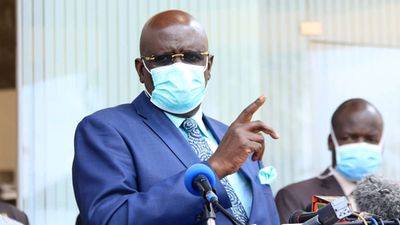
Education CS George Magoha has alerted parents to brace themselves for earlier school resumption dates if the Coronavirus (Covid-19) curve flattens in the next two or three weeks.
The CS spoke while assessing the level of preparedness at the Wote Technical Training College in Makueni County on Friday, August 28.
Magoha stated that the Covid-19 committee will meet to prepare new reopening dates if the curve flattens in a fortnight or three weeks.
“We are observing the curve and when it hits 5% in the next three weeks, we then can sit down and make hard decisions together.
“We really must get our children to schools. We want to see whether we can reopen earlier and conditions will determine,” Magoha alerted.
However, he reiterated that the choice to reopen schools was solely based on President Uhuru Kenyatta’s decision.
Magoha further criticised technical and vocational training institutions countrywide for not hastening and preparing themselves for resumption.
He urged institution heads to rely on youths under the Kazi Mtaani initiative to prepare schools as they offered cheap labour rather than having schools incur extra costs.
The CS also disclosed that he was working in tandem with his Interior Ministry colleague Fred Matiang’i to curb corruption against public resources designated towards reopening of schools.
“We are creating a system where every public secondary school gets between 50 and 100 desks. However, we are going to implement this with the help of the Interior Ministry to ensure no public money is lost and also have onboard all youth leaders in every sub-county,” the CS stated.
On Tuesday, August 25, he hinted that schools might re-open before January 2021 as planned. Magoha scrapped off the entire 2020 academic year and cancelled the KCPE and KCSE exams.
He, however, has been under pressure from Parliament, the World Health Organisation and a section of education stakeholders to reopen schools before September 2020.
In a circular Wednesday to Regional Coordinators of Education and County Directors of Education, Principal Secretary in the Ministry of Education Dr. Richard Belio Kipsang says the data used for this capitation was extracted from National Education Management Information System (NEMIS) earlier this month.
In regards to payment of salaries to school employees, he said in January 2020, the Ministry of Education released 50% of FDSE funds to schools which included P.E funds up to June 2020. In this regard he said Ksh 3,226 per learner should be utilized in the payment of salaries to non-teaching staff, water and electricity bills as well as administrative costs up to December 2020.
On utilization of maintenance and improvement funds, the PS said a total annual allocation for Maintenance and Improvement (M&l) was Ksh 5,000 of which Ksh 4,000 was disbursed in January 2020. He noted that an additional Ksh 500.00 per learner has been released to enable schools prepare for re-opening in January 2021 to conform to COVID-19 guidelines.
Consequently, he noted that the contents of a circular dated 26th November 2019 on the amounts for M&l will change to Ksh 4,500.00.
Also Read246 test positive for COVID-19
Dr Kipsang said the Ministry of Education will support teachers employed by the Boards of Management (BOMs) as at 15th March 2020 for six months only form July to December 2020 by paying them Ksh.10,000.00 per month.
“Each teacher must sign for the money personally and records kept for later auditing. Payment should be made monthly and not in advance, Schools with BOM teachers will receive a separate commensurate disbursement based on the data obtained from the Teachers Service Commission (TSC) in to their operation account. Only teachers with TSC numbers will benefit from this package. This circular supersedes the one dated 20th August, 2020.” He said
He further stated that Edu Afya medical cover for students in public secondary schools is operational and principals are required to advise students accordingly and offer support to learners/parents whenever they encounter any challenge with their UPI.
He said all principals must acknowledge receipt of funds by issuing official school receipts to the Principal Secretary, State Department of Early Learning and Basic Education for both Tuition and Operation Accounts with copies to the Sub County Directors (SCDEs) and County Directors of Education (CDEs); acknowledging receipt of funds through NEMIS by uploading a copy of the official receipt for both accounts where applicable; providing to the County Director of Education through the Sub- County Director of Education an allocation of funds dully signed by individual students and having Individual students sign form-lists that show their admission numbers and full names as in the admission register and the amount awarded. These lists should be attached to the payment voucher kept in the school as per procedure and every student issued with a school official receipt for the allocation.
He specified that this must be accomplished within two weeks of receipt of funds, failure to which further release of grants to such schools will be suspended.
“It is the responsibility of every County Director and Sub-County Director of Education to authenticate and monitor the accuracy of enrolment data of their schools as reflected in NEMIS. All County Directors of Education are asked to circulate the contents of this letter to all principals of public secondary schools within their jurisdiction.” He added.
Justice James Makau has temporarily stopped Education CS George Magoha from implementing the Community Based Learning Project that was to be launched countrywide.
He certified urgent a case filed by a parent seeking to bar Magoha from implementing community based learning.
Joseph Aura had argued as a parent since the state ordered for closure of schools due to Covid-19 in March, his children and others across the country have been at home indefinitely.
He also wanted the CS compelled to reopen schools for third term.
“I have lodged these proceedings as a parent on behalf of my children and on behalf of millions of voiceless children enrolled similarly in learning institutions across the country,” Aura says.
The father of three says in-person learning is the best when it comes to the education of children rather than virtual or any other method.
Aura wants the court to order Magoha reopen all schools from September this year for the next academic term.
He further wants the court to compel Health CS Mutahi Kagwe to reopen of all play areas and recreational centres for all children across the country.
“The oppressive psychological and mental torture inflicted on the school going children because of the open-ended closure of schools effected by the ministry from March till now has gravely injured them,” reads the court documents.
Through Lawyer Harrison Kinyanjui, Aura says many countries who had high number of Covid-19 cases have since reopened their schools and Kenya should also follow suit.
Some of counties he cited include France, Japan, Nigeria, Tanzania, Senegal, Gambia, Namibia, Ghana among others even though some opened partially for finalists.
The World Health Organization (WHO) has urged African countries to make quick arrangement that will see schools reopen to save children from suffering.
Commenting on the matter, UNICEF regional director for Eastern and Southern Africa, Mohamed M. Malick Fall, said that the long-term impact of extending the school shutdown caused harm to the children’s future.
“When we balance the harm being done to children locked out of schools, and if we follow the evidence, it leads children back into the classroom,” Malick stated.
WHO regional director for Africa Dr. Matshidiso Moeti stated that schools paved way for success for many Africans as well as provided a safe haven for children in challenging situations.
“We must not be blind-sided by our efforts to contain Covid-19 and end up with a lost generation. Just as countries are opening businesses safely, we can reopen schools,” he said.
Education CS George Magoha has insisted that learning will take place under the Community Based Learning program. TSC data shows that at least 225,000 teachers have registered for the program. The education CS also said the Community Based Learning has no official syllabus but its upon the teacher to decide on the content.
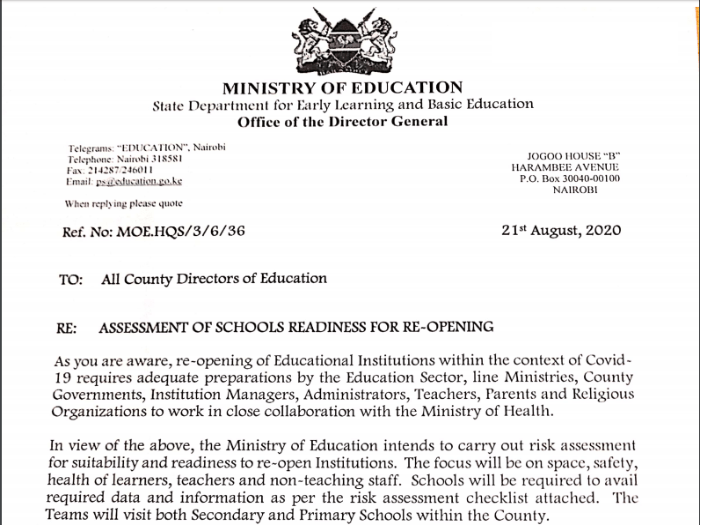
As you are aware, re-opening of Educational Institutions within the context of Covid-19 requires adequate preparations by the Education Sector, line Ministries, County Governments, Institution Managers, Administrators, Teachers, Parents and Religious Organizations to work in close collaboration with the Ministry of Health.
In view of the above, the Ministry of Education intends to carry out risk assessment for suitability and readiness to re-open Institutions. The focus will be on space, safety, health of learners, teachers and non-teaching staff. Schools will be required to avail required data and information as per the risk assessment checklist attached. The Teams will visit both Secondary and Primary Schools within the County.
The purpose of this letter is to inform you of the monitoring exercise that will begin from 23August,2020 as per the attached schedule. The teams from the Ministry will report to your offices for directions and collaboration.
Allfield officers are asked to work closely with Public and Private Basic education institutions to ensure compliance with the Health and Safety protocols.
The Ministry of Education and TSC using a multi-agency approach and in collaboration with Ministry of Interior and Coordination National Government through the Nyumba Kumi initiative will implement the community based learning as from September 2020.
This is a follow up to extensive consultations with all stakeholders in the Education sector on community- based learning as a means of engaging learners during the current period of Covid 19 pandemic.
• To enable smooth running of the programme, detailed Guidelines have been developed to facilitate the roll out of the programme
• The guidelines will cover establishment of Community Based learning committees, mapping of learners, mapping of teachers, identification of venues, content and assessment as well as supervision and monitoring
What is community based learning?
• Community based learning approach is where learners are meaningfully engaged to learn within their communities.
• The purpose of establishing community based learning is to engage learners during the COVID – 19 schools’ closure.
Establishment of CBL Implementation Committee
Composition of CBL Committees
• The implementation of community based learning will be done by multispectral committees based at
• the County level,
• Sub County level and
• the Zone.
The committees will draw their membership from the following government agencies:
• Ministry of Education
• Teachers’ service commission
• Ministry of Health
• Ministry of Interior and Coordination of National Government
• County Government
County community based learning committee
The county committee will consist of the following members
• County Commissioner
• Education CEC
• County Director of Education
• TSC County Director
• County Quality Assurance Officer
• County Ministry of Health Officer
• The county committee will be co-chaired by the County Director of
Education and the TSC County Director.
The role of the County CBL committee
• Monitor the implementation of CBL
• Receive weekly reports on CBL from the sub county
• Submit Weekly report to MOE
Sub County CBL committee
The county committee will consist of the following members
• Deputy County Commissioner
• Sub County Director of Education
• TSC Sub County Director
• Sub County Quality Assurance Officer
• Sub County Ministry of Health Officer
The Sub County Committee will be co-chaired by the Sub County
Director of Education and TSC Sub-county.
The role of the Sub County CBL committee
• Establishment of the zone committees.
• Oversee mapping of teachers at the zone
• Oversee mapping of learners at the zone
• Oversee Identification of venues
• Assess the suitability of identified venues
• Monitor the implementation of CBL
• Receive weekly reports on CBL from the Zone
• Submit weekly reports to the County office
Zone CBL committee
The Zone committee will consist of the following members
• Curriculum support officer
• Area Chief
• Ministry of Health Officer
• Nyumba kumi initiative leaders
The Zonal committee will be coordinated by the Ministry of Education and chaired by the CSO.
The role of the Zone CBL committee
• Sensitize the parents and community on the CBL programme
• Orient teachers on the programme
• Identify the venues and assess their suitability for learning
• Map learners in the Nyumba Kumi area within the zone
• Allocate teachers to the learners in their respective Nyumba kumi area
• Supervise the implementation of CBL at the zone
• Submit weekly reports to the Sub County office
Mapping of Learners
The zonal implementation committee shall carry out the following:
Sensitize the parents within the Nyumba Kumi and the community
Allocate learners to identified venues.
Allocate teachers to venues.
Orient the teachers.
Supervise the implementation of CBL.
The chiefs will assist in making sure that all the learners within their areas of jurisdiction participate in the program.
2. Where there are already existing on line learning programs the CBL
committees should take note and monitor learner engagement.
The committee will maintain the following:
An accurate record of all learners mapped
Record of activities planned for and implemented.
Records of teachers implementing the program.
Identification of Venues
• The zonal CBL committee will identify the venues on the following parameters:
Identify venues and assess their suitability guided by the MOH protocols.
All venues should be public and free of charge for use.
Identification of venues should be in consultation with the relevant stake holders.
All the venues should be child friendly in terms of location and use (schools, churches, social halls, open spaces etc)
The venues should be within comfortable walking distance for the learners.
The venues should be spacious enough to allow for social distancing (1.5m space between learners)
The chief and local administrators should ensure security of learners to, within and from the venues.
Unauthorised persons should be kept away from the venues.
Mapping of Teachers
All teachers employed by the Commission are directed to register with the Curriculum Support Officers and Sub County Directors within Zones and Sub- County where they are currently staying in by 12th August 2020 with a view to undertaking community based learning which has been identified as a means of engaging learners during the current period when schools are closed as a result of the COVID 19 pandemic.
Teachers will play a pivotal role to ensure the success of the programme. In this respect, teachers will be expected to carry out the following activities:-
Activities teachers will carry out
• Heads of institutions should be in school at least once per week to supervise and monitor the programme.
• Utilize the Nyumba Kumi programme to ensure that all learners participate in the programme.
• Set up a face to face programme of engaging not more than 15-20 learners while strictly observing the Ministry of Health Guidelines and protocols. This engagement should be at least 4 Hours a day at no charge.
• Organize the learners as much as possible according to their classes and/or age groups to ensure that the themes under discussion are relevant, suitable and appropriate to the group.
• Sensitize and educate the learners on the guidelines and protocols issued by the Ministry of Health towards the containment of the Covid-19 pandemic.
• Conduct remote daily or weekly follow up with learners and parents.
• Utilize local resources during learners’ engagement.
• Offer guidance and counselling and psycho-social support to learners.
• Monitor the progress and the status of learners and provide information to Curriculum Support Officers.
• Code of regulations for teachers and Code of conduct and Ethics for Teachers shall prevail.
Enhancing Engagement in Online Teaching
In order to enhance engagement on online teaching teachers should carry out the following activities:
i. Make Learning as interactive as possible
ii. Communicating the learning expectations to learners
iii. Use peer-to-peer networks to your advantage
iv. Emphasize self-guided learning (particularly with less experienced students)
i. Make Learning as interactive as possible
Emphasis should be placed on modern pedagogical practices, like group work, peer feedback and blended or ‘blended’ learning. These activities can be conducted online and may help to extend students’ attention spans.
ii.Communicating the learning expectations to learners
• There is need to have learners understand the learning expectations as there are many factors that can affect engagement in teaching from home situations (learners may be living with family members who impact engagement) to technology problems (learners may have older technologies or slower internet speeds) to different learning styles.
• Orientation and/or induction of CBL implementation committees will be carried out through a multi-agency approach (Ministry of Education, Ministry of Interior and Coordination of National Government, Ministry of Health and the Teachers Service Commission)
• Briefing will entail the content and activity areas as detailed below.
Community Based Learning suggested task based activities for engaging learners
• The suggested learning activities are not meant to cover the curriculum designs or syllabuses but to engage learners to gain good personal habits, competencies, skills and values. The activities have been outlined for the teachers but it is imperative that they be creative and include other activities that will be fun and enjoyable for the learners. The activities should be varied to reduce monotony and keep the learners interested.
Suggested learning activities
The suggested activities should:
be non-contact
allow for social distancing
be interesting and engaging
comprise short interval lessons
require learners to do some practical work
allow for creativity, improvisation and use of locally available materials
allow learners to express themselves freely, for example develop showcase portfolios, display of talents, dramatize, draw, song and dance.
Primary School
The suggested learning activities will be based on the following themes:
1. Life skills and values;
2. Health and fitness;
3. Learning area activities;
4. Environment and sanitation.
Secondary School
The suggested learning activities will be based on the following themes:
1. Citizenship
2. Environment
3. Creative arts
4. Languages
5. Games and Fitness
6. Life skills
7. Home science
8. Mathematics and financial literacy
Citizenship
Environment
Creative Arts
Language
• Values Formation
• Personal Hygiene
• Multi – media cards
• Language games
• Social Responsibility
• Hygiene and Conservation
• Draw and paint
• Debates
• Social
• Careers in Science
pictures
• Public speaking
Entrepreneurship
• (Non) Communicable Diseases
• Craft activities
• Poetry
• Religious Activities
• Body Systems
• Music and dance
• Oral Literature
• Socio-cultural
• Physical Exercise and Safety
• Drama
• Reading
Activities.
• Home Remedies and Simple First Aid
• Environmental Conservation
• Business Resources • Agribusiness
• Videography and photography
• Writing
Mathematics
• Geometry shapes
• Math Brain Teasers
• Trick Questions
• Riddles
• Ratios and Proportions
• The Number System
• Expressions and Equations
Financial Education
• Self-assessment
• Self -discovery
Suggested Reference/Teaching and Learning Materials
1. Teachers should plan around learning activities that do not involve too much of text books. They therefore need to engage in hands – on experiences requiring the learners to perform certain tasks.
2. Old newspapers and magazines can be used.
Take note that the materials should not be shared.
3. Guide learners on responsible use of tablets and other electronic devices.
4. Teachers can make prior arrangements to access books and other materials from the nearby schools provided there is a good issuance, maintenance and return procedures.
Supervision and Monitoring
Supervision of CBL
• In order to ensure successful engagement of learners in the CBL programme, the Zonal committees shall;
• Ensure the CBL programme runs from Monday to Friday from 9.00am to 1.00pm
• Make visits to the CBL learning venues during the learning time to ensure its successful implementation areas of jurisdiction.
• Support the teachers and demonstrate the suggested learning activities
• Receive feedback reports from teachers on the implementation of the CBL
• Compile weekly reports
• Offer continuous support on any emerging issues and continuously liaise with Sub-County and County Committees.
Monitoring
Monitoring shall be conducted through multi-agency approach at all levels. This will be conducted regularly so as to offer support and provide timely solutions to any emerging issues that may hinder the implementation of the programme.
Monitoring Template
Administrative details
• Centre name:
• Zone:
• Sub County:
• County:
• Name of teacher:
• TSC no:
• No of learners mapped for the centre
• No of learners present
• The County CBL Committee shall prepare monthly reports which shall be forwarded through the Regional Directors to the Cabinet Secretary, Ministry of Education and The Secretary Teachers Service Commission not later than the fifth day of the subsequent month.
Report Format
Title: Monitoring report on community service learning for
…….region for the month of …
• Preamble (include number of monitored centers and counties)
• Attendance (leaners and teachers attendance trends)
The teachers service commission has called on the public and teachers alike, to ignore the 2019/2020 teacher recruitment guidelines that are circulating on social media with the year falsely changed to read 2020/2021 terming it as a con that is misleading.
Through a tweet on there account TSC said it is yet to release the 2020/2021 recruitment guidelines urging the public to apply when the job advertisement is made public through the media including Interns who are eligible to apply for permanent positions.
TSC further said teacher recruitment is competitive and various aspects of the applicants are considered and not the year of graduation alone as purported in the misleading document.
Teacher Service Commission is a body responsible for the following:
Recruiting and employing registered teachers,
Assigning teachers to various institutions,
Promoting and transferring teachers,
Exercising disciplinary control over teachers.
The commission gives teachers equal terms and conditions of work. TSC has set recruitment requirements for both primary and secondary teachers in Kenya that must be met before one is employed.
Applicants applying for posts in Primary schools must be holders of a P1 certificate. Interested candidates should apply to the TSC County Director, in the County where a vacancy has been advertised and submit all relevant academic and professional documents. Successful candidates are deployed to serve in any part of
the country.
Applicants applying for posts in Secondary Schools must be holders of a minimum of Diploma in Education Certificate. Interested candidates should apply to the Secretary, Board of Management of the school where a vacancy has been advertised and submit a copy of the application to the TSC County Director.
Requirements for one to be employed/Recruited by TSC
1. You must be a Kenyan citizen
2. You must be 45 years of age and below
3. You must be registered as a teacher as per Section 23 of the Teachers Service Commission Act 2012. Those without registration certificates must attach a printout of the online application /copy of payment receipt of the application for registration
4. You must have original Professional and Academic Certificates
TSC Recruitment Requirements for employment of P1 teacher
Primary teachers are usually employed through selection. During the selection day one should carry the following original documents to sub-county selection panel;
National Identity card.
CPE/KCPE certificate (including first attempt certificate if one repeated exam).
PTE certificate.
School/college leaving certificates.
Candidates without academic and professional certificates must show evidence of having applied for confirmation from KNEC and it is the owners of the concerned teacher to follow up with KNEC within 14 days.
Sub county selection panel shall include the following;
Sub-County Director – Chairperson
TSC Sub-County Human Resource Officer – Secretary
All zonal Curriculum Support Officer – Members
TSC Requirement for Secondary school teacher
A secondary school teacher can either be a graduate or a diploma holder
Graduate Teachers
A minimum mean grade of a C+ at KCSE and a minimum mean grade of C+ in each of the two teaching subjects or a minimum of 2 principles and 1 subsidiary pass at ‘A’ Level.
Bachelor of education degree with 2 teaching subjects
Bachelor of Science with education or Arts Degree with education with two teaching subjects
Diploma Teachers
Diploma in Education from a recognized Teacher Training Institution
A minimum grade of C+ at KCSE and with at least C+ OR credit pass in the two teaching subjects or a minimum of 1 principle and 2 subsidiaries at A-level.
Diploma teachers who graduated in 2008 or before with mean grade C plain and subject grades of C plain qualify for consideration.
TSC Requirements for Technical Teachers
Applicants must have a minimum mean grade of C+ at KCSE or a minimum of 1 principle and 2 subsidiaries at A-level.
Bachelor of Education Technology degree ( Bed Tech) OR
Bachelor of Science in any relevant technical subject/course
Higher Diploma in a technical course
A Diploma in a technical course
One should have a Diploma from Kenya Technical Teachers College or Post Graduate Diploma in education ( PDGE) from a recognized university.
For TVET Institutions, the applicant must have a minimum of a higher diploma or degree in Technical education.
Applicants with a mean grade of C- and have applied for technical subjects in TVET institutions but have progressed through certificate, diploma, higher diploma, or degree qualify for employment in TVET institutions.
Persons With Disability – Hearing impaired and blind, are admitted for training with a mean grade C plain and C plain in two teaching subjects thus eligible for employment .
For applicants trained in Special Needs Education; KSL and Braille are considered as teaching subjects i.e Biology/ KSL, Geography / Braille hence eligible for employment.
Candidates whose training is in subjects that are not in the Kenyan Curriculum don’t qualify for employment irrespective of undertaking a Post Graduate Diploma in education and enhancement.
Applicants with Economics/Accounting, Social Education, and Ethics can apply for business studies and CRE/IRE vacancies respectively.
Diploma teachers with English /other subjects qualify for employment as Teacher/Literature teachers.
All applicants must have studied the two teaching subjects at KCSE except for agriculture, business studies, Home Science, and computer. For those who did not study business studies and computer, one should attain a minimum of a C+ in mathematics in KCSE. For those who did not study agriculture and home science, one should have attained a minimum of C+ in biology at KCSE.
Graduate teachers should have studied a minimum of 8-course units in each teaching subjects.
Candidates presenting enhancements certificates/ transcripts from recognized institutions qualify for employment.
Applicants previously employed under contract and whose were terminated due to inadequate units in teaching subjects and have since obtained enhancement certificates are eligible to apply.
Applicants working in other government departments who meet the requirements are eligible to apply.
TSC Filing of a complaint Form in case of Dissatisfaction during recruitment exercise
Any candidate who is dissatisfied with the whole exercise of employment should complain immediately in writing to the TSC county director and a copy sent to TSC headquarters within a period of not more than 7 days after the selection exercise. TSC county director will analyze such complaints and submit a report to TSC headquarters with necessary recommendations.
TSC Contacts Address and website
For detailed information on available vacancies in sub-counties and schools/institutions applicants
are advised to:
a) Visit the TSC Website www.tsc.go.ke
b)info@tsc.go.ke
c) Phone 020 289 200
c) Visit the TSC office at the County or Sub-county of their choice.
The Teachers Service Commission (TSC) is mandated by the Constitution of Kenya
(2010), Article 237 to among others;
Register qualified persons as teachers and
Review the standards of education and training of persons entering the teaching service.
The TSC Act (2012) Section 23 (2) prohibits any person from engaging in teaching service unless one is registered as a teacher. The TSC Code of Regulations for Teachers (2015) Part III further provides Conditions and Procedure for Registration of Teachers.
Teachers Service Commission is responsible for the registration of teachers with the following grades;
Early Child Development Education-ECDE
Primary Teacher Education-PTE
Diploma in Education
Diploma in Education for Visually and hearing impaired
Bachelor of Education
Bachelor of Arts/ Bachelor of Science
TSC Minimum Academic and Professional Requirements for Registration of Teachers
GRADE
CURRENT REQUIREMENT
a
ECDE
CERTIFICATE
i. Minimum of CPE/KCPE plus ECDE Certificate from KNEC.
ii. Minimum mean grade D+(Plus) at KCSE and ECDE Certificate from KNEC.
iii. Minimum mean grade D (Plain) at KCSE, KNEC proficiency certificate, ECDE Certificate from KNEC Diploma
DIPLOMA
i. Mean grade C (Plain) at KCSE and ECDE Certificate from KNEC.
ii. Mean grade C+ (Plus) and above for University Diploma
DEGREE
i. Mean grade C+ (Plus) and above
b
PTE
i. Minimum grade C Plain in KCSE and above
ii. PTE Certificate from KNEC
iii. Mean grade of C- (minus) for visually and hearing impaired persons
C
Diploma in Education
i. Minimum grade C+( Plus) in KCSE and above and C+ (Plus) in the two subjects specialization.
ii. At least C (Plain) in English
iii. C (plain) in Mathematics for Science-based courses
iv. D+( plus) in Mathematics in non-science based courses
d
Diploma in Education for Visually and hearing impaired
i. Minimum grade C (Plain) in KCSE and above.
ii. At least C Minus in English
iii. C- (Minus) in Mathematics for Science based courses
iv. D (Plain) in Mathematics in non-science based courses
e
Bachelor of Education
i. Minimum mean grade C+ (plus) and above or its equivalent.
ii. C+ (Plus) in two subjects of specialization
f
Bachelor of Arts/ Bachelor of Science
i. Minimum grade C+ (Plus) in KCSE and above and C+ (Plus) in the two subjects of specialization.
ii. Post graduate Diploma in Education (PGDE)
TSC Registration requirements for Teachers (Kenyan Citizens).
Certificate of Good Conduct
relevant academic and professional certificates from recognized
institutions
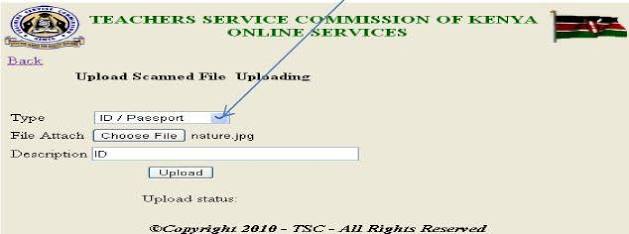
a copy of Identity Card or Passport
passport photo
KRA Pin Certificate
dully filled GP 69 Medical Form and
Payment of registration fee; Non-refundable fee of Kshs. 1055/- Deposit is made to the TSC; Registration Account – National Bank of Kenya – No. 01001000905001 or Simple Banking using Pay Bill Business Number 625625
TSC Registration requirements for Teachers (Non Kenyan Citizens)
academic and Professional Certificates and other evidence for registration as a teacher obtained in Kenya or the country of origin
Academic and Professional Certificates. NB: Must have been awarded by an accredited foreign institution and equated by the relevant public body in Kenya
Certificate of Registration as a teacher or authority to teach in the country of origin
a valid Entry / Work Permit issued by the Department of Immigration
a valid Certificate of Good Conduct issued by the relevant law enforcement agency in the country of origin
vetting letter from the Ministry of Education (Kenya) and
prescribed fee of Kshs. 1055
NB: All documents must be certified by either a TSC Director or TSC Sub – County Director.
TSC Teacher Registration Process
The Commission has provided an online platform for application and registration of
teachers. Once an applicant is sure that he/she has all the required documents, they can visit the TSC website – www.teachersonline.go.ke and begin the application process.
Upon the receipt of the application, the Commission vets the documents and the
applicant is given response / decision within 30 (thirty days).
If the application is successful, the applicant is issued with a Registration Certificate which bears the
Commission’s Chief Executive Officer’s signature.
The Certificate is then immediately posted to the teacher through the postal address indicated in the application.
Also applicants can access their registration status and/or TSC Number online on TSC website.
Temporary Teacher Registration Certificate from TSC
The TSC Code of Regulations (2015), Regulation 27 mandates the Commissions to issue a Temporary Teacher Registration Certificate to a person who;
is in Kenya on recognized education exchange programmes or other
international bilateral arrangements or
not having trained as a teacher but holds a relevant certificate issued to
him/her under any law relating to education and training.
Why TSC may not register a teacher
Section 27 of TSC Act 2012 mandates the Commission not register a person as a
teacher who;
does not possess the prescribed qualifications,
is not of good moral character,
has been convicted of a sexual offence or an offence committed against a learner,
has been convicted of a criminal offence which in the opinion of the Commission, renders the person unfit to be teacher,
is engaged in any activities which in the opinion of the Commission, are prejudicial to peace, good order or good government in Kenya,
Suffers from such physical or mental infirmity which in the opinion of a registered medical practitioner renders the person incapable of performing the duties of a teacher.
Revocation/recall of tsc certificate of registration
The Commission is mandated by the TSC Code of Regulations for Teachers (2015),
regulation 30 to after a due process revoke and recall a Certificate of Registration that
was obtained through;
fraud
misrepresentation
forgery
a result of mistake or
other unlawful means
Removal of the Name from TSC Register
The Commission is mandated by the TSC Act (2012), Regulation 30 to after due
process remove from the register the name of a person who;
has died,
the Commission is satisfied has obtained registration through fraudulent
means,
has been convicted of a sexual offence or an offence against a pupil or a student,
has been convicted of a criminal offence which in the opinion of the Commission renders the person unfit to be a teacher,
the Commission has directed removal from the register as a result of disciplinary proceedings instituted or
Suffers from physical or mental illness or infirmity which renders the person incapable of performing the duties as a teacher.
Offenses relating to teacher registration
The TSC Code of Regulations 2015, Regulation 39 spells out that any person who;
falsely or fraudulently holds himself / herself as a registered teacher,
Not being a registered teacher and teaches or assists in teaching in any school,
causes, permits, or employs to teach in any school a person who is not
registered,
defaces, amends or erases any entry in the Certificate of Registration,
Applies for employment as a teacher in any name other than the full name as
entered in the Register of Teachers,
has been removed from the Register of Teachers but continues to teach or
having been removed from the Register of Teachers and continues to hold and
use the Certificate of Registration for teaching or for any other purpose,
commits an offence and is liable on conviction a fine not exceeding one hundred thousand shillings or to imprisonment for a term not exceeding twelve months or both.
Teacher Registration enquiries
For any inquiries on Teacher Registration the applicants or the public can Call 020-
2892351 or send an e-mail to; info@tsc.go.ke.
Teachers training colleges-TTC in Kenya offer golden opportunities to KCSE candidates who have scored a minimum grade of C plain to pursue primary teacher education either P1 or diploma.
However, before pursuing a course in diploma education its important to ensure that you satisfy the minimum requirements so that after completion you do not find yourself at crossroads with Teachers Service Commission-TSC a body that is mandated with the registration of teachers in Kenya.
Once you have ensured you meet all the minimum requirements the next puzzle is to look for a good teacher training college that will impart you with appropriate skills and Knowledge.
Here is a list of registered public Teachers training colleges per county
Teachers’ Training College-TTC
County
1. Asumbi List of best Public and Private Teachers Training Colleges-TTC in Kenya, ATC
Homa Bay
2. Baringo Teachers Training College, BTTC
Baringo
3. Bondo Teachers Training College
Siaya
4. Bomet Teachers’ Training College
Bomet
5. Bungoma Teachers’ Training College
Bungoma
6. St. Lawrence Egoji Teachers college
Meru
7. Eregi Teachers’ Training College
Vihiga
8. Garissa Teachers Training college
Garissa
9. Kaimosi Teachers’ Training College
Vihiga
10. Meru Teachers’ Training College
Meru
11. Mosoriot Teachers’ Training College
Nandi
12. Murang’a Teachers College
Muranga
13. Machakos Teachers Training College
Machakos
14. Maragua Teachers Training College
Muranga
15. Migori Teachers Training College
Migori
16. Narok Teachers College
Narok
17. Shanzu Teachers’ Training College
Mombasa
18. Tambach Teachers Training College
Elgeyo Marakwet
19. Trans-Nzoia Teachers’ Training College
Trans Nzoia
20. Kamwenja Teachers Training College
Nyeri
21. Kenya Science Teachers College
Nairobi
22. Kericho Teachers College
Kericho
23. Thogoto Teachers Training College
Kiambu
24. Kagumo Teachers College
Nyeri
25. Moi-Baringo Teachers’ College
Baringo
Here is a list registered private teachers training colleges in Kenya
Teachers Training College
County
1. Kamagambo Adventist College
Nyeri
2. Nakuru Teachers’ Training College
Nakuru
3. Masai Teachers’ Training College
Narok
4. Consolata College
Nairobi
5. International Teachers Training College
Nairobi
6. Kenya Education Staff Institute
7. Amicus Group of Schools
Nairobi
8. Bible College of East Africa
Nairobi
9. Blescohouse Teachers Training College
Nakuru
10. Bunks Early Childhood Education College
Nairobi
11. C.F.K. Teachers Training College
Nairobi
12. Carol Teachers Training College
Nairobi
13. Christ the Teacher Institute for Education
Nairobi
14. Deans E.C.D. College
Nairobi
15. Deans Teacher Training College
Nairobi
16. Glad Toto Early Childhood Teachers Training Centre
Nairobi
17. International Montessori School
Nairobi
18. International Teachers Training College
Nairobi
19. Islamic Teachers’ Training College -Maragua
Muranga
20. Jerusa Teachers Training College, Jttc – Butere
Kakamega
21. Jomaken ECD Pre-Primary Teachers Training Programme & Care Centre
Nairobi
22. Nyanchwa Teachers Training College
Kisii
23. Nyeri Catholic Centre for Early Childhood Education Development
Nyeri
24. Nyeri Catholic Early Childhood Development Education Teachers Training College (ECDE TTC)
Nyeri
25. Orthodox Teachers Training College of Africa
Nairobi
26. Presbyterian Teachers College Rubate
Meru
27. Premese Montessori
Nairobi
28. Special Education & Professional Studies College
Nairobi
29. St. Ann’s ECD Teachers College
Kisii
30. St. Austin’s Teachers Training College – Ishiara
Embu
31. St. John’s Teachers Training College – Thika
Kiambu
32. St. Martin De Porres Teachers College – Kiserian
Nairobi
33. St. Paul’s Nyabururu Teachers Training College