TSC : RECRUITMENT OF TEACHERS GARISSA, WAJIR AND MANDERA COUNTIES


Vacancies for Primary School Teachers Garissa Wajir and Mandera
S/NO COUNTY NUMBER
1 Garissa 287
2 Mandera 404
3 Wajir 457
TOTAL 1148

More than 300,000 teachers will receive a salary increment after MPs approved Sh11 billion more for the Teachers Service Commission (TSC).
It means teachers under the TSC payroll will get an enhanced annual increment in their basic salary.
Another 100,000 teachers will also be promoted under the enhanced budget starting July this year. Of these teachers, half are in secondary schools with diploma qualifications.
Primary school teachers, who fall under grade B5 and presently take home Sh24,476, will now be moved up to C1 to earn Sh30,595 per month.
Data tabled in Parliament by TSC and approved by MPs shows that Sh2 billion was approved to employ 5,000 new teachers under the 100 per cent transition programme. Another Sh1.2 billion will be used for recruitment of 10,000 intern teachers.
Promotion funds
And to prepare for the Grade Five roll out of the Competency-Based Curriculum (CBC), MPs approved Sh1 billion to train teachers.
Overall, the legislators approved Sh7 billion to take care of the wage drifts and promotion funds.
The new allocations sets in motion the scramble for promotions after a government report revealed the number of teachers who have acquired higher qualifications has increased.
The latest Economic Survey data shows that the number of teachers who obtained degree level qualifications or higher went up by 6,662, which translates to a seven per cent increase.
Overall, the 2020 Economic Survey says the total number of teachers who have at least a degree qualification is now 101,560 up from 94,898.
The report further found the number of teachers with diploma qualifications and below has reduced by 698. During the review period, the report found that the number of staff with bachelor’s degrees accounted for 94.7 per cent of the total number of teachers.
It says the number of teachers with master’s and doctoral degree qualifications has gradually declined to stand at 1,920 in 2019.
Last year, teachers with diploma qualifications stood at 4,312. The number has decreased to 3,614, signifying a drop of 16.2 per cent.
A report tabled in Parliament early this year by TSC Chief Executive Officer Nancy Macharia indicated that a total of 36,341 P1 (primary school) teachers had pursued a diploma, higher diploma, bachelor’s or master’s degree, and postgraduate and doctorate qualifications by October 2018.
Broken down, the TSC report indicated that 18,076 of these teachers had attained a bachelor’s degree, while some 486 got their master’s papers. Another 17,758 had acquired higher diploma qualifications.
Only five teachers had attained doctorate qualifications, with a similar number registered for diplomas.
Some 11 teachers had attained postgraduate qualifications, according to the TSC report, which provided a summary of different cadres of academic qualifications attained by October 2018.

A teacher who is seeking for a transfer, for instance, must fill the Transfer form that is endorsed by the head and submitted to the TSC for action.
Other, many, types of TSC forms also exist. If you have been wondering where to get the forms, then worry not. Click on the links below to download the forms free of charge and in PDF form. Each form contains instructions on how to complete the parts. Remember to read these instructions correctly before completing the form. In case in doubt, do not hesitate to consult your head or TSC Subcounty office for clarification.
Here are the TSC forms:
This form is filled by a teacher who wishes to change his/ her current work station. The form enables the commission to consider a teacher’s intra and inter county transfer request. The reason for seeking the transfer must be satisfactory enough to warrant the transfer. Such reasons as ‘on medical grounds’ with supportive evidence is presumably given much weight by TSC. Those with organized swaps also get an easy ride. Click on this link to get the TSC Transfer Form
This form is filled by teachers after successful interview/ recruitment. Get the TSC Employment Form here
The TSC promotion form is for common cadre promotions. It is filled by teachers who have successfully served the required number of years in a given job grade. The form is filled by the head of institution. It is good to get the form ready and sent to TSC three months prior the expiry of the required minimum number of years that a teacher is to serve in the job group. The TSC Job group promotion form can be found on this link.

The no-nonsense approach by Teacher Service Commission (TSC) CEO Nancy Macharia on teachers affairs best exemplifies the quintessential iron lady. She has silenced the Kenya National Union of Teachers (KNUT) leadership and continues to steer the commission the best way she knows. She took over from Gabriel Lengoiboni who retired in 2015.
The TSC chief executive was born in 1963. In 1987, she graduated with a degree in Bachelor of Education in English/Literature. Ms. Nancy pursued a master of Education Policy and Management at Bristol University, UK.
She started as a teacher at Kahuhia Girls’ Secondary in Murang’a before being promoted to deputy principal of Kiandeni Girls’ Secondary in the same county. The ambitious Ms Nancy quit as a teacher and took a job as a staffing officer. She later became director teacher management, reporting directly to the CEO. She was tasked with management of 4 senior deputies.
The CEO position was advertised on May,1. It drew 69 candidates and 4 were shortlisted. After the grueling interviews, Nancy was appointed. She is the 9th person and 1st woman to hold this position.
She has trained both locally and internationally in:
Business excellence models
Public procurement
Information Communication Technology(ICT)
Corporate governance
Proactive management
She is also a member of the Kenya Association of Public Administration Management(KAPAM) and institute of directors.
Kenyans on Twitter have continuously bashed Nancy. A section of social media users castigated the CEO for being oblivious to the dangers teachers face working in North Eastern. Teachers in this region face hostility and even some are killed by Al Shabaab militants. The CEO, appeared before the National Assembly’s Education Committee and threatened them with interdiction if they absconded duty.
In 2014, President Uhuru awarded her the Order of Grand Warrior. This was due to her development contribution both inside and outside the workplace.
She was part of the team that steered the national integrated data system for TSC. She also negotiated for funds from world bank.
In order to solve the ghost workers problem, she initiated the teacher management information system.
In her CV she cited the following hobbies: traveling, assisting the society’s less fortunate, gym, music and farming.

The Dedan Kimathi University of Technology (DeKUT) is set to hold a virtual graduation ceremony for its students in two weeks, becoming the first Kenyan institution of higher learning to do so.
This comes amid a ban on public gatherings due to Covid-19.
Vice Chancellor Prof Ndirangu Kioni said the move follows requests from students.
“The students requested for the graduation ceremony because they wanted their certificates so that they can move on with their lives,” he said.
The virtual event that will be held on May 8 will see 1,777 students graduate in its 9th ceremony.
“The University Senate resolved to hold a virtual graduation in keeping with our student-centric approach. It was to ensure that we keep our promise to the students and graduands of DeKUT of timely completion of studies,” he said.
ONLY 15 PRESENT
“It will be a brief ceremony and will be attended by a maximum of 15 people spread out in our main hall. The deans will stay in their offices or wherever they will be and read out the names from there,” he said, adding that it will be streamed online.
The 15 will be the key people including the Chancellor, Vice Chancellor and members of Senate.
“The ceremony will be very brief and will follow all the laid out directives by the Ministry of Health. The short span will also discourage people congregating at any point,” he said.
The students will catch the ceremony online via the university’s YouTube, Facebook and Twitter platforms.
“In these uncertain times, it is hard to predict when the country will go back to normalcy so that a traditional graduation can be held…our graduands who worked hard to complete their studies should not suffer a delay,” said Prof Kioni.
“Our students in nursing and IT completed their studies last year but cannot secure employment for lack of the certificates yet their skills are needed during this period,” he added.
As part of preparations, the university has advised graduands to download their e-invitation cards from the student portal. They will follow the live event from wherever they will be. The graduands are required to part with between Sh3,100 (diplomas) and Sh6,100 (PhD).
The graduating class will receive their certificates after two weeks of the virtual graduation.
While student leaders seem to agree with the administration, some graduands are against virtual graduation. They have taken to Twitter and Facebook to oppose the graduation fee requirement.
Through #NoVirtualGraduation hashtag and WhatsApp groups, they questioned the rush to award certificates at a time when the pandemic has shut the economy. Hurbert Murende, a graduand said, “a virtual graduation is like being ripped off something that you are worth, it feels like watching a graduation on YouTube, which makes no sense.”
source DAILY NATION

This is a quick guide on how to apply and register for a Teachers Service Commission (TSC) number in Kenya as of 2019. This is a unique identification number given to all the qualified teachers in Kenya who have been successfully recruited by the Teachers Service Commission. Having highlighted on this website before on the TSC recruitment requirements for teachers in Kenya, on this post we are going to look at how you can apply and get your TSC number
You should scan and upload the following documents :
1. Original Professional and Academic Certificates
2. National identity card
3. Bank slip
Deposit Ksh 1,055 through Direct Banking or via MPesa. (KSh 1,000 is a non-refundable registration fee of and Ksh 55 for Bank Commission Charge to the TSC). Application for a duplicate certificate will be KSh 2055. All payable to National Bank of Kenya Ltd, Harambee Avenue branch, Account Name: TSC-Secretariat Account Number: 01001005707400. For Mpesa, the Pay Bill Business Number is 625625.
4. One passport size photo
5. KRA pin
6. GP69 form: You can download the GP69 form here. This form must be signed by a government doctor.
7. Certificate of good conduct: Here is a simple guide on how to apply for a certificate of good conduct in Kenya.
8. Entry and work permits for non-Kenyans. They are also required to upload a letter of clearance from the Ministry of Education.
Vetting Committee.
CLICK HERE to start your online registration for a TSC number.
A teacher who meets the requirements for registration will be issued with the certificate of Registration bearing a TSC number within 30 days.


KCSE was expected to begin on October 30 with KPCE set to commence on October 27, according to a timetable published by the Kenya National Examination Council (KNEC).
President allayed fears the disruption caused by coronavirus, a global pandemic which has 14 lives in Kenya and infected 296 persons since the first case was confirmed in March, will not disrupt the examination calendar, amid concerns of coverage of the syllabus ahead of the national exams.
President Kenyatta said the Ministry of Education and KNEC was exploring modalities to ensure time lost by candidates is recovered before the exams commence.
“The exams will be done what we want to do is to sit down with other stakeholders in the education sector so as to ensure that our students prepare adequately as well as recover the lost time,” the President said during an interview with Kiswahili-broadcasting radio stations at State House, Nairobi.
He said plans on resumption of studies, especially for candidates, are also under review.
Learning institutions in Kenya were closed on March 15 in a bid to curb the spread of coronavirus in the country.
This is after the country confirmed the first case of coronavirus virus on March 13.
The President did not however specify when schools will reopen.
Education Cabinet Secretary Prof George Magoha last week said he “couldn’t give the exact date when the schools will resume.”
The CS said he was awaiting directions from the Ministry of Health on how the coronavirus situation was unfolding.
Prof Magoha noted most schools had been converted to quarantine and isolation facilities to support efforts to track and isolate COVID-19 cases in counties.
The Ministry of Education through Kenya Institute of Curriculum Development (KICD) has rolled around virtual classes for learners to ensure support students at home.
President Kenyatta expressed confidence that Kenya will win the war against the coronavirus.

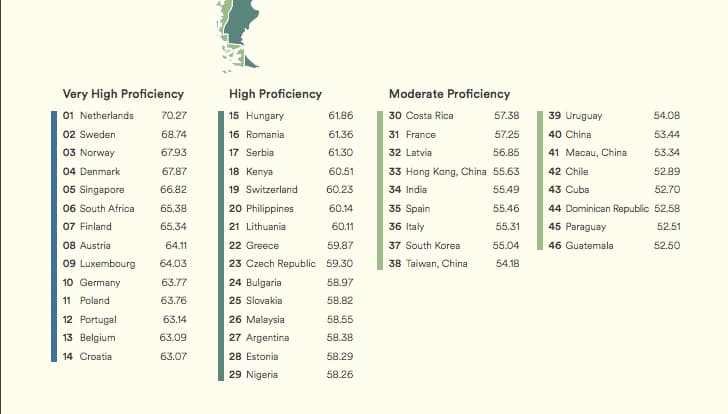
Kenyans have been ranked 18th best English speakers in the world and 2nd best in Africa after South Africa.
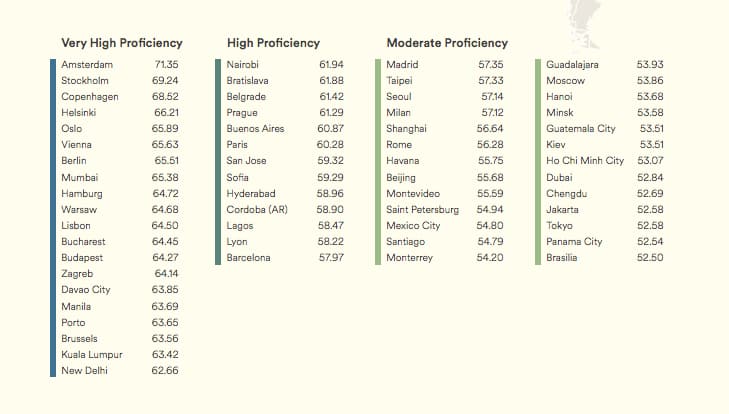
Nairobi ranked number 1 in African City followed closely by Lagos, Nigeria according to a report by global private language tutor, Education First (EF).
The English Proficiency Index (EPI) by the Switzerland-based company ranked Kenya behind South Africa even though Nairobi still emerged as the highest placed African city in English proficiency.
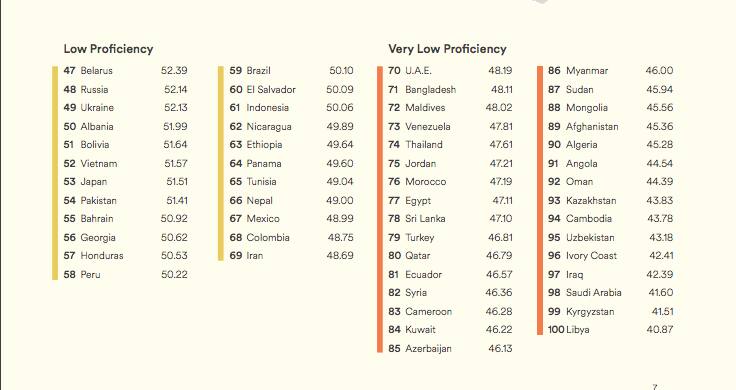
Other African countries that appeared in the top 100 list included Nigeria (29), Ethiopia (63), Tunisia (65), Egypt (77), Cameroon (83), Sudan (87), Algeria (90), Ivory Coast (96) and Libya (100).
The top country in the world was the Netherlands followed by Sweden, Norway, Denmark and Singapore finishing the list of the top five.
Kenya had a high proficiency EF EPI score of 60.51 with Netherlands leading with 70.27%.

In terms of cities, Nairobi emerged top in Africa with an EPI score of 61.94% followed by Lagos which scored 58.47 %.
Africa’s average proficiency score dropped primarily due to score changes in South Africa and Ethiopia and the inclusion of Sudan and Cameroon, which both fall in the ”very low” proficiency band, the report said.
“As in previous years, a few African countries performed well while the rest performed poorly, and the gap between higher and lower proficiency countries is wider than ever,
“The overall average for Africa dropped significantly, primarily due to score changes in South Africa and Ethiopia – both countries with large populations – and to the inclusion of Sudan and Cameroon, which were not in the Index last year, and both fall in the Very Low Proficiency band,” read the report.

The EF report links English proficiency to innovation, public investment in research and development, number of researchers per a population of one million as well as technicians per capita.
“For the first time, we find that adults aged 26-30 have the strongest English skills. This finding reflects the growing prominence of English instruction in university education around the world,” said EF.