Lycee Denis Diderot International School Fees Structure 2020

Lycee Denis Diderot International School Fees Structure 2020

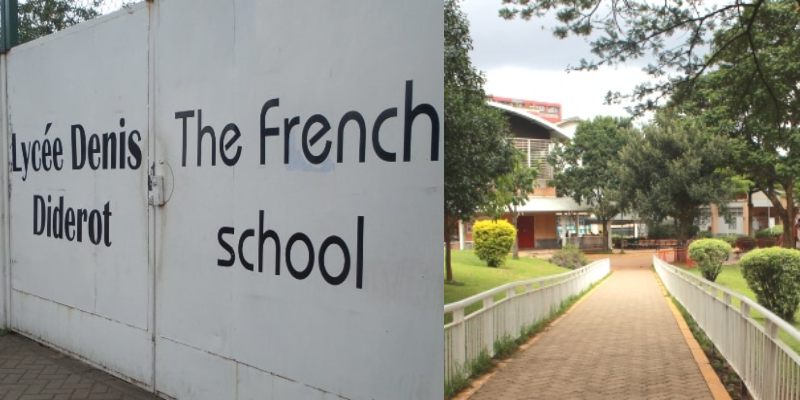
This is the fees structure for the Lycee Denis Diderot International School as of 2020. It’s a French school that is located along Argwings Kodhek Road next to Yaya Center in Nairobi. Founded in 1962, the French School is one of the oldest international schools in Kenya.

The French school hosts close to 650 students between the ages of 3 and 18 years from more than 50 countries. It is also is a member of AEFE (Agency for French Education Abroad), the largest network of schools with more than 495 schools in 137 countries. Through this association, it enjoys technical and financial support from the French government thereby allowing it to charge affordable fees.

French and Kenyan students pay slightly less given the fact that the two Governments directly or indirectly contribute to the cost of education.

Lycee Denis Diderot teaches in accordance with the principles of the French school system. The primary school consists of kindergarten, which takes in children from 3 to 6 years of age (3 school years), and elementary school which takes in children from 6 to 11 years of age (5 school years). Schooling continues at the middle school from 11 to 15 years of age (4 school years ), and then at the high school from 15 to 18 years (3 school years).

Below is the Fees structure for Lycee Denis Diderot International School in Kenyan Shillings per year.

Level

Fees

Nationality

​​ 

​​ 

Kindergarten

688, 960

French & Kenyans​​

850, 084

Other Nationalities

​​ 

​​ 

Elementary Primary

729, 756

French & Kenyans

899, 741

Other Nationalities

​​ 

​​ 

College Secondary

829, 245

French & Kenyans

1, 020, 732

Other Nationalities

​​ 

LYCEE Secondary

1, 108, 896

French & Kenyans

1, 367, 261

Other Nationalities

Other Fees: Yearly billing

First registration fee: Ksh 94, 400

Examination fees: Ksh 46, 700

SIB registration fee: Ksh 45, 200

Please note that the fees are subject to change. Contact the school using the avenues below for fee policies and payments.

Lycee Denis Diderot International School Contacts

Phone: (+254) 020 2437714

Email: assist-direction2.nairobi.diderot@aefe.fr

Greensteds International School Fees Structure 2020

Greensteds International School

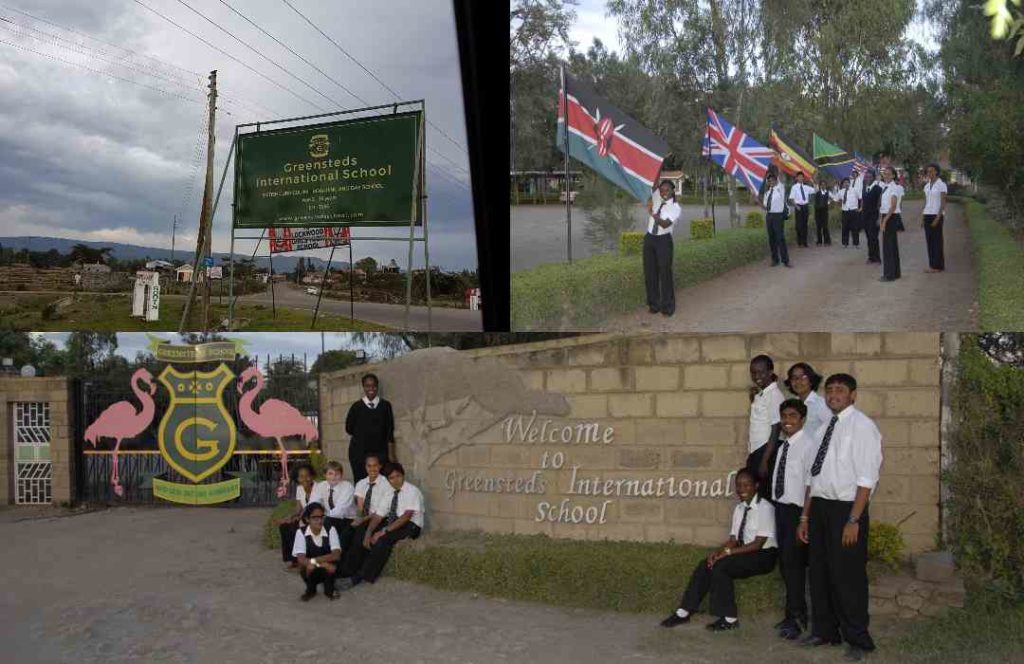
This is the fees structure for Greensteds International School as of 2020. It’s located along the Nakuru-Nairobi highway in Nakuru County; 16km from Nakuru town. The prestigious school started as a junior school back in 1936 then grew over the years to become a large school offering education from playgroup to year 13 using the British Curriculum.

It’s divided into four sections; Early years, Junior school, senior school, and sixth form. Early years has three classes; Crèche -aged 2 – 3 years, Nursery – aged 3 – 4 years, and Reception – aged 4 -5 years. Junior school starts from year 1 to 6, the senior school from year 7 to 13.

Students can choose either boarding or day school. Boarding is available to pupils from Year 1 to Year 13. Students living near Greensteds often choose to be day scholars. Daily transport service is available for them.

There are 3 terms at Greensteds International School; September to December, January to March and April to July.

Greensteds International School Fees Structure for 2020
The fees below are per term and boarding fees are inclusive of all accommodation, meals, and tuition. Textbooks and exercise books are provided, as are Lunch and snack breaks for day students. They are in Kenyan Shillings.

​​ 

Class

​​ 

Day

Boarding

​​ 

Playgroup

​​ 

45,000

​​ 

Crèche

​​ 

76,000

​​ 

Nursery

​​ 

88,000

​​ 

Reception

​​ 

88,000

​​ 

Years

1 – 2

​​ 

122,000

372,000

​​ 

Years

3 – 4

​​ 

164,500

447,500

​​ 

Years

5 – 6

​​ 

196,500

479,000

​​ 

Year

7 – 8

​​ 

259,000

595,500

​​ 

Year 9

​​ 

281,000

​​ 

659,5000

​​ 

Years

10 – 11

​​ 

317,000

715,000

​​ 

Years

12 – 13

​​ 

380,000

786,000

Other Fees 

Class

Fees

​​ 

Admission fees

​​ 

Early Years

(Crèche to Reception)

Ksh 25,000

​​ 

Residents

(Yrs 1-13)

Ksh 50,000

​​ 

Non Residents (Yrs 1-13)

2000 USD

Caution Money – Refundable (one-off payment)

​​ 

Early Years

20,000

​​ 

Years 1-13

50,000

Please note that the fees are subject to change. Contact the school using the avenues below for fee policies and payments.

Greensteds International School Contacts 

Phone : 0726-568583 / 0770-076271

Pembroke House School Fees Structure 2020

Pembroke House School Fees Structure 2020

This is the fees structure Pembroke House School as of 2020. It’s located along Nyahururu Road in Gilgil, Nakuru County. The preparatory school which founded in 1927 is among the oldest international schools in the country.

Pembroke House offers education using the British National Curriculum from pre-nursery to year 8. As of 2020, the school has a population of 209 pupils.

The school sits within 140 acres of school land which provides it plenty of space to learn and play. It has a wide range of facilities which ensure the provision of world-class education i.e modern classrooms, well-equipped library, school theatre, tennis and squash courts, cricket and rugby pitches, stables, a cross country course, a swimming pool and gymnasium, a running track, and an outdoor arena.

The quality of the boarding experience at Pembroke House is also outstanding. There are two boarding houses: Mackie House for boys and Scholes House for girls which on average house 200 children.

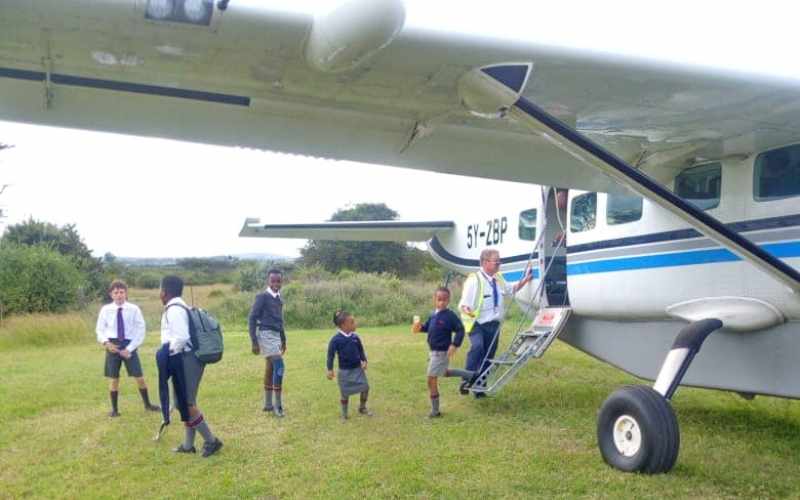
Pembroke House School students arriving for the 2020 academic year

To guarantee a place at Pembroke House, a joining fee of Ksh 150,000 per child is required. However, 50% of this fee is refunded after the final term. Let’s have a look at the termly full fees structure below in Kenyan shillings.

​​ 

Class

​​ 

Fees per term

​​ 

Pre-Nursery & Nursery

​​ 

87,500

​​ 

Reception

​​ 

163,300

​​ 

Year 1

​​ 

392,400

​​ 

Year 2

​​ 

627,800

​​ 

Years 3 – 8

​​ 

784,800

The fees above are inclusive of all boarding, seven-days-a-week.

Extras

Parents and guardians are advised to allow for approximately KSh 40,000 per child, per term, for extras.

The fees are payable three times per year (start of September, January, and end April) for Year 1 – 7 while twice for year 8 (beginning of September and beginning of January)

N/B: A registration fee of Ksh 5,000 is charged at the point of registering a child. Registration does not secure a place for the child but does give priority over those non-registered.

Please note that the fees are subject to change. Contact the school using the avenues below for fee policies and payments.

Pembroke House School Contacts

Call: + 254 (0) 734 480 439 / + 254 (0) 727 108 567

Email: registrar@pembrokehouse.sc.ke

Light International School Fees Structure 2020

Light International School Fees Structure 2020

This is the fee structure for Light International School as of 2020. It’s located off Langata Road in the leafy suburb of Karen in Nairobi, Kenya.  This is one of six schools run by the Omeriye Educational Foundation and Medical Charitable Trust which was was established in 2001.

It teaches using the British National Curriculum for all their students; Kindergarten (Aged 3-5), Primary (Year 1-6), Secondary 1 (Year 7-9), Secondary 2 (IGCSE) and A Level (Year 12-13).

Light International School Fees Structure 

​​

Class ​​ ​​ ​​ ​​​​  

​​

Fees

​​

Kindergarten 5 Full Day (Per Term)

​​

Playgroup ( Age 2- 3)

​​

100,000

​​

Nursery

(Age 3- 4)

​​

100,000

​​

Reception

(Age 4- 5)

​​

100,000

​​

Lunch Fees per term

​​

18,000

​​

Other Fees For Kindergarten Annual

​​

Admission Fee

​​

25,000 – Non-Refundable

​​

Caution Fee

​​

40,000 – Refundable

​​

Application Fee

​​

5,000

​​

Text Books & Stationary Fee

​​

15,000

Clubs & Activities Fee

8,000- Termly

​​

Emergency Ambulance Service

​​

1,000

​​

Outpatient Health Insurance

​​

2,000

​​

Year Book

​​

2,000

​​

Junior School Fees Per Term

​​

​​ Year 1-2

​​

130,000

​​

Year 3 -4

​​

165,000

​​

Year 5- 6

​​

215,000

​​

Lunch Fees per term

​​

25,000

​​

Other fees for junior school

​​

Admission Fee

​​

25,000 – Non-Refundable

​​

Caution Fee

​​

40,000 – Refundable

​​

Application Fee

​​

5,000

​​

Text Books & Stationary Fee

​​

25,000 – Annual

​​

Clubs & Activities Fee

​​

8,000 – Per Term

​​

ICT Fees

​​

8,000 – Annual

​​

Emergency Ambulance Service

​​

​​

1,000 – Annual

​​

Outpatient Health Insurance

​​

​​

2,000 – Annual

​​

Year Book

​​

2,000 – Annual

​​

SIC Card (Student ID Card)

​​

​​

1,500 – Annual

​​

Senior School Fees Per Term

​​

Year 7 -8

​​

260,000

​​

Year 9- 10

​​

275,000

​​

Year 11

​​

382,500

​​

Year 12- 13

​​

412,500

​​

Lunch Fees per term

​​

30,000

​​

Other Fees For Senior School

​​

Admission Fee

​​

25,000 – Non-Refundable

​​

Caution Fee

​​

40,000 – Refundable

​​

Boarding Caution Fee

​​

20,000- Refundable

​​

Application Fee

​​

5,000

​​

ICT fee

​​

8,000- Annual

​​

Clubs Fee

​​

8,000 – Per Term

​​

Emergency Ambulance Service

​​

​​

1,000 – Annual

​​

Outpatient Health Insurance

​​

​​

​​

2,000- Annual

​​

Year Book

​​

2,000 – Annual

​​

Career Counselling Programme

​​

​​

5,000 – Once Only for Yr. 9 and above

​​

ISIC Card (Student ID Card

​​

1,500 – Annual

​​ 

Transport Fees 

 ​​​​ 

Zone

​​ 

Transport Fees Per Term in Ksh

​​ 

A

Bomas, Karen, Race Course, Barracks

​​ 

35,000

​​ 

B

​​ 

Metrological Dept, Adams, Lavington, Jamhuri Estate, Kileleshwa, Lenana Rd., State House, Mimosa, Town .Airport View, South C, Five Star, Mogoya Phase 1-3, Jabavu Rd, Posta

​​ 

40,000

​​ 

C

Westlands , Museum Hill , Lusaka Rd. Bellevue, Mugoya Phase 4, Bellevue School, St. James Hospital, Ngara,

​​ 

45,000

​​ 

D

Highridge, Parklands, City Park Pangani, Imara Daima, City Kabanas

​​ 

50,000

​​ 

A One Way

​​ 

21,000

​​ 

B One Way

​​ 

24,000

​​ 

C One Way

​​ 

27,000

​​ 

D One Way

​​ 

30,000

Light International School Contacts 

Tel: +254 703 200 002
Email: info@lis.sc.ke

Potterhouse International School Fees Structure 2020

Potterhouse International School Fees Structure 2020

This is the fees structure for Potterhouse International School as of 2020. It’s located along Runda Road Off Ruaka Road in Nairobi’s leafy suburb of Runda. The school which was established in 2002 offers education using the British National Curriculum. It’s divided into three key stages; kindergarten ( peach class – 1.5 – 3 years old,  pear class- 3 – 4 years old, and melon class- 4 – 5 years old), primary school ( year 1 to 8) and high school ( year 9 to 11).

Potterhouse has a well-equipped library and ICT center which help in offering a world-class education. Below is the termly fees structure for Potterhouse International School as of 2020 in Kenyan Shillings.

​​ ​​​​

Class

​​

​​

Tuition Fees

Per term

​​

Caution Fees

​​

Pear

​​

77,900

​​

11,500

​​

Peach

​​

70,900

​​

10,500

​​

Melon

​​

84,000

​​

12,500

​​

Year 1

​​

142,900

​​

20,500

​​

Year 2

​​

149,400

​​

21,500

​​

Year 3

​​

158,600

​​

22,000

​​

Year 4

​​

158,600

​​

22,000

​​

Year 5

​​

169,500

​​

23,500

​​

Year 6

​​

169,500

​​

23,500

​​

Year 7

​​

206,800

​​

29,000

​​

Year 8

​​

206,800

​​

29,000

​​

Year 9

​​

225,100

​​

31,5000

​​

Year 10

​​

225,100

​​

31,500

​​

Year 11

​​

​​ 352,300

(billed twice per academic year )

​​

49,000

​​

Lunch Fees per term

​​

Peach- Year 2

​​

17,900

​​

Year 3 – 6

​​

19,900

​​

Year 7 – 9

​​

21,000

​​

Year 10 – 11

​​

22,100

​​

Transport Fees per term

​​

Zone 1

•Runda Barrier

•Kiambu Road

Barrier

•Runda Estate

​​

One Way: 16,800

Two Way: 24,200

​​

Zone 2

•Ruaka

•Rosslyn

•Village Market

•United Nations

•Evergreen

•Nyari Estate

​​

One Way: 29,400

​​ Two Way:39,900

​​

Zone 3

•Muthaiga

•Getrudes

Hospital

•Muchatha

•City Park

•UKay

•Ridgeways

•Garden Estate

•Windsor

•Kugeria Kiambu

Road

•International

School of Kenya

​​

One Way: 38,900

Two Way: 45,200

​​

Zone 4

•Pangani

•Forest Road

•Ngara

•Sarit Centre

•Wangige

•Mwimuto

•Karura

•Ndenderu

•Banana

•Kiambu Town

•KIST

•Village Inn

​​

One Way: 49,500

Two Way: 54,500

​​

Zone 5

•Roysambu

•Kariokor

​​

One Way: 52,500

Two Way: 56,800

​​

Zone 6

Ziwani

Kilimani

Yaya

Town

Upper Hill

State hOUSE

​​

​​

​​

One Way: 73,500

Two Way: 84,000

​​

Zone 7

Jericho

Kibera

Olympic

Jamhuri

Ngumo

​​

One Way: 94,500

Two Way: 115,500

​​

Zone 8

Kinoo

Kikuyu

Waithaka

Dagoretti

Donholm

Mwiki

Njiru

Utawala

​​

One Way: 126,000

Two Way: 147,000

​​

Zone 9

Karen

Langata

Wilson

Otiende

Embakasi

Komarok

Karen

​​

One Way: 157,500

Two Way: 168,000

​​

Zone 10

Ngong

Kitengela

Kiserian

Matasia

Mlolongo

​​

One Way: 189,000

Two Way: 199,500

​​

Other Fees

​​

Registration Fee

​​

11,500 – paid once

​​

Medical Emergency

​​

4,500 – per year

​​ 

Please note that the fees are subject to change. Contact the school using the avenues below for fee policies and payments.

Potterhouse School Contacts 

Phone : +254 722 252 551, +254 733 798 546

Email : info@potterhouseschool.ac.ke

Adress : Runda Estate, Runda Road Off Ruaka Road

Makini School Fees Structure 2020

Makini School Fees Structure 2020

This is the fees structure of Makini School as of 2020. It is one of the best performing schools in Kenya that was founded in February 1978. The school’s main campus is located along Makindi Road Off Ngong Road. It has other four campuses in Kibos Kisumu, Migosi Kisumu, Kisumu Main Campus along Nyerere Road, and another one along State House Avenue in Nairobi.

The school teaches using the Kenyan National Curriculum from grade 1 to 8. Below are the fees structures of all the Makini School Campuses for the year 2020.

 1. Makini School Ngong Road Fees Structure 2020

New Admissions (One Time Payments)
Application form/interview (Non-Refundable) 1,650.00
Registration fee (Non-Refundable) 2,200.00
Refundable deposit 13,200.00
Day Care
Termly tuition fees (inclusive of lunch, tea break, computer, games & swimming, chess) 65,400.00
Pre-Primary 1
Termly tuition fees (inclusive of lunch, tea break, computer, games & swimming, chess) 65,400.00
Pre-Primary 2
Termly tuition fees (inclusive of lunch, tea break, computer, games & swimming, chess) 68,300.00
Grade 1
Termly tuition fees (inclusive of lunch, tea break, computer, games & swimming, chess) 71,300.00
Grade 2
Termly tuition fees (inclusive of lunch, tea break, computer, games & swimming, chess) 79,400.00
Grade 3
Termly tuition fees (inclusive of lunch, tea break, computer, games & swimming, chess) 79,400.00
Grade 4
Termly tuition fees (inclusive of lunch, tea break, computer, games & swimming, chess) 78,200.00
Class 5
Termly tuition fees (inclusive of lunch, tea break, computer, games & swimming, chess) 78,200.00
Class 6
Termly tuition fees (inclusive of lunch, tea break, computer, games & swimming, chess) 78,200.00
Class 7
Termly tuition fees (inclusive of lunch, tea break, computer, games & swimming, chess) 102,600.00
Class 8
Termly tuition fees (inclusive of lunch, tea break, computer, games & swimming, chess) 102,600.00
Termly Optional Activities
Karate 3,000.00
Horse riding 4,500.00
Tae Kwon Do 3,500.00
Skating 4,000.00
Ballet 3,500.00
Golf 5,000.00
Other Termly Payments
P.T.A Fund 1,000.00
Group Insurance cover 550.00
Yearly Payments
School Diary 450.00

2.Makini School Junior Academy – Statehouse Avenue Fees Structure 2020

New Admissions (One Time Payments)
Application form/interview (Non-Refundable) 1,650.00
Registration fee (Non-Refundable) 2,200.00
Refundable deposit 13,200.00
Day Care
Termly tuition fees (inclusive of lunch, tea break, computer, games & swimming, chess) 57,200.00
Pre-Primary 1
Termly tuition fees (inclusive of lunch, tea break, computer, games & swimming, chess) 57,200.00
Pre-Primary 2
Termly tuition fees (inclusive of lunch, tea break, computer, games & swimming, chess) 59,800.00
Grade 1
Termly tuition fees (inclusive of lunch, tea break, computer, games & swimming, chess) 71,300.00
Grade 2
Termly tuition fees (inclusive of lunch, tea break, computer, games & swimming, chess) 72,500.00
Grade 3
Termly tuition fees (inclusive of lunch, tea break, computer, games & swimming, chess) 72,500.00
Grade 4
Termly tuition fees (inclusive of lunch, tea break, computer, games & swimming, chess) 78,200.00
Termly Optional Activities
Karate 3,000.00
Horse riding 4,500.00
Tae Kwon Do 3,500.00
Skating 4,000.00
Ballet 3,500.00
Golf 5,000.00
Other Termly Payments
P.T.A Fund 1,000.00
Group Insurance cover 550.00
Yearly Payments
School Diary 450.00

3. Makini School Kisumu Main Campus Fees Structure 2020

New Admissions (One Time Payments)
Application form/interview (Non-Refundable) 500.00
Registration fee (Non-Refundable) 1,000.00
Refundable deposit 10,000.00
Grade 2
Termly tuition fees (inclusive of lunch, tea break, computer, games & swimming, chess) 32,400.00
Grade 3
Termly tuition fees (inclusive of lunch, tea break, computer, games & swimming, chess) 32,400.00
Grade 4
Termly tuition fees (inclusive of lunch, tea break, computer, games & swimming, chess) 38,500.00
Class 5
Termly tuition fees (inclusive of lunch, tea break, computer, games & swimming, chess) 38,500.00
Class 6
Termly tuition fees (inclusive of lunch, tea break, computer, games & swimming, chess) 38,500.00
Termly Optional Activities
Chess 1,300.00
Activity fee 1,150.00
Group Insurance 550.00
Swimming 2,300.00
P.T.A. Fund 1,000.00
Other Termly Payments
Yearly Payments
School Diary 450.00

4. Makini School Kibos Fees Structure 2020

New Admissions (One Time Payments)
Application form/interview (Non-Refundable) 500.00
Registration fee (Non-Refundable) 1000.00
Refundable deposit 10,000.00
Standard 6
Termly tuition fees (inclusive of lunch, tea break, computer, games & swimming, chess) 38,500.00
Standard 7
Termly tuition fees (inclusive of lunch, tea break, computer, games & swimming, chess) 43,200.00
Standard 8
Termly tuition fees (inclusive of lunch, tea break, computer, games & swimming, chess) 43,200.00
Form 1
Termly tuition fees (inclusive of lunch, tea break, computer, games & swimming, chess) 108,000.00
Form 2
Termly tuition fees (inclusive of lunch, tea break, computer, games & swimming, chess) 108,000.00
Form 3
Termly tuition fees (inclusive of lunch, tea break, computer, games & swimming, chess) 113,100.00
Termly Optional Activities
Form 4
Termly tuition fees (inclusive of lunch, tea break, computer, games & swimming, chess) 113,100.00
Termly Optional Activities
Activity fee 1,150.00
Group Insurance 550.00
Swimming 2,300.00
P.T.A. Fund 1,000.00
Other Termly Payments
Boarding Fees 36,800.00
School Diary 450.00
Chess 1,300.00

5. Makini School Migosi Fees Structure 2020

New Admissions (One Time Payments)
Application form/interview (Non-Refundable) 500.00
Registration fee (Non-Refundable) 1,000.00
Refundable deposit 10,000.00
Day Care
Termly tuition fees (inclusive of lunch, tea break, computer, games & swimming, chess) 28,100.00
Pre-Primary 1
Termly tuition fees (inclusive of lunch, tea break, computer, games & swimming, chess) 28,100.00
Pre-Primary 2
Termly tuition fees (inclusive of lunch, tea break, computer, games & swimming, chess) 30,800.00
Grade 1
Termly tuition fees (inclusive of lunch, tea break, computer, games & swimming, chess) 32,400.00
Termly Optional Activities
Chess 1,300.00
Activity fee 1,150.00
Group Insurance 550.00
Swimming 2,300.00
P.T.A. Fund 1,000.00
Other Termly Payments
Yearly Payments
School Diary 450.00

Please note that the fees are subject to change. Contact the school using the avenues below for fee policies and payments.

Makini School Contacts

Phone: +254 20 3874950

Email: admissions@makinischool.com.

Crawford International School Fees Structure 2020

Crawford International School

This is the fees structure for Crawford International School as of 2020. Crawford International School is located in Tatu City, 5km from exit 11 on Thika Superhighway and 3km from both the Northern and Eastern bypasses. The school is part of South Africa’s AdVtech education group which boasts of 19 top private schools in South Africa. Crawford was launched in Kenya on 25th January 2019

They teach using the British Curriculum and the Cambridge International Examinations Board is the preferred choice of syllabus. There are also state of the art facilities in Crawford International School to ensure that they offer a world-class education i.e ICT Computer rooms, Innovation GO Lab (Science, Technology, Engineering, Art, Mathematics) laboratory, Dance, Drama, Music and Art Studios, Physics, Chemistry and Biology Laboratories, Multipurpose Sport and Cultural Hall, Library, 25 metre swimming pool with change rooms and pavilion, sports fields for rugby, cricket and football, basketball and tennis courts, Student Piazza, girls’ and boys’ boarding establishment, canteen and a sanatorium.

Classrooms are equipped with digital projectors, interactive smart boards, and whiteboards. Laptops are provided for all teaching staff. Students and staff have access to high-speed Broadband Internet and wireless network. On top of that, they have a fleet of buses which operate on a daily basis to transport students to and from school.

Crawford International School Fees Structure For 2020

Class

​​

​​ Fees Per Academic Year in Ksh

​​

Kindergarten

​​

KG1

​​

450,000

​​

KG2

​​

450,000

​​

Reception

​​

480,000

​​

Year 1

​​

540,000

​​ 

Application ​​ Fee

​​ 

5,000

​​

Admission Fees

​​

40,000

​​

Lunch Fees

​​

45,000

​​ 

School Textbook Deposit

​​ 

25,000

​​

Preparatory School

​​

​​ Year 2

​​

600,000

​​

Year 3

​​

630,000

​​

Year 4

​​

720,000

​​

Year 5

​​

720,000

​​

Year 6

​​

720,000

​​ 

Application Fee

​​ 

5,000

​​

Admission Fees

​​

40,000

​​

Lunch Fees

​​

75,000

​​

School Textbook Deposit

​​

25,000

​​

Middle School

​​

7

​​

870,000

​​

8

​​

900,000

​​

9

​​

900,000

​​

Junior High School

​​

10

​​

960,000

​​

11

​​

960,000

​​

Senior High School

​​

12

​​

1,000,000

​​

13

​​

1,000,000

​​

For Middle school, Junior High School and Senior High school

​​ 

Application Fee

​​ 

5,000

​​

Admission Fee- Day Scholars

​​

40,000

​​ 

Admission Fee- Boarders

​​ 

50,000

​​

School Textbook Deposit

​​

50,000

​​

Lunch – day scholars

​​

90,000

​​

Boarding (Weekly)

​​

720,000

​​

Boarding (Full)

​​

Not Offered

​​

Individual music lessons

​​

45,000

Crawford International School Contacts

Tel: +254 020 765 1053

Email : info@crawfordinternationalschool.com

Online learning a mirage in rural areas, MP tells Magoha

teacher and pupils under a tree

Education CS George Magoha has been criticised over his assertion that learning is going on online and through radio and TV lessons.

Mwingi Central MP Gideon Mulyungi said on Monday the CS is out of touch with the reality on the ground since most students in rural areas are unable to access online learning materials. Others have no access to TVs.

The lawmaker said it was unfortunate for Magoha to appear on TV and insinuate that schoolchildren are studying online while at home.

“From the perspective of my constituency and the picture in most parts of the country, this is not happening and it is a lie,” Mulyungi said.

He said learners in rural areas and some urban areas cannot afford the luxury of online learning due to a myriad of reasons.

The legislator said the only place online learning could be taking place is in urban areas where learners have access to internet connectivity, smartphones, laptops, airtime and data bundles. He insisted that in rural areas such facilities were unavailable.

“In other areas, there is no electricity and this is more the reason why the much-hyped government laptop project collapsed,” Mulyungi said.

He said in the wake of Covid-19 parents have turned their focus of putting food on the table and not online learning.

Mulyungi urged Magoha to come up with well-thought-out innovative and practical solutions to ensure all students continue with their studies.

The MP asked Magoha to also show how learners will catch-up with time lost during the Covid-19 pandemic and how parents will be compensated for the fees they had paid before schools were closed due to the coronavirus.

source https://www.the-star.co.ke/


KCSE Past Papers 2018 Computer Studies Paper 2 (451/2)

KCSE Past Papers 2019 Computer Studies Paper 2 (451/2)

Kenya Certificate of Secondary Education

2018 Computer Studies – Paper1

2 1. (a) In a school, students reside in three dormitories Red, Blue and Orange. Each dormitory is managed by a patron and each student is required to register for a game.

(i) Open a database program and create a database named schoolgames that would be used to manage the games. (1 mark)

(ii) Create the tables named; Student, Patron, Dormitory and Game in the database created in (i) using the following specifications. (7 marks)

Student table

Field name Description
Stud No Contains  unique registration code
Studname Contains the name of a student
Gamecode Contains codes of each game
Dormcode codes codes of each dormitory

Patron table

Field name Description
Patroncode Contains the  patronode name
Patronname Contains the patron name

Dormitory table

Field name Description
Dormcode Contains the Dormcode name
Dormname Contains the domitory code
Patroncode Contains the domitory patron code

Game table

Field name Description
Gamecode contains the game code
Gamename contains the name of the game

(iii) Create the relationships between the tables. (3 marks)

(b) (i) Create a form for each table that would be used for data entry. (2 marks)

(ii) Enter the following data into their respective tables:(9 marks)

Student table

Stud No Stud name Gamecode Dormcode
Koo1 Ann Gmoo4 D003
Koo2 Chris Gmoo3 D001
Koo3 Jared Gmoo1 D002
Koo4 Julian Gmoo4 D003
Koo5 Marion Gmoo1 D003
Koo6 Janet Gmoo2 D003
Koo7 Tom Gmoo2 D002
Koo8 Jerry Gmoo3 D002

Patron table

Patroncode patronname
Poo1 Maurice
Poo2 Edward
Poo3 Jane

Dormitory table

Dormcode Dormname Patroname
D00l Red P001
D002 Blue P002
D003 Orange P003

Games table

Gamecode Gamename
Gmoo1 Basketball
Gmoo2 Volleyball
Gmoo3 Table Tenis
Gmoo4 Netball

(c) Create a query to extract each of the following details:

(i) StudNo, Studentname and Gamename for all students who reside in the Orange dormitory or play Basketball. Save the query as orangeq. (5 marks)

(ii) StudNo, studentname, gamename for the students whose studentname start with letter “J”. Save the query as Jquery. (3 marks)

(d) (i) Create a tabular report showing the StudNo, Studentname, Dormname, Patronname, Gamename and grouped by Gamename. Save the report as reportgame. (8 marks)

(ii) Format the report created in (i) as follows:

I Replace the report title with the text “players for each game” (1 mark)

II Enter your name and index as a report footer. III Bold the dormitory names in the report. (e) Print out each of the following:

(i) Student, Patron, Game and Dormitory tables

(ii) Jquery and orangeq

(iii) reportgame

2 (a) (i) Open a word processing program and key in the following text as it appears. Save the documents as socialnetwork. (11 marks)

SOCIAL NETWORKING

Social networking platforms are used by organisation to improve communication and productivity by disseminating information among different groups of employees in a more efficient manner.

The advantages and disadvantages of social media are as follows.

Advantages

• Facilities open communication.

• Allows employees to discuss ideas.

• Provides an opportunity to widen business contracts.

• Targets a wide audience.

• Improves business reputation and client base.

• Expands market research.

Disadvantages


  • Susceptible to fraud
  • Potentially results to hate speech
  • Destructs normal business operationsEmployers do have the right to ban computer activity that is not work related, this approach may not yield optimal results.If employees are to be allowed access to social networking platforms then a comprehensive and well defined policy should be established to prevent abuses.

    (ii) Format the document as follows:

    I Title: Font size l8pts, font colour red, font type Tahoma. (3 marks)

    II Apply double line spacing for the text under the sub title “Advantages”. (2 marks)

    III Apply a 4 lined drop cap on the first letter of first paragraph. (3 marks)

    IV Apply a two-columns format with a line between for the text with the two subtitles such that “Advantages” are to the left column and “Disadvantages” are in the right column. (4 marks)

    V Apply bold, italic and underline to subtitles “Advantages” and “Disadvantages”.

    (iii) Apply the following format to the document: (3 marks)

    I Insert a water mark with the text “social media” on the document of a font size of 20 and running diagonally from left to right. (4 marks)

    II Insert page numbers at the bottom centre of every page. (2 marks)

    III Insert the text “social networks” as a header aligned to the right. Apply italics to the header. (3 marks)

    (b) The following is a letter from a Principal of Malimali school to other Principals inviting them for a seminar at the country education offices.

    (i) Open a new document and create the following as it appears. Save the document as Malimali (2½ marks)

    The Principal

    >

    Dear Sir

    RE: SEMINAR MEETING

    You are invited to attend the Principal’s seminar which is scheduled to be at the county education office on the 2nd of June 2015.

    You are booked to be in <> We are looking forward to a successful event.

    Yours Faithfully Lilango Jotema

    Malimali School Principal

    (ii) Use a mail merge feature to generate customised mails for the addresses shown in the following table. Save the mail merged document as Aletters. (9½ marks)

    School Room
    Ginga School Room 6
    Lubi School Room 8
    Trans School Room 10

    (c) Print out each of the following:(i) socialnetwork

    (ii) Malimali

    (iii) Aletters (3 marks)

    Questions and Answers

    2018 Computer Studies – Paper1

    1 (a)(i) Creating the database file @ 1 ½

    (ii) Creating of tables (at least 3) @1 ½

    Student table

    ✔ 4 Fields each @ ½ =2

    Patron table

    ✔ 2 Fields each @ ½ =1

    Dormitory table

    ✔ 3 Fields each @ ½ =1½

    Games table

    ✔ 2 Fields each @ ½ =1

    (iii) Relationship at least 3 each @ 1 =

    (b) (i) 4 forms for each table each @½ =2 = 2

    (ii) Entering data into the tables

    Student table

    ✔ 8 records each @ ½ =4

    Patron table

    ✔ 3 records each @ ½ = 1½

    Dormitory table

    ✔ 3 records each @½ = 1½

    Games table

    ✔ 4 records each @ ½ =2

    (c) (i) Creating the orangeq query

  • Invoking the use of query@ 1
  • selecting the fields @ 1
  • Criteria applied to the fields @ 2✔ Saving the query @ 1(ii) Creating the j query query
  • Invoking the use of query@ 1
  • Criteria (letter j) @✔ 1 Saving the query @ 1(d) (i) Creating the report
  • Using the report feature @ 1
  • selecting the report fields @ 1
  • selecting the 4 fields each @ 1=4
  • Grouping @ 1
  • Saving the query @ 1(ii) I. Replacing the report title @l✔ H. Entering name and index as report footer

    ✔Name and index @ l

    ✔Position the items in the footer @ 1

    HI. Bolding the text

    ✔Selecting the text @ 1

    ✔ applying bold format @l

    (e) Printing

    (i) 4 Tables each @ 1

    (ii) 2 queris each @ 1 =2

    (iii) The report @ 1

    2 (a) (i) Typing the story

  • Title @½
  • Centering the title @½
  • First paragraph @ 2
  • Paragraph under advantages @ 2
  • Paragraph under disadvantages @ 2
  • Last paragraph @ 2
  • Bullets used in the advantages @ ½
  • Bullets used in the disadvantages @ ‘½
  • Saving @ 1(ii) I Formatting the title,p>
  • Font size 18 @l
  • Font colored @l
  • Font typemahoma @lH Double underline
  • Selection of text under advantages @l
  • Applying double space @lIH Drop cap
  • Selection the first letter @l
  • Using drop cap feature @l
  • Dropping through 4 lines @ 1IV Two columns
  • Selection of text @l
  • Using the column feature @l
  • Applying a line between the columns @ 1
  • Advantages to the left @ /z 4
  • Formats applied on subtitles
  • Bold@1
  • Italics @l
  • Underline @ 1(iii) I Water marks
  • Using the watermark feature @ 1
  • Typing the text social media in the watermark field @l
  • Font size=20 @l
  • Direction (Diagonal left to right) @lH Page numbering
  • Using page numbering feature @½
  • Inserting page numbers @ 1
  • Centering the pages horizontally @/ 2III Header
  • Using the header field @ /
  • Typing the text in the header field @ 1
  • Alignment at the right @½
  • Applying italics @ 1(b)(i) Main document
  • Typing text @l
  • Applying formats ½
  • Saving the document @ 1(ii) Main document
  • Creation of datasource @3
  • Saving the datasource @l
  • Using the mail merge feature @½
  • Inserting the 2 fields at each @l =2
  • Generating the merged document 2
  • Saving the merged document @ 1kcse exam 2020
    kcse 2020 English
    kcse 2020 prediction
    kcse 2020 mathematics prediction
    kcse 2020 biology prediction
    kcse 2020 biology paper 1
    kcse 2020 timetable
    kcse computer project 2020 question paper
    kcse past papers
    kcse past papers 2018
    kcse past papers 2018 pdf download
    FREE KCSE 2017 PAST PAPERS (QUESTIONS, MARKING SCHEMES AND REPORTS)
    KCSE 2016 PAST PAPERS (QUESTIONS, MARKING SCHEMES AND REPORTS)
    KCSE 2015 PAST PAPERS (QUESTIONS, MARKING SCHEMES AND REPORTS)
    KCSE 2014 PAST PAPERS (QUESTIONS, MARKING SCHEMES AND REPORTS


KCSE Past Papers Mathematics 2019 (121/2)
KCSE Past Papers Mathematics 2019

Kenya Certificate of Secondary Education

KCSE Past Papers Mathematics 2019 (121/2)
2019 Mathematics Paper 2

Section I (50 marks)

Answer all the questions in this section.

1. Simplify √5+3∕ √5-2 . Give the answer in the form a + b∕c where a, b and c are integers. (2 marks)

2. Two types of flour, X and Y, cost Ksh60 and Ksh 72 per kilogram respectively.

The two types are mixed such that the cost of a kilogram of the mixture is Ksh 70. Calculate the ratio X:Y of the mixture.(3 marks)

3. A quantity P varies inversely as the square of another quantity L.

When P = 0.625, L = 4. Determine P when L — 0.2. (3 marks)

4. An arc of a circle subtends an angle of 150° at the circumference of the circle.

Calculate the angle subtended by the same arc at the centre of the circle. (2 marks)

5. Solve the equations:

x + 3y = 13
x² + 3y² = 43 (4 marks)

6. A bag contains 6 red counters and 4 blue counters.

Two counters are picked from the bag at random, without replacement.

(a) Represent the events using a tree diagram. (1 mark)

(b) Find the probability that the two counters picked are of the same colour. (2 marks)

7. Find the coordinates of the turning point of the curve y=x²-14x+10 (3 marks)

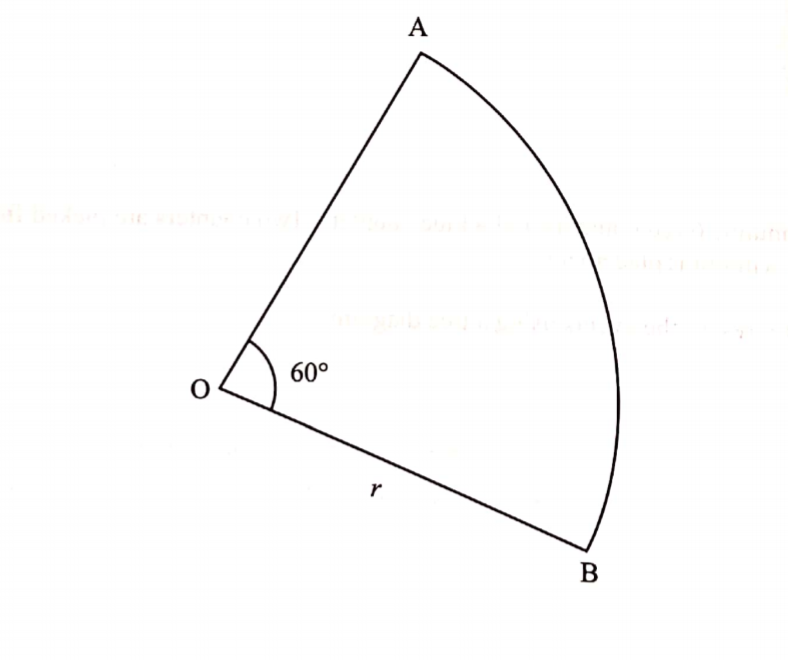
8. OAB is a Sector Of a circle of radius r cm. Angle AOB = 60°.

Find, in its simplest form, an expression in terms of r and z for the perimeter of the sector.(2 marks)

9. In a mathematics test, the scores obtained by 30 students were rccordcd as shown in the toblc below.

       Score (x) 59 61 65 K 71 72 73 75
      No. of students 2 3 5 6 7 4 2 1

The score K with a frequency of 6 is not given.

Given that ⅀fd∕⅀f = — 1.2 where d —— x – 69, and using an assumed mean of 69, determine score K.

10. Determine the amplitude and the period of the function y = 3 sin(2x + 40°). (4 marks)

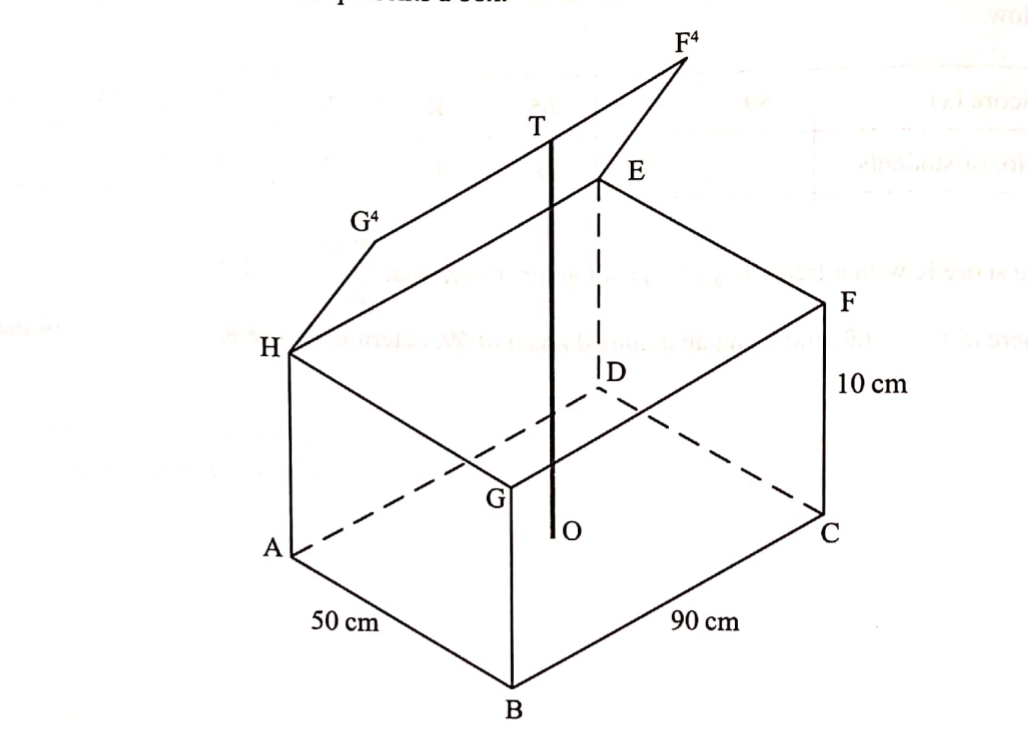
11. The figure ABCDEFGH represents a box.

The top lid of the box is opened such that the height OT is 35cm. Calculate the:

(a ) angle the top lid makes with the plane FGHE;

(b) length BE, correct to 2 decimal places.

12. The table below’ shows income tax rates in a certain year.

Monthly Income in ksh Tax rate  in each shilling
(%)
0  – 10164 10
    10165 – 19740 15
     19741 – 29316 20
     29317 – 38892 25
      38893 and above 30

In that year,mawira earned a salary of 41000 per month.calculate mawira’s income tax per month given that a monthly tax relief of ksh 1162 was allowed (3 marks)

13. The position vectors of points A,B and C are OA =[3/4],OB = [1/2] and OC =[7/-1] show that A,B and C are collinear (3 marks)

14. The vertices of a triangle PQR are P(-3, 2), Q(0, — 1) and R(2, — 1). A transformation matrix maps triangle PQR onto triangle P’Q’ R’ whose vertices are P'(—7, 2), Q'(2, — 1) and R’(4, – 1).

Find M°’, the transformation that maps P’Q’R’ onto PQR.(4 marks)

15. Solve for x in log(7x—3) + 2 log 5 = 2 + log(z + 3).(4 marks)

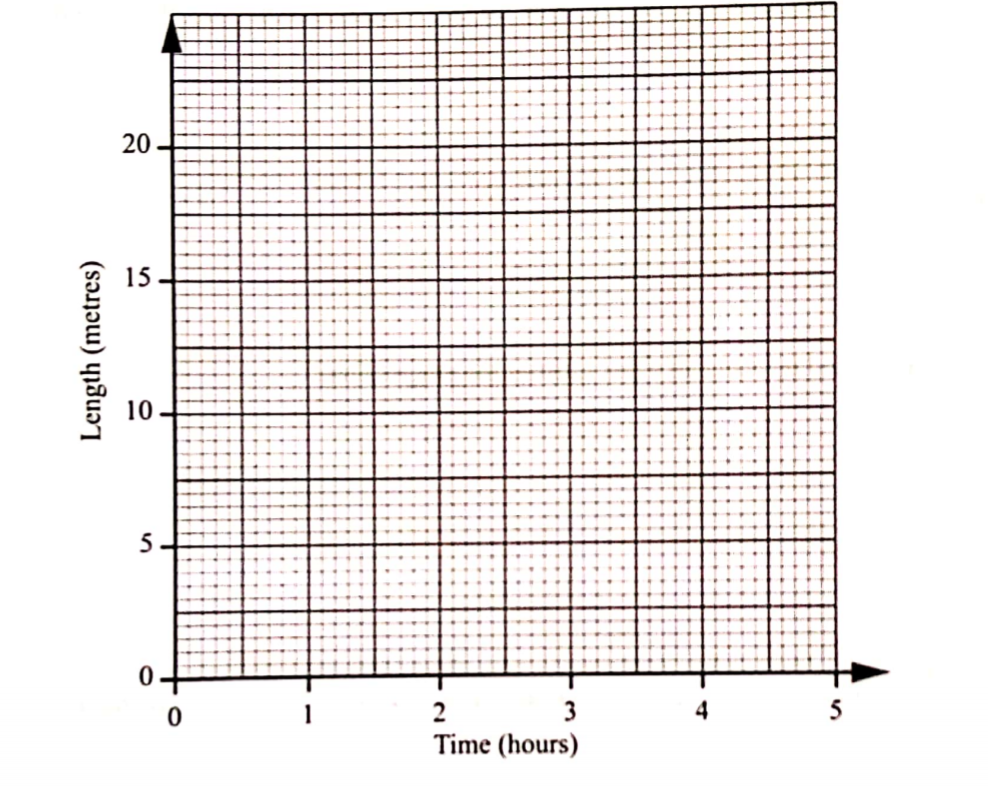
16. The length of a shadow’ of a mast was measured at intervals of 1 hour and recorded as shown in the table below.

Time( hr) 0 1 2 3 4 5
Length( m) 18.7 8.7 5.0 2.9 1.3 0

(a) On the grid prov’ided, draw the graph of length against time. (2 marks)

(b) Dctermine the rate of change of the shadow’ length at = 2 (2 marks)

SECTION II (50 MARKS)

Answer any five questions

17.The first term of an Arthmetic Progression(AP) is equal to the first term of a Geometric Progression (GP). The second team of the AP is equal to the fourth term Of the GP while the tenth term of the AP is equal to the seventh term of the GP.

(a) Given that a is the first term and d is the common difference of the AP while r is the common ratio of the GP, write the two equations connecting the AP and the GP. (2 marks)

(b) Find the value of r that satisfies the progressions.(4 marks)

(c) Given that the tenth term of the GP is 5120, find the values of a and d.(2 marks)

(d) Calculate the sum of the first 20 terms of the AP.( 2 marks)

18. Mbaka bought some plots at Ksh 400000 each. The value of each plot appreciated at the rate of 10% per annum. (a) Calculate the value of a plot after 2 years. (2 marks)

(b) After some time t, the value of a plot was Ksh 558400. Find i, to the nearest month. (4 marks)

(c) Mbaka sold all the plots he had bought after 4 years for Ksh2 928200.

Find the percentage profit Mbaka made, correct to 2 decimal places. (4 marks)

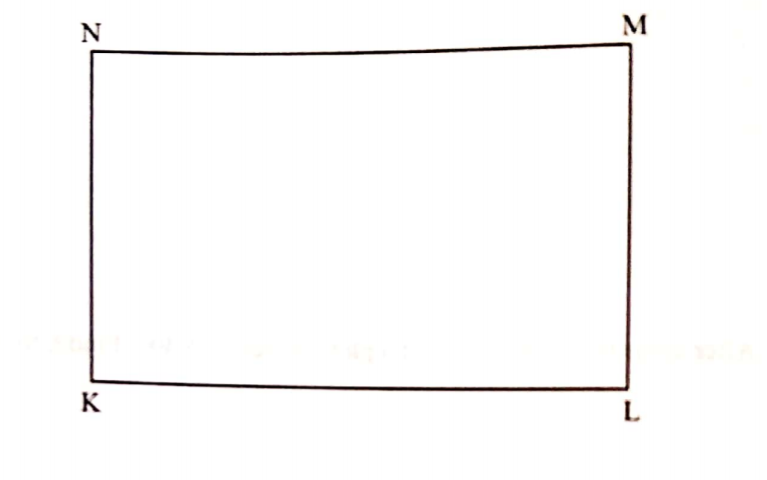
19. The figure KLMN below is a scale drawing of a rectangular piece of land of length KL = 80m

(a) On the figure, construct

(i) The locus of a poini P which is both equidistant trom points L and M It and from lines KL and LM. (3 marks)

(ii) the locus of a point Q such that ∠KQL = 90°. (3 marks)

(b) (i) Shade the region R bounded by the locus of Q and th Locus of poinis equidistant from KL and LM. (3 marks)

(ii) Find the area of the region R in m². (Take ℼ= 3.142). (3 marks)

20. A ship left point P(l0°S, 40°E) and sailed due East for 90 hours at an average speed of 24 knotS to a point R.

(Take I nautical mile (nm) to be 1.853 km and radius of the earth to be 6370 km) (a) Calculate the distance between P and R in:

(i) nm; (1 marks)

(ii) km. (1 marks)

(b) Determine the position of point R.( 5 marks)

(c) Find the local time, to the nearest minute, at point R when the time at P is II:00a.m. (3 marks)

21. A workshop makes cupboards and tables using two artisans A and B every cupboard made requires 3 days of work by artisan A and 2 days of work by artisan B.

Every table made requires 2 days of work by artisan A and 2 days of work by artisan B.

In one month artisan A worked in less than 24 while artisan B Worked for Not More Than 18 Days.

The workshop made x cupboards and y tables in that month.

(a) Write all the inequalities which must be satisfied by x and y. (3 marks)

(b) Represent the inequaliiies in (a) on the grid provided.(3 marks)

(c) The workshop makes a profit Of Ksh 6 000 on each cupboard and Ksh4 000 on each table.

Find the number of cupboards and the number of tables that must be made for maximum profit and hence determine the maximum profit. (4 marks)

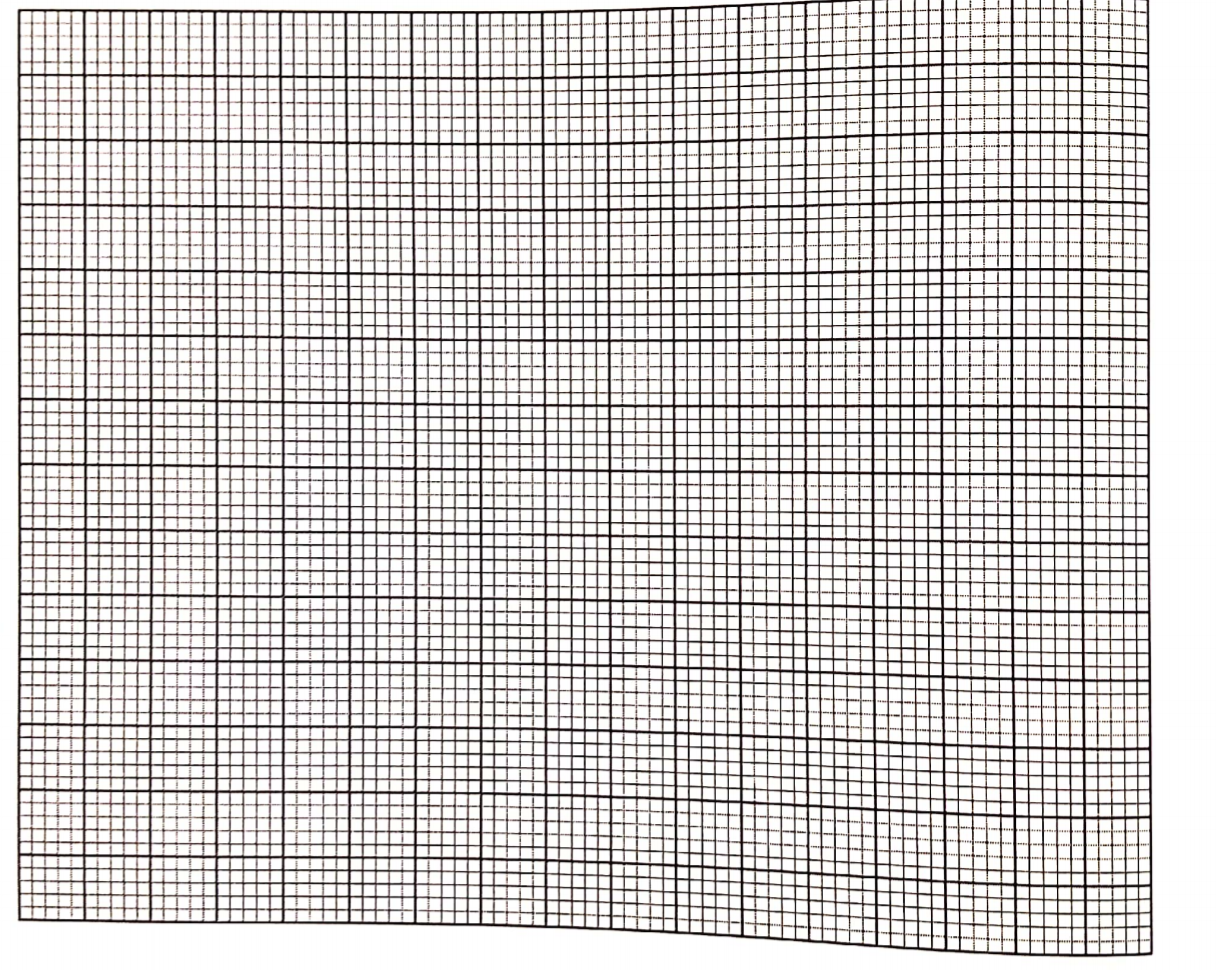
22. The amount of money contributed by a group of students during a fundraising for a needy student was as shown in the table below.

Amount(  Ksh) 301 – 400 401 – 500 501 – 600 601 – 700 701 – 800 801 – 900 901 – 1000
No. of students    2      10 12 14 7 3      2

(a) On the grid provided draw an ogive to represent the data. (4 marks)

(b) Use the graph to estimate:

(i) The median; (1 marks)

(ii) The quartile deviation; (3 marks)

(iii) The percentage number of students who contributed at least Ksh 750.50. (2 marks)

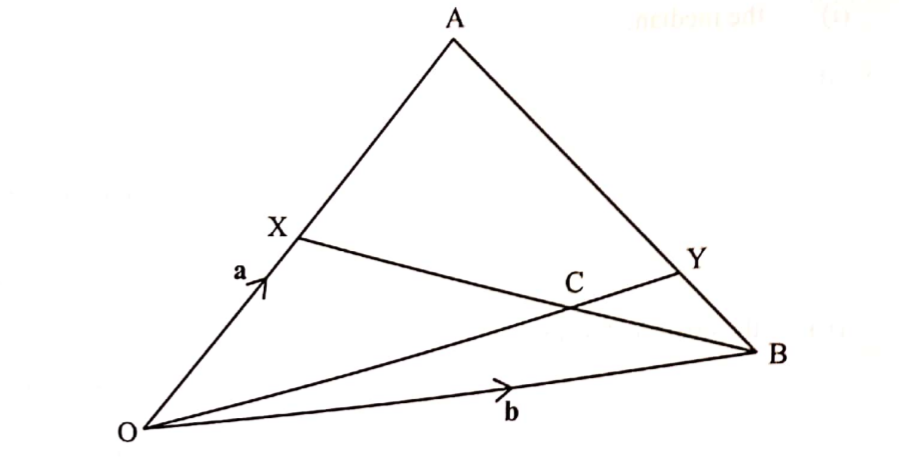
23. In the figure below, OA = a,OB = b and BX meets OY at C.OX:OA = 1:2 and BY:YA = 1:3.

(a) Express in terms of a and b: (1 marks)

(ii) OY; (2 marks)

(iii) BX. (1 marks)

(b) Given that OC = hOY and BC = kBX, determine the values of h and k. (6 marks)

24. A trapezium PQRS with vertices P(2, 2), Q(6, 2), R(6, 4) and S(2, 8) is mapped onto P’Q’R’5′ by a transformation matrix M = (—1/0 0/1).

(a) Find the coordinates of P’Q’R’ S’.(2 marks)

(b) On the grid provided draw PQRS and its image P’Q’R’S’ (2 marks)

(c) Find P”Q”R”S“, the image of P’Q’R’S’ under the transformation matrix. N = (-½/0 0/-½)(1 marks)

(ii) On the same Grid draw P”Q”R‘S”.(1 marks)

(d) (i) Find a single matrix that maps P”Q”R’S” onto P’Q’R’S’.(2 marks)

(ii) Describe fully the transformation thai maps P”Q”R”S” onto P’Q’R’s’.(2 marks)

KCSE Past Papers Mathematics 2019 (121/2)