KCSE Past Papers 2019 History and Government (311/1)

History and Government

History and Government paper 1

SECTION A (25 marks)

Answer all questions in this section

1. Identify Evo theories which explain the origin of man. (2 marks)

2. State two ways in which the Agikuyu interacted with the Maasai during the pre-colonial period.(2 marks)

3. Name the original homeland of the River-Lake Nilotes of Kenya. (1 mark)

4. Identify the main economic activity of the Akamba during the pre-colonial period. (1 mark)

5. Give one advantage of dual citizenship to a Kenyan. (1 mark)

6. State two ways in which national integration has promoted economic development in Kenya. (2 marks)

7. Identify one minority group whose rights were protected by the Constitution of Kenya at independence.(1 mark)

8. Outline two advantages of indirect democracy as practised in Kenya. (2 marks)

Give the type of human right which is violated if a person is unlawfully detained. (1 mark)

10. State two demands of the African Elected Members’ Organization (AEMO) presented to the Colonial Secretary in 1957. (2 marks)

Give the main contribution made by Tom Mboya which improved the welfare of workers during the colonial period.(1 mark)

12. Outline two types of cases which are determined by the Kadhis courts in Kenya. (2 marks)

13.Give two reasons that may lead to the removal of a County Governor from office in Kenya. (2 marks)

14. Identify one National Security organ of the Republic of Kenya. (1 mark)

15. Give one classification of land ownership enshrined in the Constitution of Kenya. (1 mark)

16. State two roles played by Theatre in nation building. (2 marks)

17. Give the main reason why president Daniel Arap Moi banned ethnic organisations in 1979. (1 mark)

SECTION B (45 marks)

Answer any three questions from this section

18. (a) Outline three factors that enabled the early visitors to come to the East African Coast before 1500 AD. (3 marks)

(b) Explain six effects of the Indian Ocean Trade on the East African Coastal inhabitants before 1500 AD. (12 marks)

19. (a) Give three reasons why the British used direct rule in Kenya.(3 marks)

(b) Explain sia results of collaboration between Lenana and the British. (12 marks)

20. (a) Outline three reasons why African reserves were created in Kenya during the colonial period. (3 marks)

(b) Explain six ways in which the construction of the Uganda Railway promoted economic development in Kenya. (12 marks)

21. (a) Identify three political organisations that Ronald Ngala worked with in his political career. (3 marks)

(b) Discuss six contributions of Professor Wangari Maathai in the politics of Kenya. (12 marks)

SECTION C (30 marks) Answer any five questions from this section

22. (a) State five economic challenges which Kenya was experiencing at independenc e. (5 marks )

(b) Discuss five features of African Socialism which was adopted in Kenya after independence.(10 marks)

23. (a) Give five qualities of a good public servant in Kenya. (5 marks)

(b) Explain five functions of the civil service of the National Go vernment of Kenya. (10 marks)

24. (a) State five functions of the Controller of Budget of the Government of Kenya. (5 marks)

(b) Explain five ways in which the recurrent expenditure funds are used by the County governments in Kenya. (10 marks)

Questions and Answers

History and Government paper 1

1. Identify two theories which explain the origin of man.

(i) The Creation Theory

(ii) The Evolution Theory

(iii) The TraditionaÎ/mythica) Theory Any 2 x 1 = 2 marks.

2.State fwO ways in whirh the Agikuyu interacted with the Maasai during the pre-colonial period.

(i) They inter married.

(ii) Ney traded/exchanged goods.

(iii)They borrowed items from each other.

(iv)They raided each other/fought. Any 2 x 1 – 2 marks.

3. Name the original homeland of the River-Lake Nilotes of Kenya.

(i) O Bahr-el-Giiazal/Southern Sudan

4.Identify the main economic activity of the Akamba during the pre-colonial period.

(i) Livestock keeping

5.Give one advanfage of duaf citizeriship to a Kenyan.

(i) persoii can work in either of the countries.

(ii) One can choose to live in either ofthe countries.

(iii) One is entitled to the rights/frecdoiRs pfovided in the Constitution of Kenya.

6. Mate two ways in which national integration has promoted economic development in Kenya.

(i) It has enabled citizens to work/employcd in any part of Kenya.

(ii) It has enabled free movement of goods/services within the country.

(iii) It has enabled citizens to invest/establish businesses in any part of the country.

(iv) It has enabled people to buy property anywhere in the country. Any 2 x l = 2 marks.

7.Identify one minority group whose rights were protected by the Constitution independence.

(i) The Europeans

(ii) The Asians

(iii) Minority indigenous African communities>

8.Outline two advantages of indirect democracy as practised in Kenya.

(i) People exercise their democratic rights/elect leaders of their own choice

(ii) The leaders are accountable to the electorate.

(iii) The electorate/people can vote out/recall their elected leaders.

(iv) People’s views in decision making are taken into account.

9. Give the type of human right which is vîolatcd if a person is unlawfully detained.

The right of movement/freedom of movernent

10.State two demands of the African Elected Members Organization (AEMO) presented to the Colonial Secretary in 1957.

(i) The increase of African elected members in the Legislative Council

(ii) Registration of voters on a common vote

11.Give the main contribution made by Tom Mboya which improved the welfare of workers in Kenya during the colonial period.

– He formed Trade union/workers’ union 1×1=1 mark.

12. Outline two types of cases which are determined by the Kadhi’s courts in Kenya.

(i) Marriage cases.

(ii) Divorce cases.

(iii)Inheritance cases.

(iv)Personal status. Any 2 x 1= 2 marks.

13. Give two reasons that may lead to the removal of a County Governor from office in Kenya.

(i) If he/she violates the Constitution/any other law.

(ii) If he/she commits a crime under nationaUinternational law.

(iii) Due to abuse of office/gross misconduct.

(iv) Due to mental or physical incapacity to perform functions of the office. Any 2 x 1 = 2 marks.

14. Identify one National Security organ of the Republic of Kenya.

(i) Kenya Defence Forces.

(ii) National Intelligence Service.

(iii)National Police Service.

15.Give one classification of land ownership enshrined in the Constitution of Kenya.

(i) Public land.

(ii) Commnunity land.

(iii) Private iand.

16. State two roles playcd by Theatre in nation building.

(i) It educates people on differcnt cultural aspects.

(ii) It provides entertainment.

(iii) It creates employment

(iv) It helps in uniting people

17.Give the main reason why President Daniel Arap Moi banned ethnic organisations 1979

In order to promote national unity

18. (a) Outline three factors that enabled the early visitors to come to the East African Coast before 1500 AD.

(i) The accessibility of the East African Coast from the sea/ocean.

(ii)The development of marine technology/existence of marines./e kr/ I all]

(iii) The existence of monsoon winds.

(iv) The technology/knowledge of boat making.

(b) Explain six effects of the Indian Ocean trade on the East African Coastal inhabitants before 1500 AD.

(i) It led to the development/growth of the city states/towns along the coast like Mombasa which were nc

(ii) Many foreigners settled in the East African Coast thereby increasing the population in the region.

(iii) Islamic code of law/sharia was introduced which was used to govern the coastal city states/people.

(iv) Islamic religion widely spread in the region as many people were converted into it.

(v) Arabic/Persian architecture was introduced which was reflected in the designs of houses/mosques built in the region.

(vi) Islamic education was introduced where Islamic schools/madrassa were constructed.

(vii) There was intermarriage between the early visitors and the coastal inhabitaiis resulting with the new breed of people called Waswahili.

(viii) Kiswahili languange emerged, which was a combination of Bantu and Arabic languagcs.

(ix) There was introduction of new cropslike rice/cloves/millet/fruits which becomes staple foods for the coastal people.

19.Give 3 reasons why te British used direct rule in kenya

(I) Most of the- communistes were statelesss/did not bave elaborate traditional governments

(ii) They wanted to establish full control of the people.

(iii) lt had been used successfully elsewhere.

(iv) They had enough personnel/administmtors.

(v) Some communities were resisting.

(vl) Most of the commnunities hud been weakened by civil wars/famires.

b) Explain six results of the collaboration between Lenana and the British.

(i) The Maasai were evicted/displaced from some of their !ands which was given to the settlers.

(ii) The Maasai lost their independence, hence colonized by the British.

(iii) Lenana was given the position of Pammount Chief by the British in order to please him.

(iv) Maasai warriors wcre employcd as mercenaries and wcrc used to supprcssfbring other communities under colonial rule.

(v) The Maasai were rewarded with livestock which was confiscated from resisting communities

(vi) Lenana was helped to fight his brother Sendeyo whom he forccd together with his followers to move to nothern Tanzania.

(vii) .Through Maasai agreements of 1904 and 1911, they were divided into Laikipia and Ngong reserves.

(viii) The Uganda railway was constructed through Maasai land which enhanced colonial/British administration.

20.Outline three reasons why Africa resereves were created in kenya during the colonial period

(i) In order to check/control the movements of Africans

(ii) In order to control room/tand for settler farming

(iii) To crcate a pool of African labour force.

(iv) To check/ reduce/ curtail/ slow down the spread of nationalist ideas

(v) 1t was a divide and rule tactic

(vi) For easier provision of social amenities to the Africans. Any 3 x I – 3 marks.

(b) Explain sÎx ways in which the construction of the Uganda Railway promoted economic development in Kenya.

. (i) lt provided cheap/easy trnnsportation of goods and services io and from the market.

(ii) lt enhanced thc movement of.labour/workers. thereby enabling them to acce,ss their work places.

(iii) There was development of towns/trading centres/duka wallas developed along the ratlway whicb generated revenuc to the government.

(iv) It created ob opportunities to many people who were employed to man/maintain it.

(v) It opened up agricultural potential areas where both settler and Africans started farming activities.

(vi) Minerals were exploited as there was access to the mines and transport of the products.

(vii) culture-related industrics were established to mainly process agricultural raw materials.

(viii) It promoted local trade as goods could be transported to areas where there wns demand.

(ix) It generated revenue for thc government through charges levied on goods/peop1c transported.

21. Identify three political organizations that Ronald Ngala Worked with in his political career

(I) Coast African Association.

(ii) Kilifi African People’s Union.

(iii) Kenya African Democratic Union.

(iv) Mombasa African Democratic Union.

(v) Kenya African National Union

(b) Discuss six contributions of Prof. Wangari Maathai in the politics of Kenya.

(i) She founded the Green Belt Movement which advanced environmental and political activism in the country.

(ii) She served as the vice-chair and later as the chair of the National Council of Women of Kenya which encouraged the participation of women in political affairs.

(iii) Together with other pro-multiparty democracy activists, she campaigned for the need to have political pluralism in Kenya.

(iv) Together with other activists, she participated in hunger strike in Freedom Corncr/Uhuru Park to put pressure on the government to release political prisoners.

(v) She was an elected Member of Parliament for Tetu Constituency on a NARC ticket where she represented her people.

(vi) She was an assistant minister for Environment and Natural Resources under the NARC government, a forum she used to improve the country’s environment

(vii) She founded the Mazingira Green Party to allow the candidates to run on a platform for environmental conservation.

22. (a) State five economic challenges which Kenya was experiencing at independence.

(i) High poverty levels among the people.

(ii) Africanisation of jobs/economy.

(iii) Unfavourable balance of trade.

(iv) Low salaries/remunerations for Africans.

(v) High unemployment level.

(vi) Inadequate capital for development.

(vii) Redistribution of land/settling landless people.

b) Discuss five features of African Socialism which was adopted in Kenya after independence.

(i) Democracy was_embraced where Africans were encouraged to participate actively.

(ii) Mutualso_ciaLresponsibility, which emphasized the spirit of brotherhood in nation building.

(iii) Private and public ownership of the factors of production would develop hand in hand.

(iv) It emphasized equal job opportunities for all regardless of one’s tribe/religion/background.

(v) Narrowing the gap between the rich and the poor would be achieved through progressive taxation/mutual assistance.

(vi) To provide the needed social services such as education/health which were inadequate.

(vii) Mixed economy was emphasized in order to improve production/living standards of the people.

(viii) Progressive Africanisation of the economy would be achieved without harming/disrupting it.

23 (a) Give five qualities of a good public servant in Kenya.

(i) Efficiency/effectiveness.

(ii)Impartiality

(iii) Accountability/ transparency.

(iv) Integrity.

(v) Professionalism.

(vi) Responsiveness.

(vii) Self-driven/self-motivated.

(b) Explain five functions of the Civil Service of the National Government of Kenya.

(i) It provides services required by the people in various sectors of the economy.

(ii) It keeps government records/documents which ensures continuity in the provision of public service.

(iii) It explains government.policies_to the people in order to make them easily understood by the public

(iv) It maintains law and order/security through various security organs like the Kenya Police/ National Intelligence Services.

(v) It monitors the implcmenlation of government projccts/policics in order to ensure proper use of public resources.

(vi) ft defends the country from external aggression through the Kenya Defence Forces.

(vii) It liaises with other countries/international organizations which conduct business with government.

(viii) Through the Judiciary, it settles disputes which arise among the people.

24. (a) State five functions of the Controller of Budget of the Government of Kenyan

(i) He/She oversees implementation of the budget of the National/County Government.

(ii) He/She authorizes withdrawals of the public funds.

(iii) He ensures that the withdrawals are lawful.

(iv) He/She submits to parliament reports on implementation of budget.

(v) He/She checks. the use of government funds.

(vi) He/She advises the government on budgeting.

(b) Explain five ways in which the recurrent expenditure funds are used by the County governments in Kenya. (10 marks)

(i) They are used to pay salaries/wages to the county government workers who provide services within the county.

(ii) They are used to repair/maintain government facilities in order to keep them in good working conditions.

(iii) They are used to pay loans borrowed to finance operations/activities in the counties.

(iv) They are used in provision of bursaries/sponsor needy students for further studies.

(v) They are used in financing sporting/cultural activities which take place in the counties.

(vi) They are used to pay subscription fee to inter-county associations/programmes in order to sustain their operations.

(vii) They are used.to buy medicine supplies/medicine required in the county health facilities.

(viii) They are used to construct/maintain transport infrastructure in order to ease movement of people/goods in the county/ ease commercial activities.

KCSE Past Papers 2019 Chemistry paper 3 (233/3)

Practical

2019 Chemistry paper 3

1. You are provided with:

Solution A aqueous Iron(III) sulphate.

• Solution B aqueous potassium iodide.

• Solution C mixture of aqueous starch and sodium thiosulphate solution.

You are required to determine the rate of reaction between aqueous Iron(III) sulphate (Solution A) and aqueous potassium iodide (solution B).

Procedure:

(i) Place 5 test tubes on a test tube rack and label them 1, 2, 3, 4 and 5. Fill a burette with solution A.

To each test tube place 3 cm3 of solution A from the burette.

(ii) Clean the burette and fill it with solution B. Place 8 cm3of solution B into a 100 ml beaker from the burette.

(iii) Using a 10 ml measuring cylinder, add 2 c 3 of solution C to the beaker containing Solution B followed by 7 cm3 of distilled water measured using the same 10m1 measuring cylinder.

(iv) Pour the contents of test tube 1 to the mixture in the beaker and immediately start the stop watch.

Swirl the contents of the beaker.

Record in table 1 the time taken for a blue colour to just appear.

Measure the temperature of the final mixture and record in the space provided.

Wash the beaker and proceed to step (v).

Place 6 cm3 of solution B into 100 ml beaker from the burene.

Add 2 cm3 of solution C followed by 9 cm3 of distilled water.

Add solution A in test tube 2 to the mixture in the beaker and immediately start the stop watch.

Swirl the contents of the beaker.

Record in table 1 the time taken for a blue colour to just appear. This is experiment 2.

(vi) Wash the beaker. Repeat step .

(v) With solution A in test tubes 3, 4 and 5 with corresponding volumes of solution B, solution C and distilled water as indicated in table 1 for experiments 3, 4 and 5.

(a) Temperature of final mixture……………………….°C (1 mark)

Experiment Volume (cm³) Time
(seconds)
Solution
A
Solution
B
Solution
C
Distilled
water
      1      3       8      2 7
      2      3       6 2 9
      3      3       5 2     10
      4      3       4      2 11
      5      3       3      2     12

(a) Complète table 2 for each experiment by: (3 marks)

(i) Calculate the square of volume of solution B,B2 and filling in the table.

(ii) calculating the rate of reaction which is given by the expression Rate 1/100 x 1000s-1 and filling in the table.

Experiment Rate = 1/time x 1000s-1
      1
      2
      3
      4
      5

(d) Plot a graph of rate (y-axix)against B2

(e) Using the graph, determine the time that it will take experiment is repeated using the following mixture:

Volume(cm³) of
Solution
A
Solution
B
Solution
C
Distilled water
3 7 2            8

(C) (f).In this experiment the rate of reaction was determined with respect to potassium iodide.

Describe how the rate of the reaction can he determined with respect to Iron(III) (3 marks)

2. You are provided with solid P. Carry out the followin2 tests and record the observations and inferences in the spaces provided.

(a) Place about one-third of solid P in a dry test tube and heat it strongly.

Test any gases produced with red litmus paper.

Observation Inferences

(b) Place the remaining amount of solid P in a boiling tube.

Add about 15 cm3 of distilled water and shake to dissolve the solid.

Use about 2 cm3 portions of the solution in a test tube for each of the tests (i) to (iv).

(i) To the first portion of the solution add aqueous sodium hydroxide.

(ii) To the second ponion of the solution add 2 or 3 drops of aqueous barium nitrate

Observation Inferences

(iii) To the third portion of the solution add 2 or 3 drops of aqueous lead(II) nitrate. Warm the mixture.

Observation Inferences

(iv) To solid D in the test tube add about 2cm of distilled water .shake and labe; this as chlorine water.

Add all the chlorine water to Ito: fourth re/Tiffin (if Shake tile mixture and then add 3 drops of starch solution,

Observation Inferences

(c) Give the formulae of the ions present in solid P: (i) cation ……….. (½ mark)

(ii) Anion …………….(½ mark)

3. You are provided with liquid Q.

Carry out the following tests and record the observation and inferences in the spaces provided.

(a) Place 2 drops of liquid Q on a watch glass. Ignite the liquid with a bunsen burner flame.

Observation Inferences

Place about 2cm3 of liquid Q in a test tube.Add about 2cm3 of distilled water and shake the mixture.

Observation Inferences

(c) To about 2 cm3 of liquid Q in a test tube, add all of the solid sodium hydrogen carbonate provided.

Observation Inferences

(d) To about 2 cm3 of liquid Q in a test tube, add 2 or 3 drops of bromine water.

Observation Inferences

(e) To about 2 cm3 of liquid Q in a test tube, add 2 or 3 drops of acidified potassium dichomate(VI) and warm the mixture.

Observation Inferences

KCSE Past Papers 2019 Chemistry paper 1(233/1)

KCSE Past Papers 2019 Chemistry paper 1(233/1)

Kenya certificate of primary Education

2019 Chemistry paper 1

1. An atom of element A has mass number 39 and 19 protons.

(a) Write the electron arrangements of the atom (1 mark)

(b) State the pcriod and group to which elementt A belongs Group ………………………………….(½ mark)

Period …………………………………..(½ mark)

(c) State whether the element is a metal or a non-metal. (1 mark)

2. Describe how an increase in concentration increases the rate of a reaction. (2 mark)

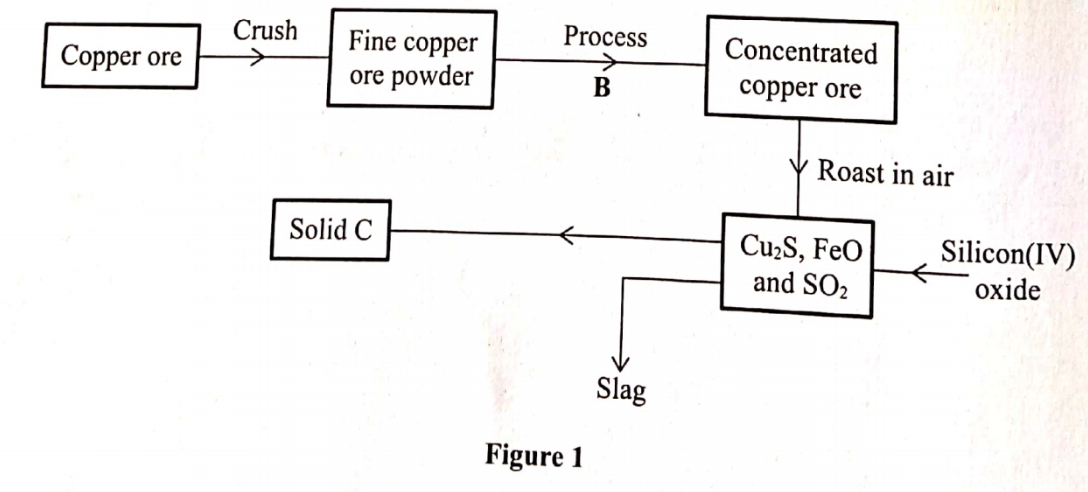
3. The flow chart in Figure 1 represents some stages in the extraction of copper metal. Study it and answer the questions that follow.

(a) Identify :

(i) The copper ore (1 mark)

(ii) Process B (½ mark)

(iii) Solid C (½ mark)

(b) Write an equation for the reaction that forms the slag. (1 mark)

4. A monomer has the following structure.

CH= CH2 ∣ C6H5

(a) Draw the structure of its polymer that contains three monomers.(1 mark)

(b) A sample of the polymer formed from the monomer has a molecular mass of 4992.

Determine the number of monomers that formed the polymer (C= 12; H= 1.0). (2 marks)

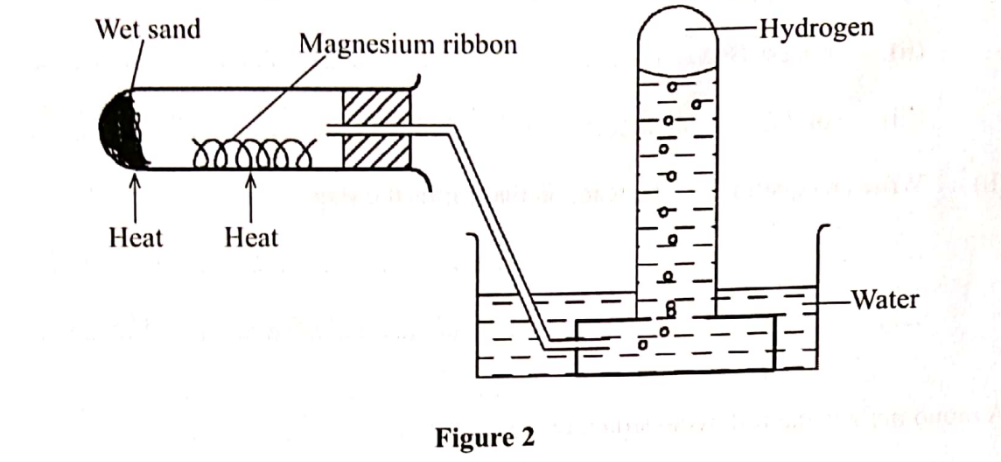
5. Hydrogcn has can be prepared by passing steam over heated magnesium ribbon as shown in the figure 2.

(a) Write an equation for the reaction that produces hydrogen gas. (I mark)

(b) Explain why the delivery tube must be removed from beneath the water before heating is stopped. (1 mark)

(c) Explain why sodium metal is not suitable for this experiment. (I mark)

6. A farmer intended to plant cabbages in his farm. He first tested the pH of the soil and found it to be 3.0.

If cabbages do well in alkaline soils, explain the advice that would be given to the farmer in order to realise a high yield.(2 marks)

7. A solution contains 40.3g of substance XOH per litre .250.0cm3of this solution required 30.0cm3 of 0.3M sulphuric(VI)acid for complete neutralisation. (a) Calculate the number of moles of XOH that reacted. (½ mark)

(b) Determine the relative atomic mass of X. (1½ mark)

8. Table 1 shows the properties of two chlorides, D and E.

Table 1

Chloride Melting Points(°C) Electrical Conductivity
(liquid)
      D            1074          Good
      E              203          Poor

(a) State the type of bond present in:

(i) D…………………..(1 mark)

(ii) E…………………..(1 mark)

(b) Explain in terms of structure and bonding, the difference in electrical activity of the chlorides D and E. (1 mark)

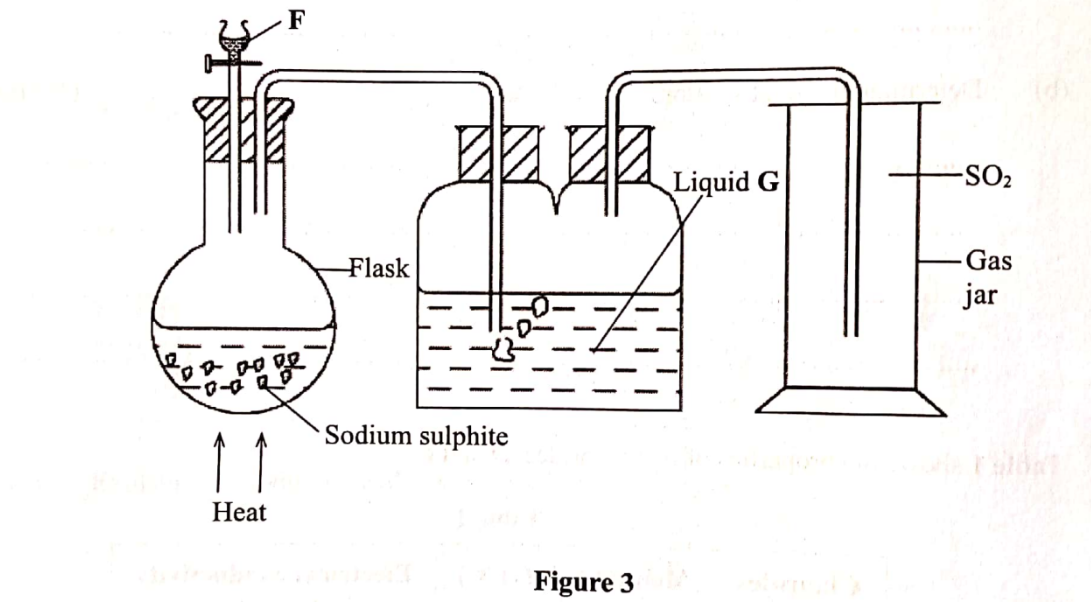
9. Sulphur(IV) oxide is prepared in the laboratory using the set-up in Figure 3.

Study it and answer the questions that follow.

(a) Identify substance F. (1 mark)

(b) Write an equation for the reaction that takes place in the flask. (1 mark)

(c) State the purpose of liquid G. (1 mark)

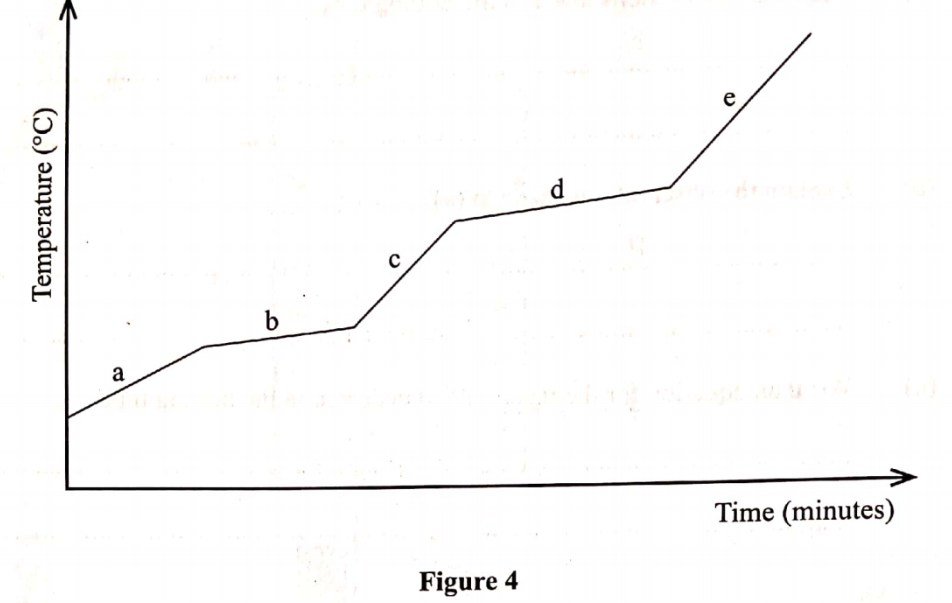
The graph in Figure 4 was obtained when a certain substance was heated and its temperature recorded at regular intervals.

(a) State the purity of the substance. (1 mark)

(b) Explain the answer in (a). (1 mark)

11. Ethene is prepared in the laboratory by dehydration of ethanol.

(a) Name a suitable dehydrating agent used in this process. (1 mark)

(b) State the condition necessary for the reaction to occur. (1 mark)

(C) Write an equation for the dehydration process. (1 mark)

112.A boiling yube filled with chlorine was inverted in a trough containing the same ssolution and the set-up left in sunlight for about 2 hours.

(a) State the observation made in the boiling tube ( 1 mark)

(b) Explain the observation made in (a) (1 mark)

(c) Write an equation for the reaction that occurred in the boiling tube (1 mark)

13. 5 g of calcium carbonate was strongly heated to a constant mass.

Calculate the mass of the solid residue formed (Ca = 40.0; C = 12.0; 0 = 16.0). (2 marks)

14. During laboratory preparation of oxygen, manganese(IV) oxide is added to reagent 11.

(a) Name reagent H. (1 mark)

(b) State the role of manganese(IV) oxide in this experiment. (1 mark)

(c) Write the equation for the reaction that takes place. ( I mark)

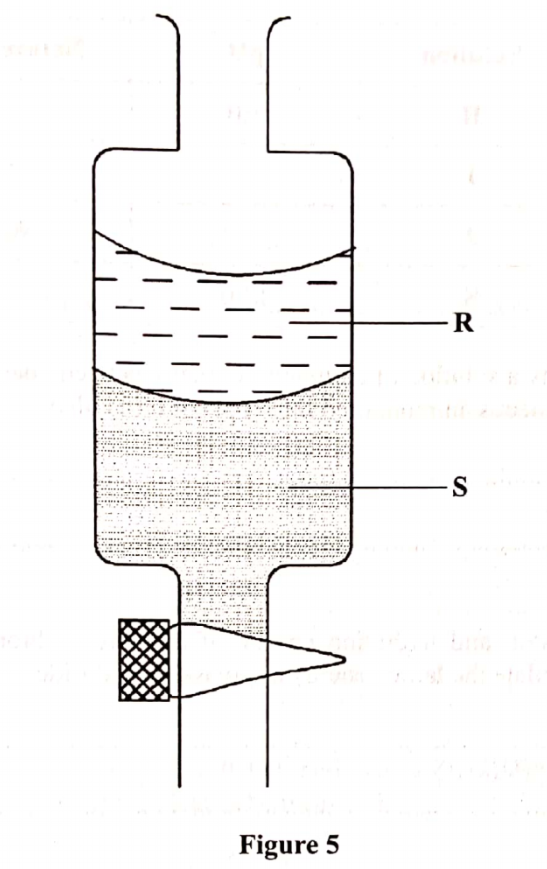
15. Figure 5 shows an apparatus used to seperate a mixture of water and hexene.

(a) Name the apparatus in Figure 5. (1 mark)

(b) State the principle by which the mixture of the two liquids is seperated (1 mark)

(c) Identify the liquids, R and S if the density of hexene is 0.66 g/cm3.

(i) R …………… (½ mark)

(ii) S …………………. (½ mark)

16.(a) Complete the following table.(2 mark)

Solution pH Nature of solution
   H 1.0
   I   Neutral
   J Weak acid
   K                13.0

(b) Explain why a solution of ammonia in methylbenzene has no effects on red litmus paper while in aqueous ammonia red litmus paper turns blue. (1 mark)

17. The heat of solution and hydration energy of potassium chloride is — 17.2 kJ and —689 kJ respectively.

Calculate the lattice energy of potassium chloride. (2 marks)

18. Use the information in Table 2 to answer the questions that follow.

Bond Bond energy(KJ mol(<sub>-1</sub>
C-H                412
  CI-CI               242
C-CI                338
H-C1               431

19. Given that the Eθ of CU(s),CU2+(aq)is + 0.34V and that 0f Zn(s)/Zn2+(aq)is- 0.76V,draw a labelled diagram of zinc and copper electrochemical cell. (3 marks)

20. During labomtory preparation of carbon(IV) oxide g tS. substance L in a conical flask.

(a) Identify substance L. (1 mark)

(b) Write an equation that produces carbon(IV) oxide. (1 mark)

(c) State the observations made when the gas produced WHS bubbled through calcium hydroxide solution for a long time. (1 mark)

21. Study the information in Table 3 and use it to answer the questions that follow. (I mark)

Elements Na Mg Al Si P S Cl
Atomic Numbers 11 12 13 14 15 16 17
Atomic radii(nm) 0.157 0.136 0.125 0.117 0.110 0.104 0.099

(a) Explain the trend in atomic radii from sodium to chlorine. (1 mark)

(b) Explain how the chloride of aluminium differs from those of other metals in the period.(2 marks)

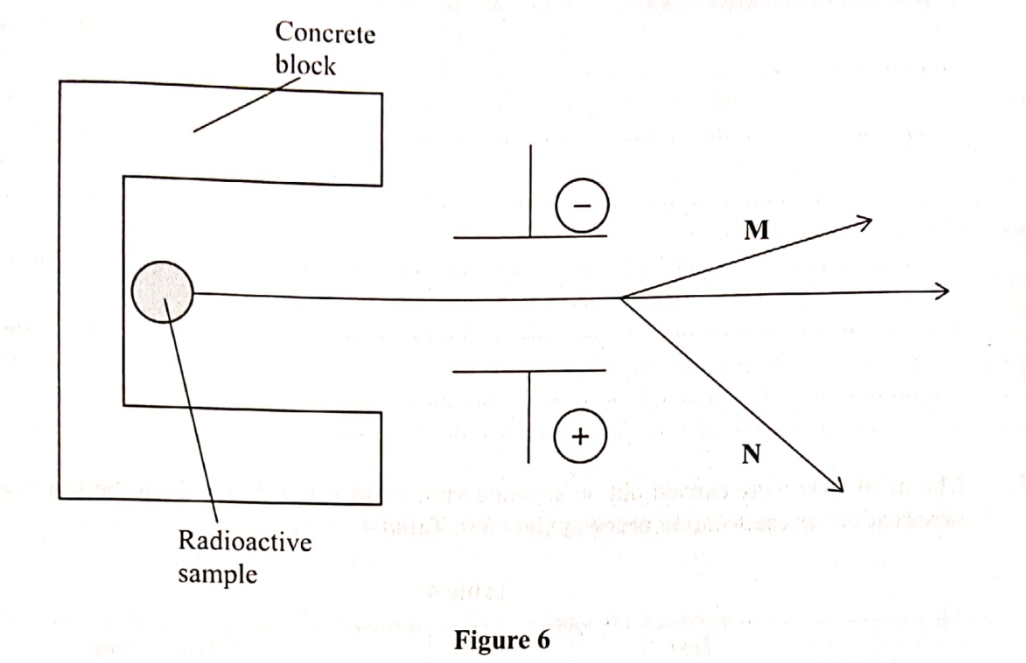
2. The diagram in figure 6 shows radiations emitted by a radioactive sample.

(a) Identify radiations:

(i) M ……………. (1 marks)

(ii) N ……………… (1 marks)

(b) Explain what would happen when a sheet of paper is placed in the path of the two radiations. (1 mark)

16/8 X 18/8 X are isotopes of element X.

They occur naturally in the ratio of 9:1 respectively.

Calculate the relative atomic mass of element X. (2 marks)

24. Starting with copper turnings, describe how a sample of copper (II) Sulphate crystals can be prepared in the laboratory. (2 marks)

25. Chemical tests were carried out on separate samples of water drawn from the same source. The observations made were recorded as shown in Table 4.

        Test Observation
(i) Addition of aqueous calcium chloride No white precipitate
(ii) Addition of dilute sulphuric(VI) acid No effervescence, colourless solution
(iii) Addition of a few drops of acidified
barium nitrate
No white precipitate
(iv) Addition of aqueous ammonia White precipitate dissolves

State the inferences made in reactions:

(i)……………………… (1 mark)

(ii)……………………….. (1 mark)

(iii)…………………………(1 mark)

26. 140cm3of nitrogen gas diffuses through a membranc in 70 seconds. How long will it take 200 cm3of carbon(iv) oxide gas to diffuse through the same membrane under the same conditions of temperature and presurre (3 marks)

27. When burning magnesium ribbon is introduced into a gas jar full of nitrogen, it continues to burn producing a greenish yellow powder.

(a) Write an equation for the reaction between nitrogen and magnesium. (I mark)

(b) Explain why magnesium continues to bum in nitrogen but sulphur does not. (2 marks)

(c) State one use of nitrogen. (I mark)

28. Draw in the space provided a labelled diagram of the set-up of the apparatus that can be used to electrolyse molten lead(II) bromide. (3 marks)

29. Name an appropriate apparatus that is used to prepare standard solutions in the laboratory.( I mark)

2020 KCPE Predictions
2020 KCSE Chemistry Prediction Questions
2020 KCSE Leakage
2020 KCSE Predictions
2020 KCSE Time Table
Biology KCSE 2020
Chemistry KCSE 2020
Cre KCSE 2020
English KCSE 2020
Geography KCSE 2020
History KCSE 2020
KCPE 2020 Predictions
KCPE Prediction Questions
KCPE Predictions 2020
KCSE 2020
KCSE 2020 Exam Timetable
KCSE 2020 
KCSE 2020 Biology
KCSE 2020 Prediction

KCSE Past Papers 2019 Computer Studies Paper 2 (451/2)

KCSE Past Papers 2019 Computer Studies Paper 2 (451/2)

Kenya Certificate of Secondary Education

2019 Computer Studies – Paper 2

1.Form 1 Class Teachers of Mwango secondary school intend to use a data base to manage students o Secondary School intend to use a database to manage students performance in three examinations: opener,mid term and endterm examination.

(n) Open a database program and create a database named analysis.

(1 mark)

(b) (i) Create three tables named Class, StudDetails and StudMarks in the database file created in (a) using the following details: (14 marks)

Class Table

Field Name Data Type and Properties
ClassID ClassID Text (size 2)
ClassName ClassID Text (size 25)
Teacher ClassID Text (size 25)

StudDetails Table

Field Name Data Type and Properties
   AdNo Number
StudName Text (size 25)
Gender Yes/No (yes for female)
ClassID Text (size = 2)
Look up values,IE,IN,IW

StudMarks Table

Field Name Data Type and Properties
AdNo Number
Opener Number
MidTerm Number
EndTerm Number

(ii) Create the relationships between the tables. (2marks)

(iii) Create a form for the Class table and add a subform for the StudDetails table using the format in £gure 1. Save the form as dataentry.

ClassID

ClassName

Teacher

AdNo StudName                    Gender ClassID

(iv) Enter the following data into their respective tables in the database (l2½ marks)

Class TabLe

ClassID ClassName Teacher
                IE Form One East   Elvis Barongo
                IN Form One North    Alice Nadiya
                IW Form One West Paul Mkacharo

StudDetails Table

    AdNo StudName Gender ClassID
7984 Mary Kikoti Female 1E
7460 Erica Kamburi Female 1E
7800 Axlam Khan Male       1E
       8083     Martin Mkanjala Male       1E
      8092     Esther Peresian         Female 1N
8490     Micah Lokiyoto         Male 1N
     8082     Mohamed Ayan Male 1N
    7896 Mark Kwalima         Male     1W
    7892     Morgan Lema        Male 1W
    8184     Emily Mawasi Female 1W
    8047     Edward Omogeni Male 1W
    AdNo Opener MidTerm EndTerm
7984       85 Female 82
7460 73 Female 79
7800        78 Male 86
       8083         81 Male 87
      8092 73         Female 83
8490 71         Male 87
     8082 81 Male 90
7896 88         Male 88
7892      85        Male 89
8184     85 Female 83
8047         90 Male 86

(c) Create a query to display the fields:

(i) AdNO, StlldName, ClassID, Opener, MidTerm and EndTer m for all students in Form One East. Save the query as FIE. (4½ marks)

(ii) AdNo, StudName, ClassID, Opener, MidTerm and EndTerm arld a Calculated field named meanscore to display the average in the three examinations.

Save the query as overall. (6 marks)

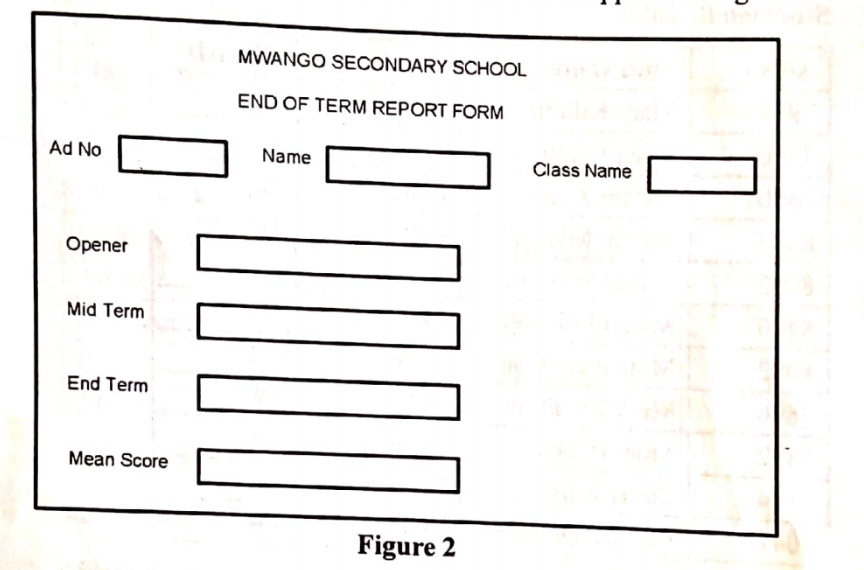
(d) Create a report to display details of each student as it appears in Figure 2 (2 ½ marks)

(e) Print out each of the following: (3 marks)

(i) the three tables

(ii) the two queries

(iii) report for the first two students

2. The Chief Printer of Zenith Printers Company would like to have business cards. As a Desktop Publishing (DTP) expert, you have been tasked to design the card for the officer.

(a) (i) Open a Desktop Publishing program and set the page layout as follows:

• Paper size: 8.5 cm width by 5.5 cm height

• Layout type: multiple pages per sheet

• Target paper size: A4

• Orientation: Portrait

• Margin: 0.75cm all round (5 marks)

(ii) Save the publication as business card. ( 1 mark)

(b) Design the card as it appears in Figure 3 ensuring that the card covers all the space in the page. (42 marks)

(c) Print out 10 copies of the card on a single A4 pnge.(2 mark)

2020 KCPE Predictions
2020 KCSE Chemistry Prediction Questions
2020 KCSE Leakage
2020 KCSE Predictions
2020 KCSE Time Table
Biology KCSE 2020
Chemistry KCSE 2020
Cre KCSE 2020
English KCSE 2020
Geography KCSE 2020
History KCSE 2020
KCPE 2020 Predictions
KCPE Prediction Questions
KCPE Predictions 2020
KCSE 2020
KCSE 2020 Exam Timetable
KCSE 2020 
KCSE 2020 Biology
KCSE 2020 Prediction

KCSE Past Papers 2019 Computer Studies Paper 1 (451/1)

KCSE Past Papers 2019 Computer Studies Paper 1

Kenya Certificate of Secondary Education

2019 Computer Studies – Paper 1

Section A

Answer all the questions in this section

State the hardware technological differences between the second generation and the third generation computers (2 marks)

2. State two ways of ensuring proper ventilation in a computer room. (2 marks)

3. Convert the decimal number 20.373 to its binary number system equivalent. (2 marks)

4. Peter has installed internet in his home computer in order to use it for browsing. State three ways in which he would prevent viruses from infecting his computer. (3 marks)

5. State three ways of transforming a picture embedded in a Desktop Publishing programme in order to fit in a designated space on a document. (3 marks)

6. Differentiate between a line printer and n page printer as used in computers.(2 marks)

7. Describe virtual realitly as used in computers. (2 marks)

8. State the function of cach of the following fetures of an email software:

(a) Inbox (1 marks)

(b) Draft (3 marks)

9. (a) Explain the term loggle key as used in computer keyboard. (2 marks)

(b) List examples of toggle keys on a computer keyboard. (2 marks)

10. State the type of error that would occur in data processing for each of the fol1owing cases:

(a) Entering the number 315 instead of 351. (3 marks)

(b) Entering the text “Kwys” instead of “Keys”. (3 marks)

11. State four factors to consider when selecting an input device for use in a computer room (4 marks)

12. State three functions 0f Un-interrupted power supply (UPS). (3 marks)

13. Distinguish between a page break and a column break as used in a word processor. (3 marks)

l4. State three factors to consider when selecting an operating system to instal in a computer (3 marks)

15. Differentiate between analogue data and digital daia as used in computers. (2 marks)

Section B

Answer question 16 and any other 3 questions from this section.

16. (a) Explain the term dry running as used in program development.(2 marks)

(b) Explain three properties of an algorithm. (6 marks)

(c) To qualify to get a driving license,an applicant must be 18 years or over.

Ten candida tes applied for a driving license test.

Draw a flow chart that would read the name and age of an applicant and display the names of those who qualify, (7 marks)

17.(a) State four outcomes that may result from using incorrect requirement specifications during system development (4 marks)

(b) A school opted to use direct change over approach when installing a new system.

Explain three challenges that die school may face as a result of this approach. (6 marks)

(c) State three reasons that may lead an organisation to instal an intranet.(3 marks)

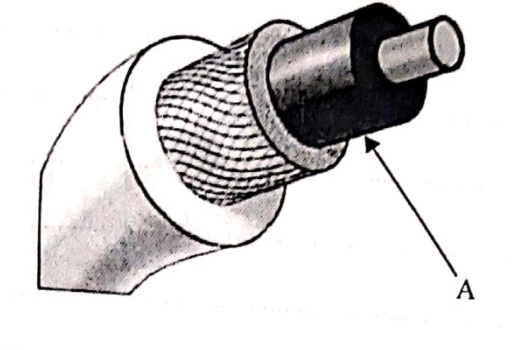
(d) The figure below shows a coaxial cable .State the function of the part labelled A. (2 marks)

18. (a) State three hardware devices that may be required to connect a computer to an existing local area network. (3 marks)

(b) A publisher intends to use a desktop publishing programme to create a publication which is to have many graphics.

State three ways in which the graphics may be acquired for this purpose. (3 marks)

(c) Interpret each of the following spread sheet formula :

(i) =countif(D2:D9,”>”$B4) (2 marks)

(ii) =sumif(B3:B11,”4M”,D3:D11)

(d) (i) The folloiviiig are llie fields of products fable in a database created to store records of products iiianufacturcd in a factory:

• product number

• product name

• price

• product description

1. State the appropriate data type for each field. (2 marks)

II. State three properties to be put in place during table design to ensure integrity of the data entered. (3 marks)

19. Explain three features of a graphical user interface as used in computers (6 marks)

(b) State the function of each of the following computer keyboard keys:

(i) Caps Lock (1 marks)

(ii) Shift (1 marks)

(iii) Home (1 marks)

(c) Using two’s complement notation,determine the value of the operation 2510-2910

(6 marks)

20. (a) Distinguish between computer Aided Instruction (CAI) and computer Aided Learning (4 marks)

(b) (i) State four activities that may be carried out when disposing off an old system in an organisation. (4 marks)

(c) State three benefits gained from the advancement in technology in the music industry (3 marks)

2020 KCPE Predictions
2020 KCSE Chemistry Prediction Questions
2020 KCSE Leakage
2020 KCSE Predictions
2020 KCSE Time Table
Biology KCSE 2020
Chemistry KCSE 2020
Cre KCSE 2020
English KCSE 2020
Geography KCSE 2020
History KCSE 2020
KCPE 2020 Predictions
KCPE Prediction Questions
KCPE Predictions 2020
KCSE 2020
KCSE 2020 Exam Timetable
KCSE 2020 
KCSE 2020 Biology
KCSE 2020 Prediction
KCSE 2020 Prediction Pdf
KCSE 2020 Prediction Questions
KCSE 2020 Predictions
KCSE 2020 Registration
KCSE 2020 Timetable

KCSE Past Papers 2019 Biology Paper 2 (231/2)

KCSE Past Papers 2019 Biology Paper 2

Kenya Certificate of Secondary Education

2019 Biology Paper 2

Answer all the questions in the spaces provided.

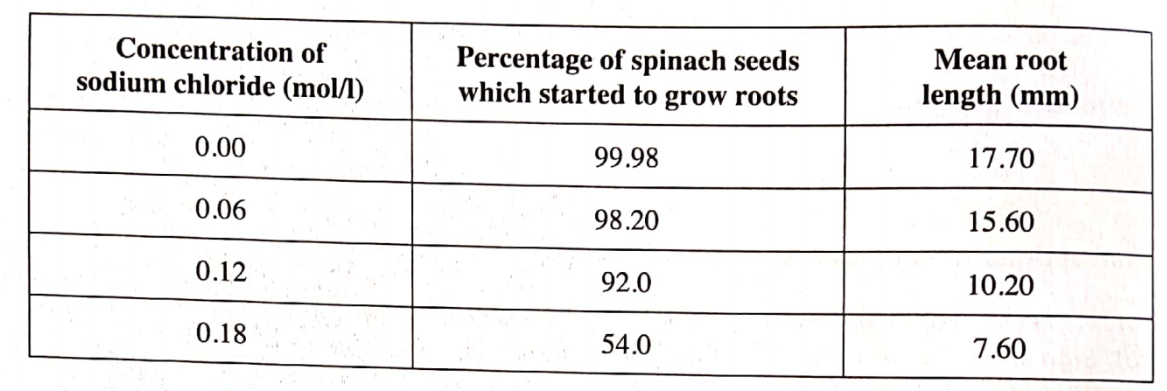
1. In an experiment to investigate the effect of Sodium chloride on the growth rate in a spinach seedling. seeds were treated with different concentrations of sodium chloride. The results are as recorded in the table below.

(a) From the results in the table above, explain the effect of increasing the concentration of sodium chloride. (3 marks)

(b) Apart from a ruler, state two other equipment one would need to determine the rate of growth in the roots. (2 marks)

(c) With a reason, state one other part of the seedling the students would focus on to determine the effect of sodium chloride on growth. (2 marks)

(d) State the likely effect on the seedling of increasing the seedling of increasing the conccntration of sodium chloride to 2.20 mol/I . (1 mark)

2. The table below shows results of blood cell counts per mm° of blood from a sample of people living at different altitudes.

(a) Explain the relationship between:

(i) Red blood cells count and the altitude;(3 mark)

(ii) White blood cells count and the altitude.(3 mark)

(b) Explain why chances of nose-bleeding increase with altitude in humans. (2 marks)

3. (a) State one importance of irritability to living organism. ( 1 mark)

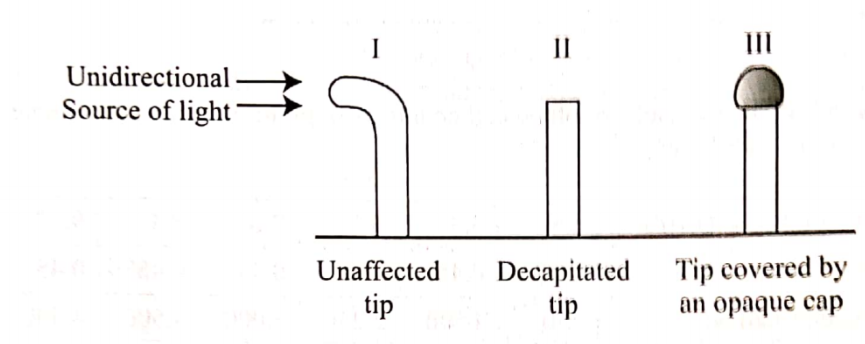
(b) ln an experiment, students treated seedlings as illustrated below.

(i) Account for the observations made in seedling 1 (3 marks)

(ii) Explain the similarity in the end results made in seedlings II and II (2 marks)

(iii) State the likely treatment that would make seedlings II and III respond like seedling I. (2 marks)

4. In cats, the gene for fur colour is sex-linked. Letter G represents the gene for ginger fur colour while letter B represents the gene for black fur colour in a given cot species. These genes are codominant.

Heterozygous females have ginger and black patches of fur rind their phenotype is described as tortoise-shell.

(a) With reference to the information given above, what is meant by the term codominance? (1 mark)

(b) Explain why male cats with a tortoise-shell phenotype do not usually occur. (2 marks)

(c) A tortoise-shell female was crossed with a black male. Determine the genotypes and phenotypes of the offspring. (5 marks)

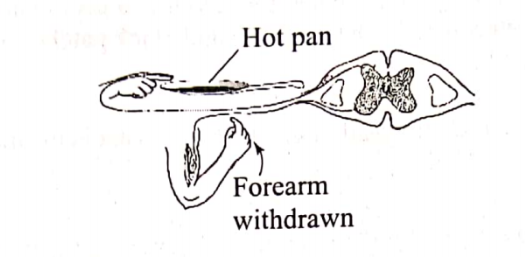
5. A person accidentally touches a hot pan and responds as illustrated in the diagram below.

(a) Explain how the response illustrated above occurs. (6 marks)

(b) Explain how auxins are utilised as selective weed killers in agriculture. (2 marks)

SECTION B (40 Marks)

Answer question 6 (compulsory) and either 7 or 8

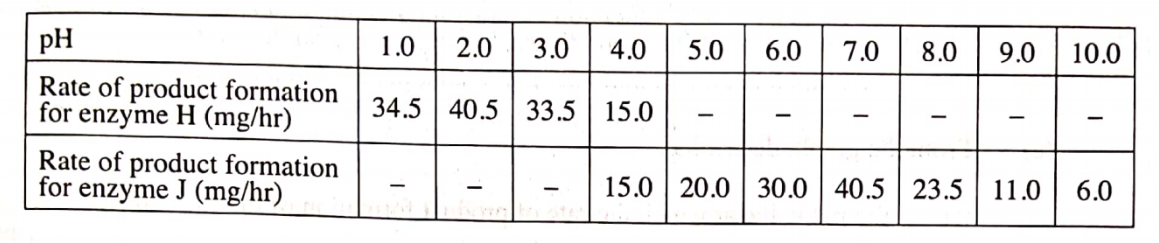
6. The table below shows the rate of product formation for two enzymes, H and J over a range of pH values.

(a) On the same axis, plot graphs of the rate of product formation against pH. (8 marks)

(b) Account for the rate of product formation for enzyme H between:

(i) pH 1.0 and 3.0 (3 marks)

(ii) pH 3.0 and 7.0. (3 marks)

(c) From the graph, determine:

(i) The pH value at which the rate of product formation of the two enzymes was the same (l mark)

(ii) The value of the rate of product formation for enzymes H and I at the pH value stated in (G)(i) above (1 mark)

(iii) The optimum pH value for enzyme J (l mark)

(d) State one variable that may lead to the change in the optimum rate of product-formation of the two enzymes. (l mark)

(e) Suggest with a reason, the likely part of the human alimentary canal where enzyme H would be found. (2 marks)

7.Giving examples,describe the following interactions among organism: (20 marks)

8. Explain the effects of increased physical activity on the following organ systems: (20 marks)

(a) Heart

(b) Lungs

(C) Kidneys

(d) Skin.


2020 KCPE Predictions
2020 KCSE Chemistry Prediction Questions
2020 KCSE Leakage
2020 KCSE Predictions
2020 KCSE Time Table
Biology KCSE 2020
Chemistry KCSE 2020
Cre KCSE 2020
English KCSE 2020
Geography KCSE 2020
History KCSE 2020
KCPE 2020 Predictions
KCPE Prediction Questions
KCPE Predictions 2020
KCSE 2020
KCSE 2020 Exam Timetable
KCSE 2020 
KCSE 2020 Biology
KCSE 2020 Prediction
KCSE 2020 Prediction Pdf
KCSE 2020 Prediction Questions
KCSE 2020 Predictions
KCSE 2020 Registration
KCSE 2020 Timetable

Free KCSE Past Papers Agriculture 2019 (443/2)

Agriculture - Paper 2 -

Agriculture – Paper 2 – November 2019 – 2 Hours

2019 Agriculture Paper 2

CLICK HERE FOR Agriculture PAPER 1

SECTION A (30 marks)

Answer all the questions in this section in the spaces provided.

1. State four effects of fleas in poultry.(2 marks)

2. Name two breeds of dairy cattle with the highest

(a) butter fat content (2 marks)

(b) milk yield (2 marks)

3. State four ways in which vaccines are administered to livestock.(2 marks)

4. State four characteristics of animals which require a high maintenance ration.(2 marks)

5. State four microbial activities that occur in thc rumen.(2 marks)

6. Name four pests that attack bees. (2 marks)

7. Name four mineral deficiency livestock disorders. 8. State four control measures for fowl typhoid.(2 marks)

9. State the function of each of the following:

(a) Mallet (½ marks)

(b) Tocar and canula (½ marks)

(c) Garden line (½ marks)

(d) Stock and die (½ marks)

10. Statc four maintenance practices carried out on a wheelbarrow.(2 marks)

11. State four limitations of biogas as a source of power on the farm.(2 marks)

12. State four function al dİfferenc es between disc and mouldboard ploughs. (2 marks)

13. State fou r advantages of the Kenya Top Bar Hive (K.T.B.H.) over the log hive. (2 marks)

14. Distinguish between the following practices as used in livestock production:

(a) tapping and serving (1 marks)

(b) ringing and raddling (1 marks)

I- (a) Name the causal organism for East Coast Fever. (½ marks)

(b) State three ways in which infectious diseases spread from one animal to another. (1½ marks)

Section B (20 MARKS)

Answer all the questions in this section

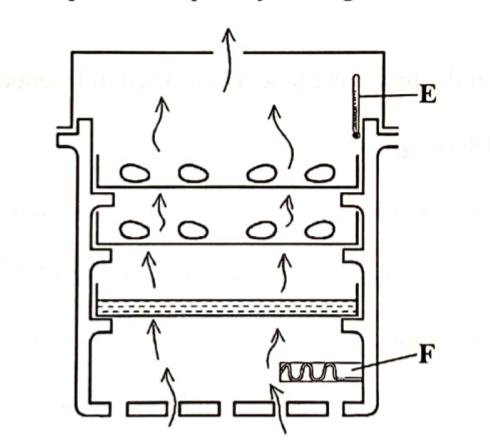
16. The diagram below illustrates a practice in poultry rearing.

(a) Identify the practice.(1 mark)

(b) Name the part labelled

E……………………….. (1 mark)

F………………………….. (l mark)

(c) Explain two activities not shown in the illustration but very important for the practice to succeed. (2 marks)

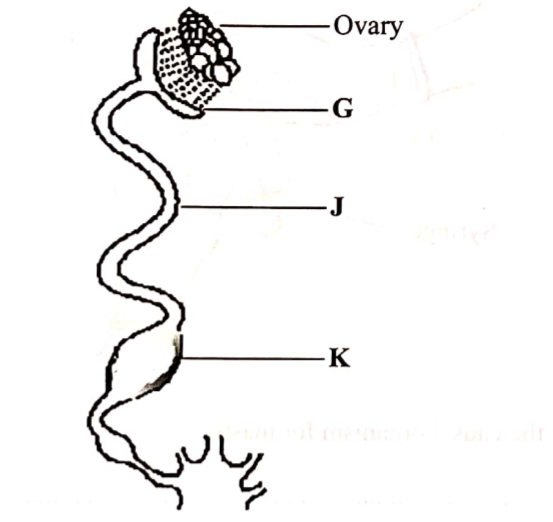
17. The diagram below shows the reproductive system of a hen.

(a) Name the part labelled K (1 marks)

(b) State one function of each of the parts labelled G………………………………(1 marks)

J……………………………….(1 marks)

(C) (i) What is the maximum numbcr of eggs a hen can lay in a day?(1 marks)

(ii) Givc a reason for your answer in (C) (i) above. (1 mark)

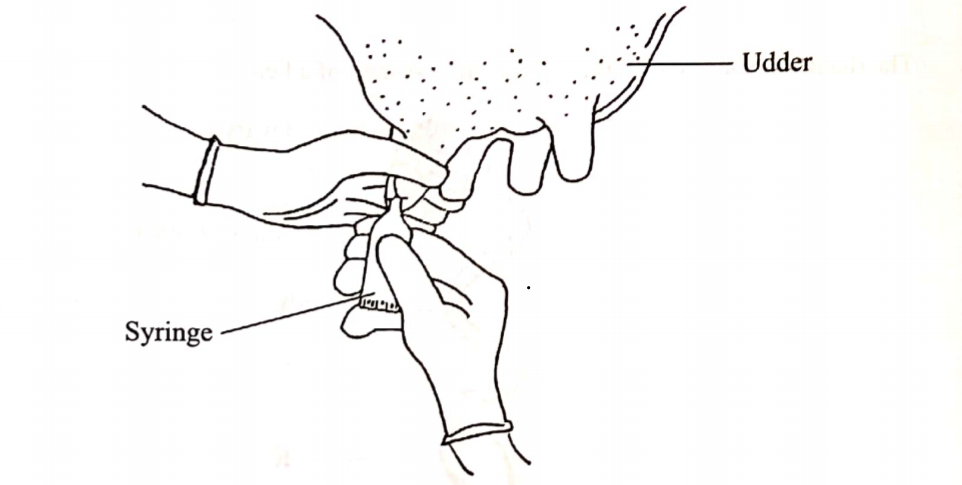
n. The diagram below illustrates a treatment practice for a cow’s udder infected with mastitis.

(a) Name the causal organism for mastitis.(1 mark)

(b) Explain the treatment practice illustrated.(1 mark)

(c) How is mastitis infection detected in a lactating cow? (1 mark)

(d) How is an infected cow handled during milking to prevent spread of the disease to other animals? (2 mark)

19.The diagram below shows a farm structure for storing gains

(a) Identify the farm structure.(1 mark)

(b) State the function of the part labelled L. (1 mark)

(c) State one disadvan tage of the roofing material used on the farm structure. (1 mark)

(d) State two ways in which the structure is made ready for grain storage. (2 marks)

SECTION C (40 marks) Answer any two questions from this section

(a) State five disadvantages of artificial insermination. (5 marks)

(b) State five differences between ruminant and non-ruminant digestive systems. (5 marks)

(c) Describe anaplasmosis (gall sickness) disease under the following sub-headings:

(i) causal organism (1 mark)

(ii) modes of transmission (2 mark)

(iii) symptoms (4 mark)

(iv) control measures. (3 mark)

21. (a) State the functions of any six parts of a piggery unit.(6 mark)

(b) Explain six disadvantages of animal drawn implements. (6 mark)

(c) State eight symptoms of tapeworm infestation in cattle. (8 mark)

22. (a) Explain five precautions taken by dairy farmers to ensure clean milk production. (10 marks)

(b) Describe how chicken is dressed for sale.(10 mark)

CLICK HERE FOR Agriculture PAPER 1

2020 KCPE Predictions
2020 KCSE Chemistry Prediction Questions
2020 KCSE Leakage
2020 KCSE Predictions
2020 KCSE Time Table
Biology KCSE 2020
Chemistry KCSE 2020
Cre KCSE 2020
English KCSE 2020
Geography KCSE 2020
History KCSE 2020
KCPE 2020 Predictions
KCPE Prediction Questions
KCPE Predictions 2020
KCSE 2020
KCSE 2020 Exam Timetable
KCSE 2020 
KCSE 2020 Biology
KCSE 2020 Prediction
KCSE 2020 Prediction Pdf
KCSE 2020 Prediction Questions
KCSE 2020 Predictions
KCSE 2020 Registration
KCSE 2020 Timetable
KCSE Prediction Questions
KCSE Predictions 2020
Kiswahili KCSE 2020
Maths KCSE 2020

Free KCSE Past Papers Agriculture 2019 (443/1)

Free KCSE Past Papers Agriculture 2019 (443/1)

Kenya Certificate of Secondary Education

2019 Agriculture Paper 1

SECTION A (30 marks)

Answer all the questions in this section in the spaces provided.

I. Name four aspects of faÎn fall that afïcct agriculture. (2 marks)

2. State four factors that determine the depth of cultivation. (2 marks)

3. State four factors that influence the quality of farmyard manure.(2 marks)

4. State two factors that determine national income. (1 marks)

5. State four causes of land fragmentation. (2 marks)

6. Name two types of labour records.(2 marks)

7. State four ways in which crop pests are classified.(2 marks)

8. What is the minimum number of people required to form a co-operative society in Kenya? (½ marks)

9. Give two examples of fixed costs in maize production. (1 marks)

10. What is meant by the term production function? (1 marks)

11. State three cliaractcristics of good trccs for agroforestry.(1½ marks)

12. Name two varieties of sorghum grown in Kenya.(1 marks)

13. State four reasons why agriculture is important to Kenya’s economy.(2 marks)

14. Give two reasons why the use of fire is discouraged in land clearing.(1 marks)

15. State four ways in which mulching conserves water.(2 marks)

16. State four uses of fault records.(2 marks)

17. State four characteristics of shifting cultivation.(2 marks)

18. State the law of supply as used in agricultural marketing.(1 marks)

19. State four ways in which trees improve soil productivity.(2 marks)

20. What is meant by the term integrated pest management? (2 marks)

Section B (20 MARKS)

Answer all the questions in this section

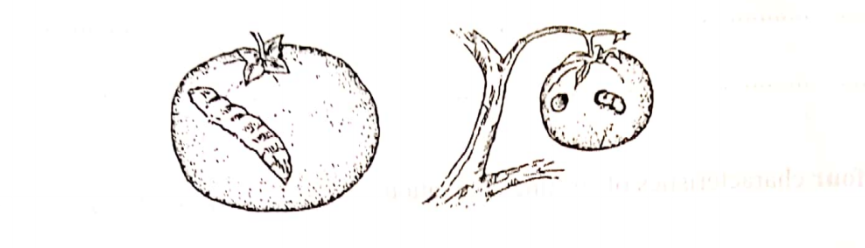
21. The diagram below illustrate a tomato fruit infested by a field pest

(a) Identify the pest. (1 mark)

(b) State two ways in which the pest is economically important. (2 mark)

(c) State two cultural ways of controlling the pest. (2 mark)

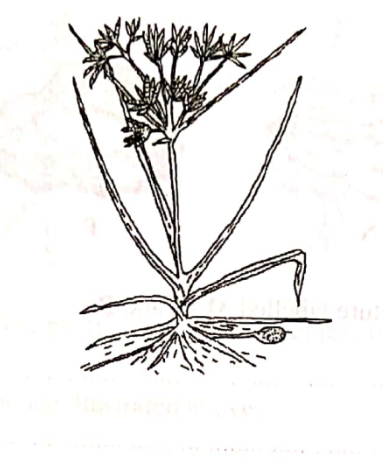
22. The diagram below shows a weed

(a) Identify the weed. (1 mark)

(b) Using features on the diagram, give two reasons why it is difficult to eradicate the above weed. (2 marks)

(c) State two ways in which the weed is economically important. (2 marks)

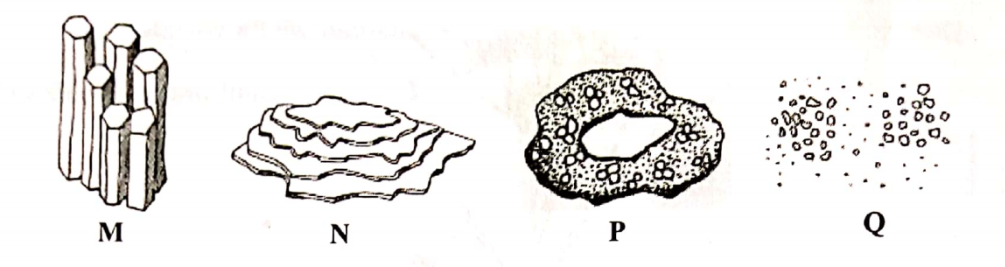
23. The diagram below represent soil structures

(a) Identify the soil structure labelled M, N and P.

M…………………………………( 1 mark)

N…………………………………( 1 mark)

P…………………………………( 1 mark)

(b) Name the type of soil where each of the structures labelled N and Q is found.

N…………………………………..( 1 mark)

Q…………………………………..( 1 mark)

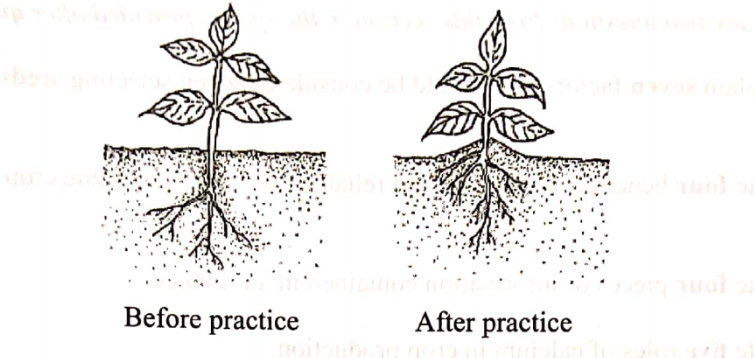
24, The diagram below shows an illustration of a crop field practice.

(a) Identify the field practice illustrated above.(I mark)

(b) Name two crops which require the practice illustrated.(2 mark)

(c) Give two reasons for carrying out the practice on one of the crops you have named in (b) above. (2 marks)

SECTION C (40 marks) Answer any two questions from this section

25. (a) Explain seven factors that should be considered when selecting seeds for planting. (7 marks)

(b) State four benefits of adequate and reliable rainfall in vegetable crop production. (4 marks)

(c) State four pieces of information contained in an invoice.(4 marks)

(d) State five roles of calcium in crop production.(5 marks)

26. (a) Describe how sugar cane is harvested.(5 marks)

(b) Explain four factors that determine the nutrient content of hay.(4 marks)

(c) State seven roles of a farm manager.(7 marks)

(d) Describe four methods used to reclaim a swampy land for agricultural production. (4 marks)

27. (a) Describe the production of carrots under the following subheadings:

(i) land preparation (3 marks)

(ii) planting (4 marks)

(b) Describe six ways in which grass cover helps in soil and water conservation. (6 marks)

(c) Explain seven nursery management practices. (7 marks)

Questions and Answers

2019 Agriculture Paper 1

Coming Soon!………….

KCSE Past Papers Agriculture

KCSE Past Papers Agriculture

KCSE Past Papers Agriculture

KCSE Past Papers Agriculture

2020 KCPE Predictions
2020 KCSE Chemistry Prediction Questions
2020 KCSE Leakage
2020 KCSE Predictions
2020 KCSE Time Table
Biology KCSE 2020
Chemistry KCSE 2020
Cre KCSE 2020
English KCSE 2020
Geography KCSE 2020
History KCSE 2020
KCPE 2020 Predictions
KCPE Prediction Questions
KCPE Predictions 2020
KCSE 2020
KCSE 2020 Exam Timetable
KCSE 2020 Leakage
KCSE 2020 Leakage Biology
KCSE 2020 Prediction
KCSE 2020 Prediction Pdf
KCSE 2020 Prediction Questions
KCSE 2020 Predictions
KCSE 2020 Registration
KCSE 2020 Timetable
KCSE Prediction Questions
KCSE Predictions 2020
Kiswahili KCSE 2020
Maths KCSE 2020
When Will KCSE 2020 Be Done

Kahuhia Girls High School KCSE 2019 Results

Kahuhia Girls High School

In 2019 KCSE examination results, Kahuhia Girls’ High School an extra-County Secondary School in Kahuro Sub-County, posted a good school mean score of 8.543 to emerge the third top best school in Murang’a County.

Kahuhia Girls’ High School is a Girls’ boarding secondary school in Murang’a County.

269 candidates from the school sat for the 2019 KCSE examinations, and 240 out of them managed the KUCCPS university direct entry.

Despite being an extra county school only 29 students scored a mean grade of C and below.

The school did not have any student scoring D, D- or E grade.

Kahuhia Girls’ High School KCSE 2019 Results

Here are the KCSE 2019 results for Kahuhia Girls’ High School, Murang’a County.

KAHUHIA GIRLS’ HIGH SCHOOL KCSE RESULTS 2019
Grade Entry
A 5
A- 25
B+ 56
B 57
B- 50
C+ 47
C 18
C- 9
D+ 2
D 0
D- 0
E 0
X 0
ENTRY
PASS%
KCSE 2019
269
89.2
8.543


Details about Kahuhia Girls High School

  • Physical Location: Off Muranga-Kangema Road.
  • Address: P.O BOX 66-10206 ,Kahuhia.
  • City/Town : Murang`a. County:
  • Code : Phone Number: 0727 288234.
  • Address‎: ‎P.O BOX 66-10206 ,Kahuhia
  • Email‎: ‎info@kahuhiagirls.ac.ke/
  • Phone Number‎: ‎0727 288234

Muranga High School KCSE 2019 Results

Murang’a High School

Muranga High School, is a public Catholic Sponsored- secondary school that posted a very good school mean score of 9.273 in 2019 KCSE examination results and emerged the best top school in Murang’a County.

Muranga High School is a boys boarding secondary school in Murang’a County.

A total of 311 candidates from the school sat for the 2019 KCSE examinations and 289 out of them managed the KUCCPS university direct entry.

Out of all the 2019 candidates who sat for the examinations, only 22 students scored grade C and below.

Muranga High School KCSE 2019 Results

Here are the KCSE 2019 results for Muranga High School, Murang’a County.

MURANG’A HIGH SCHOOL KCSE RESULTS 2019
Grade Entry
A 13
A- 53
B+ 89
B 75
B- 39
C+ 20
C 18
C- 4
D+ 0
D 0
D- 0
E 0
X 0
ENTRY
PASS%
KCSE 2019
311
92.9
9.273

Details about Muranga High School

  • Physical Location; Kangema Muranga road, Kanyenya-ini, Kangema
  • Phone: 0724 167 580
  • Website: http://www.murangahigh.sc.ke/