KCSE Past Papers 2018 Business Studies Paper 2 (565/2)

KCSE Past Papers 2019 Business Studies Paper 2

Kenya Certificate of Secondary Education

2018 Business Studies paper 2

1. (a)Explain five circumstances that may lead to the existence of a business opportunity to be exploited by the entrepreneur. (10 marks)

(b) Explain five factors that Chuma Steel Manufacturers may consider when choosing a channel for distributing their products. (10 marks)

2. (a)Explain five clauses that must be specified in the Memorandum of Association of a public limited company. (10 marks)

(b) The following information was extracted from the books of Kisababu Traders on 31 December 2014:

Details Sh
Sales 84,0000
Purchases 58,000
Opening Stock 15,700

Required:

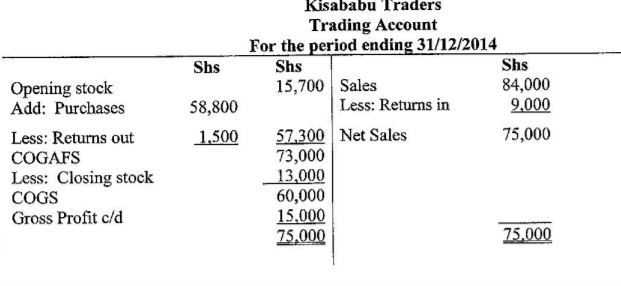
i. Prepare Kisababu Traders Trading Account for the period ending 31 December 2014. (5 marks)
ii. Work out Kisababu Traders percentage mark up.(2 marks)

iii. Calculate Kisababu Traders Rate of Stock Turnover.(3 marks)

3. (a)Explain five demerits of using carts as a means of transport in towns. (10 marks)

(b) Explain five types of direct taxes that the government may use to collect revenue from individuals and companies. (10 marks)

4. (a)The demand for soft drinks has been on the increase. Explain five factors that may have contributed to this. (10 marks)

(b) Describe five forms of economic integration that countries may join to promote international trade. (10 marks)

5. (a) Explain five differences between an open office and an enclosed office. (10 marks)

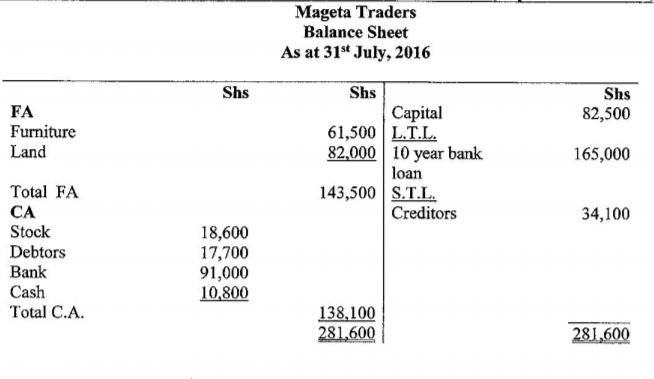
(b) The following opening balances were extracted from the books of Mageta Traders on 1 July 2016:

The following transactions took place in the course of the month:

— Paid a creditor Sh4,500 in cash.

— Took Sh3,000 from the bank for family use.

— Bought stock Sh 18,600 on credit.

— Acquired a 10 year bank loan Sh 165,000 which was credited to the business bank account.

— Purchased land worth Sh 82,000 paying by cheque.

Converted a family table worth Sh5,500 to business use.

— Received Sh 7,300 in cash from debtor.

Required: Prepare Mageta Traders Balance Sheet at the end of July 2016 (10 marks)
6. (a) Explain five problems of using national income statistics to compare the living standards of citizens of Kenya and Tanzania. (10 marks)

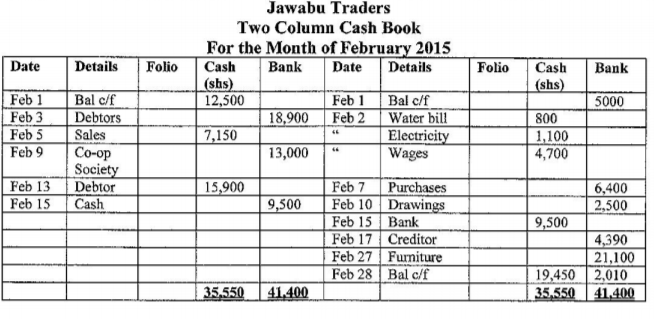
(b) Use the transactions given below to prepare Jawabu Traders two column cash book for the month of February 2015. (10 marks)

1st Feb.Had Sh 12,500 cash and a bank overdraft of Sh 5,000

2nd Feb.Used cash to pay for water bill Sh 800, electricity Sh 1,100 and wages Sh4,700.

3rd Feb.Received a cheque of Sh 18,900 from a debtor

5th Feb.Sold goods worth Sh 7,150 in cash.

7th Feb.Paid for goods bought for resale worth Sh 6,400 by cheque.

9th Feb.Received a cheque of Sh 13,000 from the co-operative society as earnings from dividends.

10th Feb.Withdrew Sh 2,500 from the bank for family use.

13th Feb.Received Sh 15,900 in cash from a debtor.

15th Feb.Deposited Sh9,500 from the office into the business bank account.

17th Feb. Paid a creditor by cheque Sh4,390.

27th Feb.Used all the money in the bank to purchase furniture leaving only a balance of Sh2,010.
Questions and Answers

2018 Business Studies paper 2

1. (a)Explain five circumstances that may lead to the existence of a business opportunity to be exploited by the entrepreneur. (10 marks)


  • Lack of some products/services.Custoiners may need some products/services which are not easily found in their area.
  • Higher prices of goods/services.Existing market prices may be unnecessarily high hence offering them at relatively lower prices would create an opportunity.
  • Excess demand.When the quantities of goods available in the market are not sufficient, an opportunity to supply more exist.
  • Low quality products.When customers expect better quality products then, this presente an opportunity to offer them.
  • Sub-standard services.An opportunity will exist where better services are offered in the distribution of goods.
  • Un-met sociocultural needs/conditions.Goods and ses ices should target the society’s existing attitudes, practices and beliefs which existing products may not be addressing.
  • Innovation.Discovery of new technology which may lead to reduced costs of production and general efficiency presents an opportunity.

    (b) Explain five factors that Chuma Steel Manufacturers may consider when choosing a channel for distributing their products. (10 marks)

  • The geographical spread of customers.If the customers are spread over a wide area, then a longer channel would be preferable.
  • Durability of the steel products.Since steel products are not easily spoilt, long channels can be used ln their distribution.
  • Level of competition.Shorter channels should be used if competition is so stiff.
  • Resources and size of the firm.If the firm has limited resources and only serves a small market, then a shorter channel is ideal.
  • Government policy.Chuma steel manufacturers must adhere to government regulation on the distribution of steel products.
  • Marketing risks.Where marketing risks are higher, more middlemen should be involved to spread such risks.
  • Availability of intermediaries.Chuma Steel Manufacturers can only use channels where intermediaries are available.
  • Pricing of the steel products.Shooter channels will be preferred where the prices are to be kept low by avoiding the intermediaries.

    2. (a)Explain five clauses that must be specified in the Memorandum of Association of a public limited company. (10 marks)

  • The Name Clause.This clause states the name of the company and ends with the word “limited”. This name must be unique to the company and not shared with any other.
  • The Objects Clause.This clause states the objectives of the company and specifies what the company has powers to do.
  • The Situation Clause.This clause states the physical location of the company’s registered office.
  • The Liability Clause.This clause states the extent to which members are fiable to the debts of the company.

    Shareholders and members have “limited liability”.

  • The Capital Clause.This clause states the amount of capital that the company is authorized to raise, the capital structure, the composition and the values of the shares.
  • Association and Subscriptions Clause.This clause contains a declaration by the original members who registered the company about their desîre to form a company, their objectives, the number of shares they will owri and their personal details.

    (b) The following information was extracted from the books of Kisababu Traders on 31 December 2014:

    Details Sh
    Sales 84,0000
    Purchases 58,000
    Opening Stock 15,700

    Required:

    i. Prepare Kisababu Traders Trading Account for the period ending 31 December 2014. (5 marks)

    ii. Work out Kisababu Traders percentage mark up.(2 marks)Mark up = GP/COGS x 100

    15,000/60000 x 100

    60, 000

    = 25%

    iii. Calculate Kisababu Traders Rate of Stock Turnover.(3 marks)

    Rate of Stock Turnover = COGS./Average Stock

    60,000/(O.P. Stock * C.L. Stock)

    60, 000

    15, 700x 3000 2

    60000/14350

    =4 times

    3. (a)Explain five demerits of using carts as a means of transport in towns. (10 marks)

    (i) Carts are prone to delays occasioned by their slow speed.

    (ii) Movement of carts is affected by extreme weather conditions like rainfall.

    (iii) They are unsuitable for transporting goods over long distances as people and animals get tired when pulling them.

    (iv) Carts offer little protection to goods against damage by elements of weather such as rain.

    (v) Goods transported by carts are susceptible to theft making it an unsuitable means of transporting valuable goods.

    (vi) Carts cannot carry very heavy and bulky goods since their carrying capacity is limited.

    (vii) Carts inconvenience motor vehicles and other road users since they are slower.

    (viii) Carts may be a cause of accidents since those pulling them usually disregard traffic rules.

    (b) Explain five types of direct taxes that the government may use to collect revenue from individuals and companies. (10 marks)

  • Personal Income Tax (P.A.Y.E.).This is tax charged on an individual’s income which may be from salaries, wages and profits made from businesses. This tax is usually progressive in nature.
  • Corporation Tax.This tax is usually charged on the profits made by companies and other incorporated business. It is a fixed percentage of the profits.
  • Capital Transfer Taa.This tax is charged when there is change of ownership of capital investment from one person to another.
  • Stamp duty.This tax is charged on the transfer of land or securities from one person to another.
  • Capital gains tax.This tax is charged when an asset is sold at a price that is higher than its book value.
  • Estate (death) duty.This tax is levied when property is transferred to an inheritor/ heir after the death of the original owner.
  • Wealth tax.This tax is levied on personal wealth that goes beyond a certain limit. This wealth may include realizableassets like land, houses, accumulated profits and even savings.
  • Withholding tax.This tax is levied on savings like pension dividends and any moneys held by individuals.

    4. (a)The demand for soft drinks has been on the increase. Explain five factors that may have contributed to this. (10 marks)

  • Favourable pricing.The soft drinks are priced at a value that consumers can easily afford.
  • Increasing consurner incomes.People are able to buy more of the products due to increased earnings.
  • High prices of substitutes.Most of the products in the market that can serve as substitutes are hîghly priced hence not preferred by buyers.
  • Favourable tastes and preferences.More consumers now like soft drinks as compared to other drinks.
  • Favourable government policies which keep the prices of soft drinks down/stable hence encouraging their consumption.
  • General increase in population.With more people, more of the products are consumed.
  • Aggressive marketing/sales promotion.More consumers are attracted to soft drinks due to intense advertising and other promotional strategies.
  • Equitable distribuôon of income among consumers.Since many people have access to earning, they are able to buy more of the products.

    (b) Describe five forms of economic integration that countries may join to promote international trade. (10 marks)

  • Preferential Trade Area.In this form ofi integration, trade barriers are reduced among the member nations while the barriers are applied at normal rates for trading activities with non-member nations.
  • Free trade area.This is economic integration where all trade barriers are removed between the member countries while each country retains its own barriers towards non-members.
  • Customs union.In this form of integration, tariffs and other trade barriers are removed between member countries whiletheir trade policies are harmonized with regard to treatment of trade with the rest of the world.
  • Common market.This integration goes beyond harmonizing trade policies and removal of trade barriers but also allows for free movement of labour and capital among member nations.
  • Economic union.In this form of integration, member countries set up common institutions like central banks, adopt use of common currency (monetary system) and have common public services like railways network.
  • Duty-free zones.Member countries allow importation of raw materials without charging duty. Exports from these zones to member countries also attract no excise duty.
  • Political union.In this form of integration, several states form a central government through which, share a central bank, the defense and core ministries that run their affairs.

    5. (a) Explain five differences between an open office and an enclosed office. (10 marks)

    Open Office

    (a) All staff work in one large room.

    (b) There is no confidentiality in consultations and discussions.

    (c) Senior staff sit together with the juniors hence no status conferred.

    (d) Office equipment and machines are easily shared and cannot be misused.

    (e) Disruptions and noise from colleagues is high due to overcrowding.

    (f) Has fewer partitions hence cheap to construct.

    (g) It is easy to supervise the staff since they are all in one room

    Enclosed Office

    (a) Each staff is allocated a room from where they work.

    (b) Discussions and consultations are done in confidence.

    (c) Confers status on tap level staff as they are allocated own offices.

    (d) Office equipment and machines like telephones are easily misused since they are located in particular offices.

    (e) Little noise and disruption from colleagues since each staff work from own offices.

    (f) Has more partitions hence costly to construct.

    (g) It is difficult to supervise the staff since they are in different rooms.

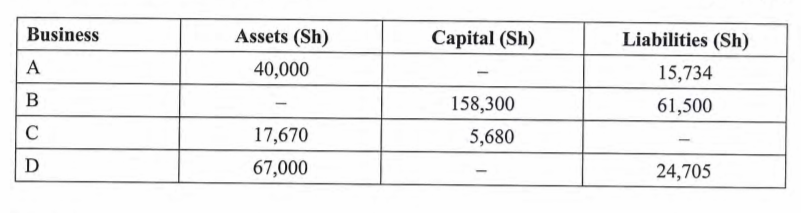
    (b) The following opening balances were extracted from the books of Mageta Traders on 1 July 2016:

    The following transactions took place in the course of the month:

    — Paid a creditor Sh4,500 in cash.

    — Took Sh3,000 from the bank for family use.

    — Bought stock Sh 18,600 on credit.

    — Acquired a 10 year bank loan Sh 165,000 which was credited to the business bank account.

    — Purchased land worth Sh 82,000 paying by cheque.

    Converted a family table worth Sh5,500 to business use.

    — Received Sh 7,300 in cash from debtor.

    Required: Prepare Mageta Traders Balance Sheet at the end of July 2016 (10 marks)

    6. (a) Explain five problems of using national income statistics to compare the living standards of citizens of Kenya and Tanzania. (10 marks)(i) The two countries may have used different currency values to calculate their national income hence different standards of measure.

    (ii) One country could be having a large subsistence sector whose income may not have been included in the measure of their income.

    (iii) The levels of income distribution in one country may be too skewed compared to the other which may have a fair income distribution.

    The two countries may have different references and economic priorities. The two countries could be differcnt in terms of resource endowment hence different abilities to generate income.

    (vi) The climatic conditions in the two countries may be different leading to difference in demand and production.

    Production activities may affect the health of citizens in the two countries differently. The political realities in the two countries could be different affecting their stability and the security of citizens.

    (ix) The degree of accuracy of the national income statistics .

    (b) Use the transactions given below to prepare Jawabu Traders two column cash book for the month of February 2015. (10 marks)

    1st Feb.Had Sh 12,500 cash and a bank overdraft of Sh 5,000

    2nd Feb.Used cash to pay for water bill Sh 800, electricity Sh 1,100 and wages Sh4,700.

    3rd Feb.Received a cheque of Sh 18,900 from a debtor

    5th Feb.Sold goods worth Sh 7,150 in cash.

    7th Feb.Paid for goods bought for resale worth Sh 6,400 by cheque.

    9th Feb.Received a cheque of Sh 13,000 from the co-operative society as earnings from dividends.

    10th Feb.Withdrew Sh 2,500 from the bank for family use.

    13th Feb.Received Sh 15,900 in cash from a debtor.

    15th Feb.Deposited Sh9,500 from the office into the business bank account.

    17th Feb. Paid a creditor by cheque Sh4,390.

    27th Feb.Used all the money in the bank to purchase furniture leaving only a balance of Sh2,010.

kcse exam 2020
kcse 2020 English
kcse 2020 prediction
kcse 2020 mathematics prediction
kcse 2020 biology prediction
kcse 2020 biology paper 1
kcse 2020 timetable
kcse computer project 2020 question paper
kcse past papers
kcse past papers 2018
kcse past papers 2018 pdf download
FREE KCSE 2017 PAST PAPERS (QUESTIONS, MARKING SCHEMES AND REPORTS)
KCSE 2016 PAST PAPERS (QUESTIONS, MARKING SCHEMES AND REPORTS)
KCSE 2015 PAST PAPERS (QUESTIONS, MARKING SCHEMES AND REPORTS)
KCSE 2014 PAST PAPERS (QUESTIONS, MARKING SCHEMES AND REPORTS

 

KCSE Past Papers 2018 Business Studies Paper 1 (565/1)

Business Studies

Kenya Certificate of Secondary Education

kcse questions and answers 2018


2018 Business Studies paper 1

1. Outline four features of labour as a factor of production. (4 marks)

(a)…………….

(b)…………….

(c)…………….

(d)…………….

2. Outline four ways in which peace within a country may encourage entrepreneurial development.(4 marks)

(a)…………….

(b)…………….

(c)…………….

(d)…………….

3. State four duties of the office clerk. (4 marks)

(a)…………….

(b)…………….

(c)…………….

(d)…………….

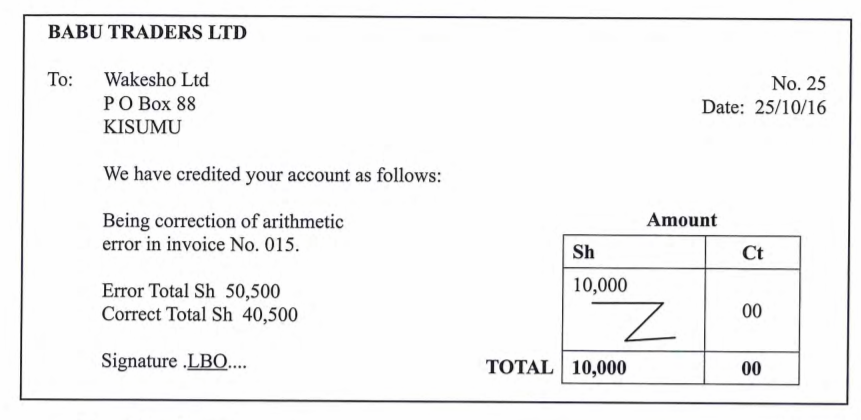
4. The document shown below is used in home trade.

(a) Identify the document(1 marks)

(b) Outline three circumstances under which the above document may be used. (3 marks)

(i)…………….

(ii)…………….

(iii)…………….

5. State four measures that may be taken by the government to control inflation. (4 marks)

(a)…………….

(b)…………….

(c)…………….

(d)…………….

6. Outline four measures that may be taken by the government to curb unemployment. (4 marks)

(a)…………….

(b)…………….

(c)…………….

(d)…………….

7. Highlight four benefits of national income statistics to the government.(4 marks)

(a)…………….

(b)…………….

(c)…………….

(d)…………….

8. Fill in the spaces in the table below: (4 marks)

9. State four categories in which the various types of business partners may be classified.(4 marks)

(a)…………….

(b)…………….

(c)…………….

(d)…………….

10. Highlight four ways in which the government creates an enabling environment for the conduct of business in the country. (4 marks)

(a)…………….

(b)…………….

(c)…………….

(d)…………….

11. Outline four roles of transport in the facilitation of trade.(4 marks)

(a)…………….

(b)…………….

(c)…………….

(d)…………….

12. State three circumstances under which firms would form a cartel.(3 marks)

(a)…………….

(b)…………….

(c)…………….

13. Outline four conditions under which a manufacturer would distribute his products through the wholesaler. (4 marks)

(a)…………….

(b)…………….

(c)…………….

(d)…………….

14. State four reasons for maintaining a cash book in a business enterprise. (4 marks)

(a)…………….

(b)…………….

(c)…………….

(d)…………….

15. Apart from the forces of demand and supply, list four other ways in which the price of a product may be set. (4 marks)

(a)…………….

(b)…………….

(c)…………….

(d)…………….

16. Outline four factors that would make two people taking the same type of life assurance policy with the same insurer to pay different amounts of premium. (4 marks)

(a)…………….

(b)…………….

(c)…………….

(d)…………….

17. State the line of communication involved in each of the following: (4 marks)

(a)…………….

(b)…………….

(c)…………….

(d)…………….

(a) The Manager of ABC Company Ltd talking to the Manager of XYZ Company Ltd.

(b) A secretary asking for time off from her boss.

(c) The Production Manager giving instructions to the Secretary of the Sales Manager.

(d) The Store Keeper giving explanations to the Chief Accountant.

18. List four books of original entry that may be used to record transactions affecting stock.(4 marks)(4 marks)

(a)…………….

(b)…………….

(c)…………….

(d)…………….

19. Highlight four external economies of scale that a firm may get when operating on a large scale.(4 marks)

(a)…………….

(b)…………….

(c)…………….

(d)…………….

20. The following information was extracted from the books of Leila Traders on 31st July 2016:

Details Sh

Capital 90,000

FixedAssets 80,000

Cash in hand 20,000

Current liabilities 20,000

Stock 20,000

Net profit 15,000

Drawings 5,000

Calculate:

(a) Capital owned

(b) Acid test ratio

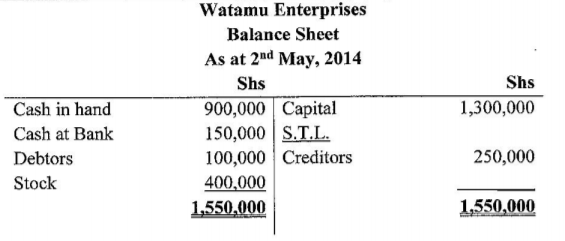
21. Watamu Enterprises had the following assets and liabilities on 1st May 2014:

Particulars Sh

Equipment 800,000

Capital 1,200,000

Creditors 100,000

Debtors 200,000

Stock 250,000

Cash at bank 50,000

The following transactions took place on 2nd May 2014:

(i) Bought goods for re-sale Sh 150,000 on credit

(ii) A debtor paid Sh 100,000 by cheque

(iii) Sold the equipment for Sh900,000 cash

Required: Prepare Watamu Enterprises balance sheet after the above transactions. (5 marks)

22. Outline four merits of indirect taxes.(4 marks)

(a)…………….

(b)…………….

(c)…………….

(d)…………….

23. Highlight four ways in which the technological environment may improve business performance.(4 marks)

(a)…………….

(b)…………….

(c)…………….

(d)…………….

24. Identify the types of ledger in which each of the following accounts would be found: (4 marks)

Account Type of ledger

a Otieno (buyer)

b Carriage outwards

Mueni (supplier)

d Cash at bank

25. Highlight four ways in which the introduction of money helped eliminate problems faced in barter trade. (4 marks)

(a)…………….

(b)…………….

(c)…………….

(d)…………….

Questions and Answers

2018 Business Studies paper 1

1. Outline four features of labour as a factor of production. (4 marks)

(a) Labour is perishable/cannot be stored.

(b) It is not separable from the labourer.

(c) The quality of labour is variable.

(d) It is mobile/can move from one place to another.

(e) It earns salary/wages.

(f) It is a basic factor of production.

2. Outline four ways in which peace within a country may encourage entrepreneurial development.(4 marks)

(a) Entrepreneurs are assured of the safety of their investment hence encouraged to invest.

(b) Funds are availed for investment instead of being spent on provision of security.

(c) There is free movement of factors of production which motivates trade.

(d) There is free interaction between people which encourage sharing of business ideas.

(e) Reduced cost of insurance due to lower risks.

(f) Increased markets since even foreigners feel free to trade with the locals.

(g) Stable complementary institutions like banks and warehouses which encourage business.

3. State four duties of the office clerk. (4 marks)

(a) handling mails.

(b) Duplicating and operating various office machines.

(c) Filing and indexing.

(d) Record keeping and simple book keeping.

(e) Helps in store-keeping.

(D) Ordering, receiving, storing and issuing of stationery.

4. The document shown below is used in home trade.

(a) Identify the document(1 marks)

Credit note

(b) Outline three circumstances under which the above document may be used. (3 marks)

(b) Circumstances under which the document is used include:

(i) When correcting arithmetic error resulting into overcharge.

(ii) Where the buyer has been charged higher prices than the recommended price.

(iii) When items included in the invoice were not delivered.

(iv) When a deserved discount is not given.

(v) When the buyer has returned some goods.

(vi) When empty crates /packaging for which a deposit had been paid are returned.

5. State four measures that may be taken by the government to control inflation. (4 marks)

(a) Setting minimum and maximum wage limits to control salaries

(b) Restricting imports.

(c) Controlling of exports.

(d) Restricting terms of hire purchase and credit terms of sale.

(e) Price control.

(f) Offer of subsidies and other incentives to local producers.

(g) Controlling the supply and circulation of money in the economy.

6. Outline four measures that may be taken by the government to curb unemployment. (4 marks)

(a) Diversification of economic activities.

(b) Control of population growth.

(c) Adoption of policies that encourage labour intensive methods of production.

(d) Partner with the private sector to create employment.

(e) Adopting relevant education system.

(f) Encouraging direct foreign investment.

(g) Encouraging efficient exploitation and use of locally available resources.

(h) Availing investment funds through favourable credit like the Youth Fund and Uwezo Fund.

7. Highlight four benefits of national income statistics to the government.(4 marks)

(a) Provides information on the country’s economic performance over a period of time.

(b) Provides information to be used for making economic policies/budgeting/planning.

(c) Provides information on the contribution of each sector of the economy to the national income.

(d) Provides a breakdown on consumer expenditure and government expenditure.

(e) Provides information on the distribution of income.

( Provide information on the types of factor incomes in the economy.

(g) Provide statistics for measuring the economic growth of the country.

(h) Provides information that is used to measure the standard of living in the country.

(i) Provide information used for comparing economic performance of the country across two or more years.

8. Fill in the spaces in the table below: (4 marks)

A.24,266

B.219,800

C.11,990

D.42,295

9. State four categories in which the various types of business partners may be classified.(4 marks)

(a) By capital contribution.

(b) By extent of liability to be borne.

(c) By activity (part played in the day-to-day running of the business).

(d) By age.

10. Highlight four ways in which the government creates an enabling environment for the conduct of business in the country. (4 marks)

(a) Provision of credit facilities at favourable rates.

(b) Ensuring political stability and good will.

(c) Training and educating the population to create a pool of skilled manpower.

(d) Marketing of final products for producers.

(e) Provision of essential social amenities like water and sewerage, health and education.

(f) Favourable policies andeasy procedures like licensing, subsidies and favourable taxation.

(g) Provision of infrastructure.

11. Outline four roles of transport in the facilitation of trade.(4 marks)

(a) Facilitates the movement of factors of production and other inputs like raw materials.

(b) Enables goods to be moved to the market from their point of production.

(c) Adds value to goods and services by moving them to the point of consumption.

(d) Opens up new markets.

(e) Makes it possible for the exploitation of natural resources.

(f) Allows for specialization since it allows people to access goods produced elsewhere.

(g) Promotes mass production since goods can be moved to be stored and sold elsewhere.

12. State three circumstances under which firms would form a cartel.(3 marks)

(a) When there is need to control output by each firm.

(b) When there is need to be in control of market prices.

(c) When there is need to eliminate stiff competition among the firms.

(d) When there is need to restrict entry of new firms into the market.

(e) When there is need to increase the firms’ bargaining power.

() When there is need to guarantee the income and financial strength of the firms.

13. Outline four conditions under which a manufacturer would distribute his products through the wholesaler. (4 marks)

(a) When it is the dictate of government policy.

(b) When the manufacturer needs time to concentrate on production.

(c) When he wants to avoid the high costs of distribution.

(d) Where it is too expensive to distribute using the manufacture’s ohm outlet.

(e) Where wholesalers prefer to market the product under their own brand names.

(f) Where the manufacturer wants to avoid marketing risks like drop in prices.

(g) When the wholesaler provides ready cash while purchasing in bulk.

(h) Where the manufacturer needs to free storage space.

14. State four reasons for maintaining a cash book in a business enterprise. (4 marks)

(a) To reduce the number of entries made into the general ledger.

(b) To easily avail cash balances/show cash balances at a glance.

(c) To enhance specialization in book keeping by allocating different ledgers to different workers.

(d) To easily monitor the cash inflow and outflow.

(e) To show the sources of funds into the business.

(f) To show the expenditure in the business.

15. Apart from the forces of demand and supply, list four other ways in which the price of a product may be set. (4 marks)

(a) Auction

(b) Haggling (Bargaining)

(c) Price legislation/price control

(d) Price discrimination

(e) Tendering

(f) Retain price maintenance

16. Outline four factors that would make two people taking the same type of life assurance policy with the same insurer to pay different amounts of premium. (4 marks)

(a) Differences in their ages.

(b) Difference in their occupations and the risks they are exposed to.

(c) Difference in their sum assured.

(d) Difference in their places of residence.

(e) Difference in their health status.

(f) Deferring maturity period of their policies

17. State the line of communication involved in each of the following: (4 marks)

(a) The Manager of ABC Company Ltd talking to the Manager of XYZ Company Ltd.


  • Horizontal communication(b) A secretary asking for time off from her boss.
  • Upward vertical communication(c) The Production Manager giving instructions to the Secretary of the Sales Manager.
  • Downward diagonal communication(d) The Store Keeper giving explanations to the Chief Accountant.
  • Upward diagonal communication18. List four books of original entry that may be used to record transactions affecting stock.(4 marks)(a) Purchases journal.

    (b) Sales journal.

    (c) Sales returns journal/Returns inwards journal.

    (d) Purchases returns/Returns outwards journal.

    19. Highlight four external economies of scale that a firm may get when operating on a large scale.(4 marks)

    (a) Ready market from the surrounding industries.

    (b) Access to skilled labour force.

    (c) Enjoy improved infrastructure.

    (d) Easy disposal of wastes.

    (e) Readily available complementary services like banking, insurance and warehousing.

    (II Improved security.

    (g) Government support/favourable policies.

    20. The following information was extracted from the books of Leila Traders on 31st July 2016:

    Details Sh

    Capital 90,000

    FixedAssets 80,000

    Cash in hand 20,000

    Current liabilities 20,000

    Stock 20,000

    Net profit 15,000

    Drawings 5,000

    Calculate:

    (a) Capital owned

    IC + NP — D

    = 90,000 + 15,000 — 5,000

    = 100.000

    (b) Acid test ratio

    CA-Stock /CL

    20, 000/20, 000

    =1:1

    21. Watamu Enterprises had the following assets and liabilities on 1st May 2014:

    Particulars Sh

    Equipment 800,000

    Capital 1,200,000

    Creditors 100,000

    Debtors 200,000

    Stock 250,000

    Cash at bank 50,000

    The following transactions took place on 2nd May 2014:

    (i) Bought goods for re-sale Sh 150,000 on credit

    (ii) A debtor paid Sh 100,000 by cheque

    (iii) Sold the equipment for Sh900,000 cash

    Required: Prepare Watamu Enterprises balance sheet after the above transactions. (5 marks)

    22. Outline four merits of indirect taxes.(4 marks)(a) Tax payment is voluntary.

    (b) It’s not easily evaded.

    (c) More revenue can be raised/covers a wide range of items.

    (d) It is convenient/paid in bits.

    (e) It’s easy to collect at the selling point.

    (f) It promotes equality/paid by everyone who purchases the goods.

    (g) It’s flexible.

    (h) Can be used selectively.

    23. Highlight four ways in which the technological environment may improve business performance.(4 marks)

    (a) Increased output/mass production.

    (b) Lower cost per unit of production.

    (c) Minimal incidences of fraud.

    (d) High quality products.

    (e) Improved business image/reputation.

    (I) Increased sales.

    (g) Better communication.

    (h) Wider market/globalization.

    (i) Faster conduct of business transactions.

    24. Identify the types of ledger in which each of the following accounts would be found: (4 marks)

    Account Type of ledger

    a Otieno (buyer)

  • (a) Debtors ledger/sales ledgerb Carriage outwards
  • Nominal ledger/General ledgerc Mueni (supplier)
  • Creditors ledger/Purchases ledgerd Cash at bank
  • Cash book25. Highlight four ways in which the introduction of money helped eliminate problems faced in barter trade. (4 marks)(a) Money eliminates the need for double coincidence of wants since it is a medium of exchange.

    (b) Stores the value of perishable goods by selling them and keeping the money for future use.

    (c) Ensures thatcommodities exchanged are of comparable value, by offering a standard measure of value.

    (d) Help in the exchange of indivisible commodities since it can be divided into smaller denominations wlthout losing value.

    (e) Money provides a unit of account by which goods and services are valued unlike in barter trade.

    (f) Money is a standard for deferred payment whereas it was not possible to make payments in the future under the barter system.

    (g) Money enables the exchange of fixed property like land.

kcse questions and answers 2018

kcse questions and answers

kcse questions and answers 2018

kcse questions and answers 2018

kcse exam 2020
kcse 2020 English
kcse 2020 prediction
kcse 2020 mathematics prediction
kcse 2020 biology prediction
kcse 2020 biology paper 1
kcse 2020 timetable
kcse computer project 2020 question paper
kcse past papers
kcse past papers 2018
kcse past papers 2018 pdf download
FREE KCSE 2017 PAST PAPERS (QUESTIONS, MARKING SCHEMES AND REPORTS)
KCSE 2016 PAST PAPERS (QUESTIONS, MARKING SCHEMES AND REPORTS)
KCSE 2015 PAST PAPERS (QUESTIONS, MARKING SCHEMES AND REPORTS)
KCSE 2014 PAST PAPERS (QUESTIONS, MARKING SCHEMES AND REPORTS
 

KCSE Past Papers 2018 Biology Paper 3 (231/3

KCSE Past Papers 2018 Biology Paper 3 (231/3

Kenya Certificate of Secondary Education

2018 Biology Paper 3

Answer all the questions in the spaces provided.

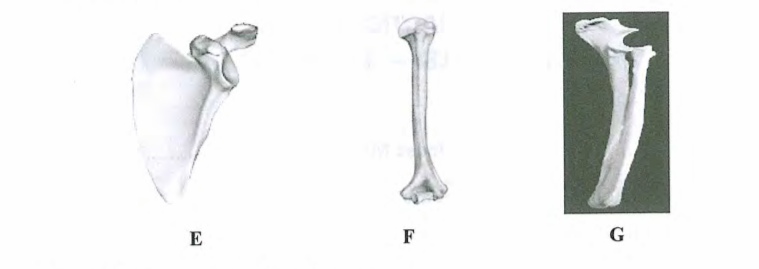
1. The photographs below represent three mammalian bones, labelled E, F and G.

E F G

(a) With reasons, identify the bones.

Identity

Bone E……….

Identity

Bone F……….

Identity

Bone G……….

(b) Name the joints formed at the anterior and posterior ends of F. Anterior end (1 mark)

Posterior end …………………..,. (1 mark)

(c) State the types of movement facilitated by the joint at the anterior end of specimen labelled F. (1 mark)

(d) (i) Name the substance found inside the living tissue of the specimen represented in photograph F. (1 mark)

(ii) State the fiinction of the substance named in (d) (i) above.

(e) (i) Name the muscle bundle usually attached onto the front of the specimen represented in photograph F.

(ii) State the function of the muscle bundle named in (e) (i) above.

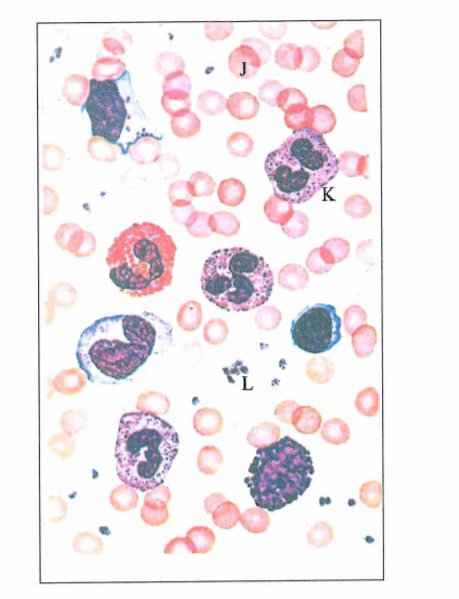
2. Below is a photograph of a blood smear from a normal individual. The arrangement is arbitrary and the number of blood elements is greater than what would normally occur in an actual microscopic field.

(a) (i) Name the blood elements labelled J, K and L. (3 marks)

J………

K……….

L……….

(ii) State one function of each of the elements named in (a) (i) above. (3 marks)

K ………………

L ……………….

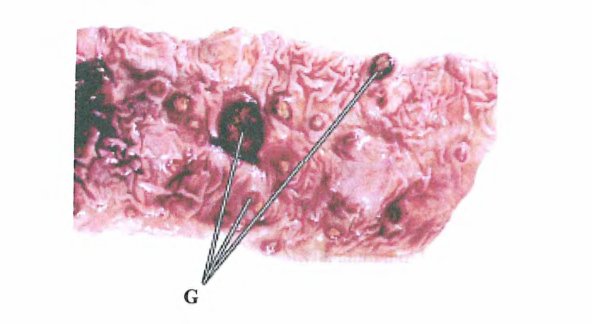
5 (b) The photograph below is of a section of the human intestines of a patient suffering from a common parasitic disease.

(i) Name the disease.(1 mark)

(ii) Name the parasite that causes the disease in (b) (i) above.(1 mark)

(iii) State Evo control measures for the disease.(2 mark)

(iv) State the effects of having the parts labelled G in the patient’s intestines.

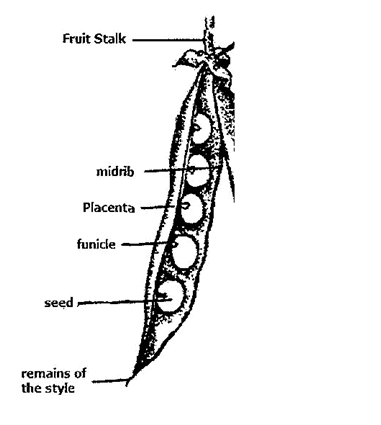
3. You are provided with a specimen labelled H. With the aid of a hand lens, examine the external features of the specimen.

(a) (i) What part of a plant is specimen H?

(ii) Give two reasons for your answer in (a) (i) above.

(b) Open up specimen H longitudinally.

Use a hand lens to observe the internal structures of specimen H. (1 mark)

(i) Draw and label the internal cut surface and associated structures of specimen H. (5 marks)

(ii) Explain how you would determine the magnification of the drawing made in (b) (i) above. (2 marks)

(iii) State the mode of dispersal for seeds of specimen H.(I mark)

(iv) Explain how seeds of specimen H are dispersed through the mode stated in (b) (iii) above. (3 marks)

BIOLOGY Questions and answers

Biology Paper 3 (231/3)

Kenya Certificate of Secondary Education

2018 Biology Paper 3

Answer all the questions in the spaces provided.

1. The photographs below represent three mammalian bones, labelled E, F and G.

E F G

(a) With reasons, identify the bones.

Identity

Bone E……….

scapula/shoulder blade;


  • Has a socket/glenoid cavity/depression to articulate with the ball/head of the humerus;
  • Flat/triangular-shaped flat blade/triangular shaped/flat blade/flattened;;
  • Has a spine/ridge/coracoids process/acromion for attachment of musclesIdentity

    Bone F……….

    Humerus;

  • Has a ball/head/rounded head that articulates with the glenoid cavity/ socket on the scapula;
  • Has condyles that articulate with radius and ulna;Identity

    Bone G……….

    G — Radius attached to ulna;

  • Ulna has a sigmoid notch for articulation with the shoulder joint/ lower end of the humerus;
  • Has trochlea/olecranon fossa;
  • Has greater/larger tuberosity Has biciptal groove;(b) Name the joints formed at the anterior and posterior ends of F. Anterior end (1 mark)

    • Ball and socket (joint);

    Posterior end ……….(1 mark)

    • Hinge joint

    (c) State the types of movement facilitated by the joint at the anterior end of specimen labelled F. (1 mark)

    Rotation/up and down/side-ways (of the arm);

    (d) (i) Name the substance found inside the living tissue of the specimen represented in photograph F. (1 mark)

  • Bone marrow;(ii) State the fiinction of the substance named in (d) (i) above.
  • Manufacture of(red) blood cells(e) (i) Name the muscle bundle usually attached onto the front of the specimen represented in photograph F.

    Biceps;

    (ii) State the function of the muscle bundle named in (e) (i) above.

    Contract/relax to move the lower arm (upwards);

    2. Below is a photograph of a blood smear from a normal individual. The arrangement is arbitrary and the number of blood elements is greater than what would normally occur in an actual microscopic field.

    (a) (i) Name the blood elements labelled J, K and L. (3 marks)J — Erythrocyte(s)/red blood cell;

    K — Leucocyte/white blood cell;

    L — Thrombocytes/Platelets

    (ii) State one function of each of the elements named in (a) (i) above. (3 marks)

    I — Transportation of oxygen/carbon (IV) oxide;

    K — Engulf/attack pathogens/ foreign materials in the blood;

    L — Blood clotting;

    5 (b) The photograph below is of a section of the human intestines of a patient suffering from a common parasitic disease.

    (i) Name the disease.(1 mark)Amoebic dysentery;

    (ii) Name the parasite that causes the disease in (b) (i) above.(1 mark)

    Entamoeba hystolytica

    (iii) State two control measures for the disease.(2 mark)

  • Boiling drinking water (before drinking);/
  • Chlorinating/treating drinking water;
  • Keeping the food covered (to keep away flies/prevent contamination/proper storage of food;
  • Proper faecal disposal in pit latrines/toilets/keeping the same clean/not to dispose faecal materials in the open/washing hands before handling food/ washing fruits/food before eating/after visiting toilet/latrine;
  • Proper cooking of food;
  • Washing hands before handling of food/washing fruits before eating(iv) State the effects of having the parts labelled G in the patient’s intestines.

    Fruit(s);

  • Has two scars; point of attachment to remains of style; and point of attachment to the receptacle/fruit stalk
  • Presence of seeds;
  • Presence of pericarp/fruit wall
  • Has epicarp, mesocarp and endocarp fused3. You are provided with a specimen labelled H. With the aid of a hand lens, examine the external features of the specimen.

    (a) (i) What part of a plant is specimen H?

    Fruit(s);

    (ii) Give two reasons for your answer in (a) (i) above.

  • Has two scars; point of attachment to remains of style; and point of attachment to the receptacle/fruit stalk
  • Presence of seeds;
  • Presence of pericarp/fruit wall
  • Has epicarp, mesocarp and endocarp fused(b) Open up specimen H longitudinally.

    Use a hand lens to observe the internal structures of specimen H. (1 mark)

    (i) Draw and label the internal cut surface and associated structures of specimen H. (5 marks)

    (ii) Explain how you would determine the magnification of the drawing made in (b) (i) above. (2 marks)Linear magnification — Length of drawing;

    Actual length of object (specimen); OWTTE

    (iii) State the mode of dispersal for seeds of specimen H.(I mark)

    Explosive mechanism/self-dispersal mechanism/self explossive

    (iv) Explain how seeds of specimen H are dispersed through the mode stated in (b) (iii) above. (3 marks)

    Dry pods; due to loss of water from the pod and pressure from within the pod; the pod opens (violently) along the sutures /1ines of weakness; seeds are thrown away from the parent plant/dispersed;


Free KCSE Past Papers Agriculture 2018 (443/2)

KCSE Past Papers Agriculture 2018

Questions and Answers

2018 Agriculture Paper 2

SECTION A (30 marks)

1. State six characteristics of a good breeding stock.(3 marks)


  • Young;
  • Healthy;
  • Prolific;
  • High performer/yielder;
  • Free from physical deformities;
  • Fertile;
  • Proper body conformation;
  • Adapted to local conditions;
  • Good mothering ability;2. State four reasons for maintaining farm tools and equipment.(2 marks)
  • Ensure efficiency;
  • Make them durable;
  • Reduce replacement costs;
  • Avoid injury to the user;3. State four reasons why a calf should be fed on colostrum.(2 marks)
  • Highly digestible;
  • Highly nutritious;
  • Contains antibodies which boost immunity; Has laxative effect;
  • Highly palatable;4. Give two reasons for growing grass around a fish pond.(1 marks)
  • Stabilize the banks;
  • Attract insects which lay eggs that hatch into larvae for fish food;5. Name four systems of poultry rearing. (2 marks)
  • Free range;
  • Deep litter;
  • Fold;
  • Battery cage;6. State three advantages of conterriporary comparison method of selecting breeding stock.(1½ marks)
  • It is possible to compare animals of different age groups;
  • Eliminates differences due to environmental factors;
  • It is possible to compare bulls of different artificial insemination centres; It is accurate;7. Give the meaning of the following terms as used in livestock breeding:(a) close breeding (½ mark)
  • Close breeding:- Breeding of closely related animals;(b) line breeding (½ mark)
  • Line breeding:- Mating of distantly related animals that share a common ancestry;(c) out crossing (½ mark)
  • (c) Out crossing:- Mating of unrelated animals within the same breed;(d) cross breeding (½ mark)
  • Cross breeding:- Mating of two animals of different breeds;8. State four livestock rearing practices undertaken in a crush to control parasites and diseases.(2 marks)
  • Vaccination;
  • Deworming;
  • Hoof trimming;
  • Spraying;
  • Dehorning;
  • Treatment/injection;9. Name the dairy cattle breed that(a) produces the highest milk yield in kilograms (½ mark)

    (a) – Friesian;

    (b) is fawn/brown coloured with white colour on the face, legs below knees and hocks, tail switch and flanks (½ mark)

  • – Guernsey;(c) is most suitable for marginal areas with poor pastures. (½ mark)
  • Jersey;10. Distinguish between each of the following breeding practices:(a) clutching and ringing (1 mark)

    (a) Crutching:- Cutting of wool around the external reproductive organ of a female sheep to facilitate mating while

    Ringing:- Trimming of wool around the sheath of the penis in rams to facilitate mating;

    (b) tupping and serving (1 mark)

    (b) Tapping:- Act of mating in goats and sheep;

    Serving:- Act of mating in cattle and pigs;

    11. What is a predisposing factor of a disease?(1 mark)

    Conditions which lead to the animal contracting a disease

    12. State four candling qualities of good eggs for incubation. (2 marks)

  • Fertile (has germinal disk; black spot);
  • Free from blood spots; Large air space;
  • Free of hair cracks;
  • Free of excessively porous shell; Free of broken shells;13. Apart from the roof, name four other parts of a building that can be constructed using wood. (2 marks)
  • Floor;
  • Ceiling;
  • Door;
  • Windows14. State four symptoms of internal parasite infestation in livestock. (2 mark)
  • Starring coat;
  • Eggs and parasites seen in faeces;
  • General emaciation; Diarrhoea;
  • Pot-bellies; Anaemia; Anorexia;
  • Dehydration/pale mucosa15. State the functional difference between the following:(a) cross-cut saw and rip saw (1 mark)
  • Rip saw: – cuts along the grain of wood.
  • Cross-cut saw — cuts across the grain of wood;(b) wood chisel and cold chisel (1 marks)
  • Wood chisel — cutting grooves/chopping rough wood surface;
  • Cold chisel — cutting thick sheets of metal.16. Give the meaning of the following terms as used in livestock health:(a) predisposing factor (1 mark)
  • Conditions inside or outside the animal body which make it to contract a disease;(b) incubation period (1 mark)
  • Is the duration between the time of infection and the time the first symptoms show up;SECTION B (20 marks)Answer all the questions in this section in the spaces provided.

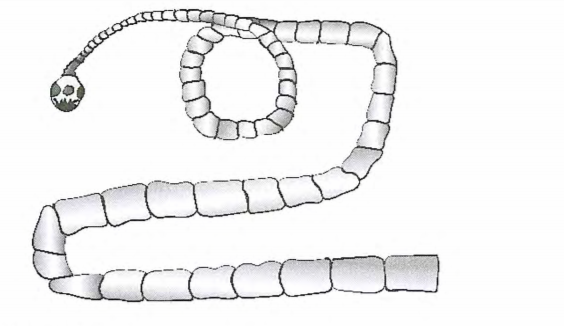
    17. The diagram below shows a livestock parasite.

    (a) Identify the parasite.(1 mark)

  • Tapeworm(b) Explain how the parasite is passed from(i) livestock to human beings(1 mark)
  • Ingestion of bladder worm;(ii) human beings to livestock(1 mark)
  • Ingestion of eggs (proglottids) passed in human faeces during grazing/feeding;(c) Explain two control measures for the parasite in a zero grazing unit.(2 mark)
  • Use of antihelmintics/deworming to kill endo-parasites;
  • Proper hygiene in the unit;
  • Proper use of latrines to prevent contamination by infected faeces;
  • Proper cooking of meat to destroy bladder worms;
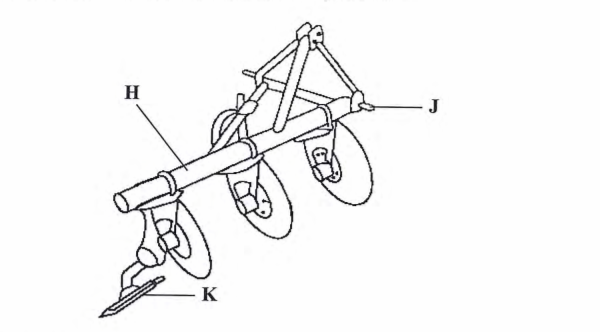
  • Use of clean feed, feeders, water and watchers to prevent contamination;18. The diagram below illustrates a tractor drawn implement.

    (a) Identify the implement (1 mark)

  • Disc plough(b) Name the part labelled H and I(1 mark)H – Beam;

    I – Lower link attachment point;

    (c) State one function of the part labelled K(1 mark)

    Counteracts the thrust by the discs to balance the plough;/helps to adjust the depth of ploughing;

    (d) Explain why the implement is suitable for ploughing areas with hidden stones. (1 mark)

    The discs are able to roll over obstacles;

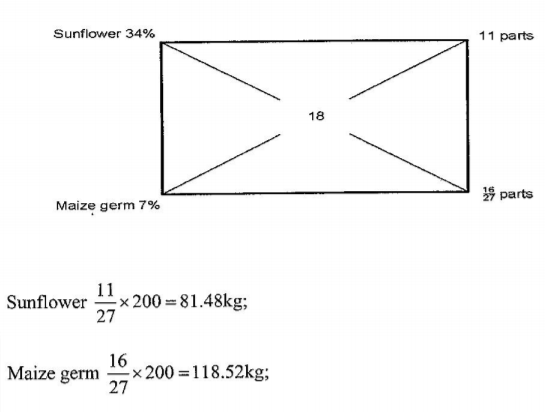
    19. A farmer is required to prepare 200 kg of dairy meal containing 18% digestible crude protein (DCP).

    Using the Pearson’s Square Method, calculate the quantity of sunflower seed cake (34% DCP) and maize germ (7% DCP) the farmer requires for the dairy meal. (5 marks)

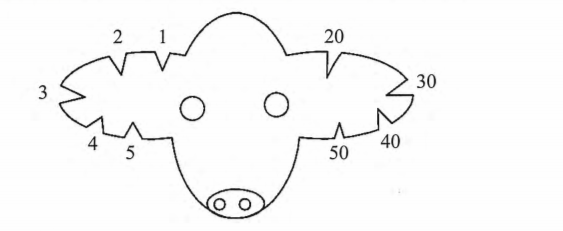
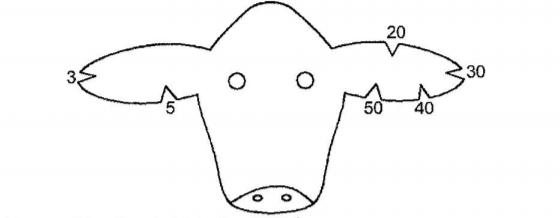
    20. The diagram below represents a practice of identifying livestock on a farm.

    (a) ldentify the practice(1 mark)Ear notching;

    (b) Determine the number that identifies the animal represented by the illustration (1 mark)

    155

    (c) Draw a diagram of the animal identified by the number 148 on the farm. (1 mark)

    (d) Give two reasons why this method of identification is discouraged in livestock rearing. (2 marks)

  • The notching is painful to the animal;
  • Notched wounds cause secondary infections;SECTION C (40 marks)Answer any two questions from this section in the spaces provided after question 23.

    21. (a) Describe how natural incubation is set up and managed.(8 mark)

  • Provide the broody hen with a nesting box which should be spacious to allow movement of the hen;
  • Provide nesting material in the nesting box to maintain warmth;
  • Provide the broody hen with 10 — 15 eggs; Keep the nest in a dry; and well-ventilated area;
  • Provide the hen with balanced feed and water;
  • Dust the hen with appropriate insecticides to control external parasites;
  • Allow the hen to go out at least once to exercise and feed;
  • Do not disturb the hen when the eggs start hatching;(b) Describe the management of growers in poultry rearing.(5 mark)
  • Provide adequate floor space, feeders, and waterers;
  • Provide litter on the floor up to 15cm deep; Provide growers mash adlib;
  • Provide plenty fresh water;
  • Dust the birds with appropriate insecticides to control external parasites; Keep the litter dry to avoid dampness;
  • Provide grit or oyster shells towards the end of growers stage/at 12 weeks;
  • Gradually introduce layers’ mash from the 16th week until it completely replaces growers’ mash at 18th — 19th week.(c) Describe seven possible sources of power on a farm.(7 mark)
  • Human power:- Working directly or utilizing their capacity of organization;
  • Animal power e.g. donkeys, oxen camels for cultivation and transportation;
  • Wind power e.g. for winnowing, pumping water and turning turbines; Water power e.g. driving turbines to produce HEP driving maize grinding mills and pumping water; Biomass e.g. Biogas, wood or charcoal;
  • Solar radiation in photosynthesis, drying crops, generate electricity, etc; Electric power from geothermal, hydropower and nuclear stations, battery;
  • Fossil fuel:- petroleum, coal, natural gas, etc;
  • Tractor:- Bums petrol or diesel to produce power which is transmitted and used in different ways;22. (a) Describe pneumonia disease under the following sub-headings:(i) causal organism(1 mark)

    Bacteria/virus/HycopIasma mycoides,

    Dust and worms in the lungs;

    (ii) animals affected(2 mark)

  • Calves;
  • kids;
  • lambs;
  • piglets;
  • poultry;(iii) predisposing factors(2 mark)
  • Poor ventilation;
  • Overcrowding;
  • Age
  • young animals;
  • Diarrhoea and other illnesses;(iv) symptoms(5 mark)Dullness;
  • Loss of appetite;
  • Starring coat;
  • Emaciation;
  • Rapid breathing;
  • Fluctuating body temperature; Nasal mucous discharge;
  • If chest is pressed, animal starts coughing(v) control measures.(3 mark)
  • Keep young animals in warm houses;
  • Proper sanitation;
  • Isolation;
  • Treatment using antibiotics;(b) Explain seven housing requirements for a calf.(7 mark)
  • Concrete/slatted floor to facilitate cleaning;
  • Spacious to allow exercise, feeding and watering;
  • Single housing to prevent licking of one another/ skin infections and spread of worms;
  • Well lit to facilitate synthesis of vitamin D;
  • Well drained to prevent dampness which predisposes the calf to infections;
  • Free from draughts: Solid on the wind ward side to prevent entry of cold winds;
  • Leak proof to avoid dampness/wetness which encourages infections;23. (a) State five signs of heat in cattle.(5 mark)
  • Restlessness;
  • Mounting others and stands still when mounted;
  • Slight rise in temperature; Slight drop in milk yield;
  • Vulva swells and becomes reddish;
  • Clear or slimy mucus discharge from vagina; Frequent mowing;(b) State five advantages a spray race has over a plunge dip.(5 mark)
  • Suitable for pregnant and sick animals;
  • Animals do not swallow the acaricide wash; Spraying is faster;
  • It is less laborious;
  • Acaricide wash is not wasted as it is recycled(c) Give five reasons for maintaining livestock healthy.(5 mark)
  • Healthy animals grow fast and mature early;
  • Animals give a longer productive life;
  • Produce good quality products;
  • Give maximum production/performance; Prevent spread of diseases;
  • Healthy animals are economical to keep; (d) Explain five factors that determine the amount of food eaten by a livestock animal. (5 marks)
  • Body size or weight of the animal; large animals eat more food;
  • Environmental conditions where the animals is; animals in cold areas require more food;
  • Physiological condition of the animal; lactating animals require more food;
  • Level of production:- High producers also require more food;
  • Purpose for which the animal is kept; animal kept as a pet requires less food than the one kept for production or performance;

kcse exam 2020
kcse 2020 English
kcse 2020 prediction
kcse 2020 mathematics prediction
kcse 2020 biology prediction
kcse 2020 biology paper 1
kcse 2020 timetable
kcse computer project 2020 question paper
kcse past papers
kcse past papers 2018
kcse past papers 2018 pdf download
FREE KCSE 2017 PAST PAPERS (QUESTIONS, MARKING SCHEMES AND REPORTS)
KCSE 2016 PAST PAPERS (QUESTIONS, MARKING SCHEMES AND REPORTS)
KCSE 2015 PAST PAPERS (QUESTIONS, MARKING SCHEMES AND REPORTS)
KCSE 2014 PAST PAPERS (QUESTIONS, MARKING SCHEMES AND REPORTS
 

KCSE Past Papers Agriculture 2018 (443/1)

KCSE Past Papers Agriculture 2018

Kenya certificate of primary Education

2018 Agriculture Paper 1

SECTION A (30 marks)

Answer all the questions in this section in the spaces provided.

1.Name four categories of livestock farming.(2 marks)

2.State four farming practices that ensure minimum tillage.(2 marks)

3.State four factors that determine the choice of water pipes used on the farm.(2 marks)

4.Name two sources of underground water.(1 marks)

5.Give four reasons why green manure is not commonly used in farming.(2 marks)

6.(a) Name two types of inventory records kept on the farm.(1 mark)

(b) State two uses of inventory records on a farm. (1 mark)

7.(a) Name three vegetative planting materials used for propagating pineapples. (1½ marks)

(b) State three qualities of certified seeds. (1½ marks)

8. State four advantages of using polythene sleeves to propagate stem cuttings.(2 mark)

9. State four disadvantages of concession land tenure system.(2 mark)

10. Name four insect pests of beans in the field.(2 marks)

11. (a) Name three legume pastures grown in high altitude areas. (l½ marks)

(b) State four management practices undertaken to improve natural pastures. (2 marks)

12. (a) Name two subsidiary books of the journal.(1 mark)

(b) State four item details contained in a sales receipt.(2 mark)

13. State four roles of Young Farmers Clubs in Kenya.(2 mark)

14. (a) What is meant by the term agroforestry? (½ mark)

(b) Name two agroforestry practices.(2 mark)

SECTION B (20 marks)

Answer all the questions in this section in the spaces provided.

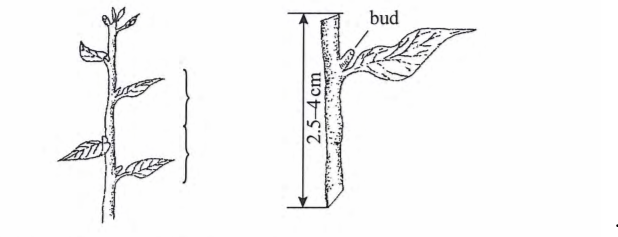
15. The diagram below shows a section of a plant from which the planting material illustrated was obtained.

(a) Identify the planting material illustrated. (1 mark)

(b) Give two reasons why only the middle part of the plant was used to prepare the planting material. (2 marks)

(c) Apart from using the middle part of the plant, explain two precautions that should be observed when preparing the illustrated planting material. (2 marks)

16. An experiment was carried out to investigate soil constituents as described below:

Step I — An empty evaporating dish was weighed and its mass was 10 gms.

Step II — Fresh garden soil was put on the evaporating dish and weighed. The mass was 40 gms.

Step III — The evaporating dish containing fresh soil was put in an oven and heated at a temperature of 105 °C for 30 minutes, cooled and then weighed.

The mass was 35 gms.

Step IV — The dish containing soil was then strongly heated on a Bunsen burner for two hours while stirring. It was then cooled and weighed. The new mass was 32 gms.

(a) Give a reason why the soil was heated

(i) at 105 °C

(ii) strongly for two hours

(b) Calculate the percentage content of the soil constituents investigated in the experiment. (3 marks)

17. The diagram below illustrates a nursery practice.

(a) Name the practice

(b) Give a reason why the tool labelled E is important in the practice illustrated. (1 mark)

(c) What is the appropriate stage of growth for carrying out the illustrated practice in agroforestry? (1 mark)

(d) Explain two activities that ensure that the illustrated practice is carried out successfully.(2 marks)

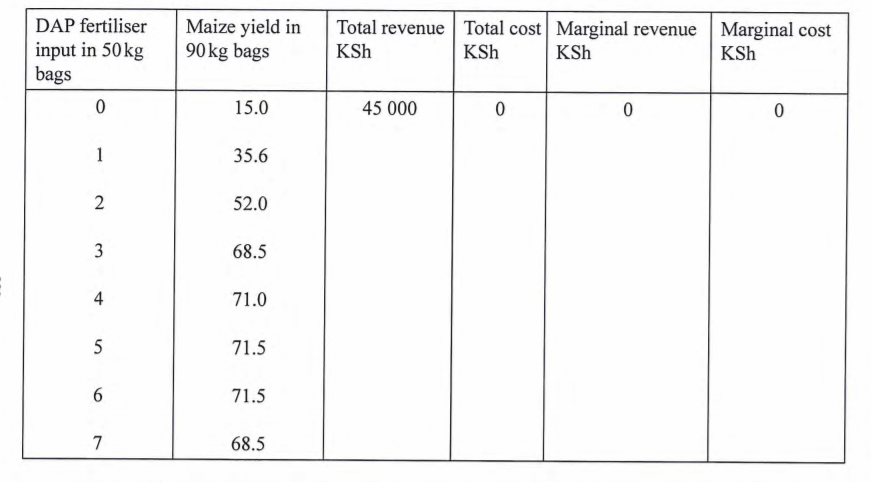
18. In a maize production enterprise carried out over a period of eight years, a farmer used one hectare of land each time and applied different quantities of DAP fertiliser.

DAP fertiliser costs KSh 2 500 per 50kg bag and the harvested maize is sold at KSh 3 000 per 90kg bag. The quantities of DAP fertiliser applied and maize harvested are as shown in this table below.

(a) Complete the table by determining the values of total revenue, total cost, marginal revenue and marginal cost. (2 marks)

(b) From the information in your table, how can the farmer determine the level of production at which profit is maximum? (1 mark)

(c) At the production level that yielded maximum profit, what was the value of each of the following?

(i) DAP fertiliser input(1 marks)

(ii) Marginal revenue(1 marks)

SECTION C (40 marks)

Answer any tiro questions from this section in the spaces provided after question 21.

19. (a) Explain six farming practices that destroy soil structure. (6 marks)

(b) (i) State four functions of calcium in plant growth. (4 marks)

(ii) State four disadvantages of using inorganic fertilisers in crop production. (4 marks)

(c) Describe six categories of pesticides based on mode of action.(6 marks)

20. (a) Explain six cultural methods of soil and water conservation.(6 marks)

(b) Explain four environmental factors that influence effectiveness of herbicides.(8 marks)

(c) Describe six post-harvest practices for dry beans.(6 marks)

21. (a) (i) Describe the harvesting and marketing of bulb onions.(6 marks)

(ii) State the precautions that should be observed when harvesting cotton.(4 marks)

(b) Explain five problems associated with agricultural credit.(5 marks)

(c) Explain five principles that govern the formation and functioning of farmer’s co-operatives.(5 marks)

kcse exam 2020
kcse 2020 leakage
kcse 2020 prediction
kcse 2020 mathematics prediction
kcse 2020 biology prediction
kcse 2020 biology paper 1
kcse 2020 timetable
kcse computer project 2020 question paper
kcse past papers
kcse past papers 2018
kcse past papers 2018 pdf download

FREE KCSE 2017 PAST PAPERS (QUESTIONS, MARKING SCHEMES AND REPORTS)
KCSE 2016 PAST PAPERS (QUESTIONS, MARKING SCHEMES AND REPORTS)
KCSE 2015 PAST PAPERS (QUESTIONS, MARKING SCHEMES AND REPORTS)
KCSE 2014 PAST PAPERS (QUESTIONS, MARKING SCHEMES AND REPORTS

KCSE Past Papers 2019 Physics paper 3 (232/3)

KCSE Past Papers 2019 Physics paper 3 (232/3)

 KCSE Past Papers 2019 Physics paper 3 (232/3)

Physics – Paper 3 – November 2019 – 2.30 Hours

Practical

2019 Physics paper 3

Question 1

You are provided with the following:


  • A stirrer
  • A stond, a boss rind a clump
  • A themionieter
  • An aninieter
  • A voltmeter
  • A beaker
  • A source of boiling water
  • Two dry cells in a cell holder
  • A switch
  • Seven connecting wires
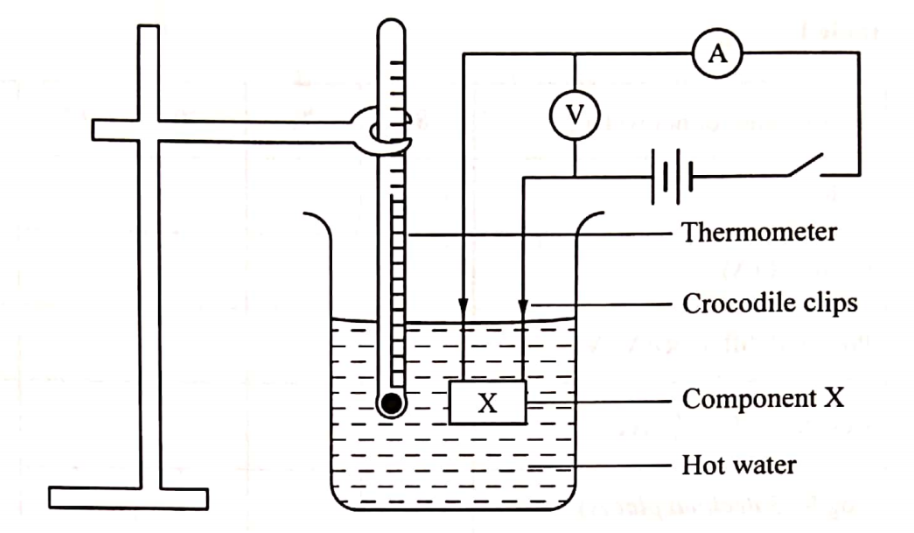
  • A component labelled XProceed as follows:

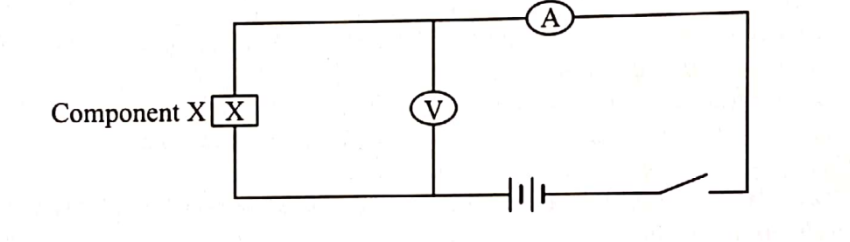
    (a) Set up the circuit as shown in figure 1.

    Close the switch, read and record the current I through component X and the potential difference V across it. (l mark)I =……………………..

    V =……………………….

    Open the switch.

    Determine the resistance R of component X given that: R = V/I

    (b) Pour hot water into the beaker and set up the apparatus as in figure 2, so that component X afid the llieriiioirieter bulb are fully immersed.

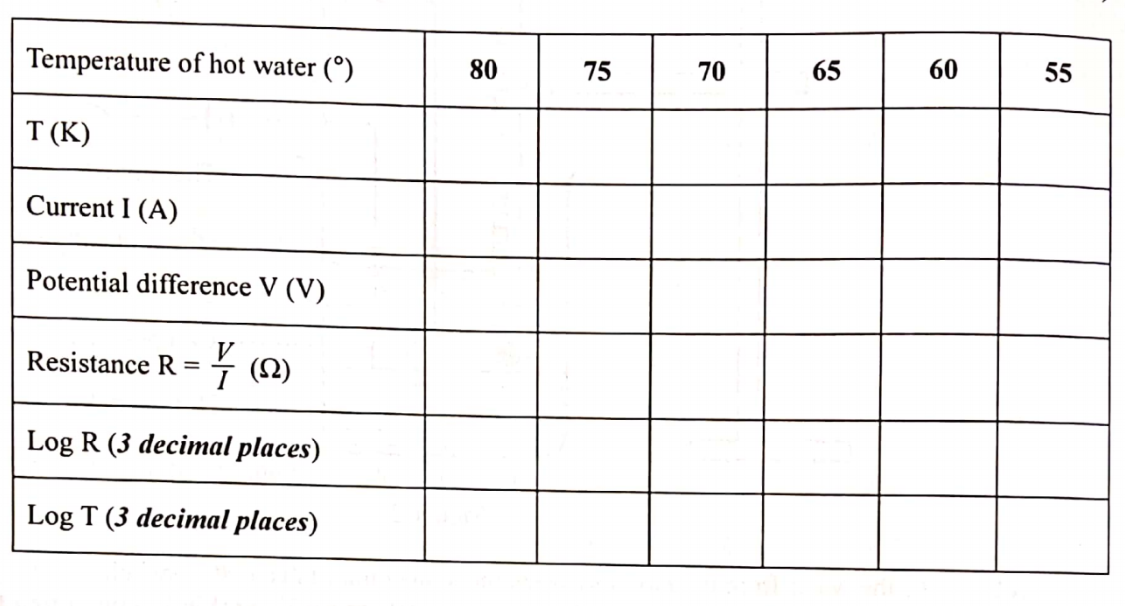
    (c) Stir the water from time to time, when the temperature falls to 80°, switch on the circuit, read and record the current I and the potential difference V in table 1. Then open the switch.(d) Repeat (c) as the temperature falls to the oÎher values shown in table 1. Complete the table. Table 1 (8 marks)

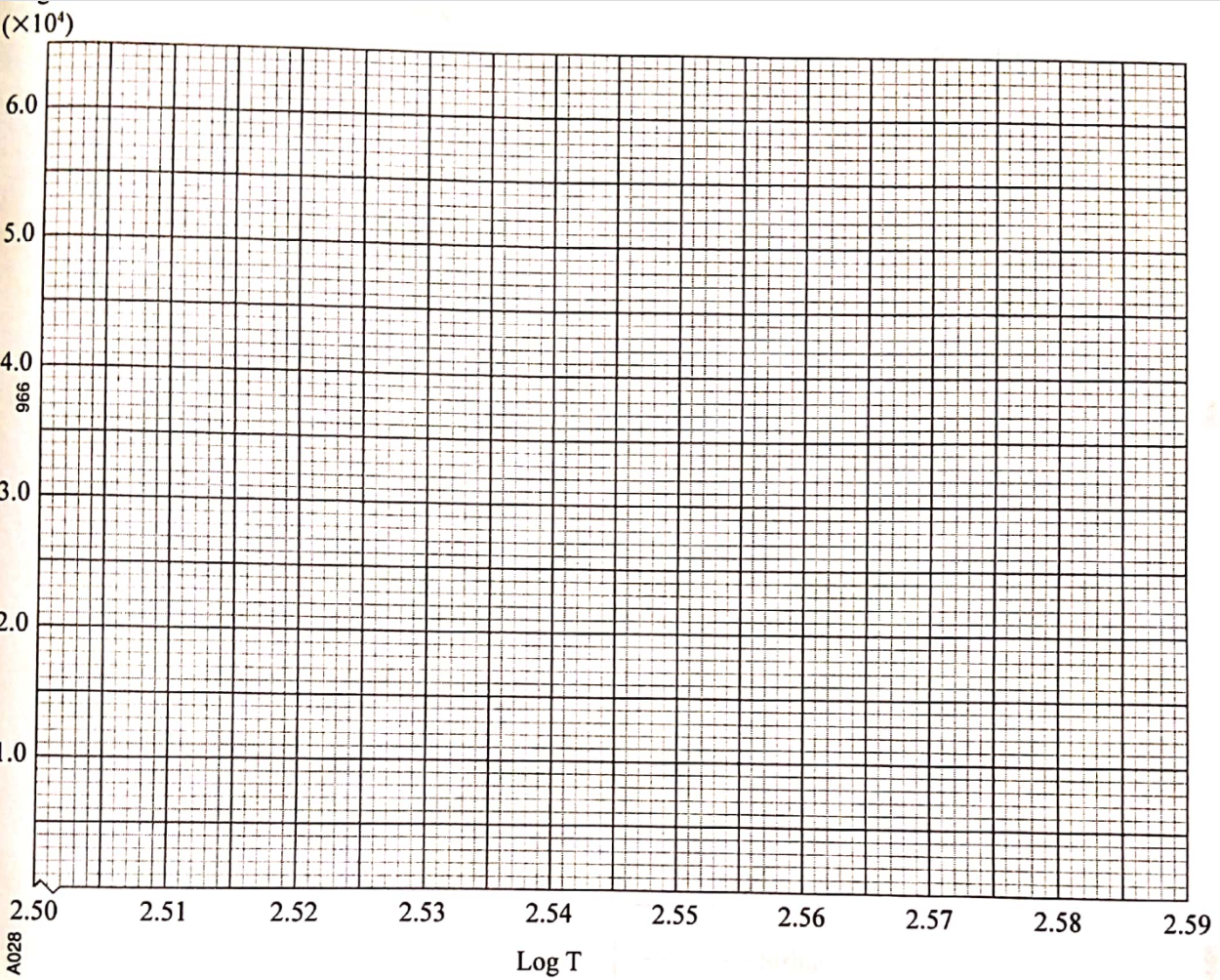
    (e) ( i) On the axis provided, plot a graph of Log R against log T. (4 marks)

    (ii) Determine the slope S of the graph. (3 marks)(ii) Given that R and T are related by the equation Log R = Log K + n Log T (4 marks)
    (i) n…………………………..(1 marks)

    (ii) k…………………………..(2 marks)

    Question 2

    You are provided with the following:

  • A metre rule
  • A stand, boss and clamp A piece of string
  • A 20 g mass
  • A 50 g mass
  • A measuring cylinder containing water
  • A concave mirror
  • A screen
  • A candle
  • Pieces of sewing threads
  • A mirror holder (Lens holder)Proceed as follows:

    PART A

    (a) Using a string, suspend the metre rule on the stand so that it balances horizontally at its center of gravity.

    Record the centimetre mark at which the metre rule balances.

    Centimetre mark =………………….cm (1 mark)

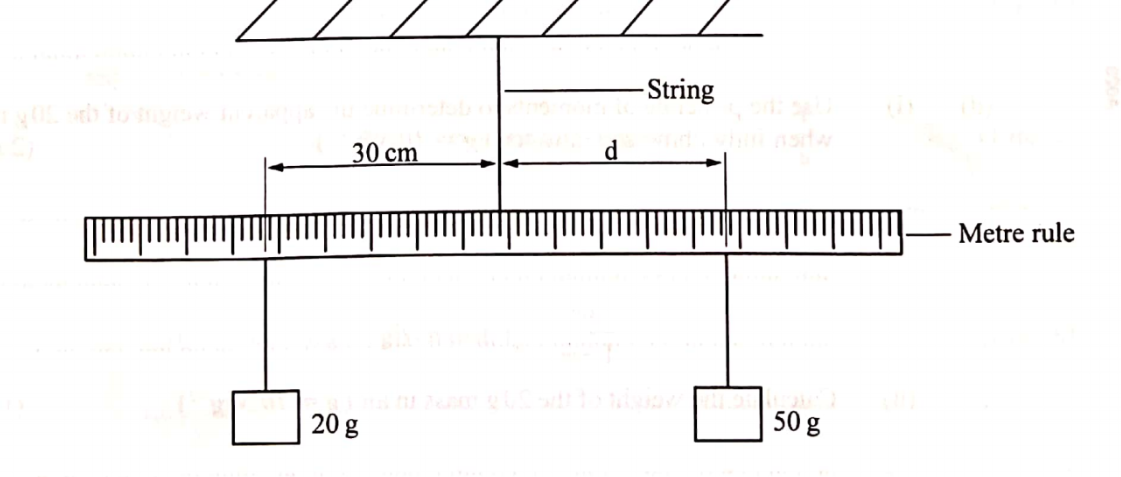
    (b) With the metre rule balanced at its centre of gravity, suspend a 20 g mass at a distance of 30 cm from the centre of gravity.

    Suspend the 50 g mass on the other side of the centre of gravity and adjust its position until the rule is balanced. See figure 3.

    Record the distance d of the 50 g ninss from the centre of gravity.d = ……………………….

    d = ……………………… (1 mark)

    Record the volume of the water in the measuring cylinder provided.

    V=……………………………….(1 mark)

    (ii) Immerse the 20 g mass fully into the water and adjust the position of the 50 g mass so that the rule balances horizontally.

    Record the volume V1 of the water plus 20 g mass and the distance d1 of the 50 g mass from the centre of gravity.

    (iii) (I) Determine the volume of the water displaced (1 mark)

    (II) Determine the weight of the water displaced. (density of water — I gcm(-3) (3 marks)

    (d) (i) Use the principle of moments to determine the apparent weight of the 20 g mass when fully immersed in water. g — 10 Nkg-1 (2 marks)

    (ii) Calculate the weight of the 20 g mass in air (g = 10 Nkg-1)

    (iii) Determine the apparent loss in weight of the 20 g mass. (l mark)

    PART B

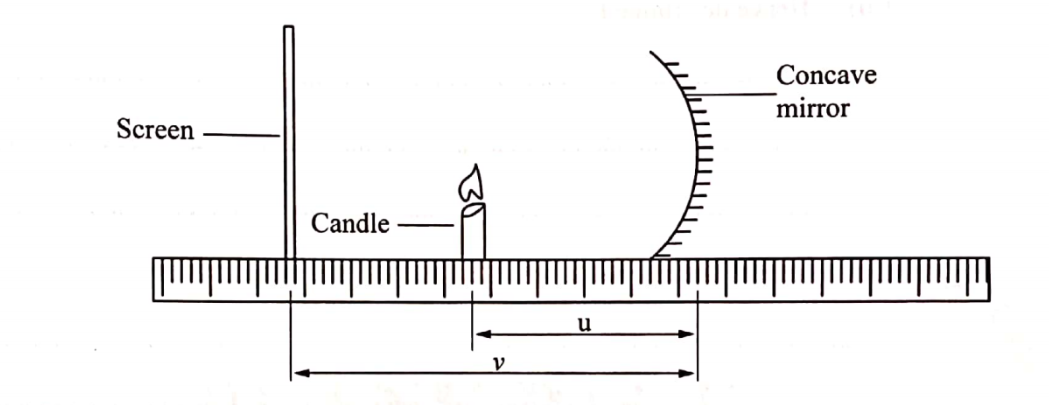
    (e) Light the candle and place it at distance u = 20 cm in front of the concave mirror. Adjust the position of the screen until a sharp image of the candle flame is obtained. See figure 4.

    (i) Read and record the distance v between the screen and the mirror.v=………………………………(1 mark)

    (ii) Determine:

    I. The magnification m of the mirror given that: m = v/u (1 mark)

    II. the value f1 given that: f1 = mu/m+1

    (f) Repeat part (e) for distance u1 = 18 cm.

    (i) Read and record the distance v1 between the screen and the mirror. (ii) Determine the magnification m1 of the mirror. (1 mark )

    (iii) Hence determine f2.

    (g) Determine the average value of f. 1


KCSE Past Papers 2019 Physics paper 2 (232/2)

KCSE Past Papers 2019 Physics paper 2 (232/2)

 KCSE Past Papers 2019 Physics paper 2 (232/2)

Physics – Paper 2 – November 2019 – 2 Hours

Kenya certificate of primary Education

2019 Physics paper 2

SECTION A (25 marks)

Answer all the questions in this section in the splices provided.

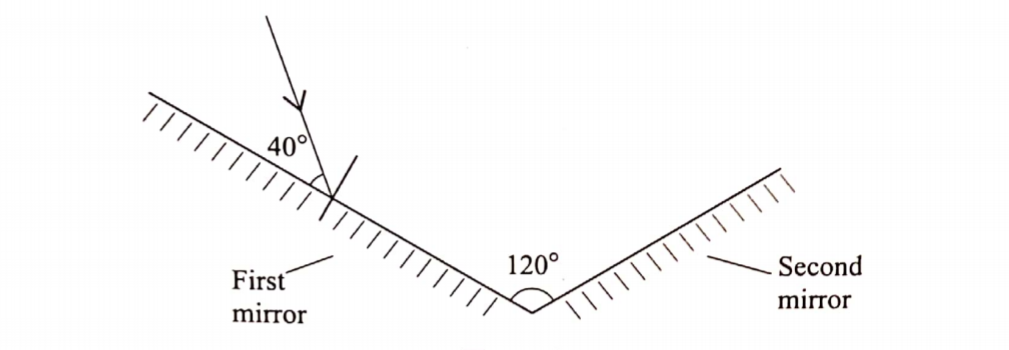
1. Figure 1 shows two plane mirrors inclined at an angle of 120° to cach other.

A ray of light makes an angle or 40° with the first mirror.

By completing the ray diagram determine the angle of reflection on the second mirror. (2 marks)

2. State the reason why an increase in leaf divergence is the only sure way of determining whether an object is negatively charged using a negatively charged electroscope. (l mark)

3. State two properties of magnetic field lines around a bar magnet. (2 marks)

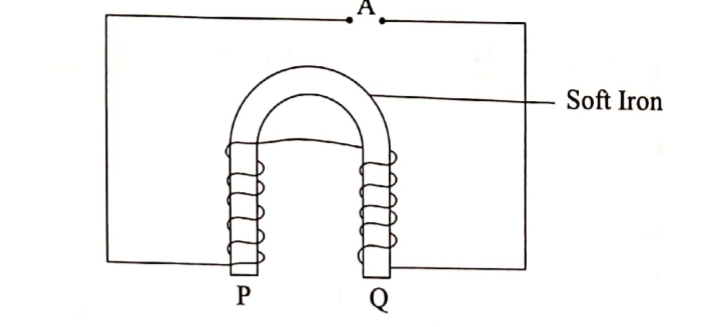
4. Figure 2 shows an incomplete circuit for an electromagnet.

(a) Complete the diagram to show how a battery should be connected at A so that the polarities at P and Q are South and North respectively. (1 mark)

(b) State two ways in which the strength of the electromagnet in (a) can be increased. (2 marks)

5. In a siren, sound is produced when a jet of air is directed perpendicular to a ring of holes on a rotating wheel.

Explain the effect on the pitch of sound produced when the speed of rotation of the wheel is increased. (2 marks)

6. State the reason why the current produced by a simple cell falls rapidly when the cell is being used. (1 mark)

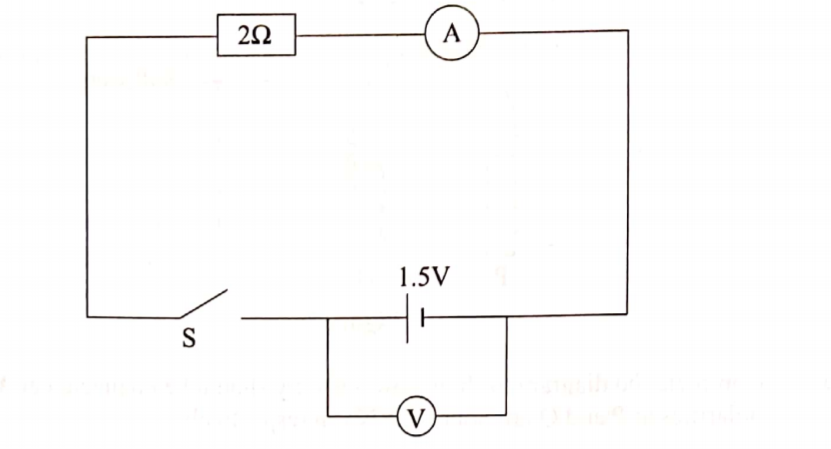
7. Figure 3 shows a cell connected in series with an ammeter, a 2 resistor and a switch.

A volumeter is connected across the cell

With the switch open, the voltmeter reads 1.5 V. Given that the internal resistance of the cell is 0.5 II, determine the ammeter reading when the switch is closed. (3 marks)

8. State two uses of gamma rays in medicine. (2 marks)

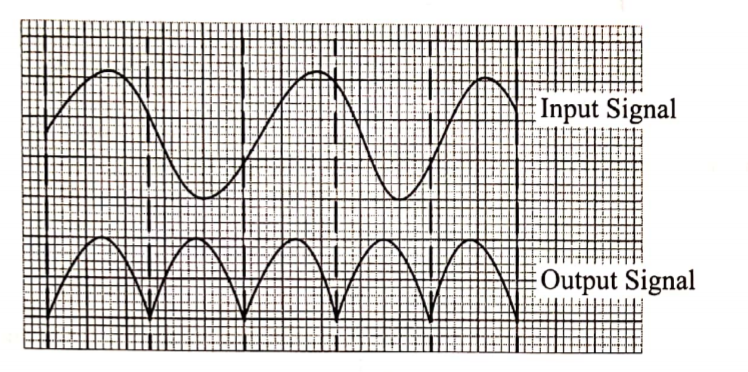
9. Figure 4 shows the input and output signals on a CRO screen when two diodes are used during a full wave rectification.

Explain how the two diodes rectify the input signal. (3 marks)

10. State how the intensity of X-rays in an X-ray tube can be increased. (3 marks)

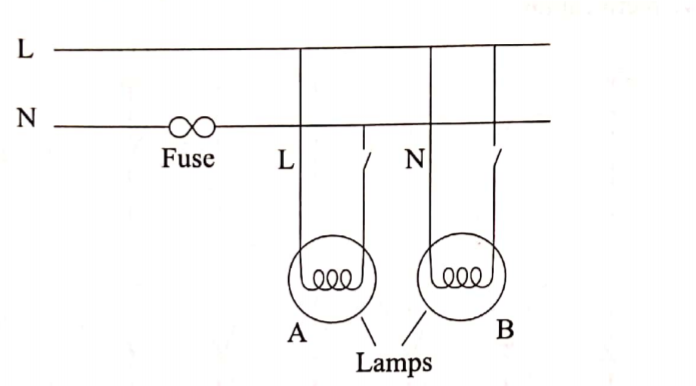
11. Figure 5 shows part of the lighting circuit in a house.

State two errors in the wiring circuit. (2 marks)

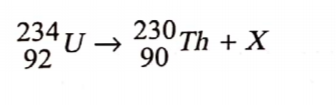
12. Uranium decays as shown below.

Name the particle X that is emitted during this decay. (1 mark)

13. State the disadvantage of rising a convex mirror as a driving mirror. (1 mark)

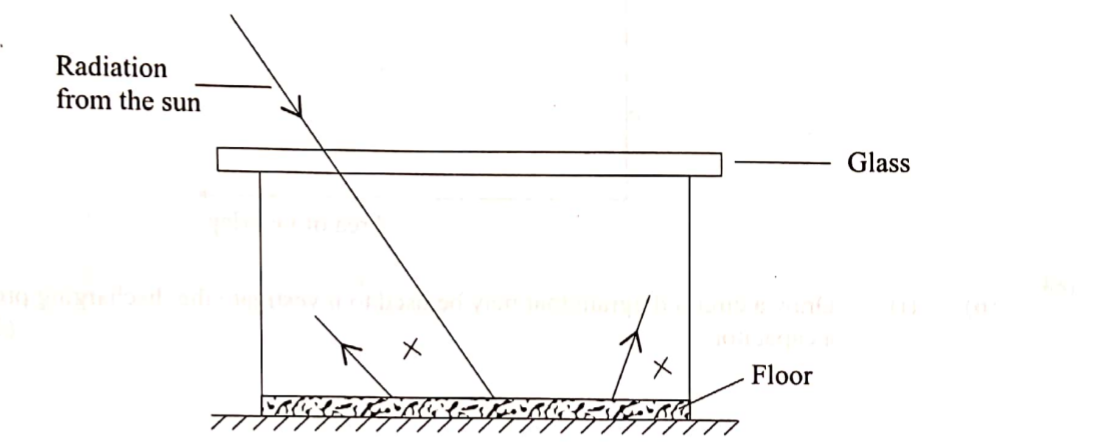
14. Figure 6 shows radiation from thc sun passing through glass in a grecnhouse onto the floor. The floor then emits radiation.

State the name of the radiation emitted by the floor. (1 mark)

SECTION b (55 marks)

Answwr all the questions in this section

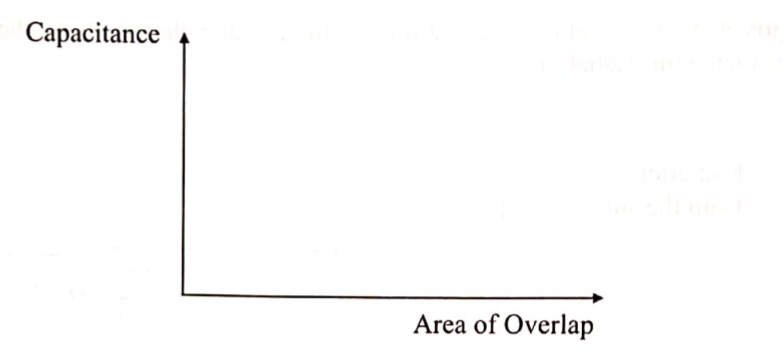
15. (a) On the axes provided, sketch a graph of Capacitance against the area of overlap of the plates of a parallel -plate capacitor.(1 mark)

(b) (i) Draw a circuit diagram that may be used to investigate the discharging proccss of a capacitor. (2 marks)

(ii) On the axes provided sketch the graph of potential difference between the plates against time for the discharging process. (1 mark)

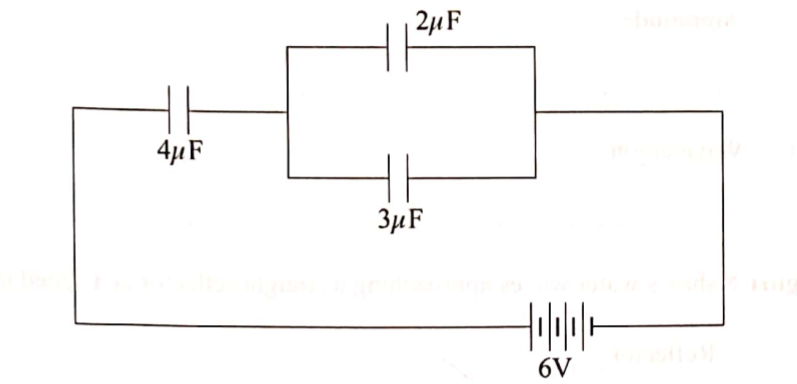
(c) Figure 7 shows the capacitors connected to a 6V battery.

Determine the:

(i) effective capacitance (3 marks)

(ii) total charge stored (2 marks)

(iii) potential difference across the 4uF capacitor (2 marks)

16. (o) Define the following terms as used in waves (i) Amplitude (1 mark)

(ii) Waves length (1 mark)

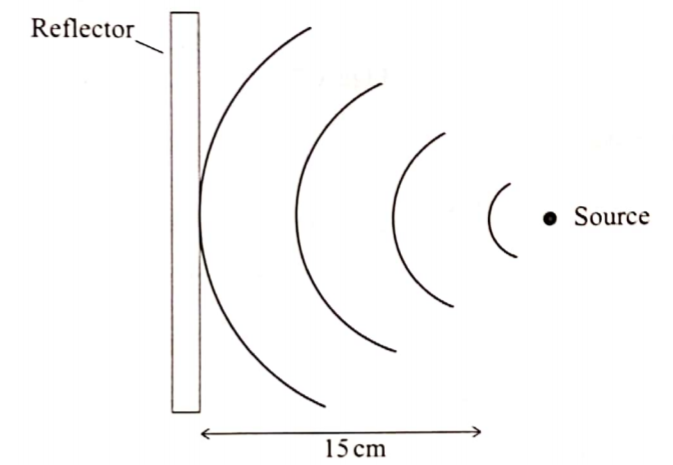
(b) Figure 8 shows water waves approaching a straight reflector at a speed of 40cm’.

(i) Draw on the diagram the reflected waves. (2 marks)

(ii) Given that the distance benveen the source and the reflector is 15 cm determine: (i). The wavelength of the waves (2 marks)

(ii). The frequency of the waves (2 marks)

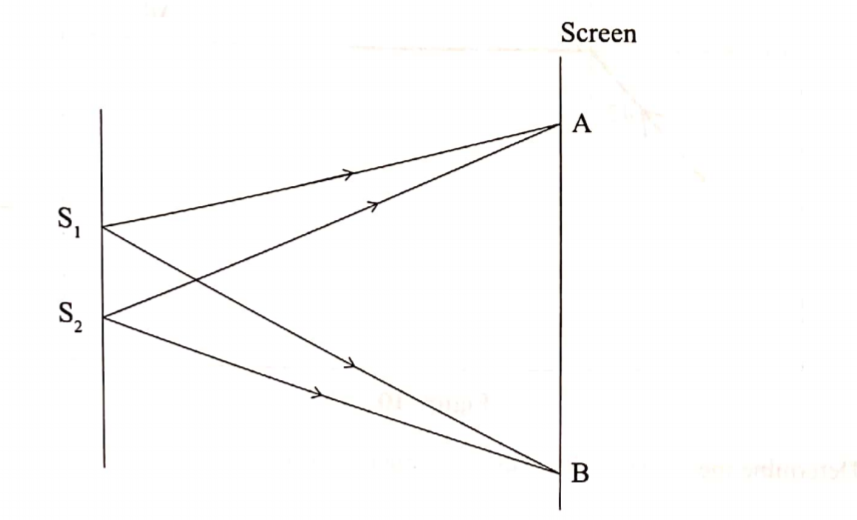
(c) Figure 9 sows light rays from two coherent sources S1 and S2 falling on a screen.

Dark and brighi fringe s are observed between A and B.

(i) State how:

I. bright fringes are formed (1 mark)

II. dark fringes are formed (1 mark)

(ii) State what is observed when light of a higher frequency is used. (1 mark)

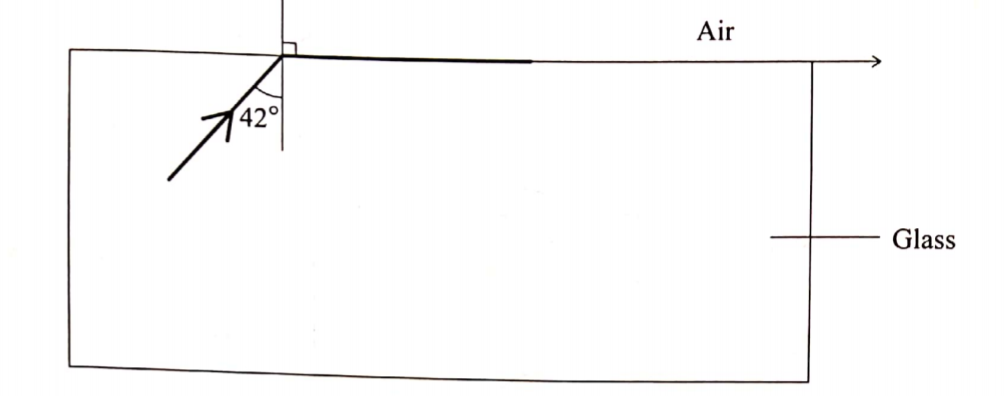
17. (a) Figure 10 shows a ray of light travelling from glass to air.

Determine the:

(i) Critical angle of the glass — air interface ( 1 mark)

(ii) Refractive index of glass (1 mark)

(b) A piece of metal is embedded at the centre of an ice block 15 cm from the surface of the ice.

Given that the refractive index of ice is 1.32, determine how far from the surface of the ice block the metal appears to be. (3 marks)

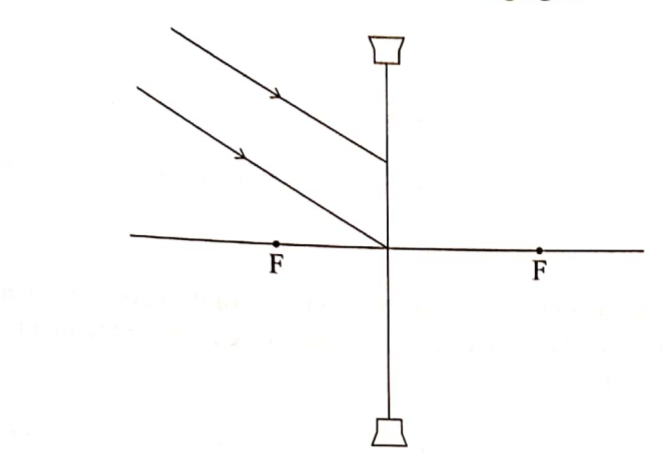
Complete the ray diagram to show the path of the rays after passing through the lens. (2 marks)

(d) (i) State two differences between the human eye and a camera lens. (2 marks)

(ii) State the name of the part of the eye that enable the lens to focus images of objects at different distances. (I mark)

18. (a) Describe how a magnet can be demagnetised using the electrical method. (2 marks)

(b) You are provided with two iron bars P and Q .One of the bars is magnetised while the other is not.

Explain how the magnetised bar can be identified without using a magnet or magnetic material. (2 marks)

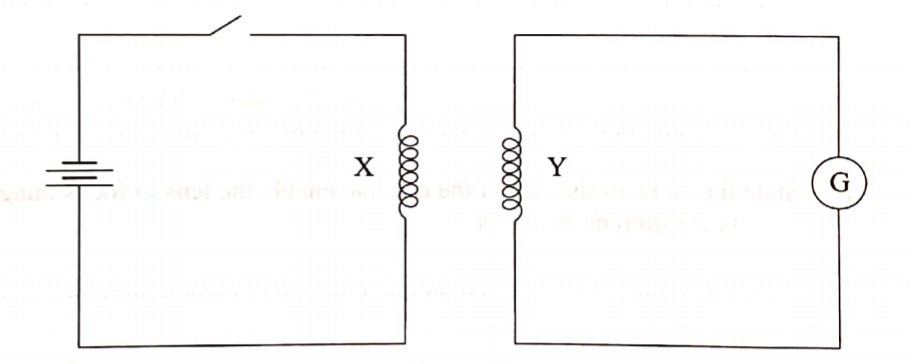
(c) Figure 12 shows two identical copper coils X and Y placed close to each other.

Coil X is connected to a DC power supply while coil Y is connected to a galvanometer.

(i) Explain what is observed on the galvanometer when the switch is closed. (4 marks)

(ii) State what is observed on the galvanometer when the switch is opened. (1 mark)

(iii) State what Would be observed if the number of turns in coil Y is doubled. (1 mark)

l9. (a) Define half life as used in radioactivity. (1 mark)

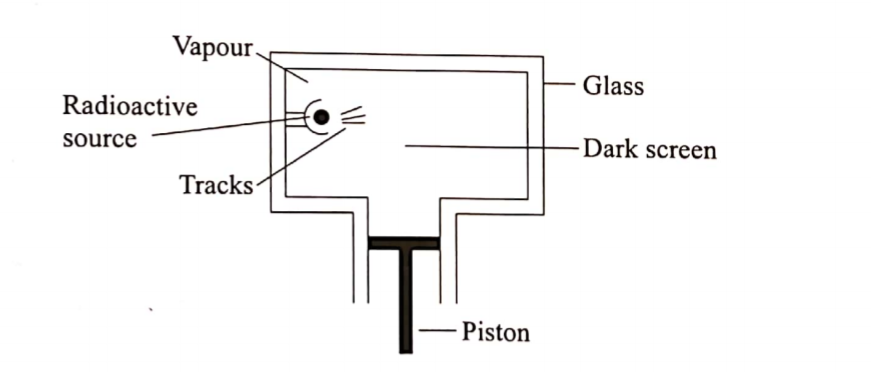
(b) Figure 13 Shows a device used to detect radioactivity by forming tracks when air is ionised.

(i) State the name of the device shown. (1 mark)

(ii) State how air in the device gets ionised. (1 mark) (c) (i) State two Factors that determine the speed of the photoelectrons emitted from a metal surface. (2 marks)

The energy of a photon of light is 2.21 eV .(electronic charge is 1.6 x 10⁻¹⁹C and planks constant h is 6.63 x 10⁻³⁴Js).

I. Express this energy in joules. (l mark)

II. Determine the frequency of the light that produces the photon. (2 marks)

KCSE Past Papers 2019 Physics paper 1 (232/1)

KCSE Past Papers 2019 Physics paper 1 (232/1)

KCSE Past Papers 2019 Physics paper 1 (232/1)

Physics – Paper 1 – November 2019 – 2 Hours

SECTION A: (25 marks)

1. A micrometer screw gauge has a —0.03 mm error. State the reading that is observed on the instrument s’hen used to measure the diameter of a wire whose actual diameter is 0.38 mm. (1 mark)

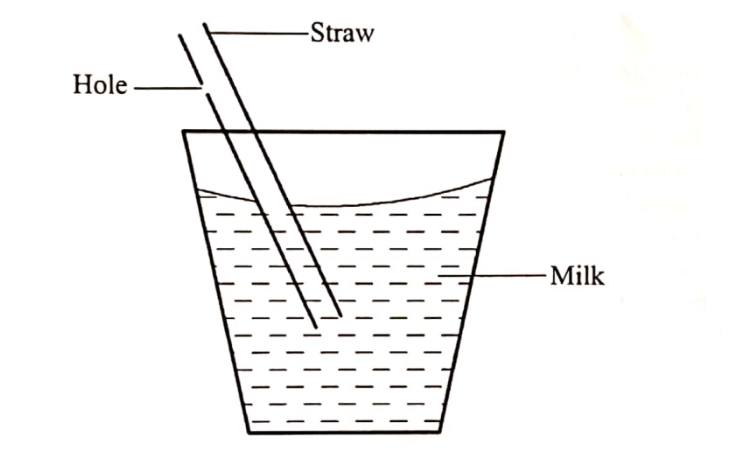
It was observed that upon sucking the straw, milk did not rise up the straw. Explain this observation. (2 marks)

3. State two ways of reducing surface tension of a liquid. (2 marks)

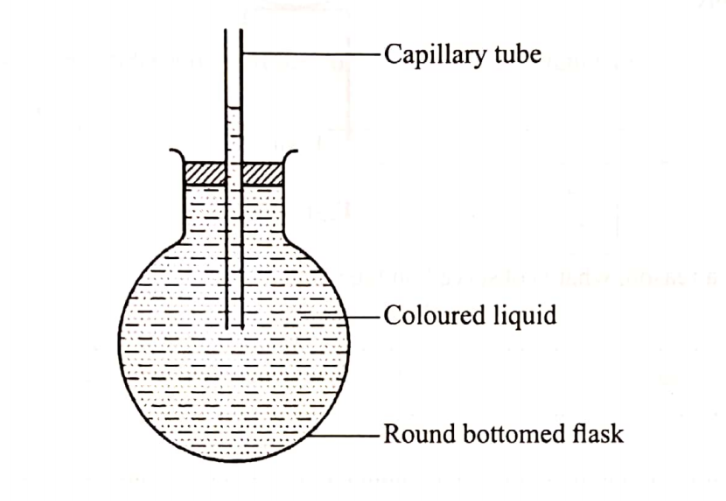
4. Figure 2 shows a round bottomed flask containing a coloured liquid.

The flask is fitted with a capillary tube.

It is observed that on holding the flask with bare hands, the level of the liquid in the capillary tube initially drops slightly and then rises. Explain this observation. (3 marks)

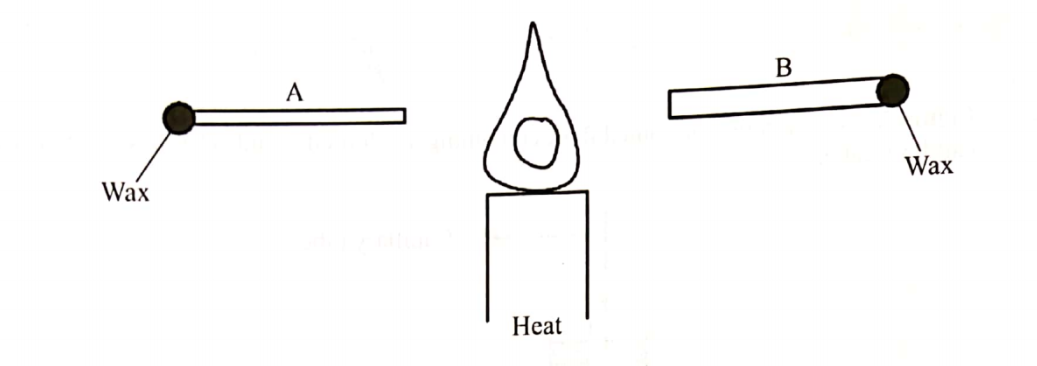
5. figure, 3 shows two metal rods A and B of equal length made of the same material but different diameters.Wax is attached at one end of each rod . A source of heat is placed between the two metal rods

State with a reason, what is observed on the wax. (2 marks)

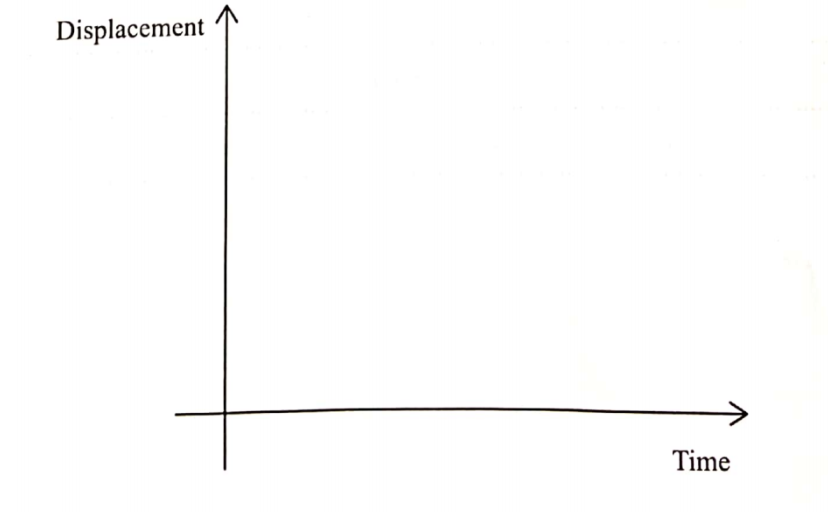
On the axes provided, sketch a displacement — time graph for a trolley moving down a frictionless inclined plane till it reaches the end of the incline.(1 mark)

7. A student carrying a heavy box using the right fund is observed to lean towards the left hand side. Explain this observntion. (2 marks)

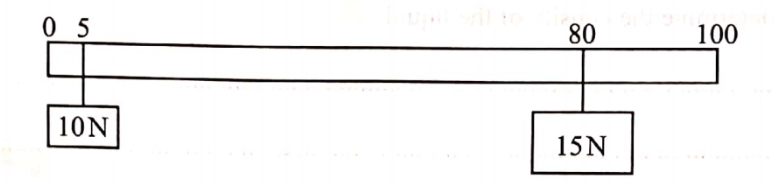
8. Figure 4 shows a one meter long uniform rod of negligible weight supporting two weights.

Determine the position of the fulcrum from Ocm for the rod to remain in equilibrium. (3 marks)

9. State the meaning of the term “radian” as a unit of measurement. ( 1 mark)

10. For a fluid flowing at a velocity V in a tube of cross-sectional area A, VA = assumptions made in deriving this equation. (2 marks)

11. A stone of volume 800 cm3 experiences an upthrust of 6.5 N when fully immersed in a certain liquid.Determine the density of the liquid. (2 marks)

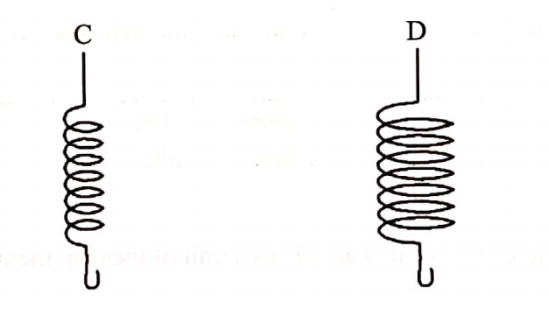
12. Figure 5 shows two springs C and D of the same length and equal number of turns made from the same wire.

State with a reason which of the two springs can support a heavier load before attaining the elastic limit. (2 marks)

13. Two boxes E and F of masses 2.0kg and 4.0kg respectively are dragged along a fiictioness surface using identical forces.

State with a reason which box moves with a higher velocity. (2 marks)

SECTION B (55 marks)

Answer all the questions in this section

14. (a) A student is provided with five 20g masses, a meter rule, a spring with a pointer,a stand,a boss and a clamp.

(i) In the space provided, sketch a labelled diagram of the setup that may be used in order to verify Hooke’s law using these apparatus. (3 marks)

(ii) State two measurements that should be recorded in order to plot a suitable graph so as to verify Hooke’s law. (2 marks)

(iii) Describe how the measurements made in (ii) can be used to determine tlic spring constant. (2 marks)

(b) A helical spring stretches by 0.6 cm when Supporting a weight Of 40 g. Determine the extension when the same spring supports a weight of 65 g. (3 marks)

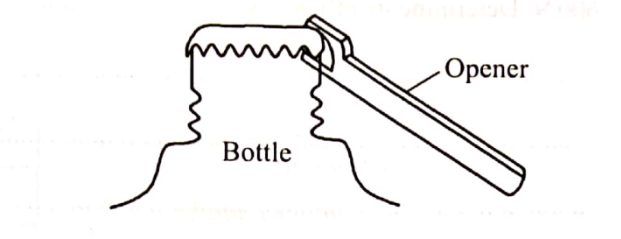
15. (il) Figure 6 shows a bottle top opener being used to open a bottle.

Indicate on the diagram the direection of the load and the effort. (2 marks)

(b) State two ways in which an inclined plane can be made to reduce the applied effort when pulling a load along the plane. (2 marks)

(c) A block and tackle system has three pulleys in the upper fixed block and two pulleys in the lower movable block.

(i) Draw a diagram to show how the system can be set up in order to lift a load and indicate the position of the load and effort. (3 marks)

(ii) State the velocity ratio of the set up. (1 mark)

(iii) In such a block and tackle system an effort of 200N is required to lift a load of 600 N. Determine its efficiency. (3 marks)

16. (a) State the meaning of the term “heat capacity.” (1 mark)

(b) State how pressure affects the melting point of a substance. (3 marks)

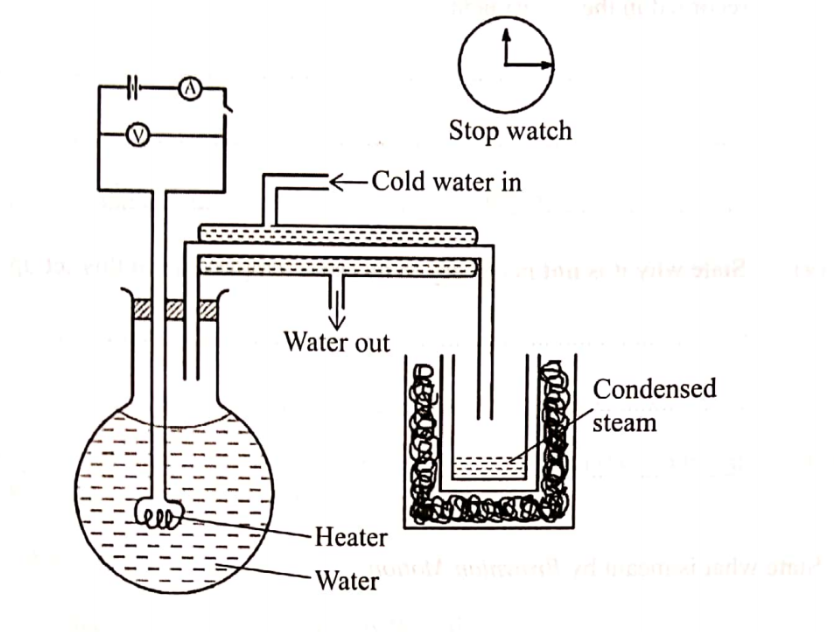
(C) Figure 7 Shows a set up of apparatus that may be used to measure the specific latent heat of vaporisntion of stenm.

(i) Describe how the mass of condensed steam is determined. (3 marks)

(ii) Other than mass and time, state two other measurements that should be taken during the experiment. (2 marks)

(iii) Show how the measurements in (c)(ii) can be used to determine the specific latent heat of vaporisation of water. (2 marks)

(iv) State the precautions that should be taken so that the mass of the condensed steamed measured corresponds to the actual mass of steam collected during the time recorded in the eperiment (1 mark)

(v) State why it is not necessary to measure temperature in this set up. (1 mark)

17. (a) State what is meant by Brownian Motion (I mark)

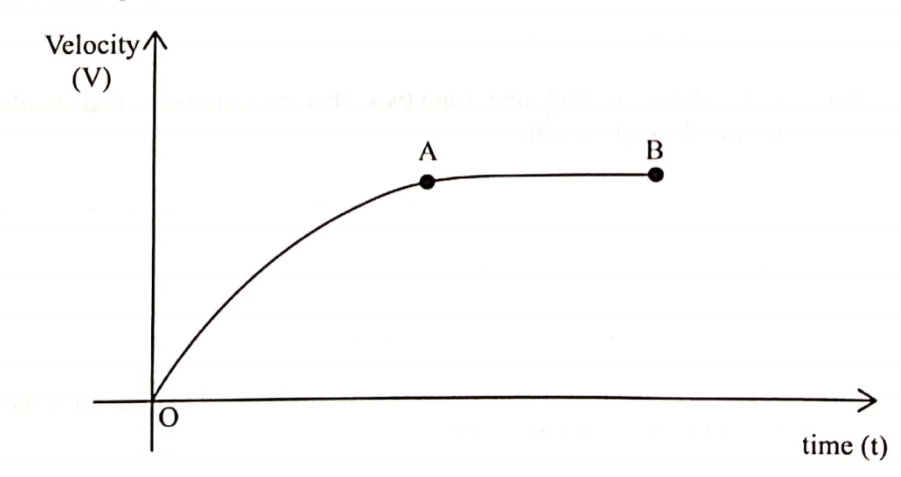
(b) Figure 8 shows the graph of velocity against tiiiic for a small steel ball falling in a viscous liquid.

(i) Describe the motion of the steal ball as represented my port OA. (1 mark)

(ii) Explain why the velocity between A and B is constant. (3 marks)

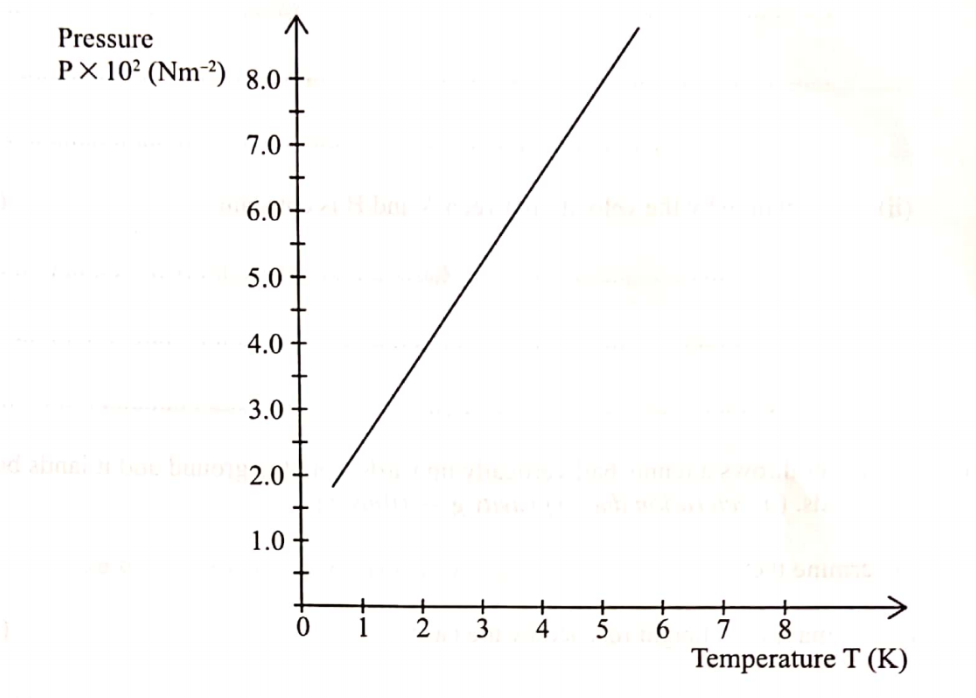
(ii) velocity with which the ball hits the ground. 18. (a) Figure 9 shows a graph of pressure against temperature for a fixed mass of gas at constant volume

From the graph, determine the values of n and c given that P = nT + c where n and c are constants. (4 marks)

(b) Explain why it is not possible to obtnin zcro pressure of a gas in real life situation. (2 marks)

(c) A fixed mass of a gas occupies 1.5 x 10⁻³m3 at a pressure of 760 mmHg and a temperature of 273 K. Determine the volume the gas will occupy at a temperature of 290 K and a pressure of 720 mmHg. (3 marks)

(d) State any three assumptions made in kinetic theory of gases. (3 marks)

KCSE Past Papers Mathematics 2019 (121/2)

KCSE Past Papers Mathematics 2019

Kenya Certificate of Secondary Education

KCSE Past Papers Mathematics 2019 (121/2)

2019 Mathematics Paper 2

Section I (50 marks)

Answer all the questions in this section.

1. Simplify √5+3∕ √5-2 . Give the answer in the form a + b∕c where a, b and c are integers. (2 marks)

2. Two types of flour, X and Y, cost Ksh60 and Ksh 72 per kilogram respectively.

The two types are mixed such that the cost of a kilogram of the mixture is Ksh 70. Calculate the ratio X:Y of the mixture.(3 marks)

3. A quantity P varies inversely as the square of another quantity L.

When P = 0.625, L = 4. Determine P when L — 0.2. (3 marks)

4. An arc of a circle subtends an angle of 150° at the circumference of the circle.

Calculate the angle subtended by the same arc at the centre of the circle. (2 marks)

5. Solve the equations:

x + 3y = 13
x² + 3y² = 43 (4 marks)

6. A bag contains 6 red counters and 4 blue counters.

Two counters are picked from the bag at random, without replacement.

(a) Represent the events using a tree diagram. (1 mark)

(b) Find the probability that the two counters picked are of the same colour. (2 marks)

7. Find the coordinates of the turning point of the curve y=x²-14x+10 (3 marks)

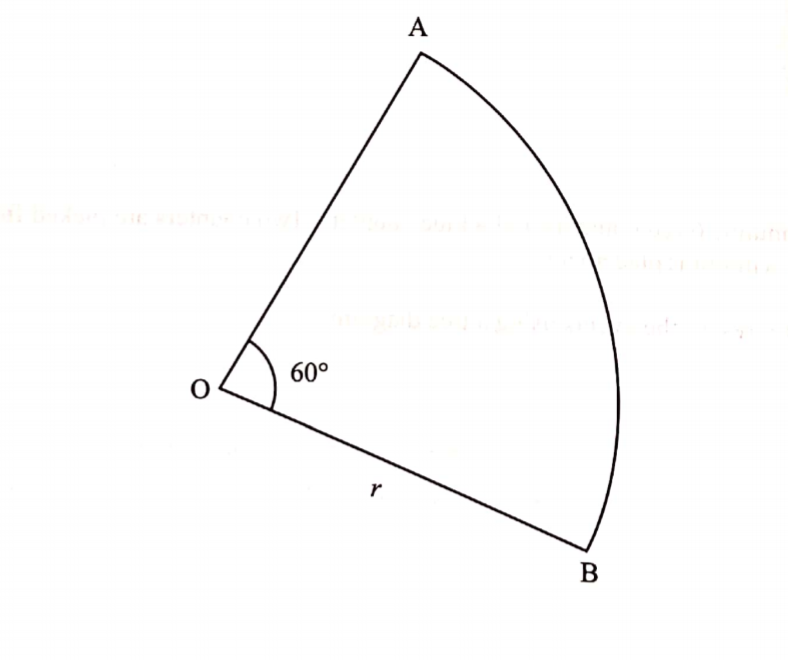
8. OAB is a Sector Of a circle of radius r cm. Angle AOB = 60°.

Find, in its simplest form, an expression in terms of r and z for the perimeter of the sector.(2 marks)

9. In a mathematics test, the scores obtained by 30 students were rccordcd as shown in the toblc below.

       Score (x) 59 61 65 K 71 72 73 75
      No. of students 2 3 5 6 7 4 2 1

The score K with a frequency of 6 is not given.

Given that ⅀fd∕⅀f = — 1.2 where d —— x – 69, and using an assumed mean of 69, determine score K.

10. Determine the amplitude and the period of the function y = 3 sin(2x + 40°). (4 marks)

11. The figure ABCDEFGH represents a box.

The top lid of the box is opened such that the height OT is 35cm. Calculate the:

(a ) angle the top lid makes with the plane FGHE;

(b) length BE, correct to 2 decimal places.

12. The table below’ shows income tax rates in a certain year.

Monthly Income in ksh Tax rate  in each shilling
(%)
0  – 10164 10
    10165 – 19740 15
     19741 – 29316 20
     29317 – 38892 25
      38893 and above 30

In that year,mawira earned a salary of 41000 per month.calculate mawira’s income tax per month given that a monthly tax relief of ksh 1162 was allowed (3 marks)

13. The position vectors of points A,B and C are OA =[3/4],OB = [1/2] and OC =[7/-1] show that A,B and C are collinear (3 marks)

14. The vertices of a triangle PQR are P(-3, 2), Q(0, — 1) and R(2, — 1). A transformation matrix maps triangle PQR onto triangle P’Q’ R’ whose vertices are P'(—7, 2), Q'(2, — 1) and R’(4, – 1).

Find M°’, the transformation that maps P’Q’R’ onto PQR.(4 marks)

15. Solve for x in log(7x—3) + 2 log 5 = 2 + log(z + 3).(4 marks)

16. The length of a shadow’ of a mast was measured at intervals of 1 hour and recorded as shown in the table below.

Time( hr) 0 1 2 3 4 5
Length( m) 18.7 8.7 5.0 2.9 1.3 0

(a) On the grid prov’ided, draw the graph of length against time. (2 marks)

(b) Dctermine the rate of change of the shadow’ length at = 2 (2 marks)

SECTION II (50 MARKS)

Answer any five questions

17.The first term of an Arthmetic Progression(AP) is equal to the first term of a Geometric Progression (GP). The second team of the AP is equal to the fourth term Of the GP while the tenth term of the AP is equal to the seventh term of the GP.

(a) Given that a is the first term and d is the common difference of the AP while r is the common ratio of the GP, write the two equations connecting the AP and the GP. (2 marks)

(b) Find the value of r that satisfies the progressions.(4 marks)

(c) Given that the tenth term of the GP is 5120, find the values of a and d.(2 marks)

(d) Calculate the sum of the first 20 terms of the AP.( 2 marks)

18. Mbaka bought some plots at Ksh 400000 each. The value of each plot appreciated at the rate of 10% per annum. (a) Calculate the value of a plot after 2 years. (2 marks)

(b) After some time t, the value of a plot was Ksh 558400. Find i, to the nearest month. (4 marks)

(c) Mbaka sold all the plots he had bought after 4 years for Ksh2 928200.

Find the percentage profit Mbaka made, correct to 2 decimal places. (4 marks)

19. The figure KLMN below is a scale drawing of a rectangular piece of land of length KL = 80m

(a) On the figure, construct

(i) The locus of a poini P which is both equidistant trom points L and M It and from lines KL and LM. (3 marks)

(ii) the locus of a point Q such that ∠KQL = 90°. (3 marks)

(b) (i) Shade the region R bounded by the locus of Q and th Locus of poinis equidistant from KL and LM. (3 marks)

(ii) Find the area of the region R in m². (Take ℼ= 3.142). (3 marks)

20. A ship left point P(l0°S, 40°E) and sailed due East for 90 hours at an average speed of 24 knotS to a point R.

(Take I nautical mile (nm) to be 1.853 km and radius of the earth to be 6370 km) (a) Calculate the distance between P and R in:

(i) nm; (1 marks)

(ii) km. (1 marks)

(b) Determine the position of point R.( 5 marks)

(c) Find the local time, to the nearest minute, at point R when the time at P is II:00a.m. (3 marks)

21. A workshop makes cupboards and tables using two artisans A and B every cupboard made requires 3 days of work by artisan A and 2 days of work by artisan B.

Every table made requires 2 days of work by artisan A and 2 days of work by artisan B.

In one month artisan A worked in less than 24 while artisan B Worked for Not More Than 18 Days.

The workshop made x cupboards and y tables in that month.

(a) Write all the inequalities which must be satisfied by x and y. (3 marks)

(b) Represent the inequaliiies in (a) on the grid provided.(3 marks)

(c) The workshop makes a profit Of Ksh 6 000 on each cupboard and Ksh4 000 on each table.

Find the number of cupboards and the number of tables that must be made for maximum profit and hence determine the maximum profit. (4 marks)

22. The amount of money contributed by a group of students during a fundraising for a needy student was as shown in the table below.

Amount(  Ksh) 301 – 400 401 – 500 501 – 600 601 – 700 701 – 800 801 – 900 901 – 1000
No. of students    2      10 12 14 7 3      2

(a) On the grid provided draw an ogive to represent the data. (4 marks)

(b) Use the graph to estimate:

(i) The median; (1 marks)

(ii) The quartile deviation; (3 marks)

(iii) The percentage number of students who contributed at least Ksh 750.50. (2 marks)

23. In the figure below, OA = a,OB = b and BX meets OY at C.OX:OA = 1:2 and BY:YA = 1:3.

(a) Express in terms of a and b: (1 marks)

(ii) OY; (2 marks)

(iii) BX. (1 marks)

(b) Given that OC = hOY and BC = kBX, determine the values of h and k. (6 marks)

24. A trapezium PQRS with vertices P(2, 2), Q(6, 2), R(6, 4) and S(2, 8) is mapped onto P’Q’R’5′ by a transformation matrix M = (—1/0 0/1).

(a) Find the coordinates of P’Q’R’ S’.(2 marks)

(b) On the grid provided draw PQRS and its image P’Q’R’S’ (2 marks)

(c) Find P”Q”R”S“, the image of P’Q’R’S’ under the transformation matrix. N = (-½/0 0/-½)(1 marks)

(ii) On the same Grid draw P”Q”R‘S”.(1 marks)

(d) (i) Find a single matrix that maps P”Q”R’S” onto P’Q’R’S’.(2 marks)

(ii) Describe fully the transformation thai maps P”Q”R”S” onto P’Q’R’s’.(2 marks)

KCSE Past Papers Mathematics 2019 (121/2)

KCSE Past Papers Mathematics 2019 (121/1)

KCSE Past Papers Mathematics 2019

Kenya Certificate of Secondary Education

KCSE Past Papers Mathematics 2019 (121/1)

2019 Mathematics Paper 1

Section I (50 marks)

Answer all the questions in this section.

1. Without using mathematical tables or a calculator, evaluate: 5.4∕ 0.025 x 3.6 (3 marks)

2. Express 1728 and 2025 in terms of their prime factors. Hence evaluate:(4 marks)

∛1728 √ 2025

3. Juma left his home at 8.30a.m. He drove a distance of l40km and arrived at his aunt’s home at 10.15 a.m.

Determine the average speed, in km/h, for Juma’s journey.(3 marks)

4. Expand and simplify:

4 (q – 6) + 7 (q — 3).(2 marks)

5. In the trapezium PQRS shown below, PQ = 8 cm and SR = 6 cm.

If the area of the trapezium is 28 cm², find the perpendicular distance between PQ and SR. (2 marks)

6.Given that = ∛ 94=3n find the value of n.(3 marks)

7. Three villages A, B and C rife Such that B is 53 km on a bearing of 295° from A and C IS 75 kin east of B.

(a) Using a scolc of 1 cm to represent 10 km, draw a diagram to show the relative positions of villages A, B and C. (2 marks)

(b) Determine the distance, in km, of C from A. (2 marks)

8. A retailer bought a bag of tea leaves. If the retailer were to repack the tea leaves into smaller packets of either 40 g, 250g or 350 g, determine the least mass, in grams, of the tea leaves in the bag.(3 marks)

9. Given that sin 2x = cos (3z — 10°), find tan z, correct to 4 significant figures. (3 marks)

10. A tourist converted 5820 US dollars into Kenya Shillings at the rate of Ksh 102.10 per dollar.

While in Kenya, he spent Ksh450 000 and converted the balance into dollars at the rate of Ksh 103.00 per dollar.

Calculate the amount of money, to the nearest dollar, that remained.(3 marks)

11. Given that b =

(2)
(4)

C,=

(3)
(2)

and a = 3c — 2b, find the magnitude of a, correct to 2 decimal (4 marks)

12. Using a ruler and a pair of compass only, construct a rhombus PQRS such that PQ = 6cm and dSPQ = 75°.

Measure the length of PR.

13. Solve the inequality 2x — 1 ≤ 3x + 4 < 7 — x. (3 marks)

14. Given that A = ( 2 3 4 4 ) B, ( X 1 2 3 ) and that AB is a Singular matrix, find the value ofx.(3 marks)

15. A trader bought two types of bulbs A and B at Ksh 60 and Ksh 56 respectively. She bought a total of 50 bulbs of both types ct a total of Ksh 2872.

Determine the number of type A bulbs that she bought. (3 marks)

16. A bus plies between two towns P and R via town Q daily. On each day it departs from P at 8.15 a.m. and stops for 40 minutes at Q before proceeding to R.

On a certain day, the bus took 5 hours 40 minutes to travel from P to Q and 3 hours 15 minutes to travel from Q to R.

Find, in 24 hour clock system, the time the bus arrived at R. (3 marks)

SECTION II (50 marks)

17. A rectangular water tank measures 2.4 m long, 2 m wide and 1.5 m high.

The tank contains some water up to a height of 0.45 m.

(a) Calculate the amount of water, in litres, needed to fill up the tank (3 marks)

(b) An inlet pipe was opened and water let to flow into the tank at a rate of 10 litres per minute.

After one hour, a drain pipe was opened and water allowed to flow out of the tank at a rate of 4 litres per minute.

Calculate:

(i) the height of water in the tank after 3 hours;(4 marks)

(ii) the total time taken to fill up the tank. (3 marks)

18. (a) A line, L, posies through tho points (3,3) and (5,7). Find the equation of L, in the form y = mx+c where m and c arc constonti. (3 marks)

(b) Another line L2 is perpendicular to L, and passes through (—2, 3). Find:

(i) the equation of L2;

(ii) the x-intercept of L2.

(c) Determine the point of intersection of L, and L2. (3 marks)

19. A triangle ABC wÎth Vertices A (—2,2),B (1,4)and C (-1,4) is mapped on to triangle A’B’C by a reflection in the line y=x+1.

(a) On the grid provided draw

(i) triangle ABC (3 marks)

(ii) the line y = x + 1; (2 marks)

(iii) triangle A’B’C’. (2 marks)

(b) Triangle A”B”C“ is the image of triangle A’B’ C’ under a negative quarter turn (0,0).

On the same grid, draw triangle A“B“C“. (3 marks)

20.The figure below is a right pyramid VEFGHI with a square base of 8cm and a slant edge of 20cm Points A B C and D lie on the slant edges or the pyramid such that VA = VB = VC = VD = I0 cm and plane ABCD iS paralell to the base EFGH.

(a) Find the lenght of AB. (2 marks)

(b) Calculate to 2 decimal places

(i) The lengh of AC (2 marks)

(ii) The perpendicular height of the pyramid VABCD (2 marks)

(c) The pyramid VABCD was cut off.Find the volume of the frustrum ABCDEFGH correct to 2 decimal places (4 marks)

21. The heights of 40 athletes in a county athletics competition were as shown in the table below.

Height,cm Frequency
150 -159    2
160 – 169    8
170 – 179   10
180 – 189   x
190 -199   6
200 – 209   2

(a) Find the value of X. (1 mark)

(b) State the modal class. (1 mark)

(c) Calculate:

(i) The mean height of the athletes;(4 marks)

(ii) The median height, correct to 1 decimal place,of the athletes (4 marks)

22. The figure below represe nts a triangular 8ower garden ABC in which AB = 4 in, BC = 5m and ∠BCA = 30°. Point D lies on AC such that BD = 4 m and ∠BDC is obtuse.

Find, correct to 2 decimal places: (a) ∠BDC; (3 marks)

(b) the length of AD; (3 marks)

(c) the length of DC; (2 marks)

(d) the area of the flower garden ABC. (2 marks)

23. The shaded region on the graph below shows a piece of land ABCD earmarked for building a sub-county hospital.

(a) Write down the ordinates of curves AB and DC for x = 0, 200, 400, 600, 800, 1000 and 1200. (2 marks)

(b) Use trapezium rule, with 6 strips to estimate the area of the piece of land ABCD, in hectares.(4 marks)

(c) Use mid-ordinate rule with 3 strips to estimate the area of the piece of land, in hectarea. (4 marks)

24. The equation of a curve is y=x3+x2-x-1

(i) Determine the stationary point of the curve (3 marks)

(Îi) the nature of the stationary points in (a) (i) above.(2 marks)

(b) Determine:

(i) the equation of the tangent to the curve at x = 1; (3 marks)

(ii) the equation of the normal to the curve at x = 1. (2 marks)

KCSE Past Papers Mathematics 2019 (121/1)