Category Teacher’s Resources

KCSE Past Papers 2018 Kiswahili Paper 2 (102/2)

KCSE Past Papers 2019 Kiswahili Karatasi ya 2 (102/2)

KCSE Past Papers 2018 Kiswahili Paper 2 (102/2)

Kenya Certificate of Secondary Education Kiswahili

UFAHAMU (Alama 15)

Soma kifungu kifuatacho kisha ujibu maswali.

“Mabibi na mabwana, ndugu wapenzi, alianza Bi. Mkesha, “huu ni mwaka wa tano tangu tufanye uchaguzi mkuu uliowapa vigoda wenzetu hawa. Katika kipindi hiki kumetokea mengi ya kujipigia kidari, pametokea pia mengi, mengi mabaya ya kuitia jamii ya Tungama izara.

Tumejipa mkono wa tahania kwa uteuzi wetu mzuri. Vilevile tumejisuta kwa uteuzi usio wa kuridhisha. Ndugu wapenzi, sina haja ya kuwakumbusha yote ambayo tumepitia; mmeyashuhudia yote.

Ila ninayotaka kusema ni kwamba malengo yetu ya kuwateua viongozi yamesalitiwa. Ndugu zangu, itakumbukwa kwamba watangulizi wetu walianza safari ya kurejesha utu wa Mwafrika wakiwa na nia thabiti ya kuwabwaga maadui watatu wa maendeleo.

Je, mnawajua maadui hao? Ni ujinga, magonjwa na umaskini.

Waanzilishi wa taifa hili, pamoja na viongozi waliowafuata walipigania huduma za bure za afya, na elimu ya bure na ya lazima kwa wote. Vijana wetu walijitoma ugani kuzamia lulu ya elimu; wakaxidhihaki vitabu hadi kufikia kilelecha cha elimu.

La kusikitisha ni kwamba elimu hii imekuwa laana kwao. Mnajua kisa na maana ya hali hii? Natija iliyotarajwa haikupatikana. Na haya si mageni kwetu. Mnajua wapo vijana humu vijijini ambao wamepiga lami kwa miaka na mikaka bila kuambulia kazi za hadhi ambazo waliahidiwa huko vyuoni.

Hatimaye hawa hawa wenye shahada mbili, na wengine hata tatu, ndio wanaokuwa matarishi wa wale ambao walichechemea masomoni.

Vijana wengine, kwa kukosa hata huo utarishi, wamearnua kuanzisha biashara rejareja ili kujikimu; wamekosa la mama, wanaamwa la mbwa. Sina haja ya kuwafafanulia kiini cha hali hii ya kutamausha.

Ni dhahiri kwamba uthabiti wa taifa lolote lile hutegemea uthabiti wa uongozi, na uaminifu wa raia wake katika kuuwajibisha huo uongozi. Hata hivyo, inasikitisha kwamba wengi wetu tuinejipoka uwezo wa kuuwajibisha uongozi kwa kuwa mawindo rahisi ya uzungukaji mbuyu.

Huu ndio uwele ambao umeufisidi utu wetu na kutusahaulisha thamani za kitaifa. Hebu niambie ewe mama mwenzangu, kuna faida gani kuuza kura yako kwa kibaba cha unga na noti ya shilingi mia moja, ati kwa kuwa unaambiwa, ‘Ukinichagua nitahakikisha kwamba ile Affirmative Action imezingatiwa?

Ipo haja gani kuchomwa na jua ukiwafuata hawa hawa viongozi, ukiwaimbia nyimbo za kuwatia raia kichaa cha shangwe ili kuwapembeja wawapigie kura? Je, faida kwako imekuwa gani? Hujangojea kwa kipindi chote hiki kusakafiwa kwa hiyo barabara uliyoahidiwa siku ulipouza kura yako? Na ile ahadi ya ‘mwenzetu’ ya kuwaajiri vijana wetu kwenye Jeshi la Wanamaji imetimia? Hatujashuhudia watu wa akraba moja wakisombwa kutoka humu lcijijini kwenda kuchukua nyadhifa katika mashirika ya umma?”

“Kweli waso hayawanamji wao, Bi. Mkesha amejikosha kweliweli,”Bi. Kuli alimwambia mwenzake Bi. Kengemeka kisha akaendelea.” Anatuambia yepi mageni ambayo masikio haya yangu yaliyokula chumvi ya miongo sita ushei ya miaka hayajasikia?”

“Anasema tumpe nafasi ajitome kwenye uwanja wa majogoo,” akajibu Bi. Kengemelca, “atakuwaje tofauti na hao wanaurne?” Hata hao wanawake tumewahi kuwapa nafasi, wakatutenda zaidi ya wanaume. Usinikumbushe kura yangu niliyoipoteza kwa kumkweza Bi. Shali kwenye usukani. Siwezi kusahau namna ile ahadi ya maji ya mabomba na kuchimbwa kwa visima ilivyoishia kwenye kauli yake tu.”

Tumetendwa sote mwenzangu,” alisema Bi. Kull, “inasikitisha kwamba dau ta masomo ya wanangu limeenda mrama huku nikikimlilia huyo huyo Bi. Shali. Kila mara tunasikia kupitia vyombo vya habari kwamba serikali imeanzisha Hazina ya Eneobunge kuyafadhili masomo ya watoto kutoka familia maskini. Lengo kuu, nasikia, ni kuhakikisha kwamba asilimia kubwa ya watoto haipati fursa ya kujiunga na shule tu, bali pia inakamilisha masomo ‘Hata hivyo, lıuu ni mwaka wa tatu tangu wanangu watatu waache masomo kutokana na ukosefu wa karo.

Na „ usidhani ni karo ya shule ya kitaifa, la, hasha! Ni karo ya shule za kutwa ambapo niliwapeleka baada ya huyu huyu Bi.Shali kunitilia huku akinitolea huko kuhusiana na ufadhili wa masomo.”

“Usinikumbushe yaliyomfika mwanangu Neema,” alisema Bi. Kengemeka huku akitwaa ukingo wa kanga yake kujipangusa machozi. “Mwana huyu alikaa nyumbani kwa muhula mzima,” akaendelea Bi. Kengenıeka,” dhiki ya kuwaona wenzake wakienda shuleni huku yeye anabaki nyumbani ikamfanya kuwa windo rahisi la mmoja wa hao wabunge, akaambulia uja uzito ambao hakuulalia wala kuuamkia.

Mwenyewe mbunge ameshika hamsini zake kana kwamba hakufanya lolote.

Mwanangu Jabali naye amehiari kuwa kibarua katika shamba la mbunge wa sasa. Mwenyewe anasema anataka kudunduiza pesa ili arudi shuleni kukamilisha mwaka wake wa mwisho. Na usidhani ni hao wangu tu waliofikwa na ya kuwafika. Tumewaona wana wa wenzetu tuliopiga foleni pamoja kuwateua hao hao wabunge, wakitumiwa kama masoko ya dawa za kulevya. Wengine wamegeuzwa walanguzi wa dawa hizi,” Bi. Kengemeka alikamilisha uzungumzi wake na kushusha pumzi kana kwamba ameutua mzigo mzito.

Hata hotuba ya Bi. Mkesha ilipofikia ukingoni, Bi. Kuli alimwambia mwenzake, “Ninavyoona ni kwamba wanasiasa wote wamefınyangwa kutoka aina sawa ya udongo. Ikitokea kwamba tutampa huyu Bi. Mkesha kura, tumpe kwa kulazimika kikatiba kupiga kura; tusiwe na matarajio makuu.

Inasikitisha kwamba vijana wetu waadilifu hawataki kujitia najisi kwa kuingilia siasa. Yule kijana wetu Angaza angekubali rai ya wazee kujitoma ukingoni tungemuunga mkono.

(a) “Malengo yetu ya kuwateua viongozi yamesalitiwa.” Thibitisha kauli hii kwa kurejelea hoja sita kutoka kwenye taarifa. (alama 6)

(b) Eleza mchango wa wanyonge katika hali ya uongozi nchini Tungama. (alama 3)

(c) Bainisha mbinu nne ambazo Bi. Mkesha anatumia kuishawishi hadhira yake. (alama 4)

(d) (i) Andika kisawe cha, ‘kuwapembeja’ kwa mujibu wa taarifa.

(ii) Andika maana ya, ‘amejikosha’ kulingana na taarifa.

2. UFUPISHO (Alama 15)

Soma kifungu kifuatacho kisha ujibu maswali.

Tangu jadi, jamii za Kiafrika zilikuwa na majukumu bayana ya kijinsia. Kila jamii ilipania kuyarithisha majukumu haya kwa vijana wa vizazi tofautitofauti. Katika jamii nyingi, vikao maalumu viliandaliwa ili kuwaelekeza vijana kuhusu namna ya kukabiliana na majukumu yao ya kijamii. Nyakati nyingine mafunzo haya yalitolewa katika vipindi vya burudani kama vile utambaji wa ngano. Kadhalika, maarifa ınengi kuhusu namna ya kukabaliana na majukumu na changamoto za jinsia mahususi yalitolewa kupitia sherehe maalumu za kitamaduni almaarufu miviga. Mifano ya sherehe hizi ni kama vile upashaji tohara, arusi, na hata matanga. Jamii za zamani, kama zilivyo za kisasa, zilikuwa na matarajio mahususi kwa watu wa jinsia zote.

Mathalani, katikajamiinyingine zaKiakika, mwanamumendiye aliyetarajiwakuikimu aila yalıe.

Katika kipindi cha Usasi na Kuhemera kwa mfano, mwanamume ndiye aliyekuwa na jukumu la kwenda kichakani kuwinda. Hali kadhalika, mwanamume ndiye aliyetarajiwa kufanya kazi zilizohitaji nguvu kama vile kufyeka misitu kwa ajili ya kutengeneza mashamba, kuchimba migodi, kuchonga mawe, kufua vyombo vya dhahabu na fedha, kuehonga vinyago, na kazi nyingine zilizohitaji nguvu. Mke naye alitengewa jukumu la ulezi, si wa watoto wake tu, bali pia wa mume wake, na hata jamii pana. Ilikuwa jukumu la mwanamke kubaki nyumbani kumpikia mumewe na watoto, kufua nguo na kunadhifisha mazingira.

Wakati mwingine waume wao walipojitoma msituni kupigania uhuru, wanawake ndio waliowapikia chakula na kutafuta nibinu za lcuwafikishia huko huko msituni.

Watoto wa kike walifunzwa kuzilinda jamii zao, si kwa mali tu, bali pia kwa hali. Walifiinzwa kwamba furaha na afya ya familia zao, kimwili, kihisia na kisaikolojia ilimtegemea mama.

Ndiye aliyeliakikisha kwamba familia yake imepata lishe bora, ndiye aliyekuwa mwalimu wa kwanza wa watoto wake; akawafunza namna ya kmjithamini na kuwathamini wenzao; akawafunza pia namna ya kutatua migogoro yao kwa njia ifaayo. Kwa upande mwingine, watoto wa kiume walifunzwa umuhimu wa kuwa watu wa kutegemewa na jamaa zao, pamoja na kubuni mikakati ya kuzihakikishia familia zao usalama.

Jamii ya kisasa inazidi kukua na kutwaa uchangamano, nayo mitazamo ya binadamu kuhusu masuala na hali mbalimbali inaendelea kubadilika.

Siku hizi kwa mfano, si ibra kupata kwamba majukumu ambayo awali yalikuwa yametengewa jinsia mahususi sasa yametwaliwa na jinsia zote.

Imedhihirika kwamba kupanda kwa gharama ya maisha kumezua haja ya waume kwa wake kushirikiana bega kwa bega kuchumia vyungu vya familia zao. Asilimia ya wanawake ambao wanafanya kazi za ajira katika mashirika ya umma na ya kibinafsi imepanda. Kadhalika, kinyume na zamani, idadi kubwa ya wanawake imesoma.

Hakika wapo wanawake wengi ambao wameibuka kuwa magwiji katika taaluma kama vile uhandisi, udaktari na usoroveya ambazo awali zilikuwa milki ya wanaume pekee.

Ulingo wa siasa nao umetwaa sura mpya.

Idadi ya wabunge wanawake inaendelea kupanda kila kuchapo. Wapo pia wanawake ambao wamejiunga na vikosi vya kulinda usalama; jambo ambalo halikuwa la kawaida katika jamii nyingi hapo awali. Wanaume nao wametwaa kazi ambazo awali zilitengewa wanawake pekee. Katika baadhi yajamii za Kiafrika, mwanamume ambaye alipatikana jikoni alichukuliwa kuwa anaufedhehesha ukoo.

Siku hizi si ajabu kuwapata akina baba wengine wakiziandalia familia zao vyakula. Vilevile idadi ya wanaume wanaosomea kazi ya uuguzi inazidi kuongezeka.

Pia wapo wanaume ambao wanafanya kazi ya ususi na kuwarembesha wanawake. Hali hii ya mwingiliano wa majukumu haisaidii tu kukabiliana na changamoto ya tofauti za kijinsia, bali pia hupalilia mshikamano wa kijamii. Watu wanapobadilishana zamu katika kutekeleza majukumu ya kijamii huthaminiana. Hujiona kama wanaotegemeana kwa hali zote, na kwa njia hii utangamano hujengeka zaidi. Kadhalika, kubadilishana majukumu ni njia bora ya kufidia udhaifu wa wenzetu.

Ni dhahiri kwamba kumekuwa na mwingiliano mkubwa wa kimajukumu, hali ambayo imeziwezesha jamii nyingi kufikia ufanisi mkubwa. Hata hivyo, imebainika kwamba hali hii inaelekea kumomonyoa faida ambazo jamii nyingi zimepata kwa wanaume na wanawake kuslurikiana kutekeleza majukumu anuwai.

Mathalani, wazazi wengi siku hizi wamo mbioni kutafuta elimu, ama kwa ajili ya kukidhi mahitaji ya kikazi, au kwa kukamia malipo zaidi. Kuna baadhi ya wazazi ambao hujisajili kwa kazi mbalimbali, si kwa sababu wanahitaji maarifa fulani, bali kwa sababu wanataka kuwapiku wenzao katika ndoa.

Matokeo ni kwamba mume na mke wanajipoka muda wa kukaa pamoja na kufahamiana, pengo la kimahusiano nalo linajengeka, hali ambayo imesababisha kusambaratika kwa baadhi ya ndoa. Hali kadhalika imebainika kwamba, kwa sababu ya mume na mke kuwa mbioni kujiendeleza kitaaluma na kielimu, malezi ya watoto yameanza kutetereka.

Jukumu la kuwalea watoto na vijana limetelekezewa vijakazi, vitwana na hata vibonzo! Ibainike kwamba kila jambo sharti liwekewe mipaka. Yapo majukumu ambayo sharti yatekelezwe na jinsia maalum, yumkini kwa sababu za kimaumbile. Yapo majukumu kama vile malezi ya watoto ambayo sharti yachangiwe na kila jinsia.

(a) Fupisha ujumbe wa aya tatu za kwanza kwa maneno 80. (alama 7, 1 ya mtiririko)

Matayarisho

Nakala Safi

Majibu

(a) “Malengo yetu ya kuwateua viongozi yamesalitiwa.” Thibitisha kauli hii kwa kurejelea hoja sita kutoka kwenye taarifa. (alama 6)


  • Vijana kusoma na kutopata kazi.
  • Waliosoma kupewa kazi za hadhi ya chini huku wasiosoma wakiwa wakubwa. Raia kuteua
  • viongozi wasiofaa kwa sababu ya ufisadi.
  • Raia kutopata huduma walizoahidiwa, kama vile maji ya mabomba.
  • Watoto wa maskini kutopata elimu licha ya kuwepo kwa hazina ya eneo bunge. Nyadhifa za juu kutwaliwa na watu wa nasaba moja/ukabila/unasaba.
  • Viongozi kuwatumia vijana kulangua dawa. Viongozi kuwatunga mimba watoto.
  • Ajira ya watoto.
  • Hazina ya eneo bunge kutowafaidi watoto wanaohitaji zaidi msaada.(b) Eleza mchango wa wanyonge katika hali ya uongozi nchini Tungama. (alama 3)
  • Kupoteza nafasi ya kuuwajibisha uongozi kwa kupokea hongo/kuuza kura. Kuwaimbia viongozi nyimbo ili kuwapembeja raia wawapigie kura.
  • Kuamini kwamba wanasiasa wote ni sawa; kukata tamaa ya kuchagua kiongozi tnwadilifu. (iv) Baadhi ya wale waadilifu kutojiunga na siasa — kwa mfano, Angaza. 3 x 1 = 3(c) Bainisha mbinu nne ambazo Bi. Mkesha anatumia kuishawishi hadhira yake. (alama 4)

    Kujinasibisha na wasikilizaji wake ndugu wapenzi, mama mwenzangu. Maswali ya balagha ili kuwachochea/ kuwavutia kwake. Je, mnajua … Kuwasawiri wasikilizaji kama wanaofaa — haya si mageni/anayasawiri mambo kama ya kawaida ili yeye na hadhira yake wayafasiri kwa namna sawa.

    (iv) Kuwaonyesha wasikilizaji wake kuwa ni mwenye mainlaka ya kuleta uthabiti katika uongozi.

    (v) Anajitenga na wanasiasa wengine na (kwa) kudokeza udhaifu wao. hawa hawa viongozi … ahadi ya ‘mwenzetu’…

    (d) (i) Andika kisawe cha, ‘kuwapembeja’ kwa mujibu wa taarifa.

    (i) Kuwapembeja — kuwarai, kuwalaghai.

    (ii) Andika maana ya, ‘amejikosha’ kulingana na taarifa.

    (ii) Amejikosha — amejitoa lawamani.

    2. (i) Majukumu ya kijinsia yalikuwa bayana.

    (ii) Majukumu yalirithlshwa kwa vizazi.

    (iii) Vijana walifunzwa kukabiliana na majukumu.

    (iv) Jamii kuwa na matarajio kuhusu jinsia.

    (v) Mwanaume kutarajiwa kukimu familia.

    (vi) Mama kuwa na jukumu la malezi.

    (vii) Watoto wa kike kutarajiwa kuzilinda familia.

    (viii) Mama kuwa mwalimu.

    (ix) Watoto wa kiume kufunzwa kuwa wa kutegemewa.

  • Watoto wa kike walifunzwa kuzilinda jamii zao.
  • Mama ndiye aliyekuwa mwalimu wa kwanza wa watoto wake.
  • Watoto wa kiume walifunzwa umuhimu wa kuwa watu wa kutegemewa. Uchangainano wa jamii umesababisha kubadilika kwa mitazamo.
  • Majukumu yameingiliana. Kwa mfano, wake wanafanya mambo ambayo awali hayakufanywa na jinsia hiyo.
  • Idadi ya wanawake wanaofanya kazi ya ajira imeongezeka.
  • Wanawake kusomea taaluma na nyanja zilizotengewa wanaume awali. Wanaume kufanya kazi zilizotengewa wanawake.
  • Hali ya mwingiliano wa kimajukumu hupalilia mshikamano na kukabiliana na tofauti za kijinsia.
  • Hufidia udhaifu wa wenzao.
  • Mwingiliano wa majukumu unaweza kuathiri vibaya faida iliyotarajiwa, kama vile kutelekezea malezi kwa vljakazi.
  • Baadhi hujisajili kwa kazi ili kushindana na wenzao. Hali hii huzua utengano na kusambaratika kwa ndoa.
  • Kila jambo sharti liwe na mipaka/kuna majukumu yanayostahili kutengewa tu jinsia maalum na mengine jinsia zote/mipaka hii idumishwe.(b)Miambakofi Yatazoleka

    (c) (i) ki — li — nunu — liw — a wa — li — tembe lew — a zi li — jeng — ew — a

    (ii) Mi-kate — (mi} wingi (kate} — mzizi

    Vi-ti Ny-ufa

    (vi} — wingi

    {ti} — mzizi

    {ny} — wingi (ufa} — mzizi

    (d) (İ) Mtu mwaminifu huheshimiwa.

    (Ü) Wao ndio walioibııka washindi.

    (iii) Mchuuzi alinunua kicha cha mboga.

    (iv) Seluwa ni mtiifu kama Maria / Seluwa ni mtiifu kuliko Maria.

    (e) (i) Ugwe — U — ZI.

    (ii) Lîmau — LI — YA

    Vifaa vya kutosha visingalikuwapo moto usingalidhibitiwa. Kama vifaa vya kutosha visingekuwepo moto usingedhibitiwa.

    Kama pasingekuwa na vifaa vya kutosha moto haingedhibitiwa. Vifaa vya kutosha visingekuwepo moto usingedhibitiwa.

    (g) Manahodha waliyakwepa majabali hayo vyoınbo vikafika fuoni salama.

    (h) Kwa mfano: Wanafunzi waliotia bidii masomoni walipata alama nzuri mno. Nomino kishazi kitegemezi kitenzi Nomino kivumishi kielezi

    (i) Barabara nyingi zitakuwa zikisakafiwa. au

    Barabara nyingi zitakuwa zinasakafiwa.

    (j) Wanafunzi wamefurahia kufika kwa wageni. Au

    Wanafunzi ivamefurahi wageni walipofika. Au

    Wanafunzi wamefurahi baada ya wageni kufika.

    (k) Maguo ambayo yanauzwa kwenye majiduka hayo yanavutia.

    (1) (i) Watoto wa Maki walilelewa na Muutu.

    (ii) Maji yalipojaa yalimwagika. Au Maji yalijaa yakamwagika.

    Au Maji yaliyojaa yalimwagika. Au Baada ya maji kujaa yalimwagika.

    (m) Sewe alituelezea jambo hilo tena. Au Sewe alituelezea jambo hilo mara mbili/mara kwa mara.

    (n) viongozi wengi — kirai nomino walikuwa waadilifu mno — Kirai tenzi waadilifu mno — kirai vumishi kabla ya uchaguzi mkuu — kitai husishi uchaguzi mkuu — kirai nomino.

    (i) KN (W * V) +KT (Ts + T) + U + KN (Ø) + KT (T)

    (ii) KN(N+KH)KT(T+E) Au KN( N+W+N) +KT( T*E)

    (i) Nyumba ni ya Medi.

    (ii) Nyumba ni ya mtu mwingine.

    (iii) Medi ndiye atairithisha nyumba.

    (iv) Mtu mwingine ndiye atairithisha nyumba.

    (v) Nyinyi (nafsi ya pili) ndio mtakaorithishwa.

    (vi) Wao (nafsi ya tatu) ndio watakaorithishwa.

    (q) “Jihadhari” akasema Kulei, “uamuzi wako unaweza kukuathiri vibaya.” (r) Mkulima hahitaji magunia haya.

    (s) (i) kusifu — kukashifu kupongeza — kukashifu chache / haba/kidogo — tele

    (iii) Nasaba/akraba/m1ango/ – ukoo Natija/tija – faida

    (t) Maana zifuatazo zijitokeze:

    (i) Kugawanya/kutenganisha, pengine kwa kisu.

    (ii) Ondoa sehemu ya kitu, kwa mfano, kukata ujira/kupunguza kitu.

    (iii) Chombo cha kuchotea maji mtunguni.

    (iv) Eneo la ardhi/sehemu inayoongozwa na kiongozi fulani k.v. Lokesheni.

    (v) Kitambaa au majani yaliyoviringwa kwa ajili ya kuwekwa kichwani kubebea mzigo.

    4.(a) Kuibua utangamano kwa kuwarejelea waumini kama ‘ndugu’, ‘wenzangu’. Kutaja jina la mwenyezi Mungu,/msamiati wa kidini.

    Kumsawiri binadamu kama anayehitaji huruma ya Mungu — ni mwenye dhambi/anayetegemea huruma.

    (iv) Kurejelea vifungu/mifano kutoka msahafu.

  • Atumie lugha inayoeleweka na hadhira.
  • Avute makini ya hadhira kwa kuwashirikisha, kwa mfano kupitia maswali ya balagha, kuwarejesha kwenye msahafu.
  • Kutasifidi lugha pale inapohitaji.
  • Lugha isiyowatia waumini unyanyapaa kwa mfano, aepuke kutumia kauli kama vile, “ukimwi unawapata wenye dhambi. .. utakuua”. Huenda kuna walioathiriwa moja kwa moja na ugonjwa wenyewe.
  • Kuzingatia fomyula na mtindo maalum/uliokubalika wa kuendeshea ibada ili wasikanganyike.
  • Kurudia baadhi ya kauli iii kuwaaminisha waumini/kuwafanya waelewe. Kuchanganya msimbo ili kurahisisha uelewa.
  • Kutumia miondoko na ishara ambazo zinakubalika na jamii — lugha husika. Pale anapohitajika/inapobidi atumie toni kali ya kuonya.
  • Atumie lugha inayotia tumaini na matarajio miongoni mwa waumini kuwa hali zao hata zingawa ngumu, zinaweza kutengenea.
  • Atumie mbinu za kushawishi/lugha ya kushawishi ili kuwavutia waumini na kuwadumisha kwenye dhehebu lake.
  • Lugha ya kuelekeza/kushauri. Kwa mfano: “Kesheni mkiomba” “Kaeni tayari kwani hamjui siku atakaporudi”.Tanbihi: Mifano itolewe ili atuzwe alama (1) kamili.

 

KCSE Past Papers 2018 Home Science Paper 2 (441/2)

KCSE Past Papers 2018 Home Science Paper 2 (441/2)

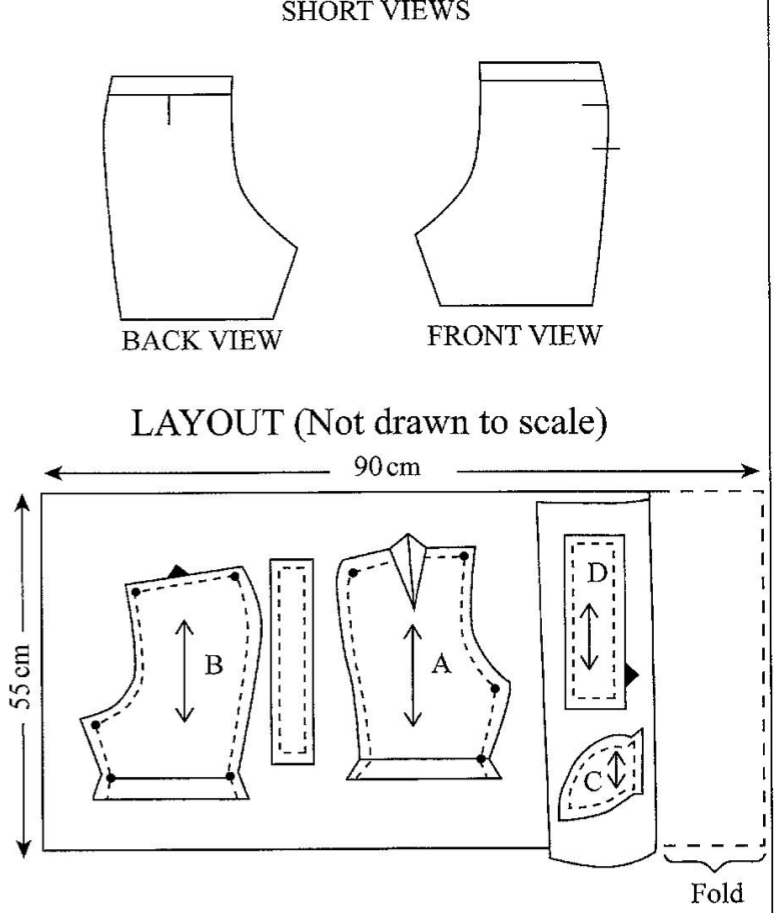
BOY’S SHORT

A pattern of a boy’s short is provided. You are advised to study the sketches, instructions and layout carefully before you begin the test.

MATERIALS PROVIDED

1. Pattern Pieces

A. Short back

B. Short front

C. Pocket

D. Waistband

2. Plain lightweight cotton fabric 55 cm long by 90 cm wide.

3. Seeing thread to match the fabric.

4. One large envelope.

The Test

Using the materials provided, cut out and make the LEFT SIDE of the boy’s short to show the following processes:

(a) Cutting out. (9½ marks)

(b) Making of the back dart.(5½ marks)

(c) Making of the inner leg seam using a French seam.(7½ marks)

(d) Attaching the in-seam pocket. (12 marks)

(e) Working of the side seam using an open seam and neatening the sectlon below the pocket. (12 marks)

(f) Preparing and attaching the interfaced waistband. (Do not trim the seam).

(i) Tack the back part waistband using even tacking.

(ii) Top stitch the edge of waistband. (22 marks)

(g) Managing the hem. Machine stitch half of the hem. (Do not remove tacking stitches).(15 marks)

(h) Overall presentation. (6½ marks)

At the end of the examination, firmly sew onto your work, on a single fabric, a label bearing your name and index number. Remove the needles, pins and loose threads from your work. Fold your work neatly and place it in the envelope provided. Do not put scraps of fabric in the envelope. Do not seal the envelope.

Questions and Answers

Home Science Paper 2 (441/2)

1. Presentation

(a)Work well pressed (1) and folded (½).

(b) Label (½) firmly fixed (1) without concealing details (½) and on a single fabric (½).

(c) Pins/needles (½) tacking threads (½) and unnecessary threads (½) removed.

(d) Made up for the left half(1).

Sub-total 6 ½

2. Cutting Out

(a) (b) All five pattern pieces cut-out (5 x ½).

Smooth cutting of short CF (1) and on straight (c) grain (½)

Smooth cutting of short CB (1) and on straight grain (½)

(d) Waistband CB. smoothly cut (½) and on straight

(e) grain (½ )

Waistband CF. smoothly cut (½ ) and on straight grain (½)

Pocket smoothly cut (2 x ½) and straight grain (2 x½)

3. Dart

(a) Straight stitchery (1) tapering to a point (½) (b) Thread ends well fastened at the point.

(c) Correct depth of dart 6.8cm to with 3mm (6.5— 7.fern)

(d) Correct width of dart 0.8cm to within 3mm (0.5- 1.1cm)

(e) Dart pressed towards C.B.

Flatness of dart of R.S. (½) and W.S. (½) (no pockets formed)

Sub-total 5½

4. Pocket

(a) Front pocket attached to front short (1) with

straight stitchery (1) with R.S together(1)

§) Back pocket attached to back short (1) with

straight stitchery (1) with R.S together(1) 3 (c) Pocket bag facing down (1) and correct shape(1)

(d) Pocket mouth reinforced at the top (½) and bottom(½)

(e) Smooth stitchery of curved edges of pocket (lx2).

Pocket mouth left open 1

Sub-total 12

5. Open Seam

(a)Joined with straight stitchery (1×2) Evenness of seam (½ x 2)

(b) Raw edges well neatened below the pocket (1x 2)

(c) Seam pressed open (½ x 2) and flat (½ x 2) on (d) W.S. (½ x 2) and R.S. ( 2 x 2).

(e) Width of seam 1.0cm to within 2mm (0.8cm — 1.2cm) (1×2)

(f) Seam snipped above and below the pocket (½ x 2)

Sub-total 12

6. French Seam (inner leg seam)

If not French Seam give zero (0)

(a) Seam well-trimmed(1) no threads on the R.S(1)

(b) Straight stitchery.

(c) Seam well knife edged.

(d) Evenness of seam.

(e) Correct size (6mm) to within 2mm (4mm-8mm)

(ft Seam pressed towards the back at the hem

(g) Flatness of seam at hem R.S. (½) and W S. (½)

(h) Hem folded and matching at the inner leg seam to within 2mm. 1

Sub-total 8½

7. Waist Band

(a) Waistband joined with straight stitchery.

(b) Waistband well knife edged (1 x 2)

(c) Waistband correctly attached with straight stitch- ery (1 x 2) and not trimmed (½ x 2) (d) Waistband even (1 x 2) and notches matching

(e) Raw edges of back waistband well tucked under. 1 Flatness of waistband on R.S. (1) and W.S. (1).

(g) Correct width of waistband 3.7cm to within 3mm (3.4cm— 4.0cm) (1 x 2).

(h) Waistband edges flash with CF (½) and C.B. (½).

Waistband interfaced. 1

(i) Waistband evenly top stitched. 2

(j) Quality of even tacking (if not even tacking (k) award zero)

Sub-total 22

8. Hem Management

Raw edges well turned (2) and held down with tacking stitches (1) using a single thread (1) Machine stitches straight (l) and close to the edge (1).

Flatness of hem on R.S. (1 x 2) and W.S. (1 x 2). Evenness of hem (1 x 2)

Correct width of hem 2.8cm to within 2mm (2.6 3.0cm) (1 x 2)

KCSE Past Papers 2018 Home Science Paper 1 (441/1)

1. Identify four signs and symptoms of food poisoning.(2 marks)

2. Define the term nutrients.(2 marks)

3. Highlight two functions of raw garnishes in the presentation of meals.(2 marks)

4. State two characteristics of foods that have been overcooked through prolonged boiling.(2 marks)

5.Distinguish between meal planning and meal management. (2 marks)

6.List four water borne diseases.(2 marks)

7.Identify two ways of sterilising a baby’s feeding equipment. (2 marks)

8.Give the meaning of the term ante-natal care.(2 marks)

9.Identify one benefit of increasing iron rich foods in a mother’s diet. (1 marks)

10.State two advantages ofa well-lit room.(2 marks)

11.Highlight two limitations of burning as a method of refuse disposal. (2 marks)

12.Differentiate between loose and fixed dirt.(2 marks)

13.Highlight the benefit of consumer protection.(1 marks)

14.State two disadvantages of buying goods by hire purchase.(2 marks)

15.State two purposes of steeping a soiled handkerchief in cold salty water.(2 marks)

16. Give the meaning of the term laundry processes. (2 marks)

17. A pleat is constructed by making folds to form three layers of fabric. Name two such layers.(1 mark)

18. Give one function of each of the following pattern markings in garment construction. (2 marks)

(a) Notch

(b) Dart

19. Outline two preparations done on a fabric before cutting out.(2 marks)

20. State three reasons why cotton fabric is popularly used for table linen.(3 marks)

21. Differentiate between conspicuous and inconspicuous seams.(2 marks)

SECTION B (20 marks) (Compulsory)

Answer question 22 in the spaces provided.

22. Your sister who is a nurse is unwell and has requested you.to assist her with household chores. Describe the procedure you would follow to:

(a) Thoroughly clean her white canvas shoes without shoe laces.(9 marks)

(b) Wash and starch her nurse’s cap using boiling water starch.(11 marks)

SECTION C (40 marks)

Answer any two questions from this section in the spaces provided after question 25.

23. (a) Describe three forms of advertisement.(6 marks)

(b) Explain three benefits of providing a diet rich in vegetables.(6 marks)

(c) Explain four precautions to take to prevent occurrence of food poisoning when handling left over foods. (8 marks)

24. (a) Explain two factors to consider when choosing a wooden clothes’ drying rack. (4 marks)

(b) Explain four points to observe on the care of a sewing machine.(8 marks)

(c) Describe the effects of the following practices when laundering wool:(8 marks)

(i) Soaking

(ii) Using cold water

(iii) Drying under direct sunlight

(iv) Using friction method

25. (a) Highlight six precautions to take when using electricity in the house.(6 marks)

(b) Explain four factors to consider when building a house.(8 marks)

(c) Describe three types of play that contribute positively to the development of a child.(6 marks)


Questions and Answers

Home Science Paper 1 (441/1)

1. Signs of symptoms of food poisoning


  • Nausea
  • Abdominal pain and cramps
  • Vomiting
  • Fever Diarrhoea
  • Dizziness2. Definition of term nutrients

    Elements found in foods which when absorbed into the body promote growth, maintenance and repair of the body tissues as well as boosting immunity against illnesses.

    3. Functions of raw garnishes in the presentation of meals

    (i) Gives fresh colour making the meal colourful.

    (ii) Gives fresh flavour making the meal tastier.

    (iii) Makes the food more attractive/appealing.

    (iv) Provides vitamin C.

    4. Characteristics of foods that have been overcooked through prolonged boiling.

    (i) The foods tend to lose their flavor/taste.

    (ii) Some food nutrients are destroyed.

    (iii) Foods lose their shape/form.

    (iv) Foods may change their colour.

    (v) Foods change their texture, thus becoming mashy and soggy.

    5. Difference between meal planning and meal management.

    Meal planning involves deciding what is to be eaten by individuals in order to meet their nutritional requirements while meal management involves acquiring ingredients, preparing, cooking and serving the food.

    6. Water borne diseases are:

    (i) Bilharzia

    (ii) Amoebic Dysentery

    (iii) Typhoid

    (iv) Cholera

    7. Ways of sterilising a baby’s feeding equipment.

    (i) Boiling

    (ii) Using sterilising solutions.

    (iii) Using an electric sterilizer

    (iv) Using a microwave

    8. Meaning of ante-natal care.

    It is the care given to an expectant mother from the time of conception to the time of delivery.

    9. Benefit of increasing iron rich foods in a mother’s diet. It replaces the amount of blood lost during delivery and also during menstrual period.

    To boost the blood levels used up in the formation of the foetus during pregnancy. To prevent anaemia

    10. Advantages of a well lit room.

    (i) It reduces fatigue.

    (ii) It enhances clear visibility/reduces eye strain.

    (iii) It enhances interior decoration.

    (iv) For efficiency.

    (v) Discourages breeding of pests

    11. Limitations of burning as a method of refuse disposal.

    (i) Emission of smoke during burning causes air pollution.

    (ii) Not all refuse can be burned.

    (iii) If the refuse is not sorted out properly, some may cause explosion or injuries.

    (iv) Building incinerators may by expensive.

    12. Difference between loose and fixed dirt.

    Loose dirt is composed of very small, light, organic or inorganic particles which are carried from place to place by air or wind and can be easily removed while fixed dirt is organic or inorganic particles that have stuck to the surface or article and is difficult to remove.

    13. Benefit of consumer protection.

    The consumer is safeguarded from exploitation by producers, traders and even other consumers. He/she is thus able to get goods and services that are of good quality, correct quantities and at fair prices.

    14. Disadvantages of buying goods by hire purchase.

    (i) Final cost of items is high.

    (ii) May lead to overspending/impulse buying/debts

    (iii) An item that is not durable may wear out before the final payment is made.

    (iv) Discounts are mot given.

    15. Purposes of steeping a soiled handkerchief in cold salty water.

    (i) To dissolve/loosen the mucus and thus make it easier to clean the handkerchief.

    (ii) To disinfect the handkerchief.

    16. Meaning of laundry processes.

    Refers to the activities which clothes and articles undergo from the time they are brought dirty to the time they are clean and ready for use.

    17. Layers formed in construction of pleats.

    (i) Surface (top).

    (ii) Underfold (fold back)

    (iii) Base (resting place)

    18. Functions of the following pattern markings.

    (a) Notch

    To match different pieces of fabric together before stitching.

    (b) Dart

    – To shape garments.

    – To control fullness in garments.

    19. Preparations done on a fabric before cutting out.

    (i) Pre-shrinking.

    (ii) Graining

    (iii) Ironing

    (iv) Transferring pattern markings

    20. Reasons why cotton fabric is popularly used for table linen. It;

    (i) Is strong and can withstand frequent washing.

    (ii) Takes in starch easily.

    (iii) Withstands high temperatures

    (iv) Comes in a variety of colours

    (v) Is easy to care for.

    21. Difference between conspicuous and inconspicuous seams.

    Conspicuous seams are used to join two pieces of fabrics together with the stitches showing on the right (RS) of garment to give a decorative effect while inconspicuous seams are used to join two pieces of fabric together without the stitches showing on the right side (RS) of the garment.

    22. (a) Procedure for thorough cleaning white canvas shoes without shoes laces.

    Protect the work surface (U›).

    Scrub (U›) the inside (U2) and outside (U) of the shoes with cold soapy water (k2) using a scrubbing brush (U›).

    – Rinse thoroughly (U ) in warm (/) water.

    – Final rinse (U) in cold (U) water.

    Remove excess water (Ui).

    – Use a sponge/piece of cloth (k2) to apply whitener (Us).

    Dry (U›) in a warm place (Ui) slightly inclined (U2).

    – Turn to ensure all parts are dry (U).

    Store appropriate /).

    (b) Procedure for washing and starching a nurse’s cap using boiling water starch.

    Soak (Ua) the cap in cold water (/›).

    Wash in hot (U) soapy water (U) using friction (fi) method. Rinse in warm water (Uc).

    Final rinse in cold water (U) squeeze out excess water (U›).

    Use cold water (U›) and starch powder (U) to make a smooth paste (U›) in a clean container (Us).

    Gradually add boiling water (Ui) to the paste, stirring vigorously (F) to obtain a clear (U) solution.

    Add equal amount of cold water (U).

    Immerse (U) the cap in the starch solution and allow it to absorb (?s) the starch.

    Squeeze out excess starch (U2). Dry the cap in the sun (U,).

    Iron with a hot iron (U›). Store appropriately (U).

    23. (a) Forms of advertisement.

    (i) Print media advertising

    This is a form of advertising that uses printed publications/ materials such as newspapers, magazines, pamphlets, billboards and posters.

    (ii) Electronic media advertising

    This is a form of advertising that is created, distributed and accessed using electronics such as radio, television, films and video.

    (iii) Person to person/word of mouth

    This is a form of advertising where consumers are informed about existence of a product or service and they are also shown how to use and care for the product. It involves demonstrations and exhibitions.

    (iv) Celebrity advertising

    This is using a famous person’s image to sell products or services by focusing on the person’s money, popularity or fame to promote the products or services.


KCSE Past Papers 2018 History and Government (311/2)

KCSE Past Papers 2019 History and Government

Kenya certificate of secondary education

History and Government paper 2

SECTION A (25 marks)

Answer all the questions in this section in the space provided at the end of question 24.

1. Identify one type of early manuscript which is likely to contain information on History and Government. (1 mark)

2. Give two developments which were made by Homo erectus that improved his way of life. (2 marks)

3. State one similar factor which contributed to the development of early agriculture in Mesopotamia and Egypt.(l mark)

4. State two advantages of using animal transport. (2 marks)

5. Outline two factors which facilitated the spread of iron working technology in Africa during the ancient times. (2 marks)

6. Identify two features of the direct rule as applied by the British in Zimbabwe. (2 marks)

7. Give the main reason why the European countries formed alliances before the outbreak of the First World War. (1 mark)

8. State the main reason why countries establish diplomatic relations. (1 mark)

9. Identify one economic factor which contributed to the collapse of the East African Community in 1977. (I mark)

10. Name the two financial institutions which were established by the United Nations after the Second World War. (2 marks)

l1. State two ways in which poverty has undermined economic development in Tanzania since independe nce. (2 marks)

12. Give one function of the Odwira festival among the Asante during the l9th Century. (1 mark)

13. State two social factors which caused the Majimaji rebellion. (2 marks)

14. State two ways in which the Royal Fire was important in the Mwene Mutapa Kingdom. (2 marks)

15. Give one function of the Court of Justice qf the Common Market for Eastern and Southern Africa. (1 mark)

16. State one way in which Angola was affected by the Cold War.(1 mark)

17. Name the country in Africa which was created to settle freed slaves.(1 mark)

SECTION B (45 marks)

Answer any three questions from this section in ltte space provided at the end of question 24.

18. (a) Highlight five changes which marked the Agrarian Revolution in Britain. (5 marks)

(b) Discuss five effects of the Agrarian Revolution in the United States of America. (10 marks)

19. (a) Identité five effects of scientific inventions on medicine.(5 mark)

(b) Describe five factors which have influenced industrialisation in India. 20. (a) State five functions of the ancient city of Athens. ( 5 marks)

(b) Describe five challenges experienced in the city of Johannesburg. (10 marks)

21. (a) State five factors which influenced the British to use indirect rule in Northern Nigeria. (5 marks)

(b) Explain five challenges which were experienced in the implementation of assimilation policy in Senegal. (10 marks)

SECTION C (30 marks)

Answer any two question from this section.

22. (a) State three external factors which speeded up the growth of African nationalism during the struggle for independence. (3 marks)

(b) Explain six challenges which were faced by the nationalists in South Africa during the apartheid rule. (I2 marks)

23. (a) State three ways in which terrorism is a threat to international peace.(3 marks)

(b) Describe six achievements of the Non-Aligned Movement since its formation. (12 marks)

24. (a) Identify three types of Federal Courts in the United States of America. (3 marks)

(b) Explain six responsibilities of the Federal Government of the United States of America.(12 marks)

Questions and Answers

History and Government paper 2

1. Identify one type of early manuscript which is likely to contain information on History and Government. (1 mark)

(i) Stone tablets

(iii) Clay tablets.

(ii) Scrolls

(iv) Parchments

2. Give two developments which were made by Homo erectus that improved his way of life. (2 marks)

(i) They made better toolslacheulian tools.

(ii) They developed speech/could communicate with others.

(iii) They invented fire.

(iv) They moved to warmer regions.

(v) Created leisure activities/art work.

(vi) Started cloth making/animal skins.

(vii) Lived in caves/rock shelters for security.

3. State one similar factor which contributed to the development of early agriculture in Mesopotamia and Egypt.(l mark)

(i) The presence of indigenous crops/animals.

(ii) The presence of fertile soils/silt deposits.

(iii) The presence of floods along river valleys.

(iv) Availability of farming tools/plough.

(v) Use of irrigation methods/shadoof/ canal/basin.

(vi) Political stability.

4. State two advantages of using animal transport. (2 marks)

(i) They are cheap to obtain/ maintain.

(ii) They can be used in inaccesslble areas.

(iii) They can sense danger.

(iv) They can provide door to door service/convenient to use.

(v) They are hardy/can withstand harsh environmental conditions.

(vi) They are safer /accidents are rare.

5. Outline two factors which facilitated the spread of iron working technology in Africa during the ancient times. (2 marks)

(i) It spread through warfare.

(ii) Through giving/receiving of gifts.

(iii) Through Bantu migration.

(iv) Through trade.

(v) Through agriculture.

(vi) Through intermarriage.

6. Identify two features of the direct rule as applied by the British in Zimbabwe. (2 marks)

(i) It was dominated by European officials.

(ii) The British used company rule/British South African Company.

(iii) The Africans held low positions in government.

(iv) The settlers had considerable influence in government.

(v) The British regarded Zimbabwe as a white man’s country.

(vi) It embraced racial segregation.

(vii) There was land alienation.

(viii) There was a Legislative Council dominated by White settlers.

7. Give the main reason why the European countries formed alliances before the outbreak of the First World War. (1 mark)

To assist/help each other in case of military attack on any of their members.

8. State the main reason why countries establish diplomatic relations. (1 mark)

In order to promote international cooperation/mutual understanding among nations.

9. Identify one economic factor which contributed to the collapse of the East African Community in 1977. (I mark)

(i) The belief/perception that Kenya was benefiting more than the other members.

(ii) Inadequate funds/capital to finance industrial development.

(iii) Unfavourable trade tariffs.

(iv) Lack of common currency.

10. Name the two financial institutions which were established by the United Nations after the Second World War. (2 marks)

(i) The World Bank/The International Bank for Reconstruction and Development.

(ii) International Monetary Fund.(I.M.F)

iv) It was held in order to settlc disputes.

(i) It v as a symbol of unity.

l1. State two ways in which poverty has undermined economic development in Tanzania since independe nce. (2 marks)

(i) It has reduced the purchasing power of many people/unable to access goods/services.

(ii) It has made it difficult for Tanzania to compete favourably with other countries.

(lii) It has resulted to dependency on foreign aid/loans.

(iv) It has made it difficult to fully exploit the resources/minerals/land.

(v) It has led to low infrastructure development /roads/ railways.

12. Give one function of the Odwira festival among the Asante during the l9th Century. (1 mark)

(i) It was held to honour/appease the dead.

(ii) It was held in order to pay allegiance to the King/Asantehene.

(iii) It was held in order to entertain people.

13. State two social factors which caused the Majimaji rebellion. (2 marks)

(i) The Germans anti-social behavior/rape/adultery/fornication.

(ii) The Germans’ disrespect towards African traditional practices/beliefs/values.

(iii) Kinjeketile’s ‘magic water’/cult instilled confidence in the people.

(iv) The ruthlessness/brutality of Germans to Africans./flogging/harshness

14. State two ways in which the Royal Fire was important in the Mwene Mutapa Kingdom. (2 marks)

(i) It symbolized the authority of the King.

(ii) It was a sign of loyalty to the King.

(iii) It was a symbol of unity among them.

15. Give one function of the Court of Justice qf the Common Market for Eastern and Southern Africa. (1 mark)

(i) To interpret the provision of the treaty/its application.

(ii) To hear/adjudicate any disputes among member states.

16. State one way in which Angola was affected by the Cold War.(1 mark)

triggered civil wars/ political instability ln the country.

(ii) Angola received military/economic assistance.

17. Name the country in Africa which was created to settle freed slaves.(1 mark)

Liberia.

SECTION B (45 marks)

Answer any three questions from this section in ltte space provided at the end of question 24.

18. (a) Highlight five changes which marked the Agrarian Revolution in Britain. (5 marks)

(i) Fallows were abolished.

(ii) Inter-cropping was introduced.

(iii) The use of iron hoes/p1oughs/seed drills/thresher machine.

(iv) Introduction of crop rotation.

(v) The use of machines/machinery in farming/harvester/harrows.

(vi) Land enclosure system was introduced/fencing.

(vii) The Royal Agricultural Society was established.

(viii) Scientific principles of farming were applied/selective breeding/cross breeding. (ix) Use of fertilizers.

(x) Use of pesticides/fungicides.

(b) Discuss five effects of the Agrarian Revolution in the United States of America. (10 marks)

(i) The invention of new farm machines enabled farmers to put more land under cultivation.

(ii) It enhanced agricultural research/scientific inventions which resulted into better crop inventions which resulted into better crop varieties/animal breeds.

(iii) There was improved transport infrastructure which speeded up the movement of farm produce.

(iv) The use of machines on farms replaced human labour. There was an lncrease in food production which stimulated population growth. It led to the expansion of agricultural related industries which processed/packaged/preserved farm produce. Increased food production led to expansion of trading activities. Use of fertilizers/hybrid seeds increased food production.

(v) It led to the expansion of urbanization. Many parts of the U.S.A were open up for farming/settlement.

19. (a) Identité five effects of scientific inventions on medicine.(5 mark)

(b) Describe five factors which have influenced industrialisation in India.

(i) It resulted with the discovery/manufacture of preventive/curative drugs.

(ii) It has led to the development of vaccines.

(iii) It has prolonged life/increased life expectancy.

(iv) It has led to the production of advanced medical equipments.

(v) It has led to the decrease in mortality rate.

(vi) It has led to improved health/wellbeing of life.

(vii) It has created job opportunities.

(viii) Overdependence on drugs /weakened immunity./drug abuse.

(ix) It has led to increased immorality due to use of contraceptives.

(x) Transplant of body parts is possible now.

20. (a) State five functions of the ancient city of Athens. ( 5 marks)

(i) It was an educational centre.

(ii) It was a centre of sports.

(iii) It was a religious centre.

(iv) It was a recreation centre/provided entertainment/music.

(v) It was a cultural/theatre/arts centre.

(xi) It was a tradingcommerclal centre.

(vii) It was a transport/communication centre.

(viii) It was an administrative centre.

(b) Describe five challenges experienced in the city of Johannesburg. (10 marks)

(i) There exists a huge gap between the wealthy Europeans and the poor/Africans. (ii) High unemployment rate among the people led to a rise in criminal activities.

(iii) High rate of infection of HIV/AIDS pandemic has increased the cost of treatment/loss of lives.

(iv) There is air/land/water pollution caused by emission of poisonous gases from the industries.

(v) There is inadequate housing which has led to the development of slums/shanties.

(vi) There is discrimination where Africans are mistreated/despised in work places/mines.

It experiences industrial unrest/strikes by the industrial workers.

(viii) There are inadequate social amenities duc to high population.

(ix) Traffic jams are rampant due to many vehicles on the road.

(x) Congestion due to rural-urban migration.

21. (a) State five factors which influenced the British to use indirect rule in Northern Nigeria. (5 marks)

(i) It was cheap/cost-effective method of administration.

(ii) The existence of an elaborate system of government/administration/Shona/Islam.

(iii) They did not want to stir up African resistance.

(iv) The system had succeeded in other parts of the wor1d/India/Uganda.

(v) The British lacked enough personnel to admlnister the vast territory.

(vi) Poor transport/communication lnfrastructure.

<b(b) explain=”” five=”” challenges=”” which=”” were=”” experienced=”” in=”” the=”” implementation=”” of=”” assimilation=”” policy=”” senegal.=”” (10=”” marks)<p=””>(i) It was cheap/cost-effective method of administration.</b(b)>

(ii) The existence of an elaborate system of government/administration/Shona/Islam.

(iii) They did not want to stir up African resistance.

(iv) The system had succeeded in other parts of the wor1d/India/Uganda.

(v) The British lacked enough personnel to admlnister the vast territory.

(vi) Poor transport/communication lnfrastructure.

SECTION C (30 marks)

Answer any two question from this section.

22. (a) State three external factors which speeded up the growth of African nationalism during the struggle for independence. (3 marks)

(i) The rise of Communism in Russia condemned colonialism/supported liberation movements.

(ii) The interaction/expericnce gained by the ex-servicemen during the world wars.

(iii) The United Nations advocated for political independence.

(iv) The granting of independence to India/Paklstan.

(v) The influence of Pan-African Movement.

(vi) The Labour Party government in Britain was against colonialism.

(b) Explain six challenges which were faced by the nationalists in South Africa during the apartheid rule. (I2 marks)

(i) They were harassed/detained/jailed by security agents which demoralized them.

(ii) Political parties/Associations were banned thereby denying them their rights to associate/assemble.

(iii) They were forced into exile as they feared to be persecuted/tortured/death.

(iv) The Pass Laws introduced by the apartheid regime/government curtailed thcir movement.

(v) The regime prescribed/censored publication which denied them the right/ access to information.

(vi) Their communities were divided along ethnic lines/creation of Bantu/ and hampered the formation of a united front.

(vii) Inadequate funds made lt difficult for them to undertake their activities effectively.

(viii) The nationalists were not united, creating division among them.

23. (a) State three ways in which terrorism is a threat to international peace.(3 marks)

(i) It engages in money laundering.

(ii) It causes loss of life/destruction of property.

(iii) It engages in piracy/hijacking aeroplane.

(iv) It destabilizes governments.

(v) It causes proliferation of arms.

(vi) It makes/improvises deadly/weapons/arms of mass destruction.

(vii) It engages in propaganda/threat/causes panic/suspicion.

(viii) It causes destruction of property.

(b) Describe six achievements of the Non-Aligned Movement since its formation. (12 marks)

(i) It advocated for political freedom which led to attainment of independence of countries which were still under colonial rule.

(ii) It kept off the military activities of two superpowers which helped to reduce international tensions

(iii) It provided a forum where members voiced their concerns on international issues such as apartheid/raclal discrimination.

(iv) It encouraged its members to put their national interests before those of the superpowers.

(v) Its member states have helped to manage crises/solve conflicts thereby contributing to preservation of peace.

(vi) It condemned arms race among countries leading to reduction in the production of arms/weapons/disarmament.

(vii) It has enabled members to vote as a bloc thereby influencing world affairs.

(viii) lt has helped its members to safeguard their national security/territorial integrity.

(ix) It raised funds which were used to cushion frontline states from the effects of sanctions imposed on them by the Apartheid Regime.

(x) It has created a new scientific/technological order, so as to bridge the gap between the developed and the developing countries.

(xi) A new economic order was emerged due to increased trade among member states.

24. (a) Identify three types of Federal Courts in the United States of America. (3 marks)

(i) Supreme Court.

(ii) Court of Appeal.

(iii) Federal District Courts.

(iv) Court of Claims

(v) Court of Customs

(vi) Circuit Courts

(b) Explain six responsibilities of the Federal Government of the United States of America.(12 marks)

(i) It is in charge of foreign policy hence defines United States relations with the rest of the world.

(ii) It regulates commerce/trade with foreign nations and federal states in line with lts foreign policy.

(iii) It resolves disputes involvlng states in order to maintain harmony in the federation.

(iv) It is responsible for paying debts incurred by government.

(v) It is in charge of tax regime hence it determines levies/collection of taxes.

(vi) It enacts/passes laws which are binding to states in the federation.

(vii) It provides a common defence of the United States of America from internal /extema1 aggressors.

(viii) It builds/maintains armed forces which defend the government from external attacks.

(ix) It establishes federal courts which administer justice/interpret the constitution.

(x) It declares war when need arises in order to protect its interests.

(xi) It admits new states in thc fedcration.

(xii) It makes issues currency.

(xiii) It establishes federal states.

(xiv) It makes /issues currency/regularizes the value of the currency

KCSE Past Papers 2018 History and Government (311/1)

History and Government

KCSE Past Papers 2018 History and Government (311/1)

History and Government – Paper 1 – November 2018- 2.5 Hours

Kenya certificate of secondary education

History and Government paper 1

SECTION A (25 marks)

Answer all questions in this section

1. Name the last stage in the evolution of man.(1 mark)

2. Which is the largest linguistic group in Kenya’?(1 mark)

3. Give two sub-groups of the Mjikenda.(2 mark)

4. Highlight one way of becoming a citizen in Kenya.(1 mark)

5. Identify two activilies that promote national unity in Kenya. (2 marks)

6. State two natural factors that were responsible for the rise of Nairobi as an urban centre.(2 marks)

7. Give two types of constitutions.(2 mark)

8. State two types of democracy. (2 marks)

9. Name the leader of the Wanga who collaborated with I he British.(1 mark)

10. Name two methods which were used by Ihe Brit ish to eslablish llieir rule in Kenya. (2 marks)

11. Name two groups which werc involved in t)ie provision of education services in Kenya during the colonial period.(2 marks)

12. State the importance of Eliud Matliu in the history or Kenya.(1 mark)

13. Give two natioDal philosophies in Kenya.(2 mark)

14. Who is the adm inistrative head of the Parliamentary Service Commission?(1 mark)

17. Ganse one category o1 eiectcd lreirbers of tirà National Assembly in Kenya.(1 mark)

SECTION B (45 marks

Answer any three questions from this section in the space provided at the end of question 4

18. (a) State five reasons that led to the migration Of the Luo fTom theil‘ original homeland to the present day Kenya. (5 marks)

(b) Describe five aspects of the social organisation of the Agikuyu in the 19″ century, ( 10 marks)

19. (a) Give five reasons that led to the corning of the Arabs to the Kenyan Coast. (5 marks)

(b) Explain five effects of Cloistian missionary activities in Kenya. (10 marks)

20. (a) Identify five roles of chiefs during the colonial period in Kenya. (5 marks)

(b) Explain five factors responsible for’ the Agiryama reistance to the British rule in Kenya.(10 marks )

21. (a) Give five political contributions by Ronald Ngala. (5 marks)

(b) Discuss five reasons thai led to thc emergence of independent churches and schools in Kenya during the colonial period. ( 10 marks)

SECTION C (30 marks)

Answer any two questions from this section in the space provided at the end of question 24

22. (a) Name three cate8ories of members who make up a County Assembly in Kenya. (3 marks)

(b) Explaln six functions of retumin8 officers in a general election in Kenya. ( 2 marks)

23. (a) State three reasons why the independence of the Judiciary is important in Kenya.(3 marks)

(b) Explain six factors that can interfere with free and fair elections in Kenya. ( 2 marks)

24. (a) State three roles of the CommiSslon on Revenue Allocation (C.R.A).(3 mark)

(b) Discuss six features of the Constitution of Kenya (2010).(12 mark)

Questions and Answers

History and Government paper 1

1. Name the last stage in the evolution of man.(1 mark)

Homo Sapiens Sapiens

2. Which is the largest linguistic group in Kenya ?(1 mark)

Bantu

3. Give two sub-groups of the Mjikenda.(2 mark)

(i) Kauma

(ii) Giriama

(iii) Duruma

(iv) Chonyi

(v) Jibania

(vi) Kambe

(vii) Ribe

(viii) Rabai

(ix) Digo

4. Highlight one way of becoming a citizen in Kenya.(1 mark)

(l) By birth.

(ii) By registration.

5. Identify two activilies that promote national unity in Kenya. (2 marks)

(i) Agricultural shows/trade fairs.

(ii) Games and sports.

(iii) National holidays.

6. State two natural factors that were responsible for the rise of Nairobi as an urban centre.(2 marks)

(i) It had good climate/cool temperatures.

(ii) The presence of water/Nairobi river.

(iii) It had level ground/flat terrain.

7. Give two types of constitutions.(2 mark)

(i) Written constitution.

(ii) Unwritten constitution.

8. State two types of democracy. (2 marks)

(i) Constitutional/liberal.

(ii) Direct/pure.

(iii) Indirect/responsive

9. Name the leader of the Wanga who collaborated with the British.(1 mark)

Nabongo Mumia

10. Name two methods which were used by Ihe British to establish their rule in Kenya. (2 marks)

(i) Collaborations.

(ii) Military expeditions.

(iii) Signing of treaties.

(iv) Company rule.

(v) Use of operational bases.

11. Name two groups which werc involved in the provision of education services in Kenya during the colonial period.(2 marks)

(i) Christian missionaries.

(ii) Colonial government.

(iii) Asians.

(iv) Africans.

12. State the importance of Eliud Mathu in the history of Kenya.(1 mark)

He was the first African to be elected to the Legislative Council (LegCo).

13. Give two natioDal philosophies in Kenya.(2 mark)

(i) African Socialism.

(ii) Harambee.

(iii) Nyayoism.

14. Who is the administrative head of the Parliamentary Service Commission?(1 mark)

The Clerk to the National Assembly/Clerk

17. Give one category of electcd members of the National Assembly in Kenya.(1 mark)

(i) Constituency Representatives/Members of Parliament.

(ii) Women Representatives.

SECTION B (45 marks

Answer any three questions from this section in the space provided at the end of question 4

18. (a) State five reasons that led to the migration Of the Luo fTom theil‘ original homeland to the present day Kenya. (5 marks)

(i) Due to drought/famine.

(ii) Due to spirit of adventure.

(iii)Due to population pressure.

(iv)Due to internal conflicts/feuds.

(v) Due to outbreak of diseases/epidemics.

(vi)They were searching for better fishing grounds.

(b) Describe five aspects of the social organisation of the Agikuyu in the 19th century, ( 10 marks)

(i) They had a family which was the smallest unit headed by a father.

(ii) They had clans made up of several families who shared a common ancestry.

(iii) They had initiation for boys and girls/circumcision which was a ri%t of passage from childhood to adulthood.

(iv) They had age-set system/riika, which was composed of people initiated at the same time.

(v) They believed in the existence of one God, Ngai whom they believed to dwell on Mt. Kirinyaga (Kenya).

(vi) They had diviners who used to interpret God’s message to the people.

(vii) They had medicinemen/m«rtd« mugoZ anda ago whose main role was to cure sick members of the community.

(viii) They had designated worship places mainly under mugomo tree which operated as shrines/where they offered sacrifices.

(ix) They believed in the existence of ancestral spirits whom they honored by pouring libation so as to appease them.

19. (a) Give five reasons that led to the corning of the Arabs to the Kenyan Coast. (5 marks)

(i) They came as refugees/fleeing religions/political persecution in Arabia.

(ii) They came to establish settlements.

(iii) They wanted to trade/control commercial activities.

(iv)They came to spread Islam.

(v) They came to explore.

(b) Explain five effects of Christian missionary activities in Kenya. (10 marks)

(i) African culture/practices like polygamy changed with Africans adopting monogamy.

(ii) Western education/civilization spread with the opening up of schools like Alliance High School/Maseno which were centres for the spread of formal education.

(iii) Christianity spread broadly resulting into some Africans abandoning their traditional religious beliefs/practices.

(iv) Mission education created jobs among the educated thus creating gap/major difference between those who were schooled and the illiterate.

(v) They built hospitals/dispensaries which ensured provision of medical services.

(vi)They resulted to the development of agricultural/technical skills by training Africans in industrial skills. carpentry/masonry/introduced new farming methods.

(vii) They led to the formation of independent churches and schools to accommodate Africans v hose children could not be admitted/acccpted in mission schools.

(viii) They led to the abolition of slave trade/establishment of freed slave centres such as Freetori near Mombasa.

(ix) They promoted exploration of East Africa as they discovered mountains, lakes/drew maps of the region which assisted latter explorers.

(x) They contributed to the promotion of imperialism as missionaries opened the way for the colonialism to come and rule Kenya/the flag followed the cross.

(xi) African representation was boosted as missionaries were allowed to represent their interest in the Legislative Council (LegCo)/ Devonshire White Paper of 1923.

20. (a) Identify five roles of chiefs during the colonial period in Kenya. (5 marks)

(i) Maintenance of public order.

(ii) Hearing of petty cases.

(iii)C1earing of roads/footpaths.

(iv)Co1lection of taxes.

(v) To control the brewing of illegal liquor/cultivation of poisonous plants/carrying of weapons.

(b) Explain five factors responsible for’ the Agiryama reistance to the British rule in Kenya.(10 marks )

(i) Forced labour in the European plantation which meant neglecting their own farms/loss of profits which they used to get by selling their farm products.

(ii) Rape of Agiryama women by the colonial policemen at Vitengeni which was a provocative action against them.

(iii) Land alienation West of Sabaki River, meaning that the Agiryama would dwell on less productive areas, leaving the best land for the European settlement.

(iv) Interruption of their trade with the Swahili/Arab traders which had been their economic main stay for a long time.

(v) Interference with their traditions/religion/customs by demolishing their shrines which they regarded as sacred.

(vi) Forced taxation which meant that Africans had to work on the European farms so as to raise the hut tax charged.

21. (a) Give five political contributions by Ronald Ngala. (5 marks)

(i) He participated in formation of coalition government in 1962.

(ii) He was a leader of position/President of Kenya African Democratic Union (KADU).

(iii)He was the first President of the Coast Regional Association.

(iv) He was a Member of African Elected Members Organisation (AEñIO).

(v) He was Minister for labour, social security and Adult Education.

(vi)He pushed/advocated for/fought for Majimbo system of government.

(b) Discuss five reasons thai led to thc emergence of independent churches and schools in Kenya during the colonial period. ( 10 marks)

(i) The Africans wanted a free environment where they could practice Christianity and still keep some cultural practices/polygamy which were forbidden by missionaries.

(ii) Africans wanted better education which could give them better opportunities as opposed to that provided by the Europeans which only gave them low position jobs in government offices.

(iii) The Africans felt discriminated against the missionaries as they were denied leadership position in the church.

(iv) Due to European alienation of their land, the Africans wanted an education system which gave them better economic status.

(v) Some Africans perceived White missionaries as colonialist since they paved way for the colonia1ists/the flag followed the cross.

(vi) The Africans wanted to create an enabling environment without European interference who did not allow them to participate in government affairs.

SECTION C (30 marks)

Answer any two questions from this section in the space provided at the end of question 24

22. (a) Name three cate8ories of members who make up a County Assembly in Kenya. (3 marks)

(i) Elected ward representatives/MCAs).

(ii) Nominated members.

(iii) The Speaker who is ex-officio.

(b) Explain six functions of returning officers in a general election in Kenya. ( 2 marks)

(i) They receive nomlnation papers from prospective candidates in wards/constituencies/counties / country’s presidential candidates.

(ii) They set up polling stations/booths in each polling station where voting talces place.

(iii)They distribute ballot papers/ boxes to all polling stations which arc manned by presiding officers.

(iv) They supervise votlng and counting of votes in the constituency.

(v) They receive/tally/verify constituency poll results before announcing them.

(vi) They appoint presiding officers who are put in charge of polling statlons.

(vii) They tally the presidential results from the constituencies/counties and relay them to the National Tallying Centre.

23. (a) State three reasons why the independence of the Judiciary is important in Kenya.(3 marks)

(i) It helps in ihe provision of services efficiently/effectively.

(ii) It safewmds itself from abuse by the Legis1ature/ Executive.

(iii) It en2bles the courts to interpret the law without fear, favour or pressure/any form of influence.

(iv) It is the basis of the Rule of Law.

(v) It ensures people enjoy their rights/freedoms.

(b) Explain six factors that can interfere with free and fair elections in Kenya. ( 2 marks)

(i) Corruption among electoral officials/other players, which compromises fairness of the electoral process.

(ii) Election violence during the election period, which may discourage/turn away potential voters from exercising their democratic right of voting.

(iii) Illiteracy of some voters may make them easily misled when voting/exposes them to the danger of being misled.

(iv) Incompetent election officials can mismanage the process thereby undermining its effectiveness.

(v) Rigging may interfere with elections where the wrong candidate is declared the winner/right candidate is denied victory.

(vi) Lack/inadequate civic education denies the electorate opportunity to learn about the importance of participating in elections.

(vii) Poor physical infrastructure where some polling stations may be inaccessible and hence denying voters in such areas a chance to vote.

(viii) Harassment of voters by supporters of different candidates/parties can prevent voters from voting in certain regions/ strongholds/zones.

(ix) Electoral equipment like BVR Kits can breakdown during elections thereby slowing down the process.

24. (a) State three roles of the CommiSslon on Revenue Allocation (C.R.A).(3 mark)

(i) Making recommendations concerning basis for equitable sharing of resources.

(ii) Making recommendations on matters concerning the financing of/financial management by County governments.

(iii) To define/enhance the revenue sources of the National and County Governments.

(iv) To encourage fiscal/ financial responsibility.

(v) To determine/publish/regu1ar1y review policy which sets out criteria for identifying the marginalized areas.

(b) Discuss six features of the Constitution of Kenya (2010).(12 mark)

(i) Sovereignty of the people and supremacy of the Constitution.

(ii) The Republic which is sovereign multiparty democratic state founded on national values and principles illustrated within the Constlr’ation. Citizenship and its entit1emcnts like passport/any documents of registration. The Bill of Rights which guarantees enjoyment of the rights fundamental freedoms entitled to everyone.

(v) The land and environment; land shall be held, used and managed in an equitable, efficient, productive and sustainable manner.

(vi) Leadership and integrity which stipulates the expected conduct of public officers.

(vii) Representation of the people which provides guiding principles to the electoral processes in the country /including the method of conducting elections/qualifications of candidates.

(Viii) The Legislature which is the law making body in the country.

(IX) The Executive which deals with the execution of the law/implementing government policies.

The Judiciary which comprises of the courts of law and judicial officers and deals with the interpretation of the law and administration ofjustice.

(xi) Devolved government which comprises the County Assembly and County Executive.

(Xii) Public finance where a Consolidated Fund is developed and into which all money is paid.

(xiii) The Public Service which enhances high standards of professional ethics/effective economic use of resources.

(xiv) National security which states that sccurity agencies shall exist and their roles clearly stipulated.

(xv) There are independent commissions and offices such as IEBC, C.R.A., and Police Service Commission whose functions are clearly spelt out.

(xvi) Amendment of the Constitution which stipulates ways of effecting amendments.

(XVii) It provides General Provisions which gives guidelines on enforcement/interpretation of the Constitution.

Transition and Consequential provisions which contain definitions of terms used in the Constitution.

KCSE Past Papers 2018 Geography paper 2 (312/2)

KCSE Past Papers 2019 Geography paper 1 (312/1)

 KCSE Past Papers 2018 Geography paper 2 (312/2)

Geography – Paper 2 – November 2018 – 2.45 Hours

2018 Geography Paper 2

SECTION A

Answer all the questions in this section.

1. (a) Name two categories of fish.(2 marks)

(b) Identify three methods of fishing that are used for deep sea fishing.(3 marks)

2. (a) Give three tourist attractions found in the lake region of Kenya.(3 marks)

(b) State three reasons why domestic tourism is encouraged in Kenya. (3 marks)

3. (a) Name three places in Kenya where geothermal energy has potential of being harnessed.(3 marks)

(b) State three physical factors that have favoured high Hydro-Electric Power production in Uganda.(3 marks)

4. (a) Give two trading blocs in Africa. (2 marks)

(b) Identify three political problems facing regional trading blocs in Africa. (3 marks)

5. List three environmental hazards that are caused by human activities. (3 marks)

SECTION B

Answer question 6 and any other two questions from this section.

6. Study the data provided below and answer the questions that follow.

Value of export earnings of selected crops from Kenya (Ksh millions)

Crop 2012 2013 2014
Tea 104141 104648 93996
Coffee 22271 16328 19913
Sisal 1184 1020 1325
Total 124896 121996 115234

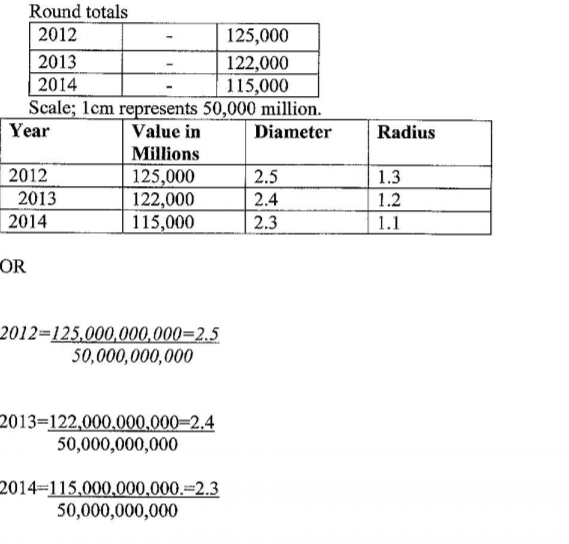
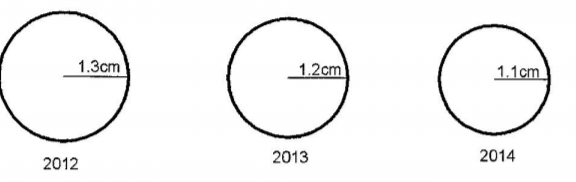
(a) (i) Using a scale of 1 cm to 50,000 million, draw proportional circles to represent the total export earnings between 2012 and 2014. Use the diameter method. (10 marks)

(ii) Calculate the percentage decline in export value between 2012 and 2013. (2 marks)

(b) (i) What conclusion on value of exports can you make from the proportional circles? (3 marks)

(ii) State four disadvantages of using proportional circles to represent the export values.(4 marks)

(c) Explain how international trade in Kenya can be improved.(6 marks)

7. (a) (i) Define the term mining.(2 marks)

(ii) State four factors that influence the occurrence of minerals.(4 marks)

(b) Describe the open cast method of mining.(5 marks)

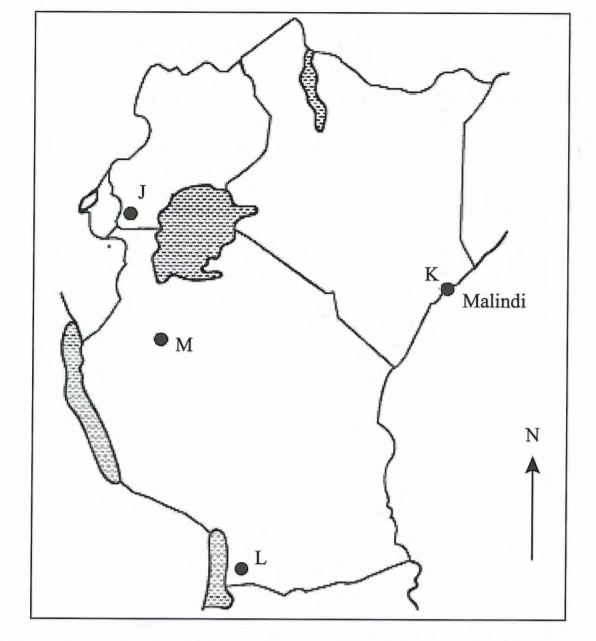
(c) The map below shows location of minerals in East Africa. Use it to answer question (e) (i).

(i) Name the minerals found in areas marked J, K, L and M(4 marks)

(ii) Describe the processing of Trona in lake Magadi.(4 marks)

(d) Explain three ways in which mining promotes industrialisation in Kenya. (6 marks)

8. (a) (i) What is forestry?(2 marks)

(ii) Apart from tropical hardwood forests, name two other types of natural forest.(2 marks)

(iii) State the problems experienced in exploitation of tropical hardwood forests.(5 marks)

(b) List the characteristics of planted forests in Kenya.(5 marks)

(c) Explain three factors that favour forestry in Canada.(6 marks)

(d) Give five measures that the government has taken to conserve and manage forests in Kenya.(5 marks)

9. (a) Explain each of the following methods of land rehabilitation:

(i) Mulching(4 marks)

(ii) Bunds and gabions(6 marks)

(b) Give three ways in which the government is trying to rehabilitate overgrazed lands in Kenya.(3 marks)

(c) (i) Name four types of irrigation practised in Kenya.(4 marks)

(ii) Explain two conditions that favour irrigation farming in Kenya.(4 marks)

(d) Give the characteristics of land reclamation in Kenya.(4 marks)

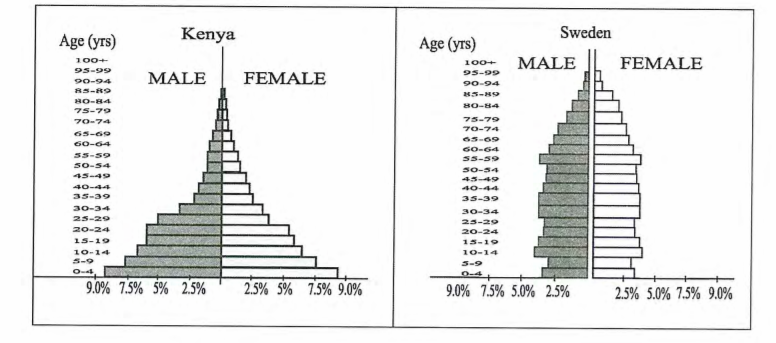
10. The pyramids below represent the population structure of Kenya and Sweden in the year 2009.

Use them to answer question

POPULATION PYRAMIDS 2009

(a) Describe the characteristics of population of the two countries as represented by the pyramids. (6 marks)

(b) (i) What is fertility rate? (2 marks)

(ii) Explain three factors that have contributed to the reduction in fertility rate in Kenya. (3 marks)

(c) State three problems caused by slow population growth rate in developed countries. (3 marks)

(d) Explain four causes of rural-rural migration in Kenya. (8 marks

Questions and Answers

2018 Geography Paper 2

1. (a) Name two categories of fish.(2 marks)


  • Pelagic
  • Demersal Anadromous.
  • Fresh water.
  • Salt water/ marine fish.(b) Identify three methods of fishing that are used for deep sea fishing.(3 marks)
  • Trawling.
  • Long line.
  • Purse seining Drifting.
  • Whaling/harpooning.2. (a) Give three tourist attractions found in the lake region of Kenya.(3 marks)
  • Wildlife in Ruma National Park/lmpala Sanctuary/birds sanctuary at Orango /kakamega forest.
  • Lake Victorial./L.simbi/ox-bow lakes.
  • Culture of the people Kisumu Museum/historical/archaeological sites.
  • Hot sunny weather. Sport fishing.
  • Beautiful scenery/escarpments/ granitic tors/crying stones/rift valleys/hot springs//waterfal1s/beaches.(b) State three reasons why domestic tourism is encouraged in Kenya. (3 marks)
  • For people to appreciate the need to preserve wildlife/culture.
  • To utilize tourist facilities during low tourist season.
  • For the people to appreciate the tourist attraction features.
  • To earn revenue especially during the low tourist season.
  • To create employment opportunities/earn income to the people. For education/ research.
  • To enhance national unity.
  • To provide market for local products.3. (a) Name three places in Kenya where geothermal energy has potential of being harnessed.(3 marks)
  • Mt. Longonot/ Suswa/Homa hills.
  • Lake Bogoria/Baringo.
  • Eburru.
  • Menengai Crater/Mai-Mahiu.
  • Lake Turkana.
  • Lake Magadi.(b) State three physical factors that have favoured high Hydro-Electric Power production in Uganda.(3 marks)
  • Large volume of water from River Nile/ other rivers/L. Victoria.
  • The Owen Falls provided a natural waterfall for power generation. High rainfall/1000mm throughout the year to enable high volume of water.
  • The regular supply of water from rivers/lakes.
  • Presence of hard basement/rocks to form firm foundation.
  • Presence of deep valleys/gorges.
  • Presence of non-porous rocks / impervious prevent leakage of water.4. (a) Give two trading blocs in Africa. (2 marks)
  • Common Market for Eastern and Southern Africa (COMESA).
  • Southern African Development Community (SADC). Economic Community of West African States (ECOWAS).
  • East African Community (EAC).(b) Identify three political problems facing regional trading blocs in Africa. (3 marks)
  • Civil wars/insecurity in some countries.
  • Political differences among leaders.
  • Negative publicity of goods among countries.
  • Inadequate institutional/ policy framework. Ideological differences among countries.
  • Many African countries are still aligned to their former colonial masters.5. List three environmental hazards that are caused by human activities. (3 marks)– Air pollution/Toxic gases/land pollution/noise/sound pollution. floods Fires
  • Oil spills
  • Desertification/drought.
  • Soil erosion LandSlides.
  • Nuclear waste/radiation.
  • Pests.SECTION BAnswer question 6 and any other two questions from this section.

    6. Study the data provided below and answer the questions that follow.

    Value of export earnings of selected crops from Kenya (Ksh millions)

    Crop 2012 2013 2014
    Tea 104141 104648 93996
    Coffee 22271 16328 19913
    Sisal 1184 1020 1325
    Total 124896 121996 115234

    (a) (i) Using a scale of 1 cm to 50,000 million, draw proportional circles to represent the total export earnings between 2012 and 2014. Use the diameter method. (10 marks)

    The proportional circles showing the total export earnings for the period 2012 to 2014. The total export earning for the period 2012 to 2014 . (Proportional circles)

    (ii) Calculate the percentage decline in export value between 2012 and 2013. (2 marks)Difference 124896 —121996 = 2900

    = 2900 x100/124896

    2.3%

    (b) (i) What conclusion on value of exports can you make from the proportional circles? (3 marks)

  • The total export values for the selected crops was highest in 2012.
  • The total export value had a decline for the consecutive years. 2014 Tegistered the lowest export value.
  • Total exports value for the three years has very little significant difference.(ii) State four disadvantages of using proportional circles to represent the export values.(4 marks)
  • It is tedious to construct.
  • It is time consuming.
  • It is difficult to accurately estimate/extract the actual total values from the circles.
  • It is difficult to compare many sets of data.
  • It is difficult to represent extreme values/very high / very low Values.
  • It is difficult to compare values which have a small range. It is difficult to determine the trend of the values.(c) Explain how international trade in Kenya can be improved.(6 marks)
  • Kenya should improve her international transport/communication links for efficient transactions.
  • Kenya is exploring new markets in order to avoid over reliance on European market/ traditional market.
  • Trade agreements signed by Kenya and various countries in Africa and America may increase volume of trade.
  • Kenya is processing some of the agricultural products before export /export processing zone in order to add value hence increase earnings.
  • The setting up of industries in the neighbouring countries by some Kenyan entrepreneurs is likely to increase volume of trade to diversify the county’s exports in order to expand market/minimize competition.
  • Improving the state of security to guarantee state of traders and goods. Intensifying market campaigns internationally to create awareness of the locally produced goods.
  • Reduce cost of production so as to compete favourably in the international market.7. (a) (i) Define the term mining.(2 marks)
  • Mining is the extraction of valuable minerals from the earth crust.(ii) State four factors that influence the occurrence of minerals.(4 marks)
  • Vulcanicity leads to solidification of minerals in cracks and crevices.
  • Metamorphism lead to change into new mineral/formation of minerals.
  • Leaching a weathering process results into concentration of minerals in the crust.
  • Erosion loosens minerals and transports them eventually depositing them as alluvial deposits.
  • Sedimentation deposits, accumulates and concentrates minerals in specific areas making them occur in layers, beds and seams.
  • Evaporation enhances crystallization leading to formation of salts.
  • Weathering exposes minerals near the earth’s surface.(b) Describe the open cast method of mining.(5 marks)– The mineral deposits lie within a few metres from the ground. The unwanted material on the top layer/overburden is removed.

    – Soft mineral deposits are removed by drilling/scooping.

    – Hard minerals are removed by blasting with explosives.

    – The mineral is then scooped by excavator.

    – The mineral is loaded into Lorries /conveyor belt to be transported for processing.

    (c) The map below shows location of minerals in East Africa. Use it to answer question (e) (i).

    (i) Name the minerals found in areas marked J, K, L and M(4 marks)J — Tin

    K — Salt/gypsium/limestone

    L — Coal

    M — Diamond

    (ii) Describe the processing of Trona in lake Magadi.(4 marks)

    The crystals are crushed and mixed with Trona and liquor.

  • A mixture of Trona and liquor is pumped through a pipeline to the soda ash factory. Trona is separated from water by being put on large sieve like trays. The Trona is washed to remove mud and salt.
  • After drying Trona is heated/roasted in big cylinders and it breaks into small particles of sodium carbonate/soda ash. Soda ash is allowed to cool. It is then ground, weighed and packed into paper bags ready for transportation to the market.(d) Explain three ways in which mining promotes industrialisation in Kenya. (6 marks)
  • Some minerals provide essential raw materials for some manufacturing industries.
  • Minerals are exported to earn the country foreign exchange which is used for development of industries.
  • Mining stimulates development of roads/railways which promotes industrial growth/eases movement of raw materials/finished products to industries.
  • Mining attracts settlements leading to development of towns which attract industrial development.
  • Mining creates employment raising the living standards of the people hence, creating a greater demand for industrial products thus promoting industrial
  • Mining has stimulated growth of related industries that supply inputs/services.8. (a) (i) What is forestry?(2 marks)Forestry is the science of developing and cultivating forests and utilizing them.

    (ii) Apart from tropical hardwood forests, name two other types of natural forest.(2 marks)

  • Temperate hardwood.
  • Coniferous forests/temperate softwood.
  • Montane forest.
  • Mangrove forest.
  • Mixed forests(iii) State the problems experienced in exploitation of tropical hardwood forests.(5 marks)
  • Trees take long time to mature
  • Forests are dense/ thick.
  • Trees do not mature at different times making harvesting difficult and expensive.
  • The forest have mixed tree species making exploitation difficult and almost impossible.
  • Tree trunks are huge, supported by buttress roots/presence of tree climbers/lianas hence difficult to exploit.
  • The trees are heavy /bulky making transportation difficult. Impassable roads/some parts of the forests are inaccessible.(b) List the characteristics of planted forests in Kenya.(5 marks)
  • Trees appear in rows.
  • They have same species.
  • There are mainly softwoods.
  • They have little / no undergrowth.
  • They take short time to mature.
  • They appear in blocks.
  • They are mainly located in highland areas.(c) Explain three factors that favour forestry in Canada.(6 marks)
  • The valley bottoms/ Coasts form good sites for location of paper mil1s/ clay from valley bottoms is used for smoothening the paper surface. There are many rivers with waterfalls suitable for generation of hydro- electric power for use in the industries.
  • The low temperatures /cold climate in the highlands discourage settlement/agriculture leaving forestry as the only land use.
  • The landscape is rugged with thin soils that discourage agricultural/settlement activities therefore most of the mountain slopes are under forests.
  • Moderate to high precipitation throughout the year favours luxuriant growth of forests.
  • Presence of rivers which provide cheap water transport to transport logs to factories/presence of snow facilitates easy movement of logs.
  • Thete is ready market of forest products in Canada and USA.
  • Rivers provide water for processing timber.
  • The advanced technology which facilitates exploitation of forests. The advanced scientific research in forest management aids in forest conservation.(d) Give five measures that the government has taken to conserve and manage forests in Kenya.(5 marks)
  • It has enacted /enforced law’s to prohibit the cutting of trees without a licence /protecting indigenous trees.
  • It has established forest research stations to conduct research on tree species. The NGOs/ Green Belt Movement/NEMA/KWS/KFS encourage protection of threatened forests. It encourages people to use alternative sources of energy.
  • The tree planting programmes /campaigns are drawn during rainy seasons and implemented.
  • Forest are protected by establishing forests guards/development of the Nyayo Tea Zones.
  • It encourages people to use energy saving jikos.
  • It has declared endangered forest as forest reserves gazetting forests
  • Farmers are encouraged to practice agro forestry.
  • Farmers are encouraged to practice agroforestry.
  • Encouraging recycling of wood products. Creating awareness on the importance of trees.
  • Establishment of training institutions in forestry.9. (a) Explain each of the following methods of land rehabilitation:(i) Mulching(4 marks)
  • This is the use of crop residues such as vegetable remains, plant litter, and grass and polythene sheets to cover the soil/crop.
  • It helps to retain soil moisture, reduce soil erosion and reduce the splashing effect of rain water on soil.
  • It increases water infiltration in to the soil by preventing it from surface runoff.
  • When the vegetative materials decompose it produces organic matter which increases the fertility of the soil.(ii) Bunds and gabions(6 marks)
  • Bunds are soil piles across a slope constructed to control soil erosion.
  • Bunds are also built to check surface runoff which would cause soil erosion/influence water infiltration.
  • Gabions are wire mesh that are filled with soil, stones and other materials.
  • Gabions are constructed on slopes/across gullies to trap soils being carried by running water down slope.
  • Gabions encourage vegetation growth in the trapped soil.
  • Both are effective for controlling soil erosion/stabilizing slopes(b) Give three ways in which the government is trying to rehabilitate overgrazed lands in Kenya.(3 marks)
  • Livestock extension officers move around advising farmers on the importance of keeping livestock according to the carrying capacity of the land.
  • Introducing exotic breeds /cross breeds to emphasize quality and not quantity.
  • It has established / encouraged establishment of ranches in the livestock keeping regions to improve quality of animals.
  • It has encouraged farmers to grow fodder /introduced nourishing grass which is drought resistant.(c) (i) Name four types of irrigation practised in Kenya.(4 marks)
  • Livestock extension officers move around advising farmers on the importance of keeping
  • livestock according to the carrying capacity of the land.
  • Introducing exotic breeds /cross breeds to emphasize quality and not quantity.
  • It has established / encouraged establishment of ranches in the livestock keeping regions to improve quality of animals.
  • It has encouraged farmers to grow fodder /introduced nourishing grass which is drought resistant.(ii) Explain two conditions that favour irrigation farming in Kenya.(4 marks)
  • Gently sloping land which permits flow of water by gravity hence reducing pumping of water to the fields
  • Presence of clay soils/black cotton soils which retain water for longer use by crops.
  • Presence of rivers /reservoirs/lakes which provide regular water supply making it possible to irrigate land throughout the year. High temperatures throughout the year which allows multiple cropping/continuous farming activities throughout the year.
  • Availability of market which stimulates production.
  • Efficient transport systems easing movement of goods and inputs.
  • Low rainfall making irrigation necessary.
  • Government policy to develop irrigation projects enhances production.(d) Give the characteristics of land reclamation in Kenya.(4 marks)
  • Simple methods of reclaiming land are used like digging canals/ditches to drain water.
  • Land is reclaimed mainly from swamps/marginal lands.
  • Irrigation is used where there is low rainfa11/in arid areas.
  • Drought resistant crops are planted.
  • There is high evaporation of irrigation water due to high temperatures.
  • Trees are planted10. The pyramids below represent the population structure of Kenya and Sweden in the year 2009.Use them to answer question

    POPULATION PYRAMIDS 2009

    (a) Describe the characteristics of population of the two countries as represented by the pyramids. (6 marks)

  • In both Kenya and Sweden the number of male and female is almost equal at all ages.
  • In Kenya the aging population is low/there is low life expectancy. In Sweden the aging population is high/the life expectancy is high.
  • In Kenya the dependency ratio is high. In Sweden the dependency ratio is low.
  • In Kenya, the number of infants from age 0 to 4 years is high. In Sweden the numbers of infants from age 0-4 years is low.
  • In Kenya the working population is low. In Sweden the working population is moderate/high.
  • In Kenya, the number of youthful population is high .In Sweden the number of youthful population is low.
  • In Kenya birth rate is high. In Sweden the birth rate is low.
  • In Kenya the death rate ls high. In Sweden the birth rate is low.
  • The fertility rate is high in Kenya .In Sweden the fertility rate ls low.(b) (i) What is fertility rate? (2 marks)
  • Fertility rate is the number of live births in a given population in a year /the number of live births per thousand women of child bearing age in a given year.(ii) Explain three factors that have contributed to the reduction in fertility rate in Kenya. (3 marks)
  • The cost of bringing up children has gone up therefore parents limit the number of children they can have.
  • Increased use of birth control methods has lowered the number of children women get in their life time.
  • More girls are attending school/ are pursuing higher education and training. This makes them stay longer before getting married.
  • Modem career opportunities have a limiting influence on a woman’s fertility rate. Some employers do not want to employ women who keep going on maternity leave.
  • There is an increase in the number of women opting to remain single, thus reducing the number of children.
  • Urbanization has influenced people to have small families.(c) State three problems caused by slow population growth rate in developed countries. (3 marks)
  • The social amenities are underutilized/high cost of maintaining social amenities.
  • There is inadequate labour supply/manpower.
  • The dependency ratio is high in old age.
  • There is reduction in revenue collection.
  • There is underutilizatlon/under exploitation n of resources.
  • There is inadequate local market for the locally produced goods/ decline of industries.
  • The high cost of transport/services.
  • Limited investment.(d) Explain four causes of rural-rural migration in Kenya. (8 marks)
  • Explain four causes of rural — rural migration in Kenya.
  • People move one rural area to another in search of employment.
  • Insecurity in some rural areas make people move to safer places.
  • Pressure on land makes people buy /look for land elsewhere and settle.
  • Setting up of government development projects may cause displacement of people who are
  • settled elsewhere /government projects may attract settlement in those areas.
  • Pastoral communities migrate from one rural area to another in search of pasture/water for their livestock.
  • Changes in land tenure system/inheritance/land disputes cause people to move and settle elsewhere.
  • Natural calamities make people to move to safer places.
  • Transfer of services from one rural area to another/retirement/retrenchment.


KCSE Past Papers 2018 Geography paper 1 (312/1)

KCSE Past Papers 2019 Geography paper 1 (312/1)

KCSE Past Papers 2018 Geography paper 1 (312/1)

Geography – Paper 1 – November 2018 – 2.45 Hours

Kenya certificate of primary Education

2018 Geography Paper 1

SECTION A

Answer all the questions in this section.

1. (a) Define the term atmosphere.(2 marks)

(b) State the composition of the inner core.(3 marks)

2. (a) Name three types of folds.(3 marks)

(b) State three factors that determine the folding of crustal rocks.(3 marks)

3. The diagram below represents some volcanic features. Use it to answer the questions below.

Name the features marked P, Q, R and S.

4. (a) Identify the main characteristics of the ocean water.(2 marks)

(b) Give three factors that influence wave deposition.(3 marks)

5. (a) List the three types of dunes. (3 marks)

(b) Identify two processes through which wind transports materials in arid areas. (2 marks)

SECTION B

Answer question 6 and any other two questions from this section.

6. Study the map of Taita Hills 1:50,000 (sheet 189/4) provided and answer the following questions.

(a) (i) Give the four figure grid reference of the trigonometrical station (2208m). (1 mark)

(ii) What is the general direction of the flow of River Voi (Goshi)? (1 mark)

(b) (i) Measure the length of the road labelled A23. Give your answer in kilometres. (2 marks)

(ii) Citing evidence from the map, identify three social services offered in the area covered by the map. (6 marks)

(c) Describe the relief of the area covered by the map. (7 marks)

(d) Citing evidence front the map, explain four factors that may have influenced agricultural activities in the area. (8 marks)

7. (a) (i) What is a rock? (2 marks)

(ii) Give Evo examples of plutonic igneous rocks. (2 marks)

(b) Describe the processes of formation of each of the following types of sedimentary rocks:

(i) Mechanically formed.(4 marks)

(ii) Organically formed.(4 marks)

(c) State the characteristics of rocks.(5 marks)

(d) You are planning to carry out a field study on rocks within the local environment.

(i) List three methods you would use to record data.(3 marks)

(ii) State three problems you are likely to encounter.(3 marks)

(iii) Give Evo economic uses of rocks you are likely to identify.(2 marks)

8. (a) (i) Identify the two types of earthquake waves.(2 marks)

(ii) Describe the two ways through which the strength of an earthquake is measured.(2 marks)

(b) (i) Explain how vulcanicity causes earthquakes.(6 marks)

(ii) Name three major earthquake zones of the world.(3 marks)

(c) Explain four effects of earthquakes on the human environment.(8 marks)

9. (a) Name two types of landslides.(2 marks)

(b) Explain how each of the following factors influence mass wasting:

(i) Climate(6 marks)

(ii) Slope(2 marks)

(c) (i) State four causes of soil creep.(4 marks)

(ii) Using a diagram, describe the process of solifluction.(5 marks)

(d) You intend to carry out a field study on the effects of mass wasting within the local environment.

(i) Give two methods of data collection that you would use for the study. (2 marks)

(ii) State two negative effects of mass wasting on the physical environment that you are likely to identify. (2 marks)

(iii) Give two follow-up activities you would be involved in after the field study. (2 marks)

10. (a) (i) Name the three types of river erosion.(3 marks)

(ii) Describe each of the following processes of river erosion:

I. Abrasion(4 marks)

II. Solution(3 marks)

(c) Describe the characteristics of the upper stage of a river.(6 marks)

(d) (i) What is river rejuvenation?(2 marks)

(ii) Give four causes of river rejuvenation.(4 marks)

(iii) Identify three features that result from river rejuvenation.(3 marks)

Questions and Answers

2018 Geography Paper 1

1. (a) Define the term atmosphere.(2 marks)

This is the layer of gases and vapour which surrounds the earth.

(b) State the composition of the inner core.(3 marks)

– It is composed of iron and nickel.

– It has very high temperalvre/ about 5000°C to 6000°C,

– The average density is 13-17gm/cc./very high density

– It is solid in nature.

2. (a) Name three types of folds.(3 marks)


  • Simple / symmetrical fold.
  • Asymmetrical fold.
  • Over fold. Recumbent fold.
  • Nappe fold./overthrust
  • Isoclinal fold. <li(b) State three factors that determine the folding of crustal rocks.(3 marks)</li
  • Crustal rocks should be in layers/sedimentary.
  • The rocks should be young in order to bend.
  • The forces operating on the crustal rocks should be compresslOnal.
  • The amount of pressure applied should be high.3. The diagram below represents some volcanic features. Use it to answer the questions below.

    Name the features marked P, Q, R and S.— Sill (1 mark) Q — Vent

    R — Batholith

    S— Lopolith

    4. (a) Identify the main characteristics of the ocean water.(2 marks)

  • Ocean water is saline/salty.
  • The temperature of ocean water varies horizontally and vertically. Varies in density
  • It is in constant movement(b) Give three factors that influence wave deposition.(3 marks)
  • The depth of the water should be shallow along the coast Configuration of the coastline/change in the alignment of coastline.
  • The shore should have a gentle gradient.
  • The breaking waves should have strong swash and a weak backwash./constructive wa es.
  • Ample materials to be deposits5. (a) List the three types of dunes. (3 marks)
  • Barchans
  • Seif dunes/longitudinal/linear Transverse/wave dunes.
  • Star dunes Draas(b) Identify two processes through which wind transports materials in arid areas. (2 marks)
  • Suspension Saltation
  • Surface creep/traction.SECTION B

    Answer question 6 and any other two questions from this section.

    6. Study the map of Taita Hills 1:50,000 (sheet 189/4) provided and answer the following questions.

    (a) (i) Give the four figure grid reference of the trigonometrical station (2208m). (1 mark)

    (2208m)

    2122

    (ii) What is the general direction of the flow of River Voi (Goshi)? (1 mark)

    Eastwards/south eastwards

    (b) (i) Measure the length of the road labelled A23. Give your answer in kilometres. (2 marks)

    14.6km (+ 0.1)

    (ii) Citing evidence from the map, identify three social services offered in the area covered by the map. (6 marks)

  • Social service
  • Evidence
  • Health services
  • Dlspensary/Health centre.
  • Religious services
  • Church/Mosques. Educational services – polytechnics/schools.
  • Administration services
  • chiefs/DC’s. Office.
  • Rehabilitation services -Rehabilitation center/prison.
  • Security
  • police post. Water supply
  • pump house(c) Describe the relief of the area covered by the map. (7 marks)
  • The land slopes from West to East.
  • The western part is a highland while the eastern is a lowland.
  • There are many hills in the area covered by the map. Example Mgange Hills/Mragua Hills.
  • The area has several river valleys.
  • The Eastern part of the area is generally gently sloping. The highest point is 2208 metres.
  • The lowest point is 620 metres. There is rugged landscape in the Western part/there are many ridges.
  • There are bluffs/cliffs.
  • The North Western part of the Map has steep slopes.
  • There are outcrop rocks.
  • There are many Cols.(d) Citing evidence front the map, explain four factors that may have influenced agricultural activities in the area. (8 marks)
  • Presence of road network to provide transport facilities.
  • The South Eastern part receives low rainfall as evidenced by scrub vegetation suitable for sisal growth.
  • There is availability of labour due to dense settlement at on the Western part around Mgange, Mragua and ,Mwangea
  • The Eastern part is sparsely settled/ widely spaced contours hence mechanization.
  • The Western part receives hi% rainfall as evidenced by forests and permanent rivers which has lnfluenced farming.
  • Availability of vertinary services evidenced by cattle dips favour livestock farming.
  • Availability of advisory services evidenced by farmers training center favour farming in the area.7. (a) (i) What is a rock? (2 marks)

    A rock is a naturally occurring aggregate of mineral particles forming part of the earth’s crust

    (ii) Give two examples of plutonic igneous rocks. (2 marks)

  • Granite Diorite Peridotite Gabbro
  • Syenite.
  • Nepheline
  • Diabase.(b) Describe the processes of formation of each of the following types of sedimentary rocks:

    (i) Mechanically formed.(4 marks)

  • Sediments used to form the rocks are derived from weathering of existing rocks.
  • The weathered materials are transported by wind/ice/water.
  • The weathered materials are deposited in layers on land or sea.
  • They are then compacted, and cemented into sedimentary rocks.(ii) Organically formed.(4 marks)
  • These rocks are formed from remains of dead plants and animals./fossiIs
  • These remains accumulate in the oceans/basins/land, in layers.
  • The materials are deposited in layers/strata.
  • The accumulated materials are compressed, compacted and cemented into sedimentary rocks.(c) State the characteristics of rocks.(5 marks)
  • Some rocks have joints.
  • Rocks have varied degree of hardness.
  • Rocks have cleavage.
  • Rocks have varied texture. Rocks have different colours Some rocks have lustre
  • Rocks have varied specific density.
  • Rocks have streak.
  • Rocks have difrerent minerals.
  • Rocks have varied mineral structures.(d) You are planning to carry out a field study on rocks within the local environment.

    (i) List three methods you would use to record data.(3 marks)

  • Photographing/video recording.
  • Labelling samples.
  • Note taking/recording observations.
  • Filling in questionnaires.
  • Drawing diagrams/sketches.
  • Tape recording.(ii) State three problems you are likely to encounter.(3 marks)

    Accidents may occur.

  • Inaccessibility of some areas with rocks.
  • Fatigue due to difficult terrain.
  • Unfavourable weather conditions that is heavy rains, high temperatures.
  • Attack by wild animals/snake bites.
  • Difficulty identifying some roks.
  • Difficulty breaking some rocks(iii) Give two economic uses of rocks you are likely to identify.(2 marks)
  • Some rocks are used for construction.
  • Some rocks are a Source of fossil fuel.
  • Some are used for making carvings.
  • Some are sources of valuable minerals. Some are tourist’s attractions.
  • Some rocks store underground water/for irrigation.
  • Rocks weather to form soils for agriculture.
  • Some rocks for example limestone is a raw materiaI/ cement manufacture.8. (a) (i) Identify the two types of earthquake waves.(2 marks)
  • Body waves/primary/secondary.
  • Surface waves/love/Rayleigh.(ii) Describe the two ways through which the strength of an earthquake is measured.(2 marks)
  • The strength of an earthquake is measured by its intensity.
  • Intensity measures how strong and hard the earthquake shakes the ground.
  • It is measured on Mercalli scale.
  • The strength of an earthquake ls measured by its magnitude.
  • It is measured on Richter scale correct method.(b) (i) Explain how vulcanicity causes earthquakes.(6 marks)
  • Sudden displacement of crustal rocks during vulcanicity causes tremors.
  • Violent volcanic eruptions/violent emissions of the volcanic gases can shake/shatter the rocks/tremors.
  • After volcanic eruption, a large void is created below the crust which causes the crustal rocks to sink due to gravity this causes the earth’s surface to shake.
  • Magma movement within the crust can cause tremors.
  • A sudden eruption of molten magma under the oceans can cause earth tremors as the water on the sea floor violently expands.(ii) Name three major earthquake zones of the world.(3 marks)
  • The Great Rift Valley belt.
  • The Mediterranean — Himalayan belt.
  • The circum- Pacific belt. /ring of fire.
  • Mid-Atlantic Ocean belt.(c) Explain four effects of earthquakes on the human environment.(8 marks)
  • Earthquakes lead to shaking/crumbllng of buildings leading to their destruction.
  • Earthquakes may lead to the falling of objects which may lead to loss of life.
  • Earthquakes may damage transport networks making movement difficult.
  • It may lead to destruction of electric lines/pipelines resulting to blackouts/fte incidences.
  • A large-scale sea wave caused by an undersea earthquake/Tsunami may flood the coastal lowlands leading to destruction of agricultural land.
  • Disturbances caused by earthquakes lead to landslides which crush and bury people/property.
  • Earthquakes may lead to collapsing of underground mines which may lead to burying of miners.
  • Earthquakes cause panic/anxiety/emotional shock.
  • Destruction of property leads to evacuation/displacement of people.
  • Strong earthquakes cause damage to nuclear plants/sewerage
  • systems which pollute the human environment.9. (a) Name two types of landslides.(2 marks)
  • Slump Debris slide
  • Rock slide
  • Debris fall
  • Avalanche
  • Rock fall.(b) Explain how each of the following factors influence mass wasting:

    (i) Climate(6 marks)

  • Areas that receive high rainfall experience massive landslides on steep s1opes/ areas that receive low rainfall have slow movement of rock materials down the slope.
  • In areas with large diurnal range of temperature there is expansion and contraction of soil particles which leads to movement of the soil particles.
  • Alternate freezing and thawing encourage mass movement of rock and soil materials.(ii) Slope(2 marks)
  • Steep slopes encourage faster movement of material down the slope. / Gentle slopes have slow movement of materials down the slope.(c) (i) State four causes of soil creep.(4 marks)
  • Ploughing on a slope loosening the soil particles.
  • Wetting and drying of soil particles.
  • External forces such as earthquakes/ explosives/eruptions/heavy vehicles movements.
  • Frost heaving beneath the soil.
  • Alternate heating and cooling of the soil particles.
  • Undercutting of the base of the slope through road construction/mining.(ii) Using a diagram, describe the process of solifluction.(5 marks)

    In moderately/gentle sloping areas during winter water in the soil freezes thus freezing the soil.When the weather becomes warm the top soil thaws.

    Overtime the top soil becomes saturated with water while the sub- soil remains frozen (permafrost). The saturated mass of top soil creeps over the frozen ground (permafrost).

    (d) You intend to carry out a field study on the effects of mass wasting within the local environment.

    (i) Give two methods of data collection that you would use for the study. (2 marks)

    Give two methods of data collection that you would use for the study.

  • Observing.
  • Administering questionnaires.
  • Photographing/video recording.
  • Reading from secondary sources/viewin films/video clips.(ii) State two negative effects of mass wasting on the physical environment that you are likely to identify. (2 marks)
  • Destruction of vegetation.
  • Dereliction of land /scars
  • Blockage of rivers.
  • Exposure of land to soil erosion.(iii) Give two follow-up activities you would be involved in after the field study. (2 marks)
  • Data analysis/discussion about findings.
  • Report writing.
  • Data presentation.
  • Consulting geography teachers.
  • Display photographs taken.
  • Drawing conclusions.
  • Reading more on the topic.10. (a) (i) Name the three types of river erosion.(3 marks)
  • Head ward erosion /spring sapping.
  • Vertical erosion.
  • Lateral erosion(ii) Describe each of the following processes of river erosion:

    I. Abrasion(4 marks)

    The river transports the materials downstream.

  • The materials are used by the river as tools for scouring,
  • The load is hurled by the water against the banks and dragged along the river bed.
  • The load chips off the rocks on the bank and river bed. The load being dragged smoothens the river bed.
  • The eddy currents rotate the load in the hollows on the river bed grinding the rocks widening into potholes.II. Solution(3 marks)
  • River water contains both organic and weak inorganic acids. It reacts with some minerals in some rocks in the river bed to form soluble minerals.
  • The soluble minerals are carried downstream in solution form.OR
  • River water flows over rocks with soluble minerals.
  • The water dissolves soluble minerals to a solution.
  • The minerals are carried away in solution.(c) Describe the characteristics of the upper stage of a river.(6 marks)
  • The gradient is steep.
  • The river has a small load. The flow of the river is fast. Vertical erosion is dominant.
  • The cross profile of the valley is v-shaped. It has interlocking spurs.
  • The river valley is deep.
  • The river channel is narrow.
  • Some parts of the river course have rapids/waterfalls/cataracts.
  • The river volume is low.
  • The river channel is winding(d) (i) What is river rejuvenation?(2 marks)

    This is the renewal of a rivers erosive ability/activity/power.

    (ii) Give four causes of river rejuvenation.(4 marks)

  • Increase in river discharge.
  • Change in rock resistance.
  • Unequal regional subsidence.
  • Regional/local uplift of the land. Fall in sea level/drop in sea level.(iii) Identify three features that result from river rejuvenation.(3 marks)
  • Knick points.
  • Rejuvenation terraces/paired terraces.
  • Incised meanders/in grown/entrenched meanders.
  • Rejuvenation gorges/valley within a valley.


KCSE Past Papers 2018 English Paper 3 (101/3)

KCSE Past Papers 2019 English Paper 3 (101/3)

KCSE Past Papers 2018 English Paper 3 (101/3)

(Comprehension, Literary Appreciation and Grammar) Nov. 2018 – 2 hours

Kenya Certificate of Secondary Education

2018 English Paper 3

Answer three questions only.

1. Imaginative Composition (Compulsory)(20 marks)

Either

(a) Write a composition beginning:

1 wondered why the principal had summoned me.

Or

(b) Describe the estate or village you live in.

2. Compulsory Set Text(20 marks)

Bertolt Brecht, The Caucasian Chalk Circle

With illustrations from Bertolt Brecht’s the Caucasian Chalk Circle, write a composition entitled:Self Centredness Does not Pay.

3. The Optional Set Texts(20 marks)

Answer any one of lhe following lhree questions.

Either

(a) The Short Story (20 marks)

Chris Wanjala (Ed.), Memories We Lost

Drawing examples from Barry McKinley’s short story“Almost Home”, write a composition on the topic: “Some people keep making one bad decision after another.”

Or

Q) Drama

Francis Imbuga, Betrayal in the Cry›

(c)John Steinbeck, The Pearl With illustrations from John Steinbeck’s The Pearl, write an essay showing the evil nature

KCSE Past Papers 2018 English Paper 2 (101/2)

KCSE Past Papers 2019 English Paper 2 (101/2)

KCSE Past Papers 2018 English Paper 2 (101/2)

(Comprehension, Literary Appreciation and Grammar) Nov. 2018 – 2 hours

eet the Discipline of Nature every time they try to do something.

This is why it is so important in school to give students more chances to do things, instead of just reading or listening to someone talk.

This discipline is a good teacher.

The learner never has to wait long for the answer, it usually comes quickly, often instantly.

The answer is often clear, and it points towards the needed correction. This way, the learner does not only see that what was done is wrong, but also why, and what they need to do instead.

Finally, and most importantly, the giver of the answer, call her ‘Nature’ is impersonal, impartial and indifferent. She does not give opinions or make judgement. With Nature, one always gets an opportunity to start afresh, this time with the intention of doing things ri8ht.

The next type of discipline is the Discipline of Culture.

Man is a social and cultural animal.

Everyone, thus, senses around them this discipline, this network of agreements, customs, habits and rules binding the society together.

People always seek to understand the society and be part of it.

They watch very carefully what other people around them are doing and wish to do the same.

These unwritten rules regarding how to act in specific situations are called social norms.

Social norms help delineate what is acceptable behaviour. For example, it is not acceptable to be loud and boisterous in a place of worship.

The third discipline is the one most people refer to when they speak of discipline — the Discipline of Superior Force. lt is the discipline of“YOU do what I tell you or I’ll make you wish you had.” There is bound to be some of this in a person’s life.

Living as we do surrounded by things that can hurt us and our friends, we cannot avoid the Discipline of Superior Force.

For example, no one can let a child find out from experience the dan8er of playing with fire. So along with other precaufions, the child is told not to play with fire or they will be punished.

There are situations where all the three disciplines overlap. We often Year people say that students will never do anything unless they are compelled to. But in their private lives, or in co-curricular activities in school, they ofien submit themselves, willingly and wholeheartedly to very intense disciplines simply because they want to learn to do a given thing well. So, discipline, does not only stem from authority figures such as parents and teachers but it also comes from a person’s willingness to do right.

Adapted fiom Connelly Mark’s The BriefSundance Reader. TboxSon Heinle, 2003

(a) What are we told about the Discipline of Nature in the first paragraph?

(b) Identify and explain the use of personification in paragraph two. (2 marks)

(c) Why do you think the Discipline of Nature is said to be a good teacher? (4 marks)

(d) “You do what I tell you or I’ll make you wish you had.” What does this statement imply?(2 marks)

(e) “So, discipline does not only stem from authority figures such as parents and teachers but it also comes from a person’s willingness to do right”.

(Rewrite beginning: Not only…) (1 mark)

(f) In about 60 words, summarise what we are told about the Discipline of Culture. (6 marks) Rough copy

(g) Explain the meanlng of the following words as used in the passage. (3 marks)

(i) Boisterous

(ii) Precautions …………. .

2. Margai et Ogola, The River and the Source

Read the excerpt below and then answer the questions that follows

“Now Nyabera, I don’t believe a daughter of mine could sound so foolish. Of course they are human, that is why they are called white people, not whlte animals. And trust is something to give to people who have earned it and therefore you have to give them a chance to do so.

I would not trusi your uncle Otieno although he is as black as the bottom of the pot I boil maize and beans in. Finally, you’d better know that 1 aim to get some help from them against Otieno. The future of your nephew Owuor is in their hands so start praying.”

“Oh, mother! Please don’t go! What if something happened to you? I am afraid, mother, I am so afraid! And how can you leave Odor alone considering the kind of irresponsible mother he has? Oh, mother, I feel like this family is cursed. What lf something happened to him, to you?

Nyabera waited, her tears running in full force. Akoko stood up to her full height which barely reached her daughter’s shoulders. Her eyes were blazing fit to send sparks to set the thatched roof ablaze.

“Nyabcra, you are not the woman 1 brought you up to be. I know you have suffered, but suffering is the lot of many.

To suffer is not a curse unless you have earned it and I have never done anything to earn a curse. Both the evil and the good suffer.

How you come through suffering is what will make or break you.

Please think, my daughter.

At least you can have children and you have a good husband. One day Were will give you a child that lives; I am sure of it after what you have just told me.

But to have a child is one thing, to bring it up to be a human fit to live with others is something else altogether — and the way you are going I doubt if you will be fit to be a mother when the baby comes. You may be just like Alando your sister-in-law.

You have known me all your life.

How could you ever imagine that 1 could leave my grandson at the Mercy of your uncle? I’ve taken him to Yimbo to live in the house of Oloo, my brother. Are you happy now?” “Oh mother! Why didn’t you bring him here to stay with me? Don’t you trust me? “Of course I trust you.

l thought of bringing him here, but I decided it was too near the nest of vipefs who now occupy the stool of Maroko, the first chief. Please can you show me a place to rest? I will be staying with you for a few days before I leave for Kisumu.

That way no one will know or suspect my motives.” Nyabera conducted her mother to her mother-in-law’s house as Chik did not allow her to spend the night in a married daughter’s house.

The next few days passed pleasantly enough, with mother and daughter chatling or hours about their lives, their people, their past, their future, their hopes and all manner of things.

Or the fifth day she embarked on a journey which would bring her and her scant oflspring to a new era: for the great river starts its journey as a little stream which al useful meanders around with any apparent direction, sometimes disappearing underground aJ together, but always there, a1ways moving towards the sea.

(a) Briefly describe what happens before the events in this excerpl.

(b) From the excerpt, what do we team about Akoko’s character? (2 marks)

(c) Who are being referred to as a ‘nest of vipers’ and why?

(d) What main theme emerges from this excerpt? illustrate your answer. (3 marks)

(e) What is the tone of the excerpt? Explain your answer. (3 marks)

(f) With reference to the novel, briefly explain the symbollsm in the last paragraph of the excerpt. (4 marks)

(g) How was Akoko’s case handled by the white man? (4 marks) ……………………………………………………………………………………………………………………………. ….

3. Read the following poem and then answer the questions that folloW.

The Man He Killed

“Had he and I but met, By some old ancient inn, We should have sat us down to wet Right many a nipperkin!

But ranged as infantry, And staring face to face, I shot at him as he at me, And killed him in his place.

l shot him dead because — Because he was my foe, Just so, my foe of course he was; That’s clear enough; although.

He thought he’d ‘list, perhaps off-hand like —just like I — Was out of work — had sold his traps — No other reason why.

Yes; quaint and curious war is! You shoot a fellow down You’d treat if met where any bar is, or help to half-a-crown.”

Thomas Hardy (1840-1923)

(a) Briefly explain what the poem is about.(3 marks)

(b) Identify and explain any two stylistic devices used in this poem. (c) What do we learn about the persona from this poem? (d) Describe the tone of this poem.

(e) What is the message of this poem?

(f) Explain the meaning of the word ‘quaint’ as used in the poem. (6 marks)

4. (a) Rewrite the following sentences according to the instructions given after each. Do not change the meaning.(5 marks)

(i) They will look after Bakari.

(Begin: Bakari…)

(ii) The textbooks said the teacher are not adequate. (Punctuate correctly)

(iii) I know that one of your books has been published.

(Begin: I know that a…)

(iv) I will help him only if he asks me to.

(Rewrite using the word “unless”) (v) All of us want to pass our exams.

(Begin: None. )

@) Fill in each blank space with lhe correct alternative from the given chOiCes. (3 marks)

(i) The bank, in conjunction with the clubs, ….

(has, have)

(ii) Neither Karimi nor her friend ………….

(iii) Kawira is one of those people who…… …..

sponsored the event.

. there. (was, were)

. alWays in a hurry. (p , ;s)

( o ) Fill in each blank space in the following sentences with a cotvect preposition.

(i) We know how proficient Jane is ……… her work.

(ii) Many people are not accustomed ……………………….. such treatment. (3 marks)

(iii) The accident victim writhed …………….. . pain as we rushed him to hospital.

(d) Explain the meaning of the underlined expression in each of the sentences below. (2 marks)

(i) Nyabera really is a top notch administrator

(ii) He has a heart of gold.

(e) Complete the following sentences using an appropriate expression from those given in brackets. (2 marks)

(i) At my sister’s graduation party, there were (a great deal of, plenty of) people.

(ii) You only require (a little, little) salt in your diet.


Marking scheme English Paper 2 (101/2)

1 (a) If you do the right things, you get the desired results/ If you do the wrong things, you get wrong results/Choices have consequences.


  • Any one point 2 marks(b) Nature has been referred to as “She”/it is said to be impersonal/impartial/indifferent etc.

    This brings out the fact that nature does not make decisions or express opinions about the thing being done or the person doing lt; it simply allows someone to learn from their actions.

    Discipline has been personified as a good teacher-it lets the learner get instant feedback.

    (1 mark for identification of personification 1 mark for eaplanation= 2 marks)

    (c) The discipline of nature is said to be a good teacher because:

  • One knows instantaneously whether they have done the right thing/it is prompt in providing feedback; hence someone can decide on the next course of action on the spot.
  • It points towards the needed correction, so one knows what to do next.
  • It shows why one did not get something right; consequently, the incorrect action is not repeated.
  • Nature does not make judgment so one proceeds without external discouragement. Any 4 points 1 mark each.(d) It means lf you do not do what is expected of you, you will suffer the consequences.

    2 marks (e) Not only does discipline stem from authority figures such as parents and teachers, but it also comes from a person’s willingness to do right.

    ( The Discipline of Culture entails acknowledging that one is a social animal and has to observe the customs, habits and rules that bind the society together .

    One watches very carefully what people around them are doing and begins to copy them .

    This discipline helps one to distinguish between what is socially acceptable behaviour and what is not.> (6 marks)

    Count up to 65 words.

    Penalize by a glimmer for faulty expression once in a sentence.

    If in note form penalize by 50% at each point and affix N on the penalized score Akoko is the source of the river.

    The River presents her family.

    The River almost peters out at some point when her sons die but it gathers momentum in her grandchild Awiti and her great grandchildren.

    A team was sent to the village to investigate the matter. (1 mark)

    Within a month the DO sent Askaris to escort Akoko to Kisuma to make her appeal. (1 mark)

    Chief Otieno was forcibly removed from the chiefdom. (1 mark) (1 mark)

    Otieno was made to return all that he had grabbed from Akoko.

    The Council of Jodongo is mandated to rule until Owuor comes of age. (1 mark)

    The poem is about a soldier who killed a man in battle/war.

    The soldier is trying to figure out why he killed the man.

    He gives a rcason but even he himself is not satisfied by his answer.

    Had he met the man under different circumstances they would have become friends/shared a drink.

    The man joined the army because he was jobless.

    Rhym—e The poem has a regular rhyme scheme e.g. abab in stanza one, words met/wet: inn/nipperkin. Rhyme makes the poem musical.

    Alliteration e.g. had, he; help, half; was, work; had, his Makes the poem musical / calls attention to the words used Use of repetition “. … Becaus—e Because”.

    It brings out the personas puzzlement — he can’t quite explain why the man he killed was his enemy.

    Irony. The fact that the persona kills a man he does not hate — a man he could have easily befriended under different circumstances.

    Also it is ironical that he joined a war whose course he does not believe in.

  • Use of archaic language- ‘nipperkin’-gives the setting of the poem.Expect identification 1 mark; illustration (1 mark); explanation (1 mark)

    He is from a working class — he speaks a simple and colloquial language e.g. ‘nipperkin’.

  • He was out of work/had sold the tools of his trade.
  • He is friendly the type who enjoys socializing Wlth others / He would gladly lend a friend some money.He is horrified by the act of taking away a human life.
  • He is empathetic — he steps into the shoes of the man he killed.He is critical-disapproves war.
  • Conscience —stricken/regretfu1/remorseful-regrets shooting a man he has no personal problem with.Expect any 4 points

    (d) The tone is critical about war / disapproving / ironic / condemnatory / reflective. The persona ls puzzled by the irrationality / senselessness of war.

    2 marks for identification 1 mark for explanation

    (e) The message of the poem is to make us appreciate the folly of war which makes men kill people whom they would under different circumstances befriend.

    Identification of message =2 marks Eaplanation =1 mark

    (f) Quaint — strange / odd

    4 (a) (i) Bakari will be looked after( by them.)

    (ii) “The textbooks,” said the teacher, “are not adequate.”

    (iii) I know that a book of yours has been published.

    (iv) I will not help him unless he asks me to / Unless he asks me to, I will not help him.

    (v) None of us wants to fail our exams. None of us doesn’t want to pass our exams.

    (b) (i) has

    (ii) was

    (iii) are

    (c) at

    to (d) (i) She is an excellent / exemplary / accomplished administrator.

    (ii) He is extremely kind / helpful / generous / compassionate.

    (e) (i) Plenty of

    (ii) a little


KCSE Past Papers 2018 English Paper 1 (101/1)

KCSE Past Papers 2019 English Paper 1 (101/1)

KCSE Past Papers 2018 English Paper 1 (101/1)

(Comprehension, Literary Appreciation and Grammar) Nov. 2018 – 2 hours

Kenya Certificate of Secondary Education

2018 English Paper 1

1. A travelling theatre group is staging a performance of one of the literature set books in the local sub-county hall. Members of the drama club, the form three students and the form four students would want to watch the performance.

As the secretary of the drama club, write a letter to the principal asking for formal permission.

In your letter, give details about who will attend, the date and the time of the performance and the cost.You should also explain why the performane is important

2. Read the passage below and fill in each blank space with the most appropriate word. (10 marks)

Are leaders born or are they created out of circumstances and experience? The debate (3) .- …………. …….. this topic has gone on as long as the chicken-and-egg (b)………………………….. There are strong points for (c) ………………………..›.. side. For our purposes, we will say that the answer is a little bit of (d) ………………………….. Some individuals such as royalty are born and bred to (e) ………………………….. on leadership roles in later life. Other people develop into leaders over a sustained (f) ………………………….. of time. This is the type of leader (g) ………………………….. should all strive to become. All too (h) ………………………….. people find themselves in awe of great leader, wondering, “where do beings like these come from?” What these same individuals fail to realize is that (i) ………………………….. personality and luck can (j) ………………………….. to a leader’s success, those things are not the essence of what makes an exceptional leader.

(Adapted from: Everything Leadership Book by Bob Adams)

3. (a) Read the Poem below, and then answer the questions that follow.

A POISON TREE

I was angry with my friend;

I told my wrath, my wrath did end.

I was angry with my foe:

I told it not, my wrath did grow.

And I watered it in fears, Night and morning with tears; And 1 sunned it with smiles, And with soft deceitful wiles.

And it grew both day and night.

Till it bore an apple bright. And my foe beheld it shine, And he knew that it was mine.

And into my garden stole, when the night had veiled the pole; in the morning glad I see; My foe outstretched beneath the tree.

By William Blake

(i) Identify and explain any two features that Would make this poem easy to recite. (4 marks)

(ii) Describe the rhyme scheme of this poem. (3 marks)

(iii) In an oral performance of this poem, how would you say the last line? (2 marks)

(b) Paying attention to the vowel sound in each of the following words, pick the odd one out.(6 marks)

(i) scene, ship, these, bean, be

(ii) one, sun, put, ton, but

(iii) hal‘d, liort, firm, earn, fur

(iv) rode, coat, port, sew, know

(v) sit, nine, fight, eye, hide

(vi) soup, food, sue, root, good

(c) For each one of the woods below, provide another word which is pronounced in the same way but spelt differently. mite ……

rest…………….. ….

waist …. ……… ….. ..

stare ………………..

rain ……. … …… ..

(d) Read the dialogue below then answer the questions that follow. (5 marks)

Ms. Simiyu: Kantai:Good morning Kantai, why are you waiting outside? Good morning Madam. I was waiting to speak to you.

Ms. Simiyu: What is the problem this time? Are the boys in your class fighting again? There is no problem, Madam. My class sent me to ask you to allow them to attend the entertainment session tomorrow.

Kantai:You already know the answer to this, Kantai.

Ms. Simiyu: Your class had their turn last weekend.

Kantai:It is true Madam, we had our turn last weekend. But Madam, the video showing this weekend is based on one of our literature set texts. Here is the notice Madam.

Ms. Simiyu: Let me see it.

Kantai:Here, Madam.

Ms. Simiyu: Also Madam, we have come up with questions which we will answer and discuss in groups after matching the video.

Kantai:Where are the questions? Here they are Madam.

(i) What marks politeness in this negotiation?(2 marks)

(;i) What part in this negotiation Shows that Kantai had prepared his case well? (2 marks)

(iii) What in Ms. Simiyu’s behaviour encourages Kantai to continue with the negotiation? (2 marks)

Marking scheme English Paper 1 (101/1)

Expect a formal letter

(a)Writer’s address and format

(b)Date and format

(c)Recipient’s address and format

(d)Salutation – Dear sir, or Dear madam,

(e)Subject-‘Re’ must appear in subject, if not deny

(f)Content appropriate to instructions

(g)Complimentary close and signature

Language and mechanics of writing – (8 marks)

Award marks according to the linguistic ability of a candidate as follows:

Group D (01 — 02 marks)

Candidate does not communicate and their language ability is so minimal that the examiner has to guess what they intended to write.


  • Poor use of expressions Poor use of punctuation marks Hardly any correct sentences Spelling errors (Broken usage must be identified)Group C (03 — 04 marks)
  • Lack of confidence in language use Very simple sentences
  • All manner of grammatical errors
  • Mother tongue interference
  • Poor organization of ideas
  • Sentence construction errors- identify the word causing it and use marking symbolsGroup B (05 — 06 marks)

    Communicates fluently, with ease of expression

  • Well- constructed sentences
  • Good use of vocabulary Some errors (slips) Sentence varietyGroup A (07 — 08 marks)
  • Ease of expression with no errors of punctuation, spelling and grammar
  • Good planning/organization of ideas
  • Clever use of vocabulary and maturity in language use
  • Definite sparks
  • Items of merit- indicated by a tickCloze test

    2. a) on

    b) one

    c) each

    d) both

    e) take

    f) period

    g) we

    h) often

    i) although/though

    j) contribute

    3. (a)

  • The lines are simple and the language is not difficult — easy to read and remember.
  • There is regular repetition of words at regular predictable parts of the poem. For example stanzas, two, three and four start Wlth the word “And” and all the lines of stanza one with ‘I’.
  • The stanzas are of the same size; all have four lines.
  • The lines are basically of the same length.These characteristics give the poem a song-like pattern to which a performer can impose a tune (Any two (2) well explained points 2(two) marks each = (Total 4 marks).

    (ii) The rhyme scheme in all four stanzas is aabbccddeeffgghh. In stanza one we have ‘friend/end’ and foe/grow; in stanza two ‘fears/tears and ‘smiles/wiles; in stanza three ‘night/bright’ and ‘shine/mine’; in stanza four stole/pole’ and ‘see/tree’. (3 marks)

    (iii) In a celebratory tone. The persona has been plotting to kill the enemy for a long time and now his plans have borne fruit\ a smile to show contentment.

    It could be said in a falling or rising intonation (low-falling intonation suggests both the end of the poem and the sad message of death). Deliberate slow pace

    (iv) Use of gesture-e.g. outstretched hands to show how the foe stretched beneath the tree (2 marks, 1 mark for identification, and 1 mark for illustration/explanation) (Give reasons from the text to qualify the answers)

    3. (b) Picking out odd vowel sound. (6 marks)

    (i) ship;

    (ii) put;

    (iii) hard;

    ( iv) port

    ( v) sit

    ( vi) good

    3. (c) might; wrest; waste; stair; reign/ rein (5 marks)

    3. (d) (h) The teacher greets the student at the start of the dialogue to create rapport The student returns the greeting;

    The student addresses the teacher with respect throughout [Madam]. The teacher respects turn taking rules (Any 2 points)

    (ii) – He brought the notice of the meeting as proof that there will be a video.

    – He brought proof of his class’s preparation.

    – He had reasons why watching the video was important to them. (Any 2 points)

    (iii) She shows interest in the evidence Kantai has brought. She listens to him.

    – Courteously/politely responds to what Kantai says.

    – Let’s Kantai express himself.

    (iv) Varied, but must show completion of the negotiation.

    Suggestions: Teacher can express appreciation for what Kantai has done/commend him for thorough preparations and promise to try and get permission or exemption.

    Kantai thanks the teacher and makes/promises that the students will behave well. (2 marks each).