Category Teacher’s Resources

KCSE Past Papers 2018 CRE Paper 2 (313/2)

KCSE Past Papers 2019 CRE Paper 2 (313/2)

Kenya Certificate of Secondary Education

2018 Christian religious Education (CRE) Paper 2

1. (a) Outline Micah’s prophecy concerning the Messiah (Micah 5: 2-5).(7 marks)

(b) Describe the annunciation of the birth of Jesus by angel Gabriel as recorded in Luke I: 26-38.(8 marks)

(c) State five lessons Christians learn from the Magnificat. (5 marks)

2. (a) Explain the teachings of Jesus on the qualities of a true disciple (Luke 6: 20-49). (8 marks)

(b) Describe the incident in which Jesus foi’gave the sinful woman (Luke 7: 36-50). (7 marks)

(c) State five lessons Christians learn from the incident in which Jesus forgave the sinful woman. (5 marks)

3. (a) With reference to the story of the rich man and Lazarus, explain the teaching of Jesus on the proper use of wealth (Luke 16: 19-31). (7 marks)

(b) Outline six signs of the end times as taught by Jesus in Luke 21: 5-38. (6 marks)

(c) Give seven ways in which Christians are preparing themselves for the second coming of Jesus Christ. (7 marks)

4. (a) Identify eight characteristics of love as tau8ht by Saint Paul in I st Corinthians 13.(8 marks)

(b) Explain thc unity of believers as expressed in the concept of the church (Ephesians 5: 21-32). (5 marks)

(c) Identify seven factors that hinder effective cooperation among Christians in Kenya ioday. (7 marks)

5. (a) Outlinc the importance of professional Codes of Ethics. (6 marks)

(b) Identify seven factors that have led to an increased rate of child labour in Kenya loday. (7 marks)

(c) State seven ways through which Christ ians in Kenya are helping to reduce child labour in the society. (7 marks)

6. (a) Give seven reasons why Christians are opposed to plastic surgery. (7 marks)

(b) State seven effects of pollution on the environment in Kenya today. (7 marks)

(c) Identify six ways through which Christians in Kenya can conool desertification. (6 marks)

Questions and Answers

Christian Religious Education Paper 2

1. (a) Outline Micah’s prophecy concerning the Messiah (Micah 5: 2-5).(7 marks)

(i) The Messiah would be born in Bethlehem.

(ii) He will rule over Israel.

(iii) His origin is from the o1d/ancient days.

(iv) He would be born of a woman.

(v) He will feed His flock.

(vi) He will rule in majesty/strength of God.

(vii) In His time Israel will be secure/peaceful.

(viii) He shall be great to the ends of the earth/eternal.

(b) Describe the annunciation of the birth of Jesus by angel Gabriel as recorded in Luke I: 26-38.(8 marks)

(i) Angel Gabriel was sent/appeared to Mary in Nazareth.

(ii) Mary was a young woman who had been engaged to a man named Joseph from the house of David.

(iii) The angel greeted Mary “Hail, O favoured one, the Lord is with you.”

(iv) Mary was troubled by the greeting/wondered what it could be.

(v) The angel told her not to be afraid since she had found favour with God/was going to conceive/give birth to a son.

(vi) He would be called Jesus.

(vii) The angel told Mary that Jesus will be great/will be called the son of the Most High/God will give him the throne of his father David.

(viii) Mary asked the angel how she was going to conceive without a husband.

(ix) The angel told her that she would conceive by the power of the Holy Spirit.

(x) The angel told Mary that her kinswomen Elizabeth had also conceived a son/was six months pregnant

(xi) Mary accepted the angel’s message/said “I am the hand maid of the Lord, let it be to me as you have said.”

(xii) The angel departed from her.

(c) State five lessons Christians learn from the Magnificat. (5 marks)

(i) Christians should always appreciate/thank/glorify God for His favours.

(ii) Christians should have faith in God. (iii) Christians should be humble.

(iv) Christians should rejoice when they are blessed by God.

(v) Christians should obey/respect the will of God.

(vi) Christians should depend on God for provision.

2. (a) Explain the teachings of Jesus on the qualities of a true disciple (Luke 6: 20-49). (8 marks)

(i) Perseverance in the face of persecution — A true disciple should endure suffering.

(ii) Unwavering faith in Jesus — A true disciple should have absolute faith in God.

(iii) Love for enemies — A true disciple should love even their enemies/pray for them.

(iv) Obedience/implementers of the teachings of Jesus — A true disciple should accept the lordship of Christ/implement His teaching.

(v) Forgiving others — A true disciple should forgive others/not revenge.

(vi) Generosity/kindness — A true disciple should share with others/be generous.

(Vil) Not to judge others — A true disciple should exercise self-criticism before judging others.

(viii) Show compassion/mercy to others — A true disciple should be mercifiil just like God.

(b) Describe the incident in which Jesus foi’gave the sinful woman (Luke 7: 36-50). (7 marks)

(i) Simon the Pharisee invited Jesus to his house to eat with him.

(ii) A woman who was known to be a sinner came to Jesus with an alabaster flask of ointment.

(iii) She started seeping/wiped the feet of Jesus with her hair/kissed/anointed the feet of Jesus.

(iv) Simon wondered how Jesus could allow such a sinner to touch Him.

(v) Jesus knowing Simon’s thoughts decided to tell him the parable of the two debtors who owed their master different amounts of money and the master forgave them.

(vi) Jesus asked Simon who among the two debtors was more grateful.

(vii) Simon answered that the debtor who had more was more grateful.

(viii) Jesus told Simon that the sinful woman had shown a lot of love because her many sins had been forgiven.

(ix) Jesus told the woman to go in peace for her faith had saved her/her sins had been forgiven.

(c) State five lessons Christians learn from the incident in which Jesus forgave the sinful woman. (5 marks)

(i) Christians should confess/repent their sins.

(ii) The Kingdom of God is open to all/universal.

(iii) Christians should have faith in God.

(iv) Christians should be merciful/show compassion to those who are lost in sin.

(v) Christians should not judge others.

(vi) Christians should be grateful/thankful for the free gift of salvation/forgiveness of sins.

3. (a) With reference to the story of the rich man and Lazarus, explain the teaching of Jesus on the proper use of wealth (Luke 16: 19-31). (7 marks)

(i) Jesus taught that wealth should be used to alleviate the suffering of others/help the needy.

(ii) Wealth should be used to spread the good news.

(iii) Wealth should be used to serve others/glorify God.

(iv) Wealth should not be used to buy unnecessary materials for luxuries when others are suffering.

(v) Proper use of wealth enables one to be rewarded in heaven.

(vi) Wealth should not be used to oppress/humiliate the poor.

(vii) Too much trust in wealth can prevent someone from having eternal life/entering the kingdom of God.

(viii) Wealth is a gift/blessing from God/Christians are custodians of wealth.

(ix) Wealth is temporary/not permanent.

(b) Outline six signs of the end times as taught by Jesus in Luke 21: 5-38. (6 marks)

(i) Strange things will happen to the celestial bodies/sun/moon/star.

(ii) People will come claiming to be the Messiah.

(iii) There will be wars between nations.

(iv) Natural calamities like earthquakes/roaring of the seas will occur.

(v) The followers of Christ will be hated/persecuted.

(vi) There will be famine/pestilences.

(c) Give seven ways in which Christians are preparing themselves for the second coming of Jesus Christ. (7 marks)

(i) Christians pray/fast in readiness for the second coming of Jesus.

(ii) By accepting/confessing Jesus as their personal savior.

(iii) Living holy lives/pursuing righteousness.

(iv) Through preachlng the gospel to others/winning souls for Christ.

(v) Reading/practicing the word of God.

(vi) By fellowshipping/encouraging one another.

(vii) By helping the poor/needy.

(viii) Christians confess/repent their sins.

4. (a) Identify eight characteristics of love as tau8ht by Saint Paul in I st Corinthians 13.(8 marks)

(i) Love is patient.

(ii) It is kind.

(iii) It is not Jealous/boastful.

(iv) Love is not arrogant/rude.

(v) Love is not se1f-seeking does not insist on its own way.

(vi) Love is not irritable/resentful.

(vii) It does not rejoice in wrong/rejoices in the right.

(viii) Love bears all things.

(ix) Love endures/perseveres.

(x) Love believes/trusts all things.

(xi) Love never ends/it is eternal.

(xii) It is the greatest gift.

(b) Explain thc unity of believers as expressed in the concept of the church (Ephesians 5: 21-32). (5 marks)

(i) Paul used the symbol of marriage to show the unity of believers.

(ii) Christians are united to Christ just as a husband is united to his wife.

(iii) Christ loves the church just as the husband loves the wife.

(iv) The church has to submit to Christ just as the wife submits to her husband.

(v) Christ is the head of the church just as the husband is the head of the wife.

(vi) Just as a husband loves his own body/nourishes it, so Christ loves the church/nourlshes it.

(c) Identify seven factors that hinder effective cooperation among Christians in Kenya ioday. (7 marks)

(i) Greed for power/leadership wrangles.

(ii) Competition to win more converts/members.

(iii) Materialism/desire to have more.

(iv) Discrimination based on gender/tribe/education/race 1/social status/disability.

(v) Political interference.

(vi) Different interpretation of the Bible/doctrinal/denominational differences.

(vii) Emergence of cults/idol worship.

(viii) Lack of equity in resources/funds.

(ix) Poor infrastructure/language barrier/poor transport/communication facilities.

(x) Lack of money/inadequate funds.

5. (a) Outline the importance of professional Codes of Ethics. (6 marks)

(i) Professional code of ethics safeguard professionals against being compromised ln their work/upholds their integrity.

(ii) They give guidance on the relationship among professionals/those they serve.

(iii) They contain regu1ations/ terms of employment/promotion/remuneration/termination of services.

(iv) They promote se1f-discipline/accountability for the work done.

(v) They act as a measure of quality services/determine the expected levels of performance.

(vi) They enable the professionals to earn public trust/respect from people they serve/maintain public image of the profession.

(b) Identify seven factors that have led to an increased rate of child labour in Kenya loday. (7 marks)

(i) Poverty in the family has forced children to work.

(ii) They are cheap to contract/quest for cheap labour by employers.

(iii) Children can easily be employed/sacked/fired because they don’t have avenues to help them fight for proper terms/conditions.

(iv) Children have no skills/cannot negotiate for better terms of service/experience/knowledge.

(v) Greed for money by the child’s parent/guardian.

(vi) Death of parents/some children has been 1ef1 to fend for themselves.

(vii) Tiuancy from home/schools whereby some children abandon homes/schools due to peer pressure.

(viii) Gender discrimination in some communities/boys preferred/given priorities than girls.

(ix) Children are given too much responsibility at an early age/negligence/irresponsib1e parents.

(c) State seven ways through which Christ ians in Kenya are helping to reduce child labour in the society. (7 marks)

(i) Christians are helping to reduce child labour in the society by fighting for the rights of children/dignity of children.

(ii) By reporting those who employ children.

(iii) By advocating for stringent measures to curb child labour.

(iv) Teaching/sensitizing the society the evils of child labour.

(v) By condemning child labour/preaching against it.

(vi) Putting up homes for orphans/neglected children.

(vii) Through guidance and counselllng of parents on responsible parenthood.

(viii) Providing education to children from poor backgrounds.

(ix) By being role models/not practicing child labour.

6. (a) Reasons why Christians are opposed to plastic surgery.

(i) Plastic surgery takes the place of God/cha1lenges God as the creator/interferes with God’S lmage.

(ii) It shows lack of appreciation for oneself.

(iii) There are high risks involved/poor health/infections.

(iv) Plastic surgery is equated to idolatry/worship of the body.

(v) Plastic surgery promotes some vices/pride.

(vi) Plastic surgery can lead to death.

(vii) It can lower one’s self-esteem/stress/guilt.

(viii) It can lead to isolation/social stigma/rejection.

(b) Effects of pollution on the environment in Kenya today.

(i) Pollution has led to infections/diseases in human beings/animals.

(ii) It has led to global warming/result in climatic change/ozone layer.

(iii) Pollution has contributed to inconsistent rainfall patterns/drought/famine.

(iv) It has led to ecological/imbalance/migration/extinction of some animalsfiirds.

(v) It has led to death of human beings/animals/plants/birds.

(vi) It has led to human/animal conflicts.

(vii) It has damaged buildings/wastage of resources.

(viii) It has affected marine life/bio-diversity.

(c) Ways through which Christians in Kenya can control desertification.

(i) Christians can control desertification by protecting water catchment areas.

(ii) By exploiting/using alternative sources of energy/fuel.

(iii) Condemning/discouraging the distraction of forests.

(iv) Christians should participate in the planting of trees/afforestation/reforestation.

(v) By using better methods of farming.

(vi) Sensitizing/creating awareness of environmental conservation.

(vii) Christians should report those who destroy forests/environment to relevant authorities.

kcse exam 2020
kcse 2020 English
kcse 2020 prediction
kcse 2020 mathematics prediction
kcse 2020 biology prediction
kcse 2020 biology paper 1
kcse 2020 timetable
kcse computer project 2020 question paper
kcse past papers
kcse past papers 2018
kcse past papers 2018 pdf download
FREE KCSE 2017 PAST PAPERS (QUESTIONS, MARKING SCHEMES AND REPORTS)
KCSE 2016 PAST PAPERS (QUESTIONS, MARKING SCHEMES AND REPORTS)
KCSE 2015 PAST PAPERS (QUESTIONS, MARKING SCHEMES AND REPORTS)
KCSE 2014 PAST PAPERS (QUESTIONS, MARKING SCHEMES AND REPORTS

KCSE Past Papers 2018 CRE Paper 1 (313/1)

Christian religious Education

Kenya Certificate of Secondary Education

2018 Christian religious Education (CRE) Paper 1

1. (a)Outline seven teachings about human beings from the Biblical creation accounts. (7 marks)

(b) Give seven similarities between traditional African view of evil and the Biblical concept of sin. (7 marks)

2. (a)State six ways in which Christians in Kenya help to restore a member who has fallen into sin. (6 marks)

(b) Give five reasons why the Israelites broke the covenant they had made with God while at Mount Sinai (Exodus 32:1-35). (5 marks)

(b) Identify eight conditions that God gave to the Israelites during the renewal of the Sinai covenant (Exodus 34:1-35). (8 marks)

(c) State the importance of the Ten Commandments to Christians. (7 marks)

3. (a) Identify seven characteristics of the Canaanite religion. (7 marks)

(b) State the challenges faced by Elijah during his prophetic ministry in Israel. (6 marks)

(c) Give seven ways in which Christians fight comiption in Kenya today. (7 marks)

4. (a)Explain the vision of the basket of summer fruits shown to Prophet Arnos by God. (Amos 8:1-3). (6 marks)

(b) Outline the teaching of Prophet Amos on the day of the Lord. (7 marks)

(c) State seven ways in which Christians help the church leaders to perform their duties effectively. (7 marks)

5. (a) State the evils condemned by Prophet Jeremiah during the temple sermon. (6 marks)

(b) Explain four symbolic acts related to hope and restoration as demonstrated by Prophet Jeremiah. (8 marks)

(c)Give six lessons Christians learn from Prophet Jeremiah’s temple sermon. (6 marks)

6. (a)Outline six roles of priests in traditional African communities. (6 marks)

(b) Explain the importance of kinship ties in traditional African communities.( 5 marks)

(c) Identify six factors that have affected the kinship ties in the traditional African communities.(6 marks)

Questions and Answers

Christian Religious Education Paper 1

1. (a)Outline seven teachings about human beings from the Biblical creation accounts. (7 marks)

(i) Human beings are created in the image/likeliness of God

(ii) Human beings are co-creators with God/have to continue with God’s work of creation

(iii) Human life is God given/have the breath of life from God

(iv) They have the authority/dominion over God’s creation/superior to the rest of the creation.

(v) Human beings have the ability to thiñk/reason/make choices/decisions/bear consequence

(vi) Human beings are social beings/need companionship

(vii) They have a duty to take care of God’s creation/till the land/work

(viii) Human beings are to use other creation for their benefits/transform the world for the benefit

(ix) They are blessed by God

(x) Man and woman are equal before God

(xi) Human beings are to procreate through marriage/mutiply/fill the earth

(xii) They have been created to obey/fellowship with God

(xiii) The woman was created out of the man’s ribs.

(b) Give seven similarities between traditional African view of evil and the Biblical concept of sin. (7 marks)

(i) In both cases God/supreme being is good/not the author of sin/evil.

(ii) In both sin/evil is considered/known to interfere with the smooth running of the community as intended by God/supreme being.

(iii) In both sin/evil leads/results to alienation of human beings from God/interferes with good relationship.

(iv) Both sin/evil arises from human beings disobedience/greed/selfishness

(v) Both sin/evil causes a lot of suffering to human beings.

(vi) In both sin/evi1 may result from failing in a social/spiritual obligatiori/duty

(vii) In both human beings have the ability to overcome evil by choosing good/ right.

(viii) God is the guardian of morality/law/order in both.

(ix) In both sin/evil destroys the relationship among human beings/creates a situation of fear/mistrust/suspicion.

(x) In both sin/evil leads to punishment from God/can lead to destruction of God’s creation through natural calamities.

(xi) In both sin/evi1 leads to death

(xii) In both there is remedy for sin/evil

2. (a)State six ways in which Christians in Kenya help to restore a member who has fallen into sin. (6 marks)

(i) By praying for/with the member.

(ii) Through providing guidance and counselling/advice.

(iii) Visiting the member/doing a follow up after preaching to him/her.

(iv) By inviting him/her to come to church.

(v) Forgiving/accepting him/her in church.

(vi) Teaching/preaching the word of God to him/her.

(vii) By showing him/ her 1ove/ by providing material/financial support .

(viii) By encouraging him/her to confess/repent/seek for forgiveness

(b) Give five reasons why the Israelites broke the covenant they had made with God while at Mount Sinai (Exodus 32:1-35). (5 marks)

(i) Moses their leader had taken too long on the mountain.

(ii) Aaron, who had been left in charge of the peoples was weak/was easily manipulated.

(iii) The Israelites wanted a god they could see.

(iv) The Israelites were still influenced by the Egyptian way of worship/idolatry

(v) The teaching/influence of Moses had vanished from the people’s minds.

(vi) They lacked faith in God

(vii) They lacked knowledge of the nature of God.

(b) Identify eight conditions that God gave to the Israelites during the renewal of the Sinai covenant (Exodus 34:1-35). (8 marks)

(i) The Israelites were to obey God’s commands.

(ii) The Israelites were not to make anycovenant treaties with other tribes.

(iii) The Israelites were to destroy/break down the altars of their gods/smash their sacred stones/places of Idol worship.

(iv) They were not to worship any other god but Yahweh.

(v) They were to keep the feast of unleavened bread.

(vi) The Israelites were to dedicate all their first born male children/those of their flock to God.

(vii) The Israelites were to rest on the seventh day.

(viii) They were to offer to God the first fruits of their harvests/observe the feast of weeks.

(ix) All the male Israelites were to appear before the Lord God three times in a year.

(x) They were not to offer the blood of the sacrifices with leaven.

(xi) They were not to intermarry.

(xii) They were not to make graven images/idols.

(c) State the importance of the Ten Commandments to Christians. (7 marks)

(i) The Ten Commandments safegurds Christians against idol worship/promotes the worship of one true God.

(ii) They help Christians to have the right relationship with God/warns against indulging themselves in practices that drives them away from God/not to misuse God’s name.

(iii) They remind Christians to keep the Sabbath day/celebrate the Sabbath day by carrying out acts of charity/fellowshipping with one another.

(iv) They promote good relationship between parents and children/others.

(v) They help Christians to preserve/respect/protect human life.

(vi) They act as a guide to Christian living/safeguard marriages/bring stability in families.

(vii) The Ten Commandments help to protect pGople’s property/condemns all forms of theft.

(viii) They help to teach the virtue of honesty/self-control.

(ix) Ten Commandments promotes good relationship with other people/enhance peaceful co-existence.

3. (a) Identify seven characteristics of the Canaanite religion. (7 marks)

(i) Canaanite religion was a nature/cosmic/cyclic religion.

(ii) It comprised of many gods/goddesses/po1ytheistic.

(iii) They had a chief god/EL.

(iv) They worshipped their gods on mountain tops/high places of worship/temples/shrines.

(v) Symbols/idols/images were made to represent each god/goddesses.

(vi) The Canaanites practiced temple prostitution/was part of the worship of gods/goddesses.

(vii) They offered elaborate human/animal/crops sacrifices to the gods/goddesses.

L (viii) Feasts/festivals were celebrated in honor of gods/goddesses.

(ix) Each god had his/her own prophet/prophetess.

(x) Each god/goddess played a specific role in the community.

(b) State the challenges faced by Elijah during his prophetic ministry in Israel. (6 marks)

(i) Prophet Elijah had to defend his faith/religion to prove that Yahweh was the True God.

(ii) He was accused by King Ahab of being the trouble maker in Israel/enemy.

(iii) Prophet Elijah had to convince the people that he was the true prophet of Yahweh.

(iv) He lived in fear after pronouncing the drought in Israel.

(v) He had to flee from Israel after killing the prophets of Baal.

(vi) Jezebel threatened to kill him.

(vii) Elijah despaired/felt discouraged/lonely/wished to die.

(viii) True prophets of God were being persecuted/killed in Israel.

(ix) Elijah had to fight Baalism which had been made a state religion

(x) The presence of the many prophets of Baa1 in Israel

(c) Give seven ways in which Christians fight comiption in Kenya today. (7 marks)

(i) Christians fight corruption through condemning all the unjust practices in the society.

(ii) By praying for the corrupt people to change their behavior.

(iii) Through advocating for the enactment of laws that can help to strengthen the fight against comiption.

(iv) Christians act as role models for others to emulate/set good example by avoiding comipt practices.

(v) They make moral choices/informed decision/through the use of life skills. By lobbying for the punishment of all those who abuse justice/promote corruption,

(vi) By educating/providing civic education on the evils Of comiption.

(vii) Through exposing corrupt practices in the society.

(viii) By obeying the laws of the state.

(x) By preaching the importance of integrity to the people.

(ix) Christians repott those engaged in comtption to the relevant authorities

4. (a)Explain the vision of the basket of summer fruits shown to Prophet Arnos by God. (Amos 8:1-3). (6 marks)

(i) Prophet Amos was shown a basket of ripe fruits at the end of the harvest.

(ii) God told Amos that Israel was ripe for destruction.

(iii) Just as one waits for time to harvest fruits, God had waited for the Israelites to repent.

(iv) Since Israelites had not repented, the time had come for them to be punished.

(v) God’s judgement would not be delayed any longer.

(vi) Prophet Amos was silent/did not plead for God’s mercy for the Israelites.

(vii) This meant that punishment was inevitable.

(b) Outline the teaching of Prophet Amos on the day of the Lord. (7 marks)

(i) The day of the Lord would be full of darkness/no ligh/eclipse.

(ii) It would be a day of horror/disaster.

(iii) The day of the Lord will be a day of disappointment to the rich/rulers.

(iv) God would punish the (sraelites for their disobedience/He will remember their evil deed/God’s judgement would be upon them.

(v) There would be earthquakes/the land shall tremble/floods.

(vi) There will be mourning/wailing or the day of the Lord.

(vii) People will not delight in their feasts/festivals.

(viii) People will thirst/hunger for the word of God.

(ix) People will faint in the process of searching for the word of God.

(x) Israelites would be defeated by their enemies on the day of the Lord.

(xi) There would be famine/hunger/lack of food on the day of the Lord.

(xii) It will be a day of disappointment to the Israehtes/there will be no happiness/joy.

(c) State seven ways in which Christians help the church leaders to perform their duties effectively. (7 marks)

(i) Christians support church leaders financially/give material help/basic needs.

(ii) They defend them against unfair criticism.

(iii) By encouraging them iti their work/giving them moral support.

(iv) Advising/counseling them on various issues.

(v) By praying for/with them.

(vi) Respecting them/participate in church activities.

(vii) By practicing their teaching/obeying the word of God.

(viii) By giving tithes/offering to support the church activities.

5. (a) State the evils condemned by Prophet Jeremiah during the temple sermon. (6 marks)

(i) Prophet Jeremiah condemned the false belief that the temple could not be destroyed since it was God’s dwelling place.

(ii) He condemned the worship of other gods/idolatry.

(iii) He condemned the practice of human sacrifice which was against the commands of God.

(iv) He condemned hypocrisy among the people/syncretism/insincere worship.

(v) Prophet Jeremiah condemned the defilement of the temple/the people had put idols in it.

(vi) He condemned the oppression of the foreigners/widows/orphans which was against the covenant way of life.

(vii) He condemned the stubbornness of the Israelites against God’s warnings/had ignored the teachings of the prophets/failed to repent.

(b) Explain four symbolic acts related to hope and restoration as demonstrated by Prophet Jeremiah. (8 marks)

(i) The vision of two baskets of figs

Jeremiah saw a vision of two baskets of figs outside the temple. One basket had bad fruits that could not be eaten while the other one had good figs.

The good figs represented the first group who submitted to the deportation to exile.

This group of people would be restored/will be given new hearts/would be called people of God. The bad figs represented the group that refused to submit to the deportation to exile/would be punished.

(ii) The buying of land

God instructed Jeremiah to buy land from his cousin in Anathoth. He carried out the transaction before witnesses/gave the title deed to Baruch the scribe for safe keeping. This showed restoration of the Israelites to their homeland/They would reclaim the land.

(iii) The wooden Ox yoke

This symbolized the perseverance of the Jews in exile. After a period in exile, God would break the Babylonian yoke/restore the people back to the land/they would be set free.

(iv) The letter to the exiles

Jeremiah wrote the letter to encourage the exiles. They were to settle/build houses/have children/live in peace because they would return to Israel.

(v) Jeremiah’s visit to the potter’s house (c)Give six lessons Christians learn from Prophet Jeremiah’s temple sermon. (6 marks)

(i) Christians should have absolute trust/faith in God.

(ii) Christians should be morally upri%t/be exemplary.

(iii) They should warn people about judgement/punish the sinners/call sinners to repentance.

(iv) Christians should denounce/condemn social evils in the society.

(v) Christians should help the needy/widows/orphans.

(vi) They should be sincere in worship/shun hypocrisy/syncretism.

(vii) They should respect/ honour places of worship.

(viii) They should obey the word of God.

6. (a)Outline six roles of priests in traditional African communities. (6 marks)

(i) They give sacrifices to God/poor libations to ancestors.

(ii) They act as advisors of the community.

(iii) The priests intercede/offer prayers to God/spirits/ancestors on behalf of human beings.

(iv) They are the religious symbols of God’s presence in the community.

(v) In some communities the priest can act as a political leader.

(vi) They solve/settle disputes in the society/judge cases.

(vii) Priests preside over religious ceremonies/festivals.

(viii) They take care of shrines/places of worship.

(ix) They are custodians of customs/taboos/traditions of the community.

(b) Explain the importance of kinship ties in traditional African communities.( 5 marks)

(i) Kinship ties helps in preserving traditional customs through informal education.

(ii) They bind the entire life of a community/unites members of the same clari/family.

It helps to maintain law and order in the community.

Kinship ties promotes a sense of be1onging/security/identity. It defines the punishment/reward in the community.

It regulates marriage relationship in the community.

(vii) It helps in settling disputes in the community/family.

(viii) It defines duties/responsibilities of members of the clan/family.

(ix) It governs the relationship between the living and the dead.

(x) Kinship prepares the youth for leadership roles.

(xi) It enables people to share/help one another.

(c) Identify six factors that have affected the kinship ties in the traditional African communities.(6 marks)

(i) Formal education.

(ii) Modem religions/Christianity/Islam.

(iii) Mass media influence.

(iv) Permissiveness in the society.

(v) Western civilization.

(vi) Migration/individual land ownership.

(vii) New government structures/systems.

(viii) Economic factors/poverty/wealth/social status.

(ix) Urbanization.

(x) Modern science and technology.


kcse exam 2020
kcse 2020 English
kcse 2020 prediction
kcse 2020 mathematics prediction
kcse 2020 biology prediction
kcse 2020 biology paper 1
kcse 2020 timetable
kcse computer project 2020 question paper
kcse past papers
kcse past papers 2018
kcse past papers 2018 pdf download
FREE KCSE 2017 PAST PAPERS (QUESTIONS, MARKING SCHEMES AND REPORTS)
KCSE 2016 PAST PAPERS (QUESTIONS, MARKING SCHEMES AND REPORTS)
KCSE 2015 PAST PAPERS (QUESTIONS, MARKING SCHEMES AND REPORTS)
KCSE 2014 PAST PAPERS (QUESTIONS, MARKING SCHEMES AND REPORTS

KCSE Past Papers 2018 Chemistry paper 3 (233/3)

Practical

2018 Chemistry paper 3

1. You are provided with:

• 0.30 g solid A, magnesium metal

• Hydrochloric acid, solution B

• 0.15 sodium carbonate, solution C

• Methyl orange indicator

You are required to determine the:

• Enthalpy change, AH per mole, of the reaction between magnesium metal and excess hydrocholoric acid.

• Concentration in moles per litre of hydrochloric acid, solution B.

Procedure I

(i) Using a burette, measure 50.0 cm3 of solution B and place it in a 100 ml plastic beaker.

(ii) Measure the temperature of solution B in the beaker after every 30 seconds and record it in Table 1.

(iii) At the 90th second, add all of the solid A provided into the beaker, stir with the thermometer and continue measuring and recording the temperature after every 30 seconds. Complete Table 1. Retain the mixture in the beaker for use in procedure II.

Table 1

Time (seconds) 0 30 60 90 120 150 180 210 240 270
Temperature°C x

(3 marks)

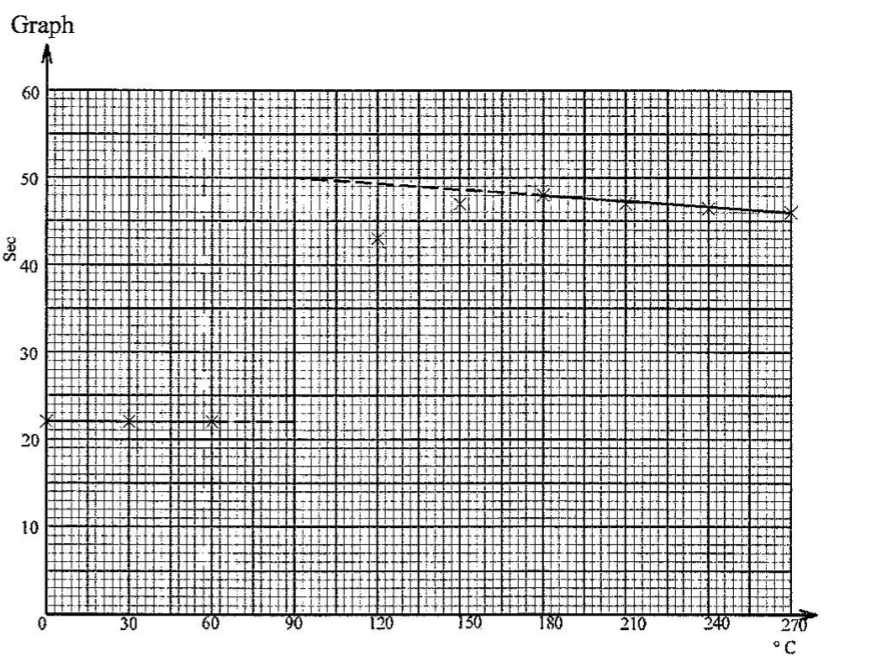
(a) Plot a graph of temperature (vertical axis) against time on the grid provided. (3 marks)

(b) Determine the change in temperature, AT, for the reaction. Show the working on the graph.

AT . (1 mark)

(c) Calculate the heat change, in joules, for the reaction. Assume that for the solution, specific heat capacity is 4.2 Jg K 1 and density is 1.0gcm 3. (2 marks)

(d) The relative atomic mass of magnesium is 24.0. Calculate the enthalpy change, AH, of the reaction per mole of magnesium. Indicate the sign of AH. (1 mark)

Procedure H

(i) Fill a clean burette with the 0.15M sodium carbonate, solution C.

(ii) Place all of the mixture in the beaker from procedure I into a 250ml volumetric flask. Add distilled water to the mark and shake thoroughly. Label the mixture as solution D.

(iii) Using a pipette filler, pipette 25.0 cm3 of solution D into a 250 ml conical flask and add 2 drops of methyl orange indicator.

(iv) Titrate solution D in the conical flask with the sodium carbonate, solution C and record the readings in Table 2.

(v) Repeat steps (iii) and (iv) and complete Table 2.

Table 2

Observations Inferences

(a) Determine the average volume of the 0.15M sodium carbonate, solution C, used. (1 mark)

(b) Calculate the number of moles of:

(i) sodium carbonate used.

(ii) hydrochloric acid in the 25.0 cm3 of solution D.

(iii) hydrochloric acid in the 250 cm3 of solution D.

(iv) hydrochloric acid that reacted with magnesium metal.(1 mark)

(v) total number of moles of hydrochloric acid in the 50.0cm3, solution B. (1 mark)

(c) Determine the concentration of hydrochloric aeid in moles per litre, in solution B. (1 mark)

2. You are provided with solid E. Carry out the following tests and record the observations and inferences in the spaces provided.

(a) Place about one-third of solid E in a dry test-tube. Heat the solid strongly and test any gas with both blue and red litmus papers.

Observations Inferences

(b) Place the remaining amount of solid E in a boiling tube. Add about 15 cm3 of distilled water and shake. Divide the mixture into four test tubes each containing about 2 cm3 .

(i) To the first portion, add three or four drops of dilute hydrochloric acid (1 mark)

(ii) To the second portion, add two or three drops of aqueous barium nitrate.

Observations Inferences

(iii) To the third portion, add aqueous sodium hydroxide dropwise until in excess.

Observations Inferences

(iv) To the fourth portion, add aqueous ammonia dropwise until in excess.

Observations Inferences

3. You are provided with solid F. Carry out the following tests and record the observations and inferences in the spaces provided.

(a) Place about one-third of solid F on a clean metallic spatula and burn it in a Bunsen burner flame.

Observations Inferences

(b) Place the remaining amount of solid F in a boiling tube. Add about 10 cm3 of distilled water and shake. Use the mixture for tests (i) to (iii) below.

Observations Inferences

(i) Using about 2 cm3 of the mixture in a test-tube, determine the pH using universal indicator paper and chart.

Observations Inferences

(ii) To about 2 cm3 of the mixture in a test tube, add two or three drops of acidified potassium manganate(VII).

Observations Inferences

(iii) To about 2 cm3 of the mixture in a test-tube add two or three drops of bromine

Observations Inferences


Practical Answers

2018 Chemistry paper 3

1.

Time,s 0 30 60 90 120 150 180 210 240 270
Temperature ºC 22.0 22.0 22.0 x 43.0 47.5 48.0 47.0 46.5 46.0

• Complete table ———-(1 mark)

• Use of decimals ( Either whole numbers, one decimal place as 0.5 (1 mark)

• Accuracy —————-½

• Trends – constant readings from t=0 sec to t=60sec, continuous rise in temperature readings from t=120 sec to maximum followed by a drop ½

a).

• Scale——-(½ mark)

• Labeling of axes—–(½ mark)

On graph paper

b).△T=(50.0 – 22.0)oc =28.0o

• Plotting (1 mark)

• Curve / lines (1 mark)

c).Heat change = 4.2 x 50 x 28.0 Joules

= 5880 Jou1es

d).Moles of magnesium = 30 0.0125/24

Enthalpy change △H= —5880/0.0125 x 1 J mol-1

= – 470400 J mol-1 OR – 470.4 kJ mol-1

-ve sign must be shown otherwise penalize

I II III
Final brette reading 24.80 33.50 41.50
Initial burette reading 1.00 10.00 18.00
Volume of solution C used cm<sub>3</sub> 23.80 23.50 23.50

• Complete table with three titrations—-(1 mark)

• Use of decimals ( 1 or 2) consistently (1 mark)

For 2 decimal places, the second decimal should be 0 or 5

• Accuracy ( any one value compared to the school value that is within 0.10 cmm or 0.20 cm3 of the school value) (1 mark)

• Principles of averaging — average of volumes that are within -L 0.10cm to 0.20 cm3 from each other.

• Final accuracy- should be within 0.10 cm3 to 0.20 cmof the school value.

a).Average volume of solution C used

23.50 + 23.50 cm3/2 = 23.50 cmcm3

b).Moles of sodium carbonate = 0.15average titre/1000

23.50 x 0.15/ 1000

— 3.525 x10⁻³

(ii) Reaction ratio is 1 mole Na2 COC3 : 2 moles HCl

Moles of hydrochloric acid in 25.0cm’ = 2 x Answer in b(i) =2×3.525 x 10-3

= 7.05 x10 -3

(nf) Moles of hydrochloric acid in 250 cm° = Answer in b(ii) x 250 2

— 0.0705

(iv) Mg * 2HCl—+ Mg Cl, + H2

Reaction ratio is Mg : HCP = 1 : 2

Moles of magnesium — 0.0125

Moles of hydrochloric acid = 2 x 0.0125 M

= 0 025

(v) Total number of moles of hydrochloric acid in 50 cm3 of solution B = Answer in b(iii) + answer in b(iv)

= 0.0705 + 0.025

= 0.0955

Concentration of hydrochloric acid in moles per litre of solution B Answer in b(v) x i000 50

0.0955 x1000 Moles per litre

= 1.91 mol dm-3

Observations Inferences
(a) Colourless liquid
condenses the on cooler parts of the
test-tube.
Red litmus turned blue
Blue litmus remains blue
(2marks)
Hydrated compound of ammonium salt
(NH ) present
(1marks)
(b) No effervescence
(i) No white precipitate
CO-2 3
* and SOA’ absent
Pb2+absent
(ii) White precipitate SO2-4
(iii) White precipitate which dissolves in
excess aqueous sodium hydroxide
Zn2+  or Al3+ present
(iv) White precipltate
insoluble in excess aqueous ammonia
Zn2+ or Al
3+
3.(a)Bums with a yellow
smoky / sooty flame
Unsaturated organic compound
OR
– long-chain organic compound
(b) Dissolves forming a colourless solution. Polar compound
(i) pH = 2
(accept pH value from 1 to 3) Reject pH range
Acidic compound probably carboxylic
acid
(ii) Acidified potassium manganate
(VII)
decolourised / purple potassium manganate
(VII) changes to colourless.
Alkene / alkyne or alkanol present
Bromine  water decolourized
/ Yellow or brown colour of bromine turns colourless
Alkene
OR alkyne present


kcse exam 2020
kcse 2020 English
kcse 2020 prediction
kcse 2020 mathematics prediction
kcse 2020 biology prediction
kcse 2020 biology paper 1
kcse 2020 timetable
kcse computer project 2020 question paper
kcse past papers
kcse past papers 2018
kcse past papers 2018 pdf download
FREE KCSE 2017 PAST PAPERS (QUESTIONS, MARKING SCHEMES AND REPORTS)
KCSE 2016 PAST PAPERS (QUESTIONS, MARKING SCHEMES AND REPORTS)
KCSE 2015 PAST PAPERS (QUESTIONS, MARKING SCHEMES AND REPORTS)
KCSE 2014 PAST PAPERS (QUESTIONS, MARKING SCHEMES AND REPORTS
KCSE Past Papers 2018 Chemistry paper 2(233/2)

KCSE Past Papers 2019 Chemistry paper 2(233/2)

2018 Chemistry paper 2

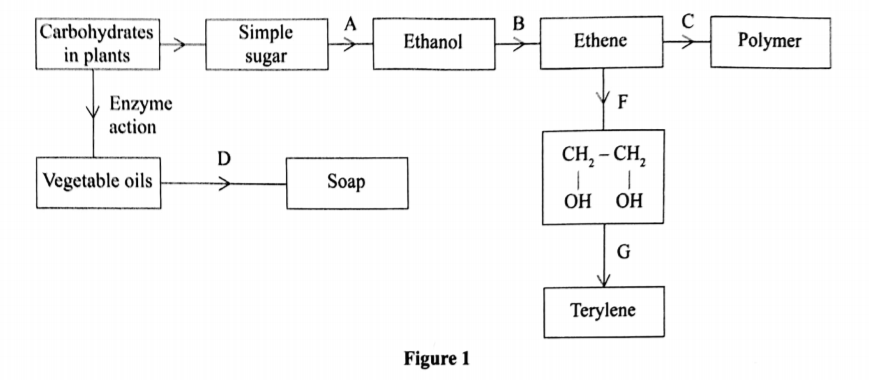
1. The diagram in figure I shows some natural and industrial processes. Study it and answer the questions that follows

(a) Identify the processes labelled: (2 marks)

A……………….

B……………….

C……………….

D……………….

(b) State the reagents and conditions required for processes B and D.

(i) Process B:

Reagent…………….(1 mark)

Conditions ………… (l mark )

(ii) Process D:

Reagent…………….(1 mark)

Conditions ………… (l mark )

(iii) Describe how process D is carried out.(2 marks)

(iv) State two additives used to improve the quality of soap.(1 marks)

(c) State the reagents required in steps F and G.(1 marks)

(iii) Draw the structure of terylene.(1 marks)

(d) (i) Name the polymer formed in step C.(1 marks)

(ii) State one disadvantage of the polymer formed in (d) (i).(1 marks)

2. Figure 2 is a section of the periodic table. Study it and answer the questions that follow. The letters do not represent the actual symbols of elements

(a) (i) Select elements which belong to the same chemical family.(1 marks)

(ii) Write the formulae of ions for elements in the same period.(1 marks)

(b) The hrst ionisation energies of two elements K and M at random are 577 kJ/mol and 494 tel/mol .(1 marks)

(i) Write equations for the 1 ˢ ᵗ ionisation energies for elements K and M and indicate their energies.(1 marks)

(iii) Write the formula of the compound formed when L and I react.(1 marks)

(iv) Give one use of elemcnt V.(1 marks)

(c) (i) State anothcr group that G can be placcd in Figure 1. Explain. (2 marks)

(ii) How do the reactivity of elements J and K compare? Explain. (2 marks)

(d) (i) Elements L and M form chlorides. Complete the following table by writing the formulae of each chloride and state the nature of the solutions. (2 marks)

(ii) The chloride of element M vapourises easily while its oxide has a high melting point. Explain. (2 marks)

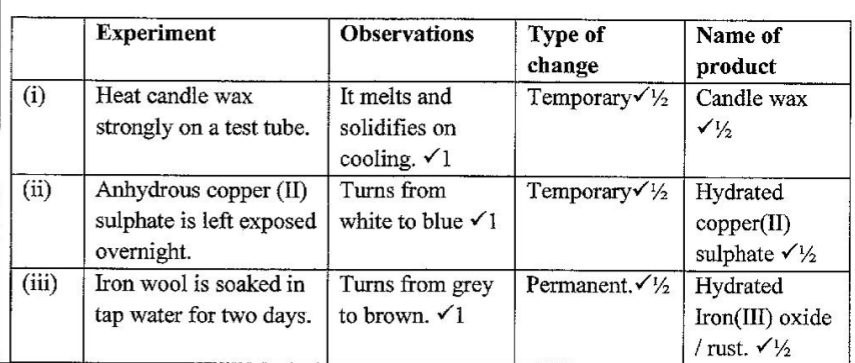
3. (a) Complete Table I by indicating the observations, type of permanent or temporary change and name of new compound formed.

(b) Use the set-up in Figure 3 to answer the questions that follow. The flask was covered with a cloth that had been soaked in ice-cold water.

(i) State the observation made on the coloured water. Explain.(2 marks)

(ii) Name the gas law illustrated in Figure 3.(1 marks)

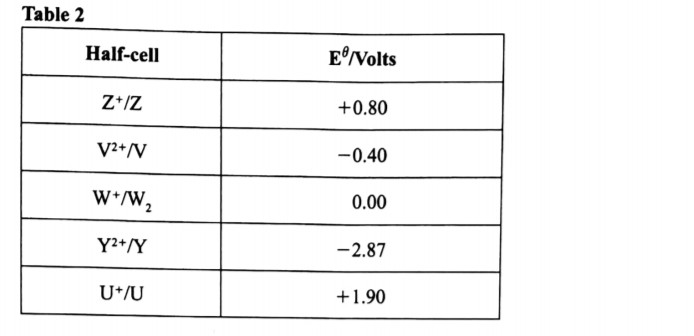
(c) Use the standard electrode potentials in Table 2 to answer the questions that follow.

(i) Write the half-cell representation for the element whose electrode potential is for hydrogen. (1 mark)

(ii) Arrange the elements in order of reducing power, starting with the weakest reducing agent. (1 mark)

(iii) I Select two half cells which combine to give a cell with the least e.m.f. (1 mark)

II Calculate the e.m.f of the half cells identified in (iii) I. (1 mark)

4. An experiment was carried out to prepare crystals of magnesium sulphate.

Excess magnesi um powder was added to l00cm’of dilute sulphuric(VI) acid in a beaker and warmed until no further reaction took place.

The mixture was filtered and the filtrate evaporated to saturation, then lcft to cool for crystals to form.

(a) (i) Write an equation for the reaction.(1 mark)

(ii) Explain why eKcess magnesium powder was used.(1 mark)

(iii) State how completion of the reaction was determined.(1 mark)

(iv) What is meant by a saturated solution?(1 mark)

(v) Explain why the filtrate was not evaporated to dryness.(2 mark)

(b) When bleaching powder, CaOC1„ is treated with dilute nitric(V) acid, chlorine gas is released.

This reaction can be used to determine the chlorine content of various samples of bleaching powders and liquids.

(i) Write an equation for the reaction of nitric(V) acid with bleaching powder.(1 mark)

(ii) Calculate the volume of chlorine produced when 10 g of CaOC1, is treated with excess nitric(V) acid. (Ca = 40.0; O = 16.0; Cl = 35.5; 1 mole of gas occupies 22.4dm3 at s.t.p) (3 marks)

(c) Apart from use of chlorine gas in bleaches and water treatment, state two other uses of chlorine gas. (1 mark)

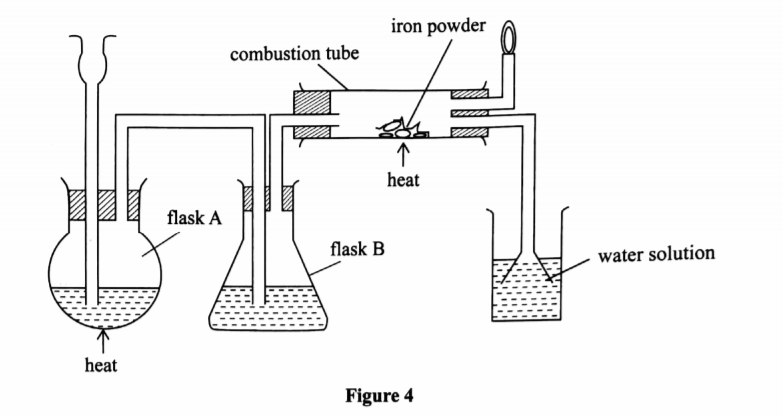
5. (a) The diagram in Figure 4 was used to prepare hydrogen chloride gas which was passed over heated iron powder.

(i) Give a pair of reagents that will produce hydrogen chloride gas in flask A. (2 marks)

(ii) Name the substance in flask B.(1 marks)

(iii) State the observation made in the combustion tube.(1 marks)

(iv) Write an equation for the reaction in the combustion tube.(1 marks)

(v) Describe a chemical test for hydrogen chloride gas.(1 marks)

(b) (i) Identify the gas that bums at the jet.(1 marks)

(ii) Explain why the gas in (b) (i) is burned.(1 marks)

(c) Give reasons why excess hydrogen chloride gas is dissolved using the funnel arrangement. (2 marks)

(d) State what will be observed when the reaction in the combustion tube is complete.(1 marks)

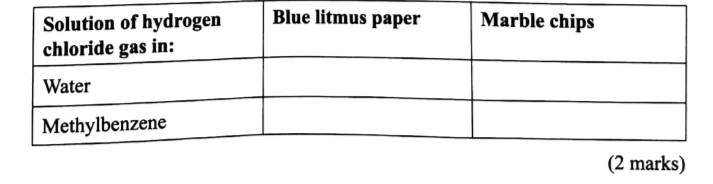
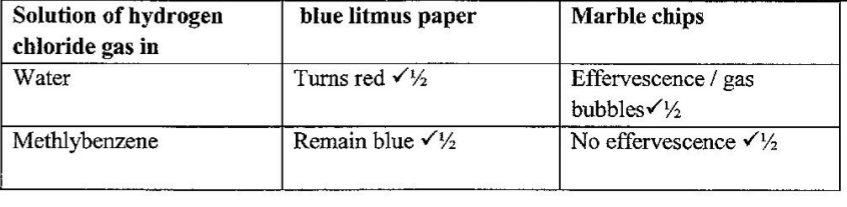
(e) Another experiment was carried out where hydrogen chloride gas was bubbled through methylbeiizene and water in separate beakers.

The resulting solutions were tested with blue litmus papers and marble chips.

(i) Write the observations made in the following table.

(ii) Explain the observations in (e) (i).(2 marks)

6. (a) In Kenya, sodium carbonate is extracted from trona at Lake Magadi. (i) Give the formula of trona.

(ii) Name the process of extracting sodium carbonate from trona.(2 marks)

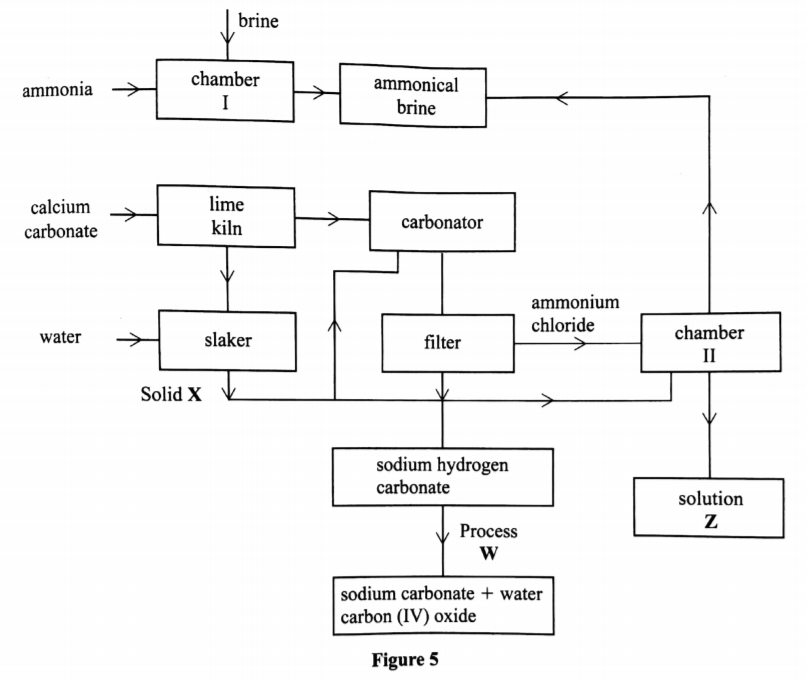
(b) The flow chart in Figure 5 summarises the steps involved in the production of sodium carbonate. Use it to answer the questions that follow.

(i) Name the process illustrated in Figure 5.(1 mark)

(ii) Identify the starting raw materials required in the production of sodium carbonate. (2 marks)

(iii) Write equations for the two reactions that occur in the carbonator. (2 marks)

(iv) Name two substances that are recycled. (v) Identify:

Solid X;…………….(l mark)

Process W……………(l mark)

(vi) Write an equation for the reaction that produces solution Z.(l mark)

(vii) Apart from softening hard water, state two other uses of sodium carbonate. (2 marks)

Questions and Answers

2018 Chemistry paper 2

1. The diagram in figure I shows some natural and industrial processes. Study it and answer the questions that follows

(a) Identify the processes labelled: (2 marks)

A — Fermentation

B — Dehydration

C — Addition polymerization / polymerization

D — Saponification

(b) State the reagents and conditions required for processes B and D.

(i) Process B:

Reagent – Concentrated sulphuric(VI) acids

Conditions – Temperature of 160°C – l80°C.

<(ii) Process D:

Reagent – hydroxide / Sodium hydroxide

Conditions – Boil / Boiling

(iii) Describe how process D is carried out.(2 marks)

The vegetable oil is mixed with sodium hydroxide and boiled

Solid sodium chloride is added to the resulting mixture, to precipitate out the soap from glycerol.

(iv) State two additives used to improve the quality of soap.(1 marks)

Perfumeand builders / tetraoxophosphates/dye

(c) State the reagents required in steps F and G.(1 marks)

Step F – acidified potassium manganate (VII)

(iii) Draw the structure of terylene.(1 marks)

(d) (i) Name the polymer formed in step C.(1 marks)

Polyethene / polythene

(ii) State one disadvantage of the polymer formed in (d) (i).(1 marks)

It is non-biodegradable hence pollutes the environment;

Produces poisonous gases when burnt.

2. Figure 2 is a section of the periodic table. Study it and answer the questions that follow. The letters do not represent the actual symbols of elements

(a) (i) Select elements which belong to the same chemical family.(1 marks)

K and J

(ii) Write the formulae of ions for elements in the same period.(1 marks)

K+ , L<sup+2< sup=””>, M3+</sup+2<>

(b) The first ionisation energies of two elements K and M at random are 577 kJ/mol and 494 tel/mol .(1 marks)

(i) Write equations for the 1ˢᵗ ionisation energies for elements K and M and indicate their energies.(1 marks)

K(g) + k(g)++ e

AHA — 494kJ/mol

M(g) + M(g)++ e

AHA — 577kJ/mol

(iii) Write the formula of the compound formed when L and I react.(1 marks)

Across the period, size of atoms decreases therefore more energy required to remove electrons from an atom i

n its gaseous state hence, 1ˢᵗ ionization energy for M will be greater than that of K.

K has lower nuclear charge / attraction than M / K has less protons than M.

(iv) Give one use of element V.(1 marks)

Being an inert gas, V is used in fluorescent tubes and bulbs.

(c) (i) State another group that G can be placcd in Figure 1. Explain. (2 marks)

Group 7.

Because G can either lose an electron to form G“ or gain an electron to form G.

(ii) How do the reactivity of elements J and K compare? Explain. (2 marks)

I is more reactive than K because of increase in the size of atoms. As we go down the group, the atoms increase in size so does reactivity. Outer electrons do not experience much nuclear attraction for bigger atoms.

OR

Reactivity increases down the group, effective nuclear attraction is greater in K than I’ atomic radius of I is greater than that of K.

(d) (i) Elements L and M form chlorides. Complete the following table by writing the formulae of each chloride and state the nature of the solutions. (2 marks)

LClNeutral

MCl/M2ClAcidic

(ii) The chloride of element M vapourises easily while its oxide has a high melting point. Explain. (2 marks)

Chloride of M vaporizes easily because of weak van der Waals forces between its dimer

Its oxide has a high melting point because of strong ionic bond is difficult to break.

3. (a) Complete Table I by indicating the observations, type of permanent or temporary change and name of new compound formed.

(b) Use the set-up in Figure 3 to answer the questions that follow. The flask was covered with a cloth that had been soaked in ice-cold water.

(i) State the observation made on the coloured water. Explain.(2 marks)

Coloured water moves towards the flask.

Cold cloth contributes to decrease in temperate causing decrease in volume; this creates a vacuum maling the ink tO move towards the flask.

(ii) Name the gas law illustrated in Figure 3.(1 marks)

Charle’s law

(c) Use the standard electrode potentials in Table 2 to answer the questions that follow.

(i) Write the half-cell representation for the element whose electrode potential is for hydrogen. (1 mark)

W+(aq)W2(G)/Pt

(ii) Arrange the elements in order of reducing power, starting with the weakest reducing agent. (1 mark)

U,Z,X,W2V,Y,

(iii) Select two half cells which combine to give a cell with the least e.m.f. (1 mark)

V2+/V and W+/W2

II Calculate the e.m.f of the half cells identified in (iii) . (1 mark)

e.m.f= 0.00- (-0.40)

+0.40V

4. An experiment was carried out to prepare crystals of magnesium sulphate.

Excess magnesi um powder was added to l00cm’of dilute sulphuric(VI) acid in a beaker and warmed until no further reaction took place.

The mixture was filtered and the filtrate evaporated to saturation, then lcft to cool for crystals to form.

(a) (i) Write an equation for the reaction.(1 mark)

Mg (s) + H2SO4 -> MgSO4 + H2

(ii) Explain why excess magnesium powder was used.(1 mark)

To ensure all the acid was used up.

(iii) State how completion of the reaction was determined.(1 mark)

When effervescence stops and presence of unreacted magnesium.

(iv) What is meant by a saturated solution?(1 mark)

Saturated solution is one that cannot dissolve any more solute at a particular temperature.

(v) Explain why the filtrate was not evaporated to dryness.(2 mark)

Because magnesium sulphate is a hydrated salt and evaporation to dryness causes it to lose it water of crystallization / crystals would not be formed because water of crystallization is lost through heating.

(b) When bleaching powder, CaOC1„ is treated with dilute nitric(V) acid, chlorine gas is released.

This reaction can be used to determine the chlorine content of various samples of bleaching powders and liquids.

(i) Write an equation for the reaction of nitric(V) acid with bleaching powder.(1 mark)

CaOC12(s) +2HNO3 -> Ca(NO3)2t -> Cl2(g) +H2

(ii) Calculate the volume of chlorine produced when 10 g of CaOC1, is treated with excess nitric(V) acid. (Ca = 40.0; O = 16.0; Cl = 35.5; 1 mole of gas occupies 22.4dm3 at s.t.p) (3 marks)

Volume of chlorine produced Mass of CaOClsub>2 = 40 + 16 + 71

=56 + 71

127

Moles of CaOClz — 10 = 0.0787 moles >1 127

Moles of CnOC/ —— moles of CU 1 mole CU —— 22.4 dm3 0.0787 = ?

0.0787 x 22.4 — 1.763 dm3

(c) Apart from use of chlorine gas in bleaches and water treatment, state two other uses of chlorine gas. (1 mark)

• Manufacture of hydrochloric acid;

• Manufacture of PVC polymers;

• Manufacture of potassium ch1orate(V);

• Manufacture of carbon tetrachloride;

• Manufacture of chloroform.

5. (a) The diagram in Figure 4 was used to prepare hydrogen chloride gas which was passed over heated iron powder.

(i) Give a pair of reagents that will produce hydrogen chloride gas in flask A. (2 marks)

Concentrated sulphuric(VI) acid and sodium chloride.

(ii) Name the substance in flask B.(1 marks)

Concentrated sulphuric(VI) acid.

(iii) State the observation made in the combustion tube.(1 marks)

Grey Iron powder turns green / solid glows red

(iv) Write an equation for the reaction in the combustion tube.(1 marks)

Fes + 2HCl —+ FeCl2 + H2

(v) Describe a chemical test for hydrogen chloride gas.(1 marks)

Open a bottle of concentrated ammonia and place it near HCI dense white fumes of NH4 Cl are observed.

(b) (i) Identify the gas that bums at the jet.(1 marks)

Hydrogen gas

(ii) Explain why the gas in (b) (i) is burned.(1 marks)

To prevent an explosion since a mixture of hydrogen and oxygen explodes

(c) Give reasons why excess hydrogen chloride gas is dissolved using the funnel arrangement. (2 marks)

To prevent suck back

To increase surface area for dissolution of hydrogen chloride in water

(d) State what will be observed when the reaction in the combustion tube is complete.(1 marks)

The flame will go off.

(e) Another experiment was carried out where hydrogen chloride gas was bubbled through methylbeiizene and water in separate beakers.

The resulting solutions were tested with blue litmus papers and marble chips.

(i) Write the observations made in the following table.

(ii) Explain the observations in (e) (i).(2 marks)

In water the hydrogen chloride ionizes to form hydrogen ions and chloride ions. / In methylbenzene which is non polar, 6. (a) In Kenya, sodium carbonate is extracted from trona at Lake Magadi. (i) Give the formula of trona.

Na2CO3.NaHCO3.H2O

(ii) Name the process of extracting sodium carbonate from trona.(2 marks)

Fractional crystallization.

(b) The flow chart in Figure 5 summarises the steps involved in the production of sodium carbonate. Use it to answer the questions that follow.

(i) Name the process illustrated in Figure 5.(1 mark)

Solvay process

(ii) Identify the starting raw materials required in the production of sodium carbonate. (2 marks)

Brine, ammonia, calcium carbonate and water

(iii) Write equations for the two reactions that occur in the carbonator. (2 marks)

NH3 + COC + H2O —+ NH4 HCO2

(iv) Name two substances that are recycled.

Ammonia and Carbon(IV) oxide, water

(v) Identify:

Solid X – Calcium hydroxide >1 [Ca(OH)2

Process W – Thermal decomposition

(vi) Write an equation for the reaction that produces solution Z.(l mark)

NH4Cl +Ca(OH)2NHCaCl+ H2

(vii) Apart from softening hard water, state two other uses of sodium carbonate. (2 marks)

• Glass making

• Paper industry

• Sodium silicate in making detergents

kcse exam 2020
kcse 2020 English
kcse 2020 prediction
kcse 2020 mathematics prediction
kcse 2020 biology prediction
kcse 2020 biology paper 1
kcse 2020 timetable
kcse computer project 2020 question paper
kcse past papers
kcse past papers 2018
kcse past papers 2018 pdf download
FREE KCSE 2017 PAST PAPERS (QUESTIONS, MARKING SCHEMES AND REPORTS)
KCSE 2016 PAST PAPERS (QUESTIONS, MARKING SCHEMES AND REPORTS)
KCSE 2015 PAST PAPERS (QUESTIONS, MARKING SCHEMES AND REPORTS)
KCSE 2014 PAST PAPERS (QUESTIONS, MARKING SCHEMES AND REPORTS
KCSE Past Papers 2018 Chemistry paper 1(233/1)

KCSE Past Papers 2019 Chemistry paper 1(233/1)

Kenya certificate of primary Education

2018 Chemistry paper 1

1. (a) Define a soluble base. (1 mark)

(b) Aqueous solutions of 2M ethanoic acid and 2M nitric(V) acid were tested for electrical conductivity. Which solution is a better conductor of electricity? Explain. (2 marks)

2. (a) Explain why it is not advisable to prepare a sample of carbon(IV) oxide using barium carbonate and dilute sulphuric(VI) acid. (2 marks)

(b) State a method that can be used to collect dry carbon(IV) oxide gas. Give a reason. (l mark)

3. The following are formulae of organic compounds. Use the formulae to answer the questions that follow:

CH3CH CH2OH

CH3 OOH

CH3CH2CH 2CH

CH3CCCH3 (a) Select:

(i) two compounds which when reacted together produce a sweet smelling compound. (1 mark)

(ii) an unsaturated hydrocarbon.(1 mark)

(b) Name the compound selected in (a) (ii).(1 mark)

4. One of the allotropes of sulphur is rhombic sulphur.

(a) Name the other allotrope of sulphur.(1 mark)

(b) Draw a diagram to show the shape of the allotrope named in (a) above.(1 mark)

(c) Write an equation for the reaction between concentrated sulphuric(VI) acid and sulphur.(1 mark)

5. Describe an experiment to show that group one elements react with cold water to form alkaline solutions. (3 marks)

6. (a) State Graham’s law of diffusion. (1 mark)

(b) Explain why a balloon filled with helium gas deflates faster than a balloon of the same size filled with argon gas. (2 marks)

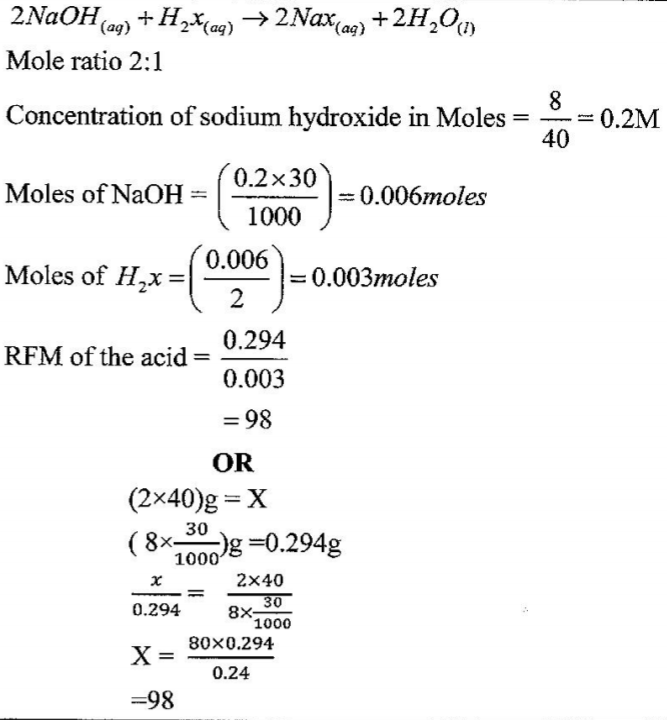
7. 30.0 cm3 of aqueous sodium hydroxide containing 8.0 g per litre of sodium hydroxide were completely neutralised by 0.294 g of a dibasic acid. Determine the relative formula mass of the dibasic acid. (Na = 23.0 ; O = 16.0 ; H 1.0) (3 marks)

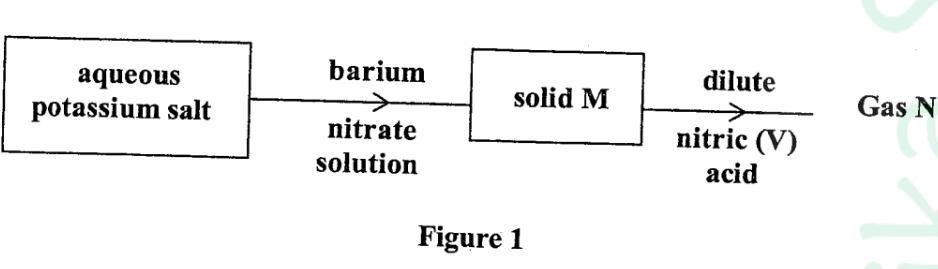
8. Study the flow chart in Figure 1 and answer the questions that follow.

Gas N forms a while suspension with aqueous calcium hydroxide.(1 mark)

(a) Name the anion present in the potassium salt.(1 mark)

(b) Write an ionic equation for the formation of solid M.(1 mark)

(c) Give one use of gas N.(1 mark)

9.An experiment was carried out to determine the presence of substancePQR and S in mixture T.the results obtained are as follows

(a) Name the method of sepration illustrated in figure 2

(ii) a substance wh‹eh is least soluble in t)ie solvent used. 10. Using iron filings, describe an experiment that can be conducted to show that oxygen is present in air. (3 marks)

11. (a) Element U has atomic number 12 while element V has atomic number 16. How do the melting points of their oxides compare? Explain. (3 marks)

12. When ethene gas is compressed at a high temperature, a solid is formed.

(a) Give the name of the solid. (I mark)

(b) Explain why it is not advisable to allow the solid to accumulate in the environment. (2 marks)

13. In the Haber process, nitrogen reacts with hydrogen according to the following equation.

3112(g) + N2(g) 2NH3(g) ; AH = —92 kJ mol**

(a) What would be the effect of adding a catalyst on the position of the equilibrium? (1 mark)

(b) Explain why it is not advisable to use temperatures higher than 773 K in the Haber process. (2 marks)

14. Figure 3 shows a set-up used by a student to prepare dry chlorine gas in the laboratory.

Identify three mistakes in the set-up, and give a reason for each. (3 marks)

15. You are provided with solid potassium hydrogen carbonate. Describe how a solid sample of potassium nitrate can be prepared. (3 marks)

16. Metal X and Y have standard electrode potentials of —0.13 V and —0.76V respectively, T metals were connected to fonn a cell as shown in Figure 4.

(a) Name the part labelled Z.

(b) State one function of the part labelled Z.

(c) Calculate the e.m.f. of the cell. (1 mark)

17. Figure 5 represents a grid that is part of the periodic table. Study it and answer the questions that follow. The letters are not the actual symbols of the elements.

(a) Write the electron arrangement of element C. (1 mark)

(b) On the grid provided, show with a tick (I) the position of element D whose atomic number is 18. (1 mark)

(c) Element E is more reactive than A. Explain.

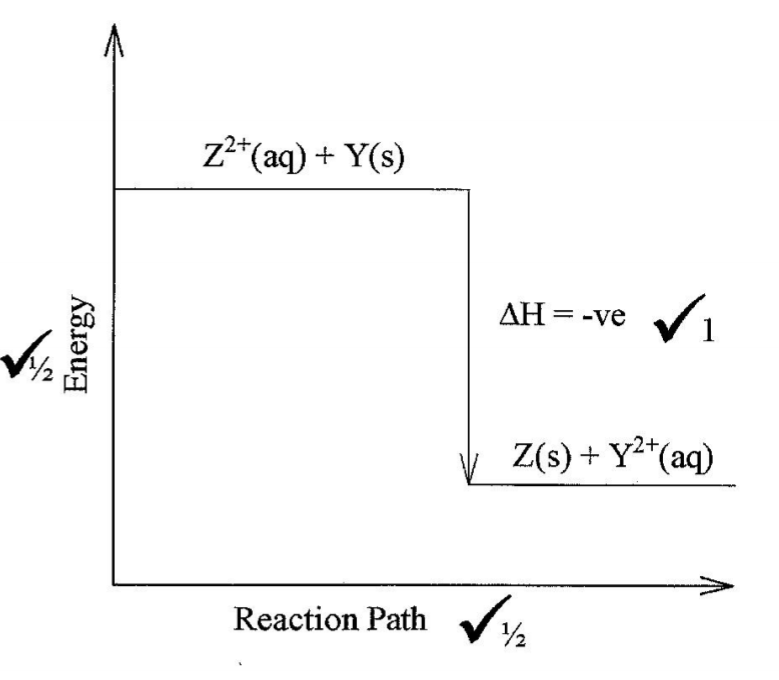
18. (a) Define molar heat of displacement. (1 mark)

(b) The following ionic equation represents the reaction between metal Y and an aqueot solution of Z°+.

Z°+ (aq) + Y(s) Z(s) + Y2 (aq); AH = -ve

Draw an energy level diagram to represent the reaction.

19. (a) Give the symbols of the two charged particles emitted by a radioactive isotope. (2 marks)

(b) An isotope 2 0 Pb disintegrates by emitting two beta particles. Determine the mass number and atomic number of the resulting nuclide.

20. (a) Zinc reacts with hydrochloric acid according to the following equation. Zn(s) + 2HCl (aq) ZnCl2(aq) + H2(g) Identify the reducing agent. Give a reason for the answer. (2 marks)

(b) Iron sheets are dipped in molten zinc to prevent rusting. Name this process. (l mark)

21. Study the set-up in Figure 6 and answer the questions that follow.

(a) Name the substance that was collected in tube P. (1 mark)

(b) Write an equation for the reaction which occurs in tube Q in the first few minutes of the experiment. (1 mark)

(c) Give a suitable conclusion for the experiment in the set-up. (1 mark)

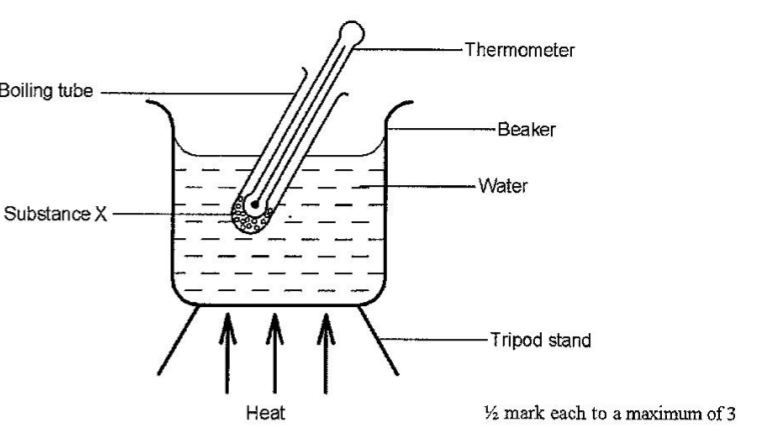
22. You are provided with the following: thermometer, boiling tube, beaker, Bunsen burner, pure substance X whose boiling point is about 80°C, water and any other apparatus that may be required. Draw a labelled diagram of the set-up that can be used to determine the melting point ofX. (3 marks)

23. Explain why it is important to put off a non-luminous flame immediately after use. (2 marks)

24. (a) Name two ores of iron. (1 mark)

(b) Describe how the amount of iron in a sample of iron(III) oxide can be determined. (2 marks)

25. Explain why a solution of sodium chloride conducts electricity while that of sugar does not. (2 marks)

26. Explain why commercial indicators are preferred to flower extracts as aCid-base indicators. (2 marks)

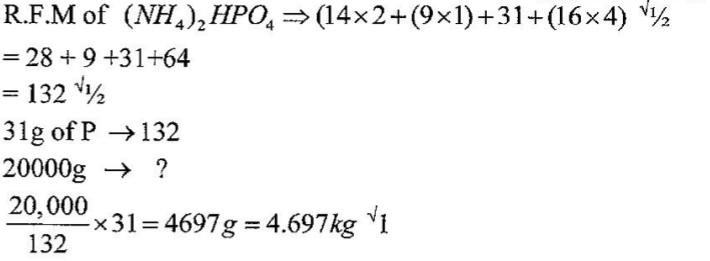
27. (NH, )2HPO4 is a fertiliser used by farmers to boost their crop production. (a) Calculate the mass of phosphorus in a 20 kg packet of + * 4)2HPO4. (N = 14.0; H — 1.0; P = 31.0; O = 16.0) (2 marks)

(b) State one advantage of this fertilizer, (NH4)2HPO4, over urea (CO(NH 2)2)- (1 mark)

28.Distinguish between emprical and molecular formular of a compond

Questions and Answers

2018 Chemistry paper 2

1. (a) Define a soluble base. (1 mark)

A soluble base is a substance that dissociates in water to produce hydroxide ions as the only negative ions.

(b) Aqueous solutions of 2M ethanoic acid and 2M nitric(V) acid were tested for electrical conductivity. Which solution is a better conductor of electricity? Explain. (2 marks)

Nitric(V) acid. This is because nitric(V) acid is a strong acid and dissociates completely in solution producing many H+ ions.

2. (a) Explain why it is not advisable to prepare a sample of carbon(IV) oxide using barium carbonate and dilute sulphuric(VI) acid. (2 marks)

– The reaction starts but soon stops.

This is because the insoluble barium sulphate produced forms a coating on the surface of the barium carbonate preventing further reaction and evolution of carbon(IV) oxide gas.

(b) State a method that can be used to collect dry carbon(IV) oxide gas. Give a reason. (l mark)

– Downward delivery.

– Carbon(IV) oxide is denser than air.

3. The following are formulae of organic compounds. Use the formulae to answer the questions that follow:

CH3CH CH2OH

CH3 OOH

CH3CH2CH 2CH

CH3CCCH3 (a) Select:

(i) two compounds which when reacted together produce a sweet smelling compound. (1 mark)

CH CH CH OH and CH.,COOH

(ii) an unsaturated hydrocarbon.(1 mark)

CHP CCCH

(b) Name the compound selected in (a) (ii).(1 mark)

But-2-yne

4. One of the allotropes of sulphur is rhombic sulphur.

(a) Name the other allotrope of sulphur.(1 mark)

Monoclinic sulphur / beta sulphur / prismatic sulphur

(b) Draw a diagram to show the shape of the allotrope named in (a) above.(1 mark)

(c) Write an equation for the reaction between concentrated sulphuric(VI) acid and sulphur.(1 mark)

S + 2H2SO4 -> 3SO2 + 2H20

5. Describe an experiment to show that group one elements react with cold water to form alkaline solutions. (3 marks)

Place a small piece of sodium metal on water in a trough.

When the reaction stops, drop a strip of red litmus paper to the resulting solution. The red litmus paper turns blue showing that the resulting solution is alkaline. ( Any indicator used)

6. (a) State Graham’s law of diffusion. (1 mark)

The rate of diffiision of a gas is inversely proportional to the square root of its denslty at constant temperature and pressure.

(b) Explain why a balloon filled with helium gas deflates faster than a balloon of the same size filled with argon gas. (2 marks)

Helium is less dense than argon hence it diffuses out of the balloon faster than argon.

7. 30.0 cm3 of aqueous sodium hydroxide containing 8.0 g per litre of sodium hydroxide were completely neutralised by 0.294 g of a dibasic acid. Determine the relative formula mass of the dibasic acid. (Na = 23.0 ; O = 16.0 ; H 1.0) (3 marks)

8. Study the flow chart in Figure 1 and answer the questions that follow.

Gas N forms a while suspension with aqueous calcium hydroxide.(1 mark)

(a) Name the anion present in the potassium salt.(1 mark)

Carbonate (CO32 )

(b) Write an ionic equation for the formation of solid M.(1 mark)

Ba2+(aq) * CO32 (aq) —› BaCO3(S)

(c) Give one use of gas N.(1 mark)

– Making soft drinks/aerated drinks;

– In refrigeration;

– In extinguishing fires;

– Making baking powder; Manufacture of sodium carbonate; Cloud seeding.

9.An experiment was carried out to determine the presence of substancePQR and S in mixture T.the results obtained are as follows

(a) Name the method of sepration illustrated in figure 2

Chromatography/paper chromatography

(ii)A substance which is least soluble in the solvent used.

Q

10. Using iron filings, describe an experiment that can be conducted to show that oxygen is present in air. (3 marks)

Wet a measuring cylinder/gas jar and sprinkle some iron filings on the wet surface. Remove the excess iron filings;

Invert the measuring cylinder in a trough of water; – Take the reading of the air column in the measuring cylinder. Leave the set-up for 2 days;

Read and record the volume of the air column;

11. (a) Element U has atomic number 12 while element V has atomic number 16. How do the melting points of their oxides compare? Explain. (3 marks)

The oxide of U has higher melting point than the oxide of V;

This is because the oxide of U is a solid with ionic bonds hence requires a lot of energy to melt;

The oxide of V is a gas hence requires little energy to melt/break molecular forces of attraction.

12. When ethene gas is compressed at a high temperature, a solid is formed.

(a) Give the name of the solid. (I mark)

Polythene / Polyethene

(b) Explain why it is not advisable to allow the solid to accumulate in the environment. (2 marks)

It is non-biodegradable, hence pollutes the environment.

13. In the Haber process, nitrogen reacts with hydrogen according to the following equation.

3H2(g) + N2(g) 2NH3(g) ; AH = —92 kJ mol**

(a) What would be the effect of adding a catalyst on the position of the equilibrium? (1 mark)

No effect/does not affect the position of the equilibrium.

(b) Explain why it is not advisable to use temperatures higher than 773 K in the Haber process. (2 marks)

Forward reaction is exothermic, excessive temperatures would favour the backward reaction therefore lowering the yield of ammonia.

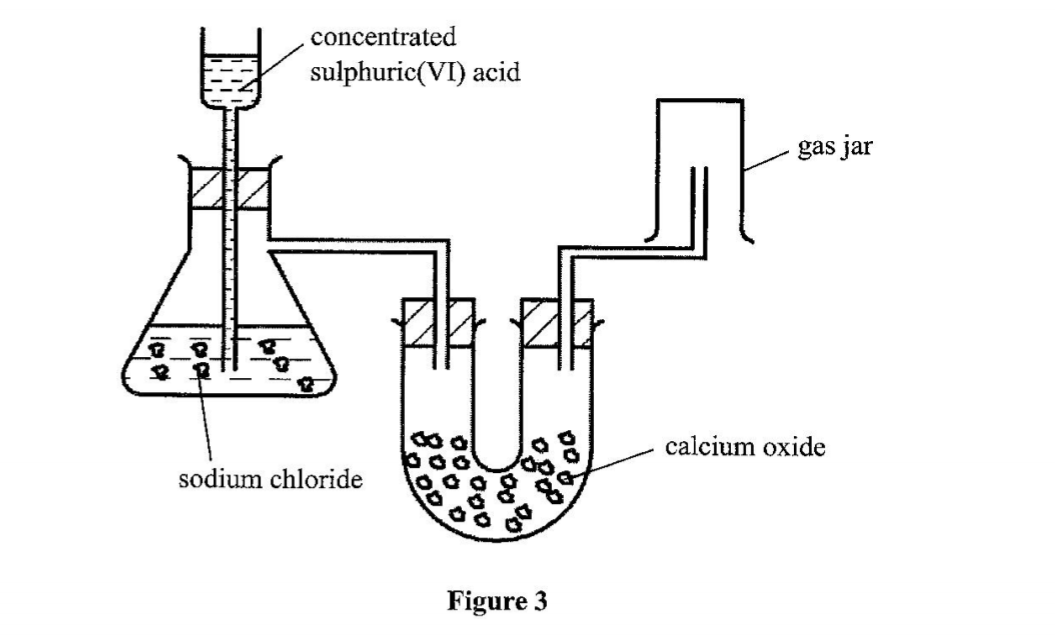
14. Figure 3 shows a set-up used by a student to prepare dry chlorine gas in the laboratory.

Identify three mistakes in the set-up, and give a reason for each. (3 marks)

– One reagent is missing, hence reagents provided cannot produce chlorine;

– Wrong drying agent — Calcium oxide will react with the chlorine gas;

– Incorrect method of gas collection – No gas will be collected / chlorine is denser than air.

15. You are provided with solid potassium hydrogen carbonate. Describe how a solid sample of potassium nitrate can be prepared. (3 marks)

Measure a certain volume of dilute nitric(V) acid and place it in a beaker;

Add potassium hydrogen carbonate little by little as the mixture is stirred until effervescence stops;

Evaporate the solution to saturation and allow to cool for crystals to form;

Dry the crystals in between filter papers.

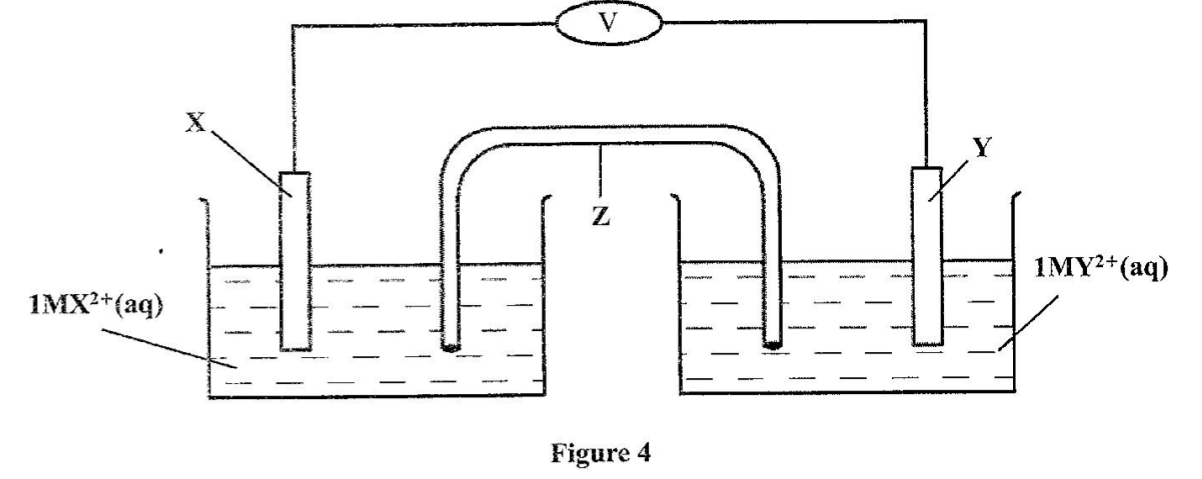
16. Metal X and Y have standard electrode potentials of —0.13 V and —0.76V respectively, T metals were connected to fonn a cell as shown in Figure 4.

(a) Name the part labelled Z.

Salt bridge

(b) State one function of the part labelled Z.

– Provides electrical contact between the electrodes//completes the circuit;

(c) Calculate the e.m.f. of the cell. (1 mark)

—0.13 – 0.76

=+0.63K

17. Figure 5 represents a grid that is part of the periodic table. Study it and answer the questions that follow. The letters are not the actual symbols of the elements.

– Provides cations and anions to replace those used up.

(a) Write the electron arrangement of element C. (1 mark)

2.8.4

(b) On the grid provided, show with a tick (I) the position of element D whose atomic number is 18. (1 mark)

period 3, group 8

(c) Element E is more reactive than A. Explain.

E has a bigger atomic radius than A / the valence electrons of element E are further from the nucleus, hence loosely held by the positive nucleus and requires less energy to be removed during reaction.

OR

A has a smaller atomic radius than E / the valence electrons of element A are closer to the nucleus, hence strongly held by the positive nucleus and requires more energy to be removed during a reaction.

18. (a) Define molar heat of displacement.

(1 mark)

Molar heat of displacement is the enthalpy change that occurs when one mole of a substance is displaced from its ions in solution.

(b) The following ionic equation represents the reaction between metal Y and an aqueot solution of Z°+.

Z°+ (aq) + Y(s) Z(s) + Y2 (aq); AH = -ve

Draw an energy level diagram to represent the reaction.

19. (a) Give the symbols of the two charged particles emitted by a radioactive isotope.(2 marks)

a – positively charged / 2ffe

@ – negatively charged / Je

21082Pb -> abX + 2º

(b) An isotope 2 0 Pb disintegrates by emitting two beta particles. Determine the mass number and atomic number of the resulting nuclide.

a = 210 + 0 = 210

b = 82 + 2 = 84

mass no = 210 Atomic number = 84

20. (a) Zinc reacts with hydrochloric acid according to the following equation. Zn(s) + 2HCl (aq) ZnCl2(aq) + H2(g) Identify the reducing agent. Give a reason for the answer. (2 marks)

– Reducing agent — Zn

– The oxidation number of Zn increased from 0 to +2 OR

Zn loses electrons form zinc ions/ Zn is oxidized to Zn2+

(b) Iron sheets are dipped in molten zinc to prevent rusting. Name this process. (l mark)

Galvanization

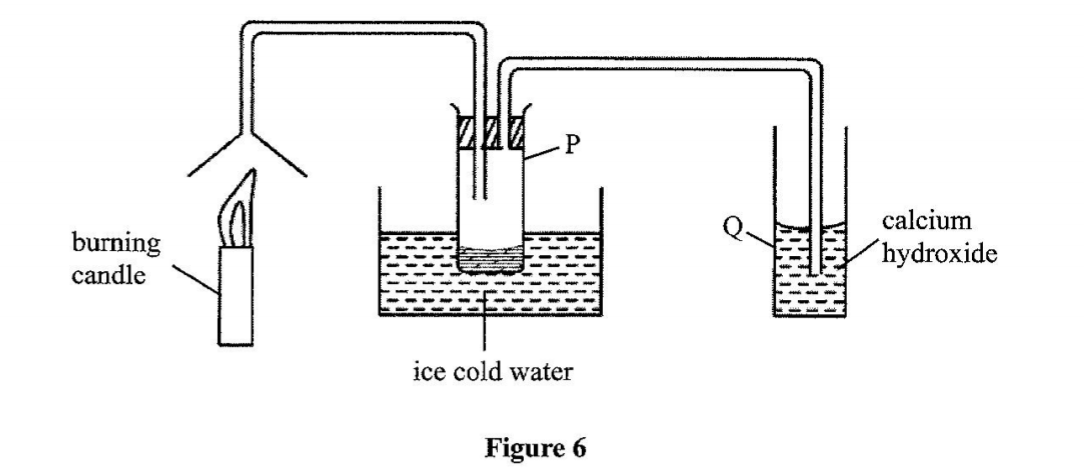
21. Study the set-up in Figure 6 and answer the questions that follow.

(a) Name the substance that was collected in tube P. (1 mark)

Water

(b) Write an equation for the reaction which occurs in tube Q in the first few minutes of the experiment. (1 mark)

COZ + Ca (OH)2O -> CaCO3 + H2O (c) Give a suitable conclusion for the experiment in the set-up. (1 mark)

Burning candle /organic matter produces water and carbon(V) oxide. OR Candle contains carbon and hydrogen / candle is a hydrocarbon

22. You are provided with the following: thermometer, boiling tube, beaker, Bunsen burner, pure substance X whose boiling point is about 80°C, water and any other apparatus that may be required.

Draw a labelled diagram of the set-up that can be used to determine the melting point ofX. (3 marks)

23. Explain why it is important to put off a non-luminous flame immediately after use. (2 marks)

A non -luminous flame is invisible, hence it should be put off to avoid being accidentally burned.

24. (a) Name two ores of iron. (1 mark)

– Haematite;

– Magnetite;

– Siderite.

(b) Describe how the amount of iron in a sample of iron(III) oxide can be determined. (2 marks)

– Weigh the Iron(III) oxide together with a crucible;

– Heat the Iron(III) oxide and coke to a constant mass;

– Cool and re-weigh residue and crucible

– The difference in mass is weight of the iron.

25. Explain why a solution of sodium chloride conducts electricity while that of sugar does not. (2 marks)

A solution of sodium chloride contains ions which are free to conduct electricity while that of sugar contains molecules hence cannot conduct electricity.

26. Explain why commercial indicators are preferred to flower extracts as aCid-base indicators.(2 marks)

The composition of commercial indicators remains constant. hence gives consistent results.

The composition of flower extracts change with time giving inconsistent results.

27. (NH, )2HPO4 is a fertiliser used by farmers to boost their crop production.

(a) Calculate the mass of phosphorus in a 20 kg packet of + * 4)2HPO4.

(N = 14.0; H — 1.0; P = 31.0; O = 16.0) (2 marks)

(b) State one advantage of this fertilizer, (NH4)2HPO4, over urea (CO(NH 2)2)- (1 mark)

has two nutrients available to crops, nitrogen and phosphorus, urea has only nitrogen.

28.Distinguish between emprical and molecular formular of a compond

Empirical formula shows the Simplest whole number ratio of the moles of atoms of different elements in a compound while the molecular formula shows the actual number of atoms of various elements present in one molecule of the compound.

kcse exam 2020
kcse 2020 English
kcse 2020 prediction
kcse 2020 mathematics prediction
kcse 2020 biology prediction
kcse 2020 biology paper 1
kcse 2020 timetable
kcse computer project 2020 question paper
kcse past papers
kcse past papers 2018
kcse past papers 2018 pdf download
FREE KCSE 2017 PAST PAPERS (QUESTIONS, MARKING SCHEMES AND REPORTS)
KCSE 2016 PAST PAPERS (QUESTIONS, MARKING SCHEMES AND REPORTS)
KCSE 2015 PAST PAPERS (QUESTIONS, MARKING SCHEMES AND REPORTS)
KCSE 2014 PAST PAPERS (QUESTIONS, MARKING SCHEMES AND REPORTS
 

KCSE Past Papers 2018 Computer Studies Paper 2 (451/2)

KCSE Past Papers 2019 Computer Studies Paper 2 (451/2)

Kenya Certificate of Secondary Education

2018 Computer Studies – Paper1

2 1. (a) In a school, students reside in three dormitories Red, Blue and Orange. Each dormitory is managed by a patron and each student is required to register for a game.

(i) Open a database program and create a database named schoolgames that would be used to manage the games. (1 mark)

(ii) Create the tables named; Student, Patron, Dormitory and Game in the database created in (i) using the following specifications. (7 marks)

Student table

Field name Description
Stud No Contains  unique registration code
Studname Contains the name of a student
Gamecode Contains codes of each game
Dormcode codes codes of each dormitory

Patron table

Field name Description
Patroncode Contains the  patronode name
Patronname Contains the patron name

Dormitory table

Field name Description
Dormcode Contains the Dormcode name
Dormname Contains the domitory code
Patroncode Contains the domitory patron code

Game table

Field name Description
Gamecode contains the game code
Gamename contains the name of the game

(iii) Create the relationships between the tables. (3 marks)

(b) (i) Create a form for each table that would be used for data entry. (2 marks)

(ii) Enter the following data into their respective tables:(9 marks)

Student table

Stud No Stud name Gamecode Dormcode
Koo1 Ann Gmoo4 D003
Koo2 Chris Gmoo3 D001
Koo3 Jared Gmoo1 D002
Koo4 Julian Gmoo4 D003
Koo5 Marion Gmoo1 D003
Koo6 Janet Gmoo2 D003
Koo7 Tom Gmoo2 D002
Koo8 Jerry Gmoo3 D002

Patron table

Patroncode patronname
Poo1 Maurice
Poo2 Edward
Poo3 Jane

Dormitory table

Dormcode Dormname Patroname
D00l Red P001
D002 Blue P002
D003 Orange P003

Games table

Gamecode Gamename
Gmoo1 Basketball
Gmoo2 Volleyball
Gmoo3 Table Tenis
Gmoo4 Netball

(c) Create a query to extract each of the following details:

(i) StudNo, Studentname and Gamename for all students who reside in the Orange dormitory or play Basketball. Save the query as orangeq. (5 marks)

(ii) StudNo, studentname, gamename for the students whose studentname start with letter “J”. Save the query as Jquery. (3 marks)

(d) (i) Create a tabular report showing the StudNo, Studentname, Dormname, Patronname, Gamename and grouped by Gamename. Save the report as reportgame. (8 marks)

(ii) Format the report created in (i) as follows:

I Replace the report title with the text “players for each game” (1 mark)

II Enter your name and index as a report footer. III Bold the dormitory names in the report. (e) Print out each of the following:

(i) Student, Patron, Game and Dormitory tables

(ii) Jquery and orangeq

(iii) reportgame

2 (a) (i) Open a word processing program and key in the following text as it appears. Save the documents as socialnetwork. (11 marks)

SOCIAL NETWORKING

Social networking platforms are used by organisation to improve communication and productivity by disseminating information among different groups of employees in a more efficient manner.

The advantages and disadvantages of social media are as follows.

Advantages

• Facilities open communication.

• Allows employees to discuss ideas.

• Provides an opportunity to widen business contracts.

• Targets a wide audience.

• Improves business reputation and client base.

• Expands market research.

Disadvantages


  • Susceptible to fraud
  • Potentially results to hate speech
  • Destructs normal business operationsEmployers do have the right to ban computer activity that is not work related, this approach may not yield optimal results.If employees are to be allowed access to social networking platforms then a comprehensive and well defined policy should be established to prevent abuses.

    (ii) Format the document as follows:

    I Title: Font size l8pts, font colour red, font type Tahoma. (3 marks)

    II Apply double line spacing for the text under the sub title “Advantages”. (2 marks)

    III Apply a 4 lined drop cap on the first letter of first paragraph. (3 marks)

    IV Apply a two-columns format with a line between for the text with the two subtitles such that “Advantages” are to the left column and “Disadvantages” are in the right column. (4 marks)

    V Apply bold, italic and underline to subtitles “Advantages” and “Disadvantages”.

    (iii) Apply the following format to the document: (3 marks)

    I Insert a water mark with the text “social media” on the document of a font size of 20 and running diagonally from left to right. (4 marks)

    II Insert page numbers at the bottom centre of every page. (2 marks)

    III Insert the text “social networks” as a header aligned to the right. Apply italics to the header. (3 marks)

    (b) The following is a letter from a Principal of Malimali school to other Principals inviting them for a seminar at the country education offices.

    (i) Open a new document and create the following as it appears. Save the document as Malimali (2½ marks)

    The Principal

    >

    Dear Sir

    RE: SEMINAR MEETING

    You are invited to attend the Principal’s seminar which is scheduled to be at the county education office on the 2nd of June 2015.

    You are booked to be in <> We are looking forward to a successful event.

    Yours Faithfully Lilango Jotema

    Malimali School Principal

    (ii) Use a mail merge feature to generate customised mails for the addresses shown in the following table. Save the mail merged document as Aletters. (9½ marks)

    School Room
    Ginga School Room 6
    Lubi School Room 8
    Trans School Room 10

    (c) Print out each of the following:(i) socialnetwork

    (ii) Malimali

    (iii) Aletters (3 marks)

    Questions and Answers

    2018 Computer Studies – Paper1

    1 (a)(i) Creating the database file @ 1 ½

    (ii) Creating of tables (at least 3) @1 ½

    Student table

    ✔ 4 Fields each @ ½ =2

    Patron table

    ✔ 2 Fields each @ ½ =1

    Dormitory table

    ✔ 3 Fields each @ ½ =1½

    Games table

    ✔ 2 Fields each @ ½ =1

    (iii) Relationship at least 3 each @ 1 =

    (b) (i) 4 forms for each table each @½ =2 = 2

    (ii) Entering data into the tables

    Student table

    ✔ 8 records each @ ½ =4

    Patron table

    ✔ 3 records each @ ½ = 1½

    Dormitory table

    ✔ 3 records each @½ = 1½

    Games table

    ✔ 4 records each @ ½ =2

    (c) (i) Creating the orangeq query

  • Invoking the use of query@ 1
  • selecting the fields @ 1
  • Criteria applied to the fields @ 2✔ Saving the query @ 1(ii) Creating the j query query
  • Invoking the use of query@ 1
  • Criteria (letter j) @✔ 1 Saving the query @ 1(d) (i) Creating the report
  • Using the report feature @ 1
  • selecting the report fields @ 1
  • selecting the 4 fields each @ 1=4
  • Grouping @ 1
  • Saving the query @ 1(ii) I. Replacing the report title @l✔ H. Entering name and index as report footer

    ✔Name and index @ l

    ✔Position the items in the footer @ 1

    HI. Bolding the text

    ✔Selecting the text @ 1

    ✔ applying bold format @l

    (e) Printing

    (i) 4 Tables each @ 1

    (ii) 2 queris each @ 1 =2

    (iii) The report @ 1

    2 (a) (i) Typing the story

  • Title @½
  • Centering the title @½
  • First paragraph @ 2
  • Paragraph under advantages @ 2
  • Paragraph under disadvantages @ 2
  • Last paragraph @ 2
  • Bullets used in the advantages @ ½
  • Bullets used in the disadvantages @ ‘½
  • Saving @ 1(ii) I Formatting the title,p>
  • Font size 18 @l
  • Font colored @l
  • Font typemahoma @lH Double underline
  • Selection of text under advantages @l
  • Applying double space @lIH Drop cap
  • Selection the first letter @l
  • Using drop cap feature @l
  • Dropping through 4 lines @ 1IV Two columns
  • Selection of text @l
  • Using the column feature @l
  • Applying a line between the columns @ 1
  • Advantages to the left @ /z 4
  • Formats applied on subtitles
  • Bold@1
  • Italics @l
  • Underline @ 1(iii) I Water marks
  • Using the watermark feature @ 1
  • Typing the text social media in the watermark field @l
  • Font size=20 @l
  • Direction (Diagonal left to right) @lH Page numbering
  • Using page numbering feature @½
  • Inserting page numbers @ 1
  • Centering the pages horizontally @/ 2III Header
  • Using the header field @ /
  • Typing the text in the header field @ 1
  • Alignment at the right @½
  • Applying italics @ 1(b)(i) Main document
  • Typing text @l
  • Applying formats ½
  • Saving the document @ 1(ii) Main document
  • Creation of datasource @3
  • Saving the datasource @l
  • Using the mail merge feature @½
  • Inserting the 2 fields at each @l =2
  • Generating the merged document 2
  • Saving the merged document @ 1kcse exam 2020
    kcse 2020 English
    kcse 2020 prediction
    kcse 2020 mathematics prediction
    kcse 2020 biology prediction
    kcse 2020 biology paper 1
    kcse 2020 timetable
    kcse computer project 2020 question paper
    kcse past papers
    kcse past papers 2018
    kcse past papers 2018 pdf download
    FREE KCSE 2017 PAST PAPERS (QUESTIONS, MARKING SCHEMES AND REPORTS)
    KCSE 2016 PAST PAPERS (QUESTIONS, MARKING SCHEMES AND REPORTS)
    KCSE 2015 PAST PAPERS (QUESTIONS, MARKING SCHEMES AND REPORTS)
    KCSE 2014 PAST PAPERS (QUESTIONS, MARKING SCHEMES AND REPORTS
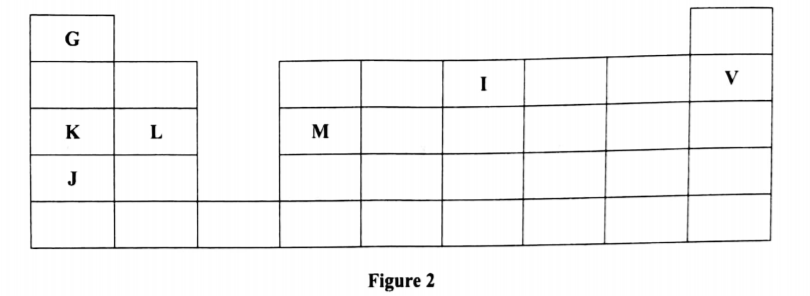
 

KCSE Past Papers 2018 Computer Studies Paper 1 (451/1)

KCSE Past Papers 2019 Computer Studies Paper 1

Kenya Certificate of Secondary Education

2018 Computer Studies – Paper1

1. State two reasons for the increased use of laptop computers in government offices. (2 marks)

2. Computer network technicians prefer to use command-line based operating system when configuring networks. State three reasons for the preference. (3 marks)

3. State three measures that should be put in place in a computer laboratory to safeguard users’ health. (3 marks)

4. State three ways in which barcode readers may be used in schools.(3 marks)

5. State three advantage of flat panel monitors over cathode ray tube monitors as used in computers. (3 marks)

6. State three possible reasons for the extinction of daisy wheel printers in the market. (3 marks)

7. State three ways in which an operating system secures a computer system. (3 mark)

8. A law firm prefers to use hard copy output over soft copy output when handling documents for legal matters. State two reasons for this preference. (2 marks)

9. State the function of each of the following features in a word processor application: (a) Thesaurus;(1 marks)

(b) Comments.(1 marks)

10. With the aid of an example, explain the term multi-level list as used in word processing. (3 marks)

11. Distinguish between real-time operating system and distributed operating system. (3 marks)

12. Explain the function of protect sheet feature in a spreadsheet program. (2 marks)

13. State four computer-based careers introduced as a result of computerised data processing method at the airport. (2 marks)

14. In a spreadsheet, the formula =If(A1>10, A1*77, A1*50) is entered in a cell. Interpret the results. (3 marks)

15. State a stage in systems development life cycle where each of the following activities are carried out:

(a) identifying the technologies that may be used in a proposed system; (1 mark)

(b) identifying shortcomings of a system; (1 mark)

(c) preparing the system migration plan.(1 marks)

SECTION B (60 marks)

Answer question 16 and any other three questions from this section in the spaces provided.

16. (a) With the aid of a flow chart, describe a loop control structure as used in programming.(4 marks)

(b) Study the following pseudocode and answer the questions that follow.

1. Start

2. Get value l and value2

3. If value I > value2 Then

4. Maximum = valuel

5. Else If value l < value2 Then

6. Maximum = value2

8. Else Go to 9

9. Display Maximum

10. Stop

(i) State the purpose of the pseudocode.(1 mark)

(ii) Draw a flowchart equivalent to the pseudocode. (6 marks)

(c) Distinguish between a source program and a compiler as used in computer programming.(4 marks)

17. (a) (i) Explain the term search engine as used in the Internet.(2 marks)

(ii) Peter intends to download a movie from the Internet.

State the three factors that may determine the total time taken to complete the download. (3 marks)

(b) Wakulima online is an organisation that runs a web based system for assisting farmers to obtain market for their farm produce.

State four technological reasons that may cause a farmer not to access the organisation’s system. (4 marks)

(c) Explain a situation when each of the following Desktop Publishing program features may be used when creating a publication:

(i) cropping;(2 marks)

(ii) transparency.(2 marks)

(d) List two areas where infrared waves are used in data communication.(2 marks)

18. (a) State four activities of the planning stage of systems development. (4 marks)

(b) Explain a circumstance when each of the following feasibility studies are carried out during systems development:

(i) Technical;(2 marks)

(ii) Economic;(2 marks)

(iii) Schedule.(2 marks)

(c) Table 1 and Table 2 are related tables in a database. Use them to answer the questions that follow.

Table 1

Dept Code Dept Name
001 Computer
002 Aviation
003 Engineering

Table 2

Dept ID Students Registration No. Students Name
002 st1 Alex Toro
003 st2 Naomi Komi
002 st3 Peter Kengo

(i) Identify the appropriate primary key for each table. (1 mark)

(iii) Explain two benefits of enforcing referential integrity in the database. (4 marks)

19. (a) Describe each of the following validation checks as used in data processing:

(i) Preserve check;(2 marks)

(ii) Data type check;(2 marks)

(iii) Check digit.(2 marks)

(b) Write each of the following abbreviations in full:

(i) BCD;(1 marks)

(ii) EBCD;(1 marks)

(iii) ASCII.(1 mark)

(c) Using 10 — bits binary number system, perform the following decimal operation using two’s complement (6 marks)

l2910 12810

20. (a) The figure shows a network design. Use it to answer the questions that follow.

(i) Explain the function of each of the following in the network. I Router;

II Firewall;(2 marks)

III File server.(2 marks)

(ii) State two categories of software that must be installed in a computer so that users can use it to access the internet. (2 marks)

(b) State four ways in which computers may be used to manage data in a research environment.(4 marks)

(c) Some computer companies have opted to use the Internet to provide shared processing resources and online application services to users.

State three advantages that this approach will have on their customers. (3 marks)

Questions and Answers

2018 Computer Studies – Paper1

1. Reasons for the preference for laptops.


  • They are small and fit in a small storage space.
  • They are light weight hence can be carried to areas where their services are required.
  • The monitor, system unit, keyboard units are attached together hence making its use to be convenient.
  • Rechargeable / backup battery. Any 2 x 12. Reasons for the use of command — line interface OS
  • They do not take up a lot of memory hence boot faster than the GUI OS.
  • They have direct access or most hardware devices.
  • They are cheaper to acquire as some can be downloaded free of charge. They can run on lower —bit hardware systems such as 32-bit computers. Any 3 x 13. Measures to be put in place in the laboratory to safeguard user health.
  • All power cables must be insulated and hidden from users.
  • The furniture used must be of standard computer furniture.
  • The room should be lit with adequate lighting.
  • The room must be ventilated.
  • Computer monitor should be fitted with antiglare to filter excess light rays emanating from the monitor.
  • Avoid slippery floors/cemented floors.
  • Controlling dust.4. Ways in which barcode readers can be used in a school.
  • To take inventory of items in the school.
  • To keep track of employee login log out.
  • Used to transact business in the library.
  • Used to keep track of movement of goods.5. Advantages of flat panel monitors.
  • They are compact and light weight;
  • They consume less power;
  • They do not suffer from geometrical distortions;
  • They do not cause eye fatigue.
  • They support many advanced technologies;
  • They can be made in almost any size and shape; They support higher resolution.
  • Low heat radiation.6. Reasons why daisy wheel printer are in extinct.
  • They supported one font size and font face;
  • They were monochrome printers;
  • They produced noise while printing;
  • They were very slow;
  • Did not print graphics.
  • Had poor print quality.7. Ways in which an OS secures computer system:
  • Access controls: Authentication of users in order to access files;
  • Performing regular patches of updates;
  • Creating secure accounts with required privileges;
  • Scrutinizing all incoming and outgoing packets of data through a firewall;
  • Encryption of data, during the transmission stage; Password / biometric analysis;
  • Log files to detect any breach. Any 3 x 18. Advantages of hardcopy output.
  • – They are acceptable as exhibit in cases of litigation.
  • Can be used without a computer.
  • They are difficult to change without leaving any trace.
  • They can be used without power.
  • They can be used without the experience of computer usage. Any 2 x 19. (i) Thesaurus:

    It is a feature in a word processor that suggest words with similar or opposite meaning to the selected word @l.

    (ii) Comments:

    It is a feature in WP that allows a user to attach a remark about the selection @l.

    10. Multilevel list:

    It is a format style that shows the listed items of different levels rather than one at one level.

    Each level has different indentation and numbering style @2.

    Example (Accept any)

    1. Chapter One

    Introduction

    Definition of terms @l.

    11. Distinction between real-time and distributed OS.

  • Real-time OS reads information from input devices and must respond within a short duration of time to ensure correct performance.
  • Distributed OS distributes computation among several physical processors which do not share memory or clock.12. Function of protect sheet:
  • It is a feature used to prevent unwanted changes to be made on the data contained in a sheet by limit the ability to make changes.13. Computer based careers created by introducing computerized data processing.
  • System analysts Hardware technicians
  • Data entry clerks
  • Programmers Networks techniciansDatabase administrators
  • Web designers
  • Network administrator14. = If (A1 > 10, Al * 77, Al * 50)

    Compares the value in cell Al If it is greater than 10, if comparison is True, the results of operations Al * 77 is displayed, if it is False the results of the operations Al * 50 is displayed.

    15. (a) Identifying technologies that could be used in the system.

    — System ana1ysis/ information gathering/problem recognition (@ 1)

    (b) Identifying the shortcoming of the old system

    — Problem definition

    (@ 1)

    (c) Prepares the software migration plan

    — Implementation stage (@ 1) 3

    Section B (60 Marks) Marking Scheme

    16. (a) Looping is the control structure that allows a block of code/statements to be repeated until a certain condition is fulfilled. @ 2 marks

    Accept any type of looping control structure

    (c) Distinction between a source program and compiler

  • Source program is the original computer based instructions written by a programmer in a programming language whileA compiler is a program that processes statements/instructions and translates them into machine language.

    17. (a) (i) Search-engine

    It is a web-based application used to locate for an item or information from world wide web.

    (ii) Factors that affects duration of download

  • The size of the video
  • The band width of the media used
  • Availability of network
  • Other activities that may be running in the computer.
  • Other restrictions enforced in the computer
  • The restrictions by the ISP
  • Speed of computer (Any 3 @ l)(b) Causes of Wakulima system’s failure
  • Lack of power supply to the system servers.
  • Network infrastructure breakdown/poor network coverage/lack of connection.
  • Program failure in the system/malware (virus).
  • Hardware failure in the system.
  • Human action which could be accidental or intentional.
  • Lack of access rights.
  • System overload (Any 4 @ 1 mark)(c) (i) Cropping

    Used when handling a graphic and there is a need to remove some of the portions in the graphic.

    (ii) Transparency

    Used when there is a need to make the background of a graphic to be visible.

    (d) Areas where infra-red radio waves are used.

  • TV remote control communication; DVD remote control communication
  • Communication between peripheral devices and the computer
  • Data link over short distance using mobile phones Radio remote control
  • Remote locking / opening doors/devices18. (a) Activities at the planning stages
  • Identify opportunity for the new project.
  • Analyse feasibility to establish the viability of the project.
  • Develop a work plan.
  • Identify appropriate staff to work in the project.
  • Control and direct the project.(b) (i) Technical Feasibility

    Meant to determine whether the proposed solution is technically practical/establish whether the technology is available /expertise is available. (@ 2)

    (ii) Economic Feasibility

    Meant to establish whether the proposed system will be cost effective. (@ 2)

    (iii) Schedule Feasibility

    Meant to establish whether the system can be implemented within an acceptable time kame. (@ 2)

    (c) (i) Primary keys in the table Table 1 : Dept code @

    Table 2 : Student’s Registration No. @

    (ii) Benefits of referential integrity in the table

  • No record can be added to the table 2 if its corresponding record in Table 1 does not exist.
  • No record in Table 1 can be deleted without first deleting associated records in Table 2.
  • Reduces data redundancies.
  • Prevent deletion of related tables. (Any 2 x 2)19. (a) (i) Preserve check

    It is a measure placed used to ensure that data item is in its original status. (@ 2 marks)

    (ii) Data type check

    It is a measure that ensures that correct data type is entered for each field. (@ 2 marks)

    (iii) Check digit

    This is a number calculated by the computer to make sure that the other numbers in a sequence have been entered properly. (@ 2 marks)

    (b) (i) BCD

    Binary Coded Decimal

    (o i)

    (ii) EBCDIC

    Extended Binary Coded Decimal Interchange Code.

    (iii) ASCII

    American Standard Code for Information Interchange

    20. (a) (i) I. Router It is the device meant to forward data packets between computer network in the school and the internet. (@ 2 marks)

    H. Firewall

    It is a device that prevents unauthorized access to or from a private network (school’s LAN) (@ 2 marks)

    III. File server

    It is a computer attached to a network whose purpose is to provide location for shared disk access (shared storage of computer files). (@ 2 marks)

    (ii) Software to be installed in a computer

  • Network operating system
  • Browser/Mozi11a,firefox Necessary system drivers to supports installed hardware
  • Protocols(SMTP,HTTP) (Any 2 @ 1 mark)(b) Use of computers in research for data management
  • Used for data manipulation;
  • Computers aid in data capturing;
  • Computers can be used to store researched and analysed data;
  • Information in computers can be a secondary source of data;
  • Computers can be used to generate reports;
  • Computers can be used to communicate researched work. (Any 4 x 1)(c) Advantages of online application services and shared processing resources.

    Users will not be required to have powerful processing devices;

  • Users can access the services from anywhere in the world;
  • Users can access services at any time (24/7);
  • Users can offload their data to the cloud infrastructure;
  • Users can collaborate with remote users to process the data;
  • The approach will cut out high cost of hardware;
  • Sharing of resources;
  • Faster access to service;
  • Cost effective;
  • Orders are made without going to the shop. (Any 3 x 1)

kcse exam 2020
kcse 2020 English
kcse 2020 prediction
kcse 2020 mathematics prediction
kcse 2020 biology prediction
kcse 2020 biology paper 1
kcse 2020 timetable
kcse computer project 2020 question paper
kcse past papers
kcse past papers 2018
kcse past papers 2018 pdf download
FREE KCSE 2017 PAST PAPERS (QUESTIONS, MARKING SCHEMES AND REPORTS)
KCSE 2016 PAST PAPERS (QUESTIONS, MARKING SCHEMES AND REPORTS)
KCSE 2015 PAST PAPERS (QUESTIONS, MARKING SCHEMES AND REPORTS)
KCSE 2014 PAST PAPERS (QUESTIONS, MARKING SCHEMES AND REPORTS
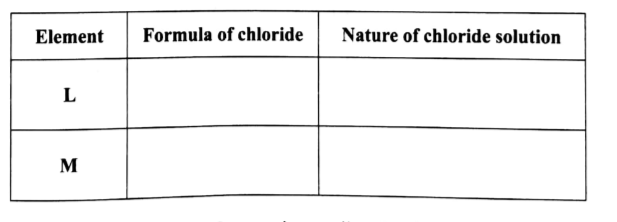
 

KCSE Past Papers 2018 Business Studies Paper 2 (565/2)

KCSE Past Papers 2019 Business Studies Paper 2

Kenya Certificate of Secondary Education

2018 Business Studies paper 2

1. (a)Explain five circumstances that may lead to the existence of a business opportunity to be exploited by the entrepreneur. (10 marks)

(b) Explain five factors that Chuma Steel Manufacturers may consider when choosing a channel for distributing their products. (10 marks)

2. (a)Explain five clauses that must be specified in the Memorandum of Association of a public limited company. (10 marks)

(b) The following information was extracted from the books of Kisababu Traders on 31 December 2014:

Details Sh
Sales 84,0000
Purchases 58,000
Opening Stock 15,700

Required:

i. Prepare Kisababu Traders Trading Account for the period ending 31 December 2014. (5 marks)

ii. Work out Kisababu Traders percentage mark up.(2 marks)

iii. Calculate Kisababu Traders Rate of Stock Turnover.(3 marks)

3. (a)Explain five demerits of using carts as a means of transport in towns. (10 marks)

(b) Explain five types of direct taxes that the government may use to collect revenue from individuals and companies. (10 marks)

4. (a)The demand for soft drinks has been on the increase. Explain five factors that may have contributed to this. (10 marks)

(b) Describe five forms of economic integration that countries may join to promote international trade. (10 marks)

5. (a) Explain five differences between an open office and an enclosed office. (10 marks)

(b) The following opening balances were extracted from the books of Mageta Traders on 1 July 2016:

The following transactions took place in the course of the month:

— Paid a creditor Sh4,500 in cash.

— Took Sh3,000 from the bank for family use.

— Bought stock Sh 18,600 on credit.

— Acquired a 10 year bank loan Sh 165,000 which was credited to the business bank account.

— Purchased land worth Sh 82,000 paying by cheque.

Converted a family table worth Sh5,500 to business use.

— Received Sh 7,300 in cash from debtor.

Required: Prepare Mageta Traders Balance Sheet at the end of July 2016 (10 marks)

6. (a) Explain five problems of using national income statistics to compare the living standards of citizens of Kenya and Tanzania. (10 marks)

(b) Use the transactions given below to prepare Jawabu Traders two column cash book for the month of February 2015. (10 marks)

1st Feb.Had Sh 12,500 cash and a bank overdraft of Sh 5,000

2nd Feb.Used cash to pay for water bill Sh 800, electricity Sh 1,100 and wages Sh4,700.

3rd Feb.Received a cheque of Sh 18,900 from a debtor

5th Feb.Sold goods worth Sh 7,150 in cash.

7th Feb.Paid for goods bought for resale worth Sh 6,400 by cheque.

9th Feb.Received a cheque of Sh 13,000 from the co-operative society as earnings from dividends.

10th Feb.Withdrew Sh 2,500 from the bank for family use.

13th Feb.Received Sh 15,900 in cash from a debtor.

15th Feb.Deposited Sh9,500 from the office into the business bank account.

17th Feb. Paid a creditor by cheque Sh4,390.

27th Feb.Used all the money in the bank to purchase furniture leaving only a balance of Sh2,010.

Questions and Answers

2018 Business Studies paper 2

1. (a)Explain five circumstances that may lead to the existence of a business opportunity to be exploited by the entrepreneur. (10 marks)


  • Lack of some products/services.Custoiners may need some products/services which are not easily found in their area.
  • Higher prices of goods/services.Existing market prices may be unnecessarily high hence offering them at relatively lower prices would create an opportunity.
  • Excess demand.When the quantities of goods available in the market are not sufficient, an opportunity to supply more exist.
  • Low quality products.When customers expect better quality products then, this presente an opportunity to offer them.
  • Sub-standard services.An opportunity will exist where better services are offered in the distribution of goods.
  • Un-met sociocultural needs/conditions.Goods and ses ices should target the society’s existing attitudes, practices and beliefs which existing products may not be addressing.
  • Innovation.Discovery of new technology which may lead to reduced costs of production and general efficiency presents an opportunity.

    (b) Explain five factors that Chuma Steel Manufacturers may consider when choosing a channel for distributing their products. (10 marks)

  • The geographical spread of customers.If the customers are spread over a wide area, then a longer channel would be preferable.
  • Durability of the steel products.Since steel products are not easily spoilt, long channels can be used ln their distribution.
  • Level of competition.Shorter channels should be used if competition is so stiff.
  • Resources and size of the firm.If the firm has limited resources and only serves a small market, then a shorter channel is ideal.
  • Government policy.Chuma steel manufacturers must adhere to government regulation on the distribution of steel products.
  • Marketing risks.Where marketing risks are higher, more middlemen should be involved to spread such risks.
  • Availability of intermediaries.Chuma Steel Manufacturers can only use channels where intermediaries are available.
  • Pricing of the steel products.Shooter channels will be preferred where the prices are to be kept low by avoiding the intermediaries.

    2. (a)Explain five clauses that must be specified in the Memorandum of Association of a public limited company. (10 marks)

  • The Name Clause.This clause states the name of the company and ends with the word “limited”. This name must be unique to the company and not shared with any other.
  • The Objects Clause.This clause states the objectives of the company and specifies what the company has powers to do.
  • The Situation Clause.This clause states the physical location of the company’s registered office.
  • The Liability Clause.This clause states the extent to which members are fiable to the debts of the company.

    Shareholders and members have “limited liability”.

  • The Capital Clause.This clause states the amount of capital that the company is authorized to raise, the capital structure, the composition and the values of the shares.
  • Association and Subscriptions Clause.This clause contains a declaration by the original members who registered the company about their desîre to form a company, their objectives, the number of shares they will owri and their personal details.

    (b) The following information was extracted from the books of Kisababu Traders on 31 December 2014:

    Details Sh
    Sales 84,0000
    Purchases 58,000
    Opening Stock 15,700

    Required:

    i. Prepare Kisababu Traders Trading Account for the period ending 31 December 2014. (5 marks)

    ii. Work out Kisababu Traders percentage mark up.(2 marks)Mark up = GP/COGS x 100

    15,000/60000 x 100

    60, 000

    = 25%

    iii. Calculate Kisababu Traders Rate of Stock Turnover.(3 marks)

    Rate of Stock Turnover = COGS./Average Stock

    60,000/(O.P. Stock * C.L. Stock)

    60, 000

    15, 700x 3000 2

    60000/14350

    =4 times

    3. (a)Explain five demerits of using carts as a means of transport in towns. (10 marks)

    (i) Carts are prone to delays occasioned by their slow speed.

    (ii) Movement of carts is affected by extreme weather conditions like rainfall.

    (iii) They are unsuitable for transporting goods over long distances as people and animals get tired when pulling them.

    (iv) Carts offer little protection to goods against damage by elements of weather such as rain.

    (v) Goods transported by carts are susceptible to theft making it an unsuitable means of transporting valuable goods.

    (vi) Carts cannot carry very heavy and bulky goods since their carrying capacity is limited.

    (vii) Carts inconvenience motor vehicles and other road users since they are slower.

    (viii) Carts may be a cause of accidents since those pulling them usually disregard traffic rules.

    (b) Explain five types of direct taxes that the government may use to collect revenue from individuals and companies. (10 marks)

  • Personal Income Tax (P.A.Y.E.).This is tax charged on an individual’s income which may be from salaries, wages and profits made from businesses. This tax is usually progressive in nature.
  • Corporation Tax.This tax is usually charged on the profits made by companies and other incorporated business. It is a fixed percentage of the profits.
  • Capital Transfer Taa.This tax is charged when there is change of ownership of capital investment from one person to another.
  • Stamp duty.This tax is charged on the transfer of land or securities from one person to another.
  • Capital gains tax.This tax is charged when an asset is sold at a price that is higher than its book value.
  • Estate (death) duty.This tax is levied when property is transferred to an inheritor/ heir after the death of the original owner.
  • Wealth tax.This tax is levied on personal wealth that goes beyond a certain limit. This wealth may include realizableassets like land, houses, accumulated profits and even savings.
  • Withholding tax.This tax is levied on savings like pension dividends and any moneys held by individuals.

    4. (a)The demand for soft drinks has been on the increase. Explain five factors that may have contributed to this. (10 marks)

  • Favourable pricing.The soft drinks are priced at a value that consumers can easily afford.
  • Increasing consurner incomes.People are able to buy more of the products due to increased earnings.
  • High prices of substitutes.Most of the products in the market that can serve as substitutes are hîghly priced hence not preferred by buyers.
  • Favourable tastes and preferences.More consumers now like soft drinks as compared to other drinks.
  • Favourable government policies which keep the prices of soft drinks down/stable hence encouraging their consumption.
  • General increase in population.With more people, more of the products are consumed.
  • Aggressive marketing/sales promotion.More consumers are attracted to soft drinks due to intense advertising and other promotional strategies.
  • Equitable distribuôon of income among consumers.Since many people have access to earning, they are able to buy more of the products.

    (b) Describe five forms of economic integration that countries may join to promote international trade. (10 marks)

  • Preferential Trade Area.In this form ofi integration, trade barriers are reduced among the member nations while the barriers are applied at normal rates for trading activities with non-member nations.
  • Free trade area.This is economic integration where all trade barriers are removed between the member countries while each country retains its own barriers towards non-members.
  • Customs union.In this form of integration, tariffs and other trade barriers are removed between member countries whiletheir trade policies are harmonized with regard to treatment of trade with the rest of the world.
  • Common market.This integration goes beyond harmonizing trade policies and removal of trade barriers but also allows for free movement of labour and capital among member nations.
  • Economic union.In this form of integration, member countries set up common institutions like central banks, adopt use of common currency (monetary system) and have common public services like railways network.
  • Duty-free zones.Member countries allow importation of raw materials without charging duty. Exports from these zones to member countries also attract no excise duty.
  • Political union.In this form of integration, several states form a central government through which, share a central bank, the defense and core ministries that run their affairs.

    5. (a) Explain five differences between an open office and an enclosed office. (10 marks)

    Open Office

    (a) All staff work in one large room.

    (b) There is no confidentiality in consultations and discussions.

    (c) Senior staff sit together with the juniors hence no status conferred.

    (d) Office equipment and machines are easily shared and cannot be misused.

    (e) Disruptions and noise from colleagues is high due to overcrowding.

    (f) Has fewer partitions hence cheap to construct.

    (g) It is easy to supervise the staff since they are all in one room

    Enclosed Office

    (a) Each staff is allocated a room from where they work.

    (b) Discussions and consultations are done in confidence.

    (c) Confers status on tap level staff as they are allocated own offices.

    (d) Office equipment and machines like telephones are easily misused since they are located in particular offices.

    (e) Little noise and disruption from colleagues since each staff work from own offices.

    (f) Has more partitions hence costly to construct.

    (g) It is difficult to supervise the staff since they are in different rooms.

    (b) The following opening balances were extracted from the books of Mageta Traders on 1 July 2016:

    The following transactions took place in the course of the month:

    — Paid a creditor Sh4,500 in cash.

    — Took Sh3,000 from the bank for family use.

    — Bought stock Sh 18,600 on credit.

    — Acquired a 10 year bank loan Sh 165,000 which was credited to the business bank account.

    — Purchased land worth Sh 82,000 paying by cheque.

    Converted a family table worth Sh5,500 to business use.

    — Received Sh 7,300 in cash from debtor.

    Required: Prepare Mageta Traders Balance Sheet at the end of July 2016 (10 marks)

    6. (a) Explain five problems of using national income statistics to compare the living standards of citizens of Kenya and Tanzania. (10 marks)(i) The two countries may have used different currency values to calculate their national income hence different standards of measure.

    (ii) One country could be having a large subsistence sector whose income may not have been included in the measure of their income.

    (iii) The levels of income distribution in one country may be too skewed compared to the other which may have a fair income distribution.

    The two countries may have different references and economic priorities. The two countries could be differcnt in terms of resource endowment hence different abilities to generate income.

    (vi) The climatic conditions in the two countries may be different leading to difference in demand and production.

    Production activities may affect the health of citizens in the two countries differently. The political realities in the two countries could be different affecting their stability and the security of citizens.

    (ix) The degree of accuracy of the national income statistics .

    (b) Use the transactions given below to prepare Jawabu Traders two column cash book for the month of February 2015. (10 marks)

    1st Feb.Had Sh 12,500 cash and a bank overdraft of Sh 5,000

    2nd Feb.Used cash to pay for water bill Sh 800, electricity Sh 1,100 and wages Sh4,700.

    3rd Feb.Received a cheque of Sh 18,900 from a debtor

    5th Feb.Sold goods worth Sh 7,150 in cash.

    7th Feb.Paid for goods bought for resale worth Sh 6,400 by cheque.

    9th Feb.Received a cheque of Sh 13,000 from the co-operative society as earnings from dividends.

    10th Feb.Withdrew Sh 2,500 from the bank for family use.

    13th Feb.Received Sh 15,900 in cash from a debtor.

    15th Feb.Deposited Sh9,500 from the office into the business bank account.

    17th Feb. Paid a creditor by cheque Sh4,390.

    27th Feb.Used all the money in the bank to purchase furniture leaving only a balance of Sh2,010.

kcse exam 2020
kcse 2020 English
kcse 2020 prediction
kcse 2020 mathematics prediction
kcse 2020 biology prediction
kcse 2020 biology paper 1
kcse 2020 timetable
kcse computer project 2020 question paper
kcse past papers
kcse past papers 2018
kcse past papers 2018 pdf download
FREE KCSE 2017 PAST PAPERS (QUESTIONS, MARKING SCHEMES AND REPORTS)
KCSE 2016 PAST PAPERS (QUESTIONS, MARKING SCHEMES AND REPORTS)
KCSE 2015 PAST PAPERS (QUESTIONS, MARKING SCHEMES AND REPORTS)
KCSE 2014 PAST PAPERS (QUESTIONS, MARKING SCHEMES AND REPORTS
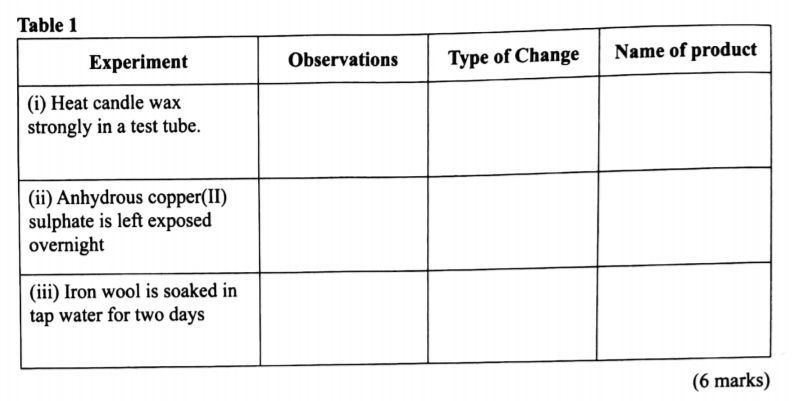
 

KCSE Past Papers 2018 Business Studies Paper 1 (565/1)

Business Studies

Kenya Certificate of Secondary Education

kcse questions and answers 2018


2018 Business Studies paper 1

1. Outline four features of labour as a factor of production. (4 marks)

(a)…………….

(b)…………….

(c)…………….

(d)…………….

2. Outline four ways in which peace within a country may encourage entrepreneurial development.(4 marks)

(a)…………….

(b)…………….

(c)…………….

(d)…………….

3. State four duties of the office clerk. (4 marks)

(a)…………….

(b)…………….

(c)…………….

(d)…………….

4. The document shown below is used in home trade.

(a) Identify the document(1 marks)

(b) Outline three circumstances under which the above document may be used. (3 marks)

(i)…………….

(ii)…………….

(iii)…………….

5. State four measures that may be taken by the government to control inflation. (4 marks)

(a)…………….

(b)…………….

(c)…………….

(d)…………….

6. Outline four measures that may be taken by the government to curb unemployment. (4 marks)

(a)…………….

(b)…………….

(c)…………….

(d)…………….

7. Highlight four benefits of national income statistics to the government.(4 marks)

(a)…………….

(b)…………….

(c)…………….

(d)…………….

8. Fill in the spaces in the table below: (4 marks)

9. State four categories in which the various types of business partners may be classified.(4 marks)

(a)…………….

(b)…………….

(c)…………….

(d)…………….

10. Highlight four ways in which the government creates an enabling environment for the conduct of business in the country. (4 marks)

(a)…………….

(b)…………….

(c)…………….

(d)…………….

11. Outline four roles of transport in the facilitation of trade.(4 marks)

(a)…………….

(b)…………….

(c)…………….

(d)…………….

12. State three circumstances under which firms would form a cartel.(3 marks)

(a)…………….

(b)…………….

(c)…………….

13. Outline four conditions under which a manufacturer would distribute his products through the wholesaler. (4 marks)

(a)…………….

(b)…………….

(c)…………….

(d)…………….

14. State four reasons for maintaining a cash book in a business enterprise. (4 marks)

(a)…………….

(b)…………….

(c)…………….

(d)…………….

15. Apart from the forces of demand and supply, list four other ways in which the price of a product may be set. (4 marks)

(a)…………….

(b)…………….

(c)…………….

(d)…………….

16. Outline four factors that would make two people taking the same type of life assurance policy with the same insurer to pay different amounts of premium. (4 marks)

(a)…………….

(b)…………….

(c)…………….

(d)…………….

17. State the line of communication involved in each of the following: (4 marks)

(a)…………….

(b)…………….

(c)…………….

(d)…………….

(a) The Manager of ABC Company Ltd talking to the Manager of XYZ Company Ltd.

(b) A secretary asking for time off from her boss.

(c) The Production Manager giving instructions to the Secretary of the Sales Manager.

(d) The Store Keeper giving explanations to the Chief Accountant.

18. List four books of original entry that may be used to record transactions affecting stock.(4 marks)(4 marks)

(a)…………….

(b)…………….

(c)…………….

(d)…………….

19. Highlight four external economies of scale that a firm may get when operating on a large scale.(4 marks)

(a)…………….

(b)…………….

(c)…………….

(d)…………….

20. The following information was extracted from the books of Leila Traders on 31st July 2016:

Details Sh

Capital 90,000

FixedAssets 80,000

Cash in hand 20,000

Current liabilities 20,000

Stock 20,000

Net profit 15,000

Drawings 5,000

Calculate:

(a) Capital owned

(b) Acid test ratio

21. Watamu Enterprises had the following assets and liabilities on 1st May 2014:

Particulars Sh

Equipment 800,000

Capital 1,200,000

Creditors 100,000

Debtors 200,000

Stock 250,000

Cash at bank 50,000

The following transactions took place on 2nd May 2014:

(i) Bought goods for re-sale Sh 150,000 on credit

(ii) A debtor paid Sh 100,000 by cheque

(iii) Sold the equipment for Sh900,000 cash

Required: Prepare Watamu Enterprises balance sheet after the above transactions. (5 marks)

22. Outline four merits of indirect taxes.(4 marks)

(a)…………….

(b)…………….

(c)…………….

(d)…………….

23. Highlight four ways in which the technological environment may improve business performance.(4 marks)

(a)…………….

(b)…………….

(c)…………….

(d)…………….

24. Identify the types of ledger in which each of the following accounts would be found: (4 marks)

Account Type of ledger

a Otieno (buyer)

b Carriage outwards

Mueni (supplier)

d Cash at bank

25. Highlight four ways in which the introduction of money helped eliminate problems faced in barter trade. (4 marks)

(a)…………….

(b)…………….

(c)…………….

(d)…………….

Questions and Answers

2018 Business Studies paper 1

1. Outline four features of labour as a factor of production. (4 marks)

(a) Labour is perishable/cannot be stored.

(b) It is not separable from the labourer.

(c) The quality of labour is variable.

(d) It is mobile/can move from one place to another.

(e) It earns salary/wages.

(f) It is a basic factor of production.

2. Outline four ways in which peace within a country may encourage entrepreneurial development.(4 marks)

(a) Entrepreneurs are assured of the safety of their investment hence encouraged to invest.

(b) Funds are availed for investment instead of being spent on provision of security.

(c) There is free movement of factors of production which motivates trade.

(d) There is free interaction between people which encourage sharing of business ideas.

(e) Reduced cost of insurance due to lower risks.

(f) Increased markets since even foreigners feel free to trade with the locals.

(g) Stable complementary institutions like banks and warehouses which encourage business.

3. State four duties of the office clerk. (4 marks)

(a) handling mails.

(b) Duplicating and operating various office machines.

(c) Filing and indexing.

(d) Record keeping and simple book keeping.

(e) Helps in store-keeping.

(D) Ordering, receiving, storing and issuing of stationery.

4. The document shown below is used in home trade.

(a) Identify the document(1 marks)

Credit note

(b) Outline three circumstances under which the above document may be used. (3 marks)

(b) Circumstances under which the document is used include:

(i) When correcting arithmetic error resulting into overcharge.

(ii) Where the buyer has been charged higher prices than the recommended price.

(iii) When items included in the invoice were not delivered.

(iv) When a deserved discount is not given.

(v) When the buyer has returned some goods.

(vi) When empty crates /packaging for which a deposit had been paid are returned.

5. State four measures that may be taken by the government to control inflation. (4 marks)

(a) Setting minimum and maximum wage limits to control salaries

(b) Restricting imports.

(c) Controlling of exports.

(d) Restricting terms of hire purchase and credit terms of sale.

(e) Price control.

(f) Offer of subsidies and other incentives to local producers.

(g) Controlling the supply and circulation of money in the economy.

6. Outline four measures that may be taken by the government to curb unemployment. (4 marks)

(a) Diversification of economic activities.

(b) Control of population growth.

(c) Adoption of policies that encourage labour intensive methods of production.

(d) Partner with the private sector to create employment.

(e) Adopting relevant education system.

(f) Encouraging direct foreign investment.

(g) Encouraging efficient exploitation and use of locally available resources.

(h) Availing investment funds through favourable credit like the Youth Fund and Uwezo Fund.

7. Highlight four benefits of national income statistics to the government.(4 marks)

(a) Provides information on the country’s economic performance over a period of time.

(b) Provides information to be used for making economic policies/budgeting/planning.

(c) Provides information on the contribution of each sector of the economy to the national income.

(d) Provides a breakdown on consumer expenditure and government expenditure.

(e) Provides information on the distribution of income.

( Provide information on the types of factor incomes in the economy.

(g) Provide statistics for measuring the economic growth of the country.

(h) Provides information that is used to measure the standard of living in the country.

(i) Provide information used for comparing economic performance of the country across two or more years.

8. Fill in the spaces in the table below: (4 marks)

A.24,266

B.219,800

C.11,990

D.42,295

9. State four categories in which the various types of business partners may be classified.(4 marks)

(a) By capital contribution.

(b) By extent of liability to be borne.

(c) By activity (part played in the day-to-day running of the business).

(d) By age.

10. Highlight four ways in which the government creates an enabling environment for the conduct of business in the country. (4 marks)

(a) Provision of credit facilities at favourable rates.

(b) Ensuring political stability and good will.

(c) Training and educating the population to create a pool of skilled manpower.

(d) Marketing of final products for producers.

(e) Provision of essential social amenities like water and sewerage, health and education.

(f) Favourable policies andeasy procedures like licensing, subsidies and favourable taxation.

(g) Provision of infrastructure.

11. Outline four roles of transport in the facilitation of trade.(4 marks)

(a) Facilitates the movement of factors of production and other inputs like raw materials.

(b) Enables goods to be moved to the market from their point of production.

(c) Adds value to goods and services by moving them to the point of consumption.

(d) Opens up new markets.

(e) Makes it possible for the exploitation of natural resources.

(f) Allows for specialization since it allows people to access goods produced elsewhere.

(g) Promotes mass production since goods can be moved to be stored and sold elsewhere.

12. State three circumstances under which firms would form a cartel.(3 marks)

(a) When there is need to control output by each firm.

(b) When there is need to be in control of market prices.

(c) When there is need to eliminate stiff competition among the firms.

(d) When there is need to restrict entry of new firms into the market.

(e) When there is need to increase the firms’ bargaining power.

() When there is need to guarantee the income and financial strength of the firms.

13. Outline four conditions under which a manufacturer would distribute his products through the wholesaler. (4 marks)

(a) When it is the dictate of government policy.

(b) When the manufacturer needs time to concentrate on production.

(c) When he wants to avoid the high costs of distribution.

(d) Where it is too expensive to distribute using the manufacture’s ohm outlet.

(e) Where wholesalers prefer to market the product under their own brand names.

(f) Where the manufacturer wants to avoid marketing risks like drop in prices.

(g) When the wholesaler provides ready cash while purchasing in bulk.

(h) Where the manufacturer needs to free storage space.

14. State four reasons for maintaining a cash book in a business enterprise. (4 marks)

(a) To reduce the number of entries made into the general ledger.

(b) To easily avail cash balances/show cash balances at a glance.

(c) To enhance specialization in book keeping by allocating different ledgers to different workers.

(d) To easily monitor the cash inflow and outflow.

(e) To show the sources of funds into the business.

(f) To show the expenditure in the business.

15. Apart from the forces of demand and supply, list four other ways in which the price of a product may be set. (4 marks)

(a) Auction

(b) Haggling (Bargaining)

(c) Price legislation/price control

(d) Price discrimination

(e) Tendering

(f) Retain price maintenance

16. Outline four factors that would make two people taking the same type of life assurance policy with the same insurer to pay different amounts of premium. (4 marks)

(a) Differences in their ages.

(b) Difference in their occupations and the risks they are exposed to.

(c) Difference in their sum assured.

(d) Difference in their places of residence.

(e) Difference in their health status.

(f) Deferring maturity period of their policies

17. State the line of communication involved in each of the following: (4 marks)

(a) The Manager of ABC Company Ltd talking to the Manager of XYZ Company Ltd.


  • Horizontal communication(b) A secretary asking for time off from her boss.
  • Upward vertical communication(c) The Production Manager giving instructions to the Secretary of the Sales Manager.
  • Downward diagonal communication(d) The Store Keeper giving explanations to the Chief Accountant.
  • Upward diagonal communication18. List four books of original entry that may be used to record transactions affecting stock.(4 marks)(a) Purchases journal.

    (b) Sales journal.

    (c) Sales returns journal/Returns inwards journal.

    (d) Purchases returns/Returns outwards journal.

    19. Highlight four external economies of scale that a firm may get when operating on a large scale.(4 marks)

    (a) Ready market from the surrounding industries.

    (b) Access to skilled labour force.

    (c) Enjoy improved infrastructure.

    (d) Easy disposal of wastes.

    (e) Readily available complementary services like banking, insurance and warehousing.

    (II Improved security.

    (g) Government support/favourable policies.

    20. The following information was extracted from the books of Leila Traders on 31st July 2016:

    Details Sh

    Capital 90,000

    FixedAssets 80,000

    Cash in hand 20,000

    Current liabilities 20,000

    Stock 20,000

    Net profit 15,000

    Drawings 5,000

    Calculate:

    (a) Capital owned

    IC + NP — D

    = 90,000 + 15,000 — 5,000

    = 100.000

    (b) Acid test ratio

    CA-Stock /CL

    20, 000/20, 000

    =1:1

    21. Watamu Enterprises had the following assets and liabilities on 1st May 2014:

    Particulars Sh

    Equipment 800,000

    Capital 1,200,000

    Creditors 100,000

    Debtors 200,000

    Stock 250,000

    Cash at bank 50,000

    The following transactions took place on 2nd May 2014:

    (i) Bought goods for re-sale Sh 150,000 on credit

    (ii) A debtor paid Sh 100,000 by cheque

    (iii) Sold the equipment for Sh900,000 cash

    Required: Prepare Watamu Enterprises balance sheet after the above transactions. (5 marks)

    22. Outline four merits of indirect taxes.(4 marks)(a) Tax payment is voluntary.

    (b) It’s not easily evaded.

    (c) More revenue can be raised/covers a wide range of items.

    (d) It is convenient/paid in bits.

    (e) It’s easy to collect at the selling point.

    (f) It promotes equality/paid by everyone who purchases the goods.

    (g) It’s flexible.

    (h) Can be used selectively.

    23. Highlight four ways in which the technological environment may improve business performance.(4 marks)

    (a) Increased output/mass production.

    (b) Lower cost per unit of production.

    (c) Minimal incidences of fraud.

    (d) High quality products.

    (e) Improved business image/reputation.

    (I) Increased sales.

    (g) Better communication.

    (h) Wider market/globalization.

    (i) Faster conduct of business transactions.

    24. Identify the types of ledger in which each of the following accounts would be found: (4 marks)

    Account Type of ledger

    a Otieno (buyer)

  • (a) Debtors ledger/sales ledgerb Carriage outwards
  • Nominal ledger/General ledgerc Mueni (supplier)
  • Creditors ledger/Purchases ledgerd Cash at bank
  • Cash book25. Highlight four ways in which the introduction of money helped eliminate problems faced in barter trade. (4 marks)(a) Money eliminates the need for double coincidence of wants since it is a medium of exchange.

    (b) Stores the value of perishable goods by selling them and keeping the money for future use.

    (c) Ensures thatcommodities exchanged are of comparable value, by offering a standard measure of value.

    (d) Help in the exchange of indivisible commodities since it can be divided into smaller denominations wlthout losing value.

    (e) Money provides a unit of account by which goods and services are valued unlike in barter trade.

    (f) Money is a standard for deferred payment whereas it was not possible to make payments in the future under the barter system.

    (g) Money enables the exchange of fixed property like land.

kcse questions and answers 2018

kcse questions and answers

kcse questions and answers 2018

kcse questions and answers 2018

kcse exam 2020
kcse 2020 English
kcse 2020 prediction
kcse 2020 mathematics prediction
kcse 2020 biology prediction
kcse 2020 biology paper 1
kcse 2020 timetable
kcse computer project 2020 question paper
kcse past papers
kcse past papers 2018
kcse past papers 2018 pdf download
FREE KCSE 2017 PAST PAPERS (QUESTIONS, MARKING SCHEMES AND REPORTS)
KCSE 2016 PAST PAPERS (QUESTIONS, MARKING SCHEMES AND REPORTS)
KCSE 2015 PAST PAPERS (QUESTIONS, MARKING SCHEMES AND REPORTS)
KCSE 2014 PAST PAPERS (QUESTIONS, MARKING SCHEMES AND REPORTS
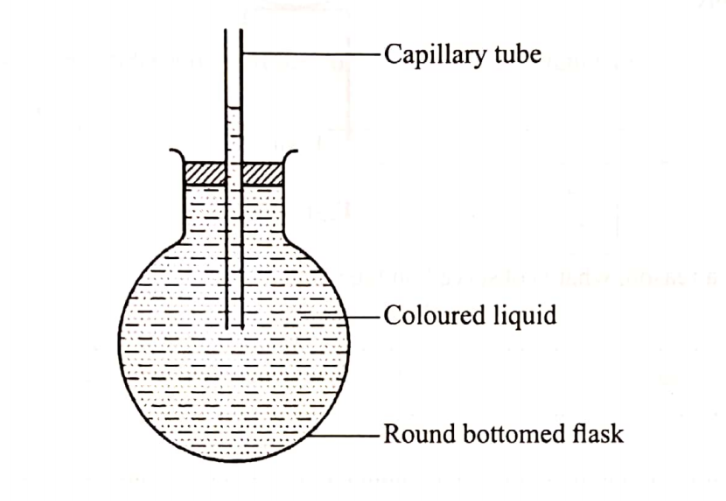
 

KCSE Past Papers 2018 Biology Paper 3 (231/3

KCSE Past Papers 2018 Biology Paper 3 (231/3

Kenya Certificate of Secondary Education

2018 Biology Paper 3

Answer all the questions in the spaces provided.

1. The photographs below represent three mammalian bones, labelled E, F and G.

E F G

(a) With reasons, identify the bones.

Identity

Bone E……….

Identity

Bone F……….

Identity

Bone G……….

(b) Name the joints formed at the anterior and posterior ends of F. Anterior end (1 mark)

Posterior end …………………..,. (1 mark)

(c) State the types of movement facilitated by the joint at the anterior end of specimen labelled F. (1 mark)

(d) (i) Name the substance found inside the living tissue of the specimen represented in photograph F. (1 mark)

(ii) State the fiinction of the substance named in (d) (i) above.

(e) (i) Name the muscle bundle usually attached onto the front of the specimen represented in photograph F.

(ii) State the function of the muscle bundle named in (e) (i) above.

2. Below is a photograph of a blood smear from a normal individual. The arrangement is arbitrary and the number of blood elements is greater than what would normally occur in an actual microscopic field.

(a) (i) Name the blood elements labelled J, K and L. (3 marks)

J………

K……….

L……….

(ii) State one function of each of the elements named in (a) (i) above. (3 marks)

K ………………

L ……………….

5 (b) The photograph below is of a section of the human intestines of a patient suffering from a common parasitic disease.

(i) Name the disease.(1 mark)

(ii) Name the parasite that causes the disease in (b) (i) above.(1 mark)

(iii) State Evo control measures for the disease.(2 mark)

(iv) State the effects of having the parts labelled G in the patient’s intestines.

3. You are provided with a specimen labelled H. With the aid of a hand lens, examine the external features of the specimen.

(a) (i) What part of a plant is specimen H?

(ii) Give two reasons for your answer in (a) (i) above.

(b) Open up specimen H longitudinally.

Use a hand lens to observe the internal structures of specimen H. (1 mark)

(i) Draw and label the internal cut surface and associated structures of specimen H. (5 marks)

(ii) Explain how you would determine the magnification of the drawing made in (b) (i) above. (2 marks)

(iii) State the mode of dispersal for seeds of specimen H.(I mark)

(iv) Explain how seeds of specimen H are dispersed through the mode stated in (b) (iii) above. (3 marks)

BIOLOGY Questions and answers

Biology Paper 3 (231/3)

Kenya Certificate of Secondary Education

2018 Biology Paper 3

Answer all the questions in the spaces provided.

1. The photographs below represent three mammalian bones, labelled E, F and G.

E F G

(a) With reasons, identify the bones.

Identity

Bone E……….

scapula/shoulder blade;


  • Has a socket/glenoid cavity/depression to articulate with the ball/head of the humerus;
  • Flat/triangular-shaped flat blade/triangular shaped/flat blade/flattened;;
  • Has a spine/ridge/coracoids process/acromion for attachment of musclesIdentity

    Bone F……….

    Humerus;

  • Has a ball/head/rounded head that articulates with the glenoid cavity/ socket on the scapula;
  • Has condyles that articulate with radius and ulna;Identity

    Bone G……….

    G — Radius attached to ulna;

  • Ulna has a sigmoid notch for articulation with the shoulder joint/ lower end of the humerus;
  • Has trochlea/olecranon fossa;
  • Has greater/larger tuberosity Has biciptal groove;(b) Name the joints formed at the anterior and posterior ends of F. Anterior end (1 mark)

    • Ball and socket (joint);

    Posterior end ……….(1 mark)

    • Hinge joint

    (c) State the types of movement facilitated by the joint at the anterior end of specimen labelled F. (1 mark)

    Rotation/up and down/side-ways (of the arm);

    (d) (i) Name the substance found inside the living tissue of the specimen represented in photograph F. (1 mark)

  • Bone marrow;(ii) State the fiinction of the substance named in (d) (i) above.
  • Manufacture of(red) blood cells(e) (i) Name the muscle bundle usually attached onto the front of the specimen represented in photograph F.

    Biceps;

    (ii) State the function of the muscle bundle named in (e) (i) above.

    Contract/relax to move the lower arm (upwards);

    2. Below is a photograph of a blood smear from a normal individual. The arrangement is arbitrary and the number of blood elements is greater than what would normally occur in an actual microscopic field.

    (a) (i) Name the blood elements labelled J, K and L. (3 marks)J — Erythrocyte(s)/red blood cell;

    K — Leucocyte/white blood cell;

    L — Thrombocytes/Platelets

    (ii) State one function of each of the elements named in (a) (i) above. (3 marks)

    I — Transportation of oxygen/carbon (IV) oxide;

    K — Engulf/attack pathogens/ foreign materials in the blood;

    L — Blood clotting;

    5 (b) The photograph below is of a section of the human intestines of a patient suffering from a common parasitic disease.

    (i) Name the disease.(1 mark)Amoebic dysentery;

    (ii) Name the parasite that causes the disease in (b) (i) above.(1 mark)

    Entamoeba hystolytica

    (iii) State two control measures for the disease.(2 mark)

  • Boiling drinking water (before drinking);/
  • Chlorinating/treating drinking water;
  • Keeping the food covered (to keep away flies/prevent contamination/proper storage of food;
  • Proper faecal disposal in pit latrines/toilets/keeping the same clean/not to dispose faecal materials in the open/washing hands before handling food/ washing fruits/food before eating/after visiting toilet/latrine;
  • Proper cooking of food;
  • Washing hands before handling of food/washing fruits before eating(iv) State the effects of having the parts labelled G in the patient’s intestines.

    Fruit(s);

  • Has two scars; point of attachment to remains of style; and point of attachment to the receptacle/fruit stalk
  • Presence of seeds;
  • Presence of pericarp/fruit wall
  • Has epicarp, mesocarp and endocarp fused3. You are provided with a specimen labelled H. With the aid of a hand lens, examine the external features of the specimen.

    (a) (i) What part of a plant is specimen H?

    Fruit(s);

    (ii) Give two reasons for your answer in (a) (i) above.

  • Has two scars; point of attachment to remains of style; and point of attachment to the receptacle/fruit stalk
  • Presence of seeds;
  • Presence of pericarp/fruit wall
  • Has epicarp, mesocarp and endocarp fused(b) Open up specimen H longitudinally.

    Use a hand lens to observe the internal structures of specimen H. (1 mark)

    (i) Draw and label the internal cut surface and associated structures of specimen H. (5 marks)

    (ii) Explain how you would determine the magnification of the drawing made in (b) (i) above. (2 marks)Linear magnification — Length of drawing;

    Actual length of object (specimen); OWTTE

    (iii) State the mode of dispersal for seeds of specimen H.(I mark)

    Explosive mechanism/self-dispersal mechanism/self explossive

    (iv) Explain how seeds of specimen H are dispersed through the mode stated in (b) (iii) above. (3 marks)

    Dry pods; due to loss of water from the pod and pressure from within the pod; the pod opens (violently) along the sutures /1ines of weakness; seeds are thrown away from the parent plant/dispersed;